

GCSE Engineering Remark Appeal: Is It Worth It?
GCSE engineering remark appeal guide covering marking reviews, NEA moderation, fees, risks and when challenging your result may be worthwhile.
Results day has a strange way of turning one mark into the only mark that matters. If your Engineering result is close to the next grade, a GCSE engineering remark appeal may be worthwhile but only when there is evidence of a marking or administrative error. Being near a grade boundary, by itself, does not prove that anything went wrong.
The first step is usually to speak to your school's exams officer or Engineering teacher. They can check your component marks, explain whether the concern involves the written paper or non-exam assessment, and request the appropriate post-results service from the exam board.
The quick decision checklist
Before paying for any review, ask:
- How many marks are you from the next overall grade boundary?
- Is the concern about the written examination, the non-exam assessment, or both?
- Has your teacher looked at a copy of the marked paper where available?
- Can they identify a possible marking error rather than simply a harsh-looking judgement?
- Could a lower mark affect your final grade?
- Is the result needed for sixth form, college or another progression requirement?
- What is the current exam-board deadline and fee?
A review becomes more reasonable when the grade matters for progression, the gap is small and a teacher can identify a credible issue. It becomes less attractive when the request is based only on disappointment or a predicted grade.
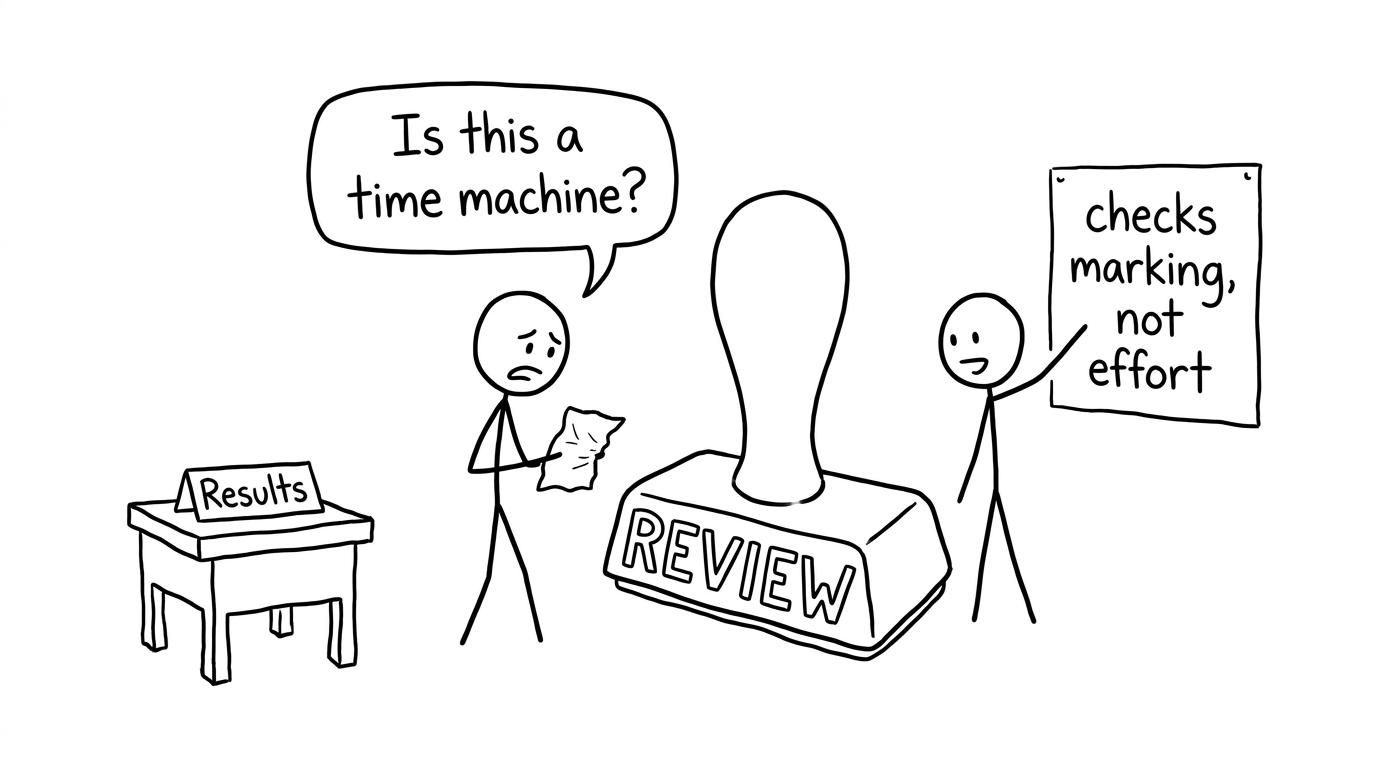 A student discovers that a review checks marking rather than rewinding the exam
Is a remark the same as a review of marking?
Students often say "remark", but the formal service is normally called a review of marking. That difference matters.
The reviewer does not simply mark the entire paper again and replace every judgement with their own. They check whether the original marking applied the mark scheme correctly and whether any marking errors occurred. If an error is found, the mark is corrected. If the original mark represents a reasonable application of the mark scheme, it can remain unchanged even if another examiner might have made a slightly different judgement.
There are several post-results routes.
Clerical re-check
A clerical re-check looks for administrative mistakes. It can check whether every part of the script was marked, whether marks were totalled correctly and whether the result was recorded accurately.
This service may be appropriate if a page appears unmarked or the recorded total looks inconsistent. It does not reconsider the academic quality of an answer.
Review of marking
A review of marking checks the examiner's application of the mark scheme as well as the relevant clerical processes. Marks may rise, stay the same or fall. Your school therefore needs your written consent before submitting the request.
The possibility of a lower mark is not small print to ignore. It is part of the decision. If you are only just above the boundary below, your teacher should consider both directions before recommending a review.
Access to the marked paper
Where the relevant service is available, your centre may request a copy of the marked script. This allows a teacher to compare the responses, examiner annotations and mark scheme before deciding whether a review has a sound basis.
This is often more useful than guessing from how the examination felt. Memory after an exam is unreliable; the marked paper is evidence. Access-to-script arrangements and deadlines vary, so contact the exams officer promptly.
How the GCSE Engineering process works
For a GCSE Engineering qualification such as AQA Engineering, the final result includes a written examination and non-exam assessment, commonly shortened to NEA. These components are not challenged in exactly the same way.
The normal route is:
- collect your component marks from the school;
- compare the overall result with the published grade boundaries;
- ask whether a marked script can be obtained;
- let an appropriate teacher review the evidence;
- give written consent if a review of marking is recommended;
- allow the school or college to submit the request;
- wait for the awarding body's outcome.
Candidates generally do not submit a review directly when they entered through a school or college. The centre handles the application, payment arrangements and communication with the awarding body. Private candidates should contact the centre through which they entered.
Exact services, fees and closing dates are published for each examination series. They can change, so use the current information supplied by your centre rather than a date or price found in an old discussion online.
What happens with Engineering NEA?
Engineering NEA is usually marked internally by teachers and moderated externally by the awarding body. Moderation checks whether the centre has applied the assessment criteria to the correct standard across its candidates.
A review of moderation is different from a review of marking. It is requested by the centre and concerns the moderation of the centre's work rather than one student's project in isolation. If the awarding body adjusted the centre's marks during moderation, the school can consider whether there are grounds to request this service.
An individual student cannot normally demand that only their NEA be moderated again. If your concern is about how the school conducted its internal assessment or review process, ask for the centre's internal appeals procedure. That is distinct from an appeal against an awarding body's post-results decision.
This distinction prevents a common misunderstanding: a review of the written Engineering paper will not automatically reopen the NEA, and an individual NEA concern is not automatically a review of moderation.
When is a GCSE Engineering remark appeal worth the fee?
A useful decision has three parts: consequence, evidence and risk.
The grade has a real consequence
A review may be worth considering if the next grade is required for a confirmed sixth-form, college or apprenticeship condition. Tell the institution that a review is pending, but do not assume it must hold a place or that the result will change.
If the higher grade would be welcome but would not alter your next step, the financial case is weaker. That does not make the result unimportant. It simply changes what the review can realistically achieve.
There is evidence in the script
Distance from a boundary tells you what change is needed. It does not tell you how likely that change is.
If your current total is MMM, the next boundary is BBB and B>MB>MB>M, the required increase is:
B−MB-MB−MThat calculation is useful, but it is only the beginning. A teacher should then ask whether the marked responses contain plausible missed credit worth at least that amount. A small gap with no identifiable issue may be less persuasive than a slightly larger gap supported by clear marking concerns.
The overall qualification boundary also matters more than the raw result on one component. Component weighting and any scaling must be considered by the exams officer rather than estimated casually.
You understand the downside
Marks can decrease as well as increase. The original mark is not protected simply because you requested the service. A lower mark can lead to a lower qualification grade.
Fees differ between awarding bodies and services, while schools also have different payment arrangements. Awarding bodies commonly have provisions concerning fees when a qualification grade changes, but you should ask your centre what applies to your exact request before agreeing to pay.
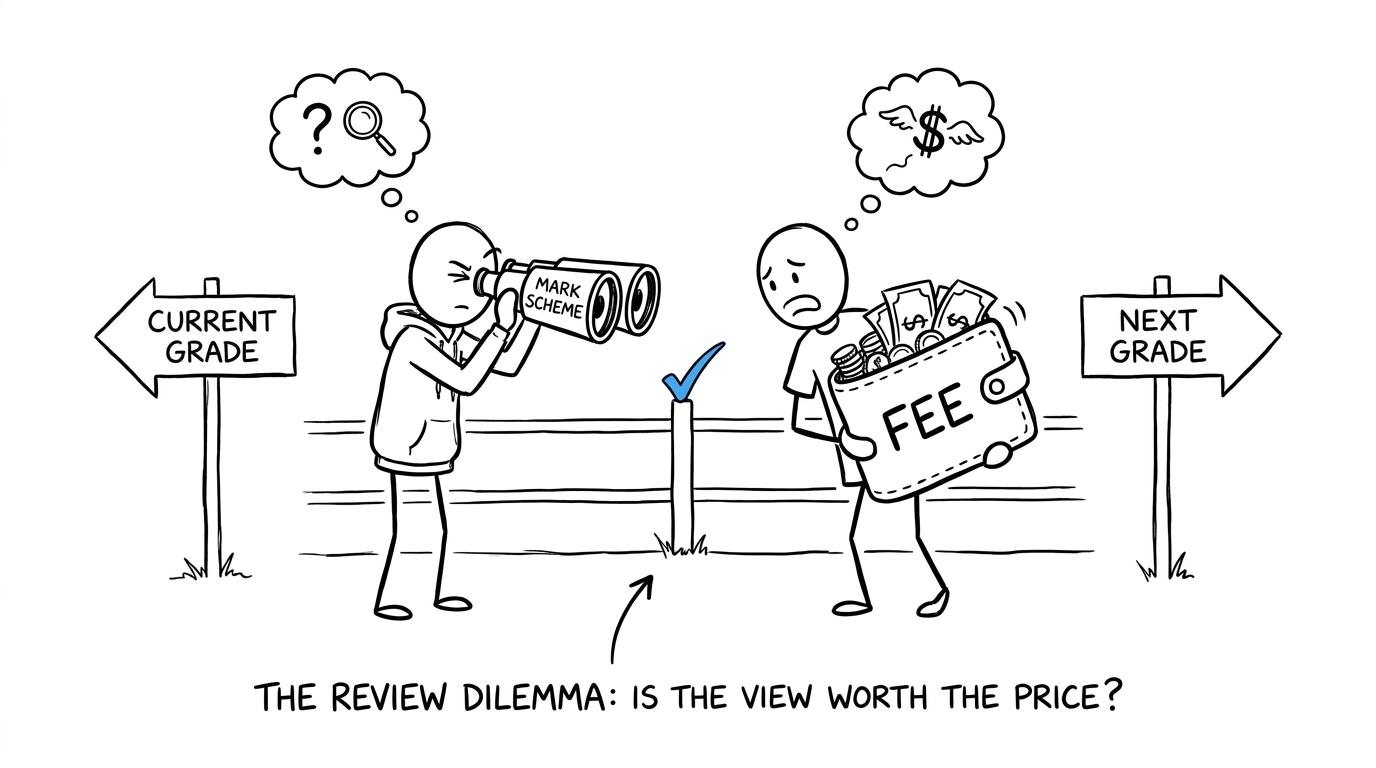 A single mark sits on a fence while students weigh evidence against the fee
A review is not yet an appeal
If a review of marking does not produce the result you expected, that does not automatically mean there are grounds for an appeal.
An appeal usually follows the awarding body's review process and is submitted by the centre. It considers whether the awarding body followed its procedures properly and whether the outcome was reasonable under the applicable rules. It is not simply another opportunity to say that the answer deserved more marks.
Your school should examine the review outcome and explain whether a permissible ground for appeal exists. Appeals have separate procedures, stages, deadlines and possible fees. They should be based on a specific concern about process or the correction of an error, not on the fact that the grade remained unchanged.
Common mistakes to avoid
Treating a predicted grade as proof
A predicted grade is an informed estimate, not evidence of a marking error. Examination performance, NEA marks and annual grade boundaries determine the awarded result.
Looking only at the nearest boundary
Students often count marks to the boundary above but ignore the boundary below. Because marks can fall, both distances matter.
Missing the deadline while deciding
Post-results windows are limited. Ask your exams officer for the current deadline immediately, especially if your progression place depends on the result.
Requesting the wrong service
A possible addition error points towards a clerical re-check. A possible misapplication of the mark scheme may justify a review of marking. A moderated NEA concern requires a different conversation led by the centre.
Assuming an appeal means a fresh remark
An appeal examines defined grounds under the awarding body's process. It is not an unlimited sequence of new examiners reconsidering the same work until the mark rises.
Paying before asking a teacher to inspect the evidence
Where a script can be accessed in time, informed professional advice is more valuable than results-day instinct. Ask what specific responses might have been marked incorrectly and how much difference they could make.
What to do while the outcome is pending
Once the request has been submitted, there may be little you can influence. That can feel uncomfortable, particularly when one grade seems to control the next step.
Use that waiting period to contact your intended sixth form or college, keep copies of relevant messages and prepare an alternative route if necessary. Then return your attention to the work you can control.
For maths preparation, start with the free GCSE Maths revision lessons, where topics are organised by grade and supported by videos and exam-style questions. If your target is a secure pass, the grade 444 revision topics and grade 555 revision topics provide a focused route through the specification.
Students aiming higher can build depth through the grade 666 revision topics and grade 777 revision topics. Use GCSE Maths past papers under timed conditions, then compare your work carefully with the mark schemes and video solutions. Near the examination series, MathsGenie predicted papers can provide further structured practice alongside the revision planner and mini tests.
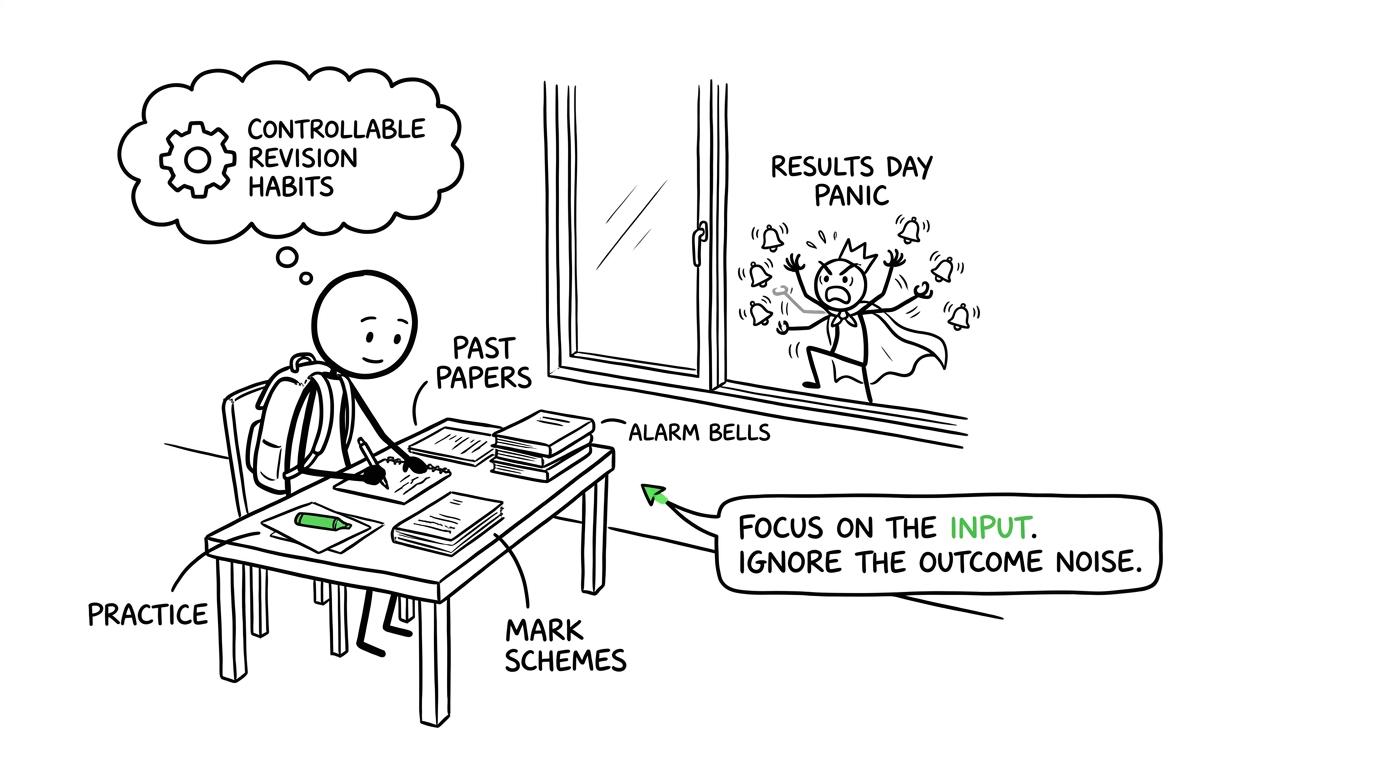 A calm student revises while Results Day Panic rings alarms outside
Make the decision from evidence, not hope
A GCSE Engineering review is genuinely worth considering when the result affects your next step, you are within a realistic distance of the required grade and a teacher can identify credible marking concerns. It is less likely to be worthwhile when the only evidence is that the result feels surprising.
Speak to your exams officer quickly. Ask for the component marks, the current fee and deadline, the risk to the grade below, and whether an Engineering teacher can inspect the marked paper. If NEA is the concern, clarify whether the issue involves internal assessment or external moderation before choosing a route.
Then turn back towards what comes next. MathsGenie offers free revision lessons, practice questions, mini tests, past papers, predicted papers, mark schemes and video solutions to make that next stage less uncertain. Start with the topic that costs you the most marks, practise it carefully, and let evidence guide the next decision too.










