GCSE Arabic Revision Environment: Does It Matter?
GCSE Arabic revision environment advice grounded in evidence. Learn which changes improve focus, recall and realistic exam practice without chasing perfection.
Revision advice often begins with furniture: find a quiet desk, buy better pens, clear the room and somehow concentration will arrive. That can make students feel as though effective revision belongs to people with spare rooms and silent homes.
The honest answer is more useful. Your GCSE Arabic revision environment does matter, but mainly because it affects attention, practice quality and whether you begin. A reasonably comfortable place with fewer interruptions can help. A beautiful desk cannot make passive revision effective, and an imperfect room does not prevent you from learning.
For students balancing Arabic with GCSE maths, the same principle applies to both: improve the conditions you can control, then spend your energy on retrieval and exam-style practice rather than endlessly redesigning the desk.
The short answer: what actually matters?
Use this checklist before a revision session:
- Put your phone somewhere you cannot casually reach it.
- Choose one specific task, such as vocabulary retrieval or a listening exercise.
- Keep only the materials needed for that task in front of you.
- Reduce disruptive noise where reasonably possible.
- Make sure the lighting, temperature and chair are adequate.
- Practise some tasks under quiet, timed, exam-like conditions.
- Use different locations occasionally so recall does not feel tied to one desk.
- Stop trying to create a perfect room before you start.
The environment should make good revision easier. It should not become a substitute for revision.
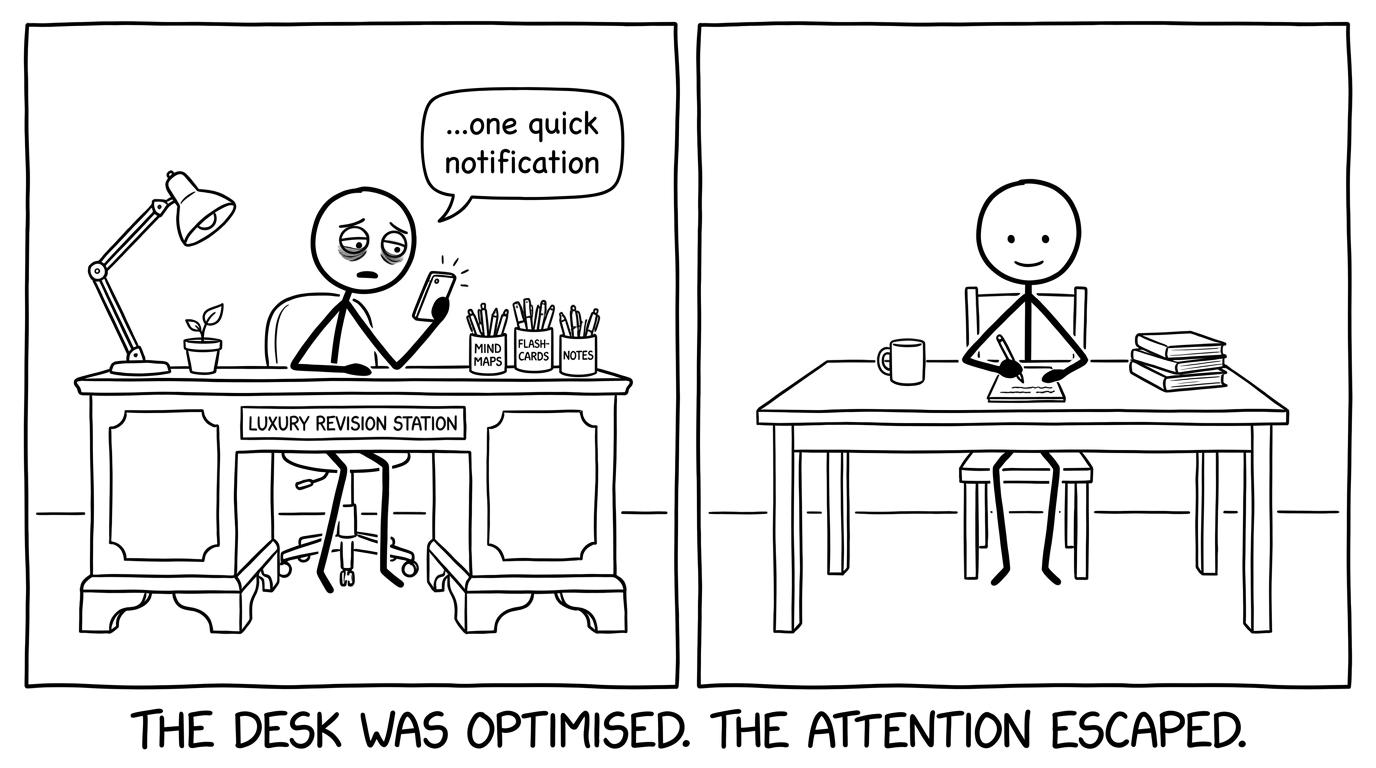 A perfectly organised revision desk fails to contain a distracting phone
Why your revision environment can change what sticks
A room does not place vocabulary into memory. It changes the likelihood that you will pay attention long enough to learn it.
Arabic revision places several demands on attention. You may need to distinguish sounds in a listening recording, recall precise vocabulary, read unfamiliar passages, form accurate sentences or rehearse spoken answers. Frequent interruptions make those tasks harder because you repeatedly have to reconstruct what you were doing.
Research on mobile-phone distraction supports a practical conclusion: a phone can interfere with learning even when it is not being actively used. Notifications are an obvious problem, but anticipation matters too. Part of your attention remains occupied by the possibility of a message.
That is why putting a phone face down beside your book is often less effective than leaving it across the room, in a bag or with another person for the duration of a short session. The aim is not moral purity. It is to remove a decision you would otherwise have to keep making.
The same applies in maths. A demanding algebra question or timed paper section requires sustained thought. MathsGenie's GCSE maths revision hub provides lessons, questions and papers, but those resources become valuable only when you give them uninterrupted attention.
A good room helps, but method matters more
Evidence about physical learning environments is less dramatic than social media advice often suggests. Extreme noise, uncomfortable heat, poor lighting or unsuitable seating can create genuine barriers. Once conditions are adequate, however, changing the décor or buying elaborate equipment is unlikely to transform learning by itself.
The larger difference usually comes from what happens in the room.
For GCSE Arabic, compare these two sessions:
- rereading a vocabulary list while music, messages and several browser tabs compete for attention;
- closing the list, recalling the words from memory, checking errors and returning to missed items later.
The second session is stronger because it requires retrieval and feedback. Its advantage does not come from a particular lamp or colour of highlighter.
This is also why self-regulation matters. Setting a goal, checking whether you achieved it and deciding what to revisit are more productive than measuring a session by how long you sat at the desk. If planning is difficult, MathsGenie's free revision planner can help you organise maths alongside your other GCSE subjects without relying on last-minute decisions.
Build the environment around the Arabic skill
Edexcel GCSE Arabic assesses listening, speaking, reading and writing through four externally assessed papers. Each skill creates slightly different revision needs, so there is no single ideal environment for every session.
Listening needs clean audio and active responses
For listening practice, reduce competing speech. A television or nearby conversation is more disruptive than a steady, quiet background sound because your brain tries to process both streams of language.
Use headphones if they are safe and comfortable, but do not make every practice recording artificially easy. The real assessment requires you to follow recordings under controlled conditions. Some sessions should therefore use ordinary audio equipment at a sensible volume rather than depending on premium noise-cancelling headphones.
Listen with a purpose. Decide whether you are identifying key details, recognising opinions or following tense changes. Then check what you missed.
Speaking needs privacy, not silence
Speaking practice is difficult in a place where you feel watched or embarrassed. A bedroom, quiet classroom, library practice room or walk with a voice recorder may be more useful than a perfectly silent desk.
You need enough privacy to speak audibly and repeat an answer after correcting it. If home is busy, ask a teacher whether a room is available before or after school. The best speaking environment is the one in which you will actually speak.
Reading needs fewer visual interruptions
Reading Arabic closely requires patience. Keep dictionaries, notifications and unrelated tabs out of the immediate workspace unless your teacher has specifically asked you to use them during learning. Dictionaries are not permitted in the Edexcel GCSE Arabic assessments, so some reading practice should test what you can infer and understand unaided.
A plain page, a pen and one passage can be more effective than an elaborate collection of resources. Mark unfamiliar language after attempting the text rather than interrupting every sentence.
Writing needs both learning mode and exam mode
During learning mode, use notes, corrections and model language to improve accuracy. During exam mode, remove those supports, set an appropriate time and complete the task independently.
This distinction matters. Support helps you build knowledge; unsupported practice reveals whether that knowledge is available. Maths students can use the same progression: learn through a revision lesson, answer practice questions, then move into timed work using the MathsGenie past-paper library.
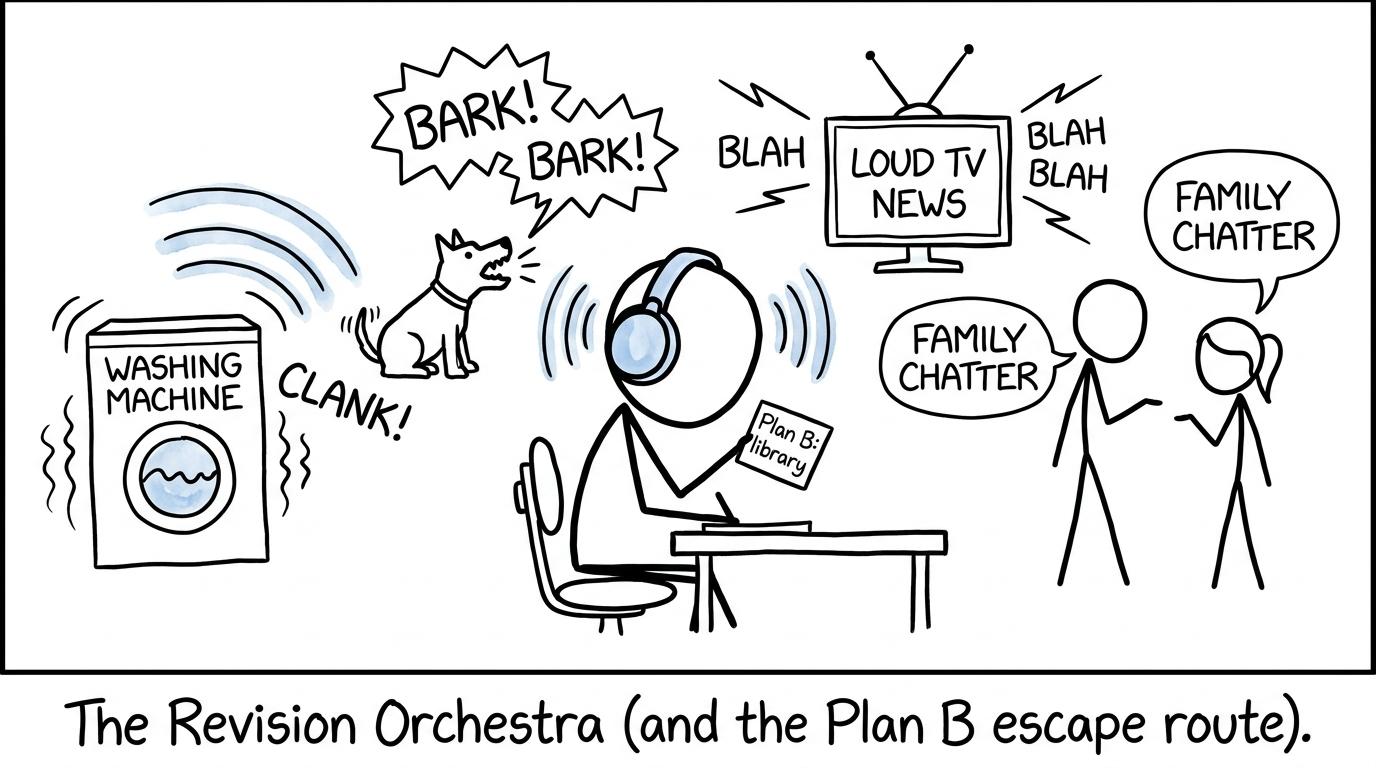 A student discovers that a busy household has formed a revision orchestra
What if your home is noisy or crowded?
Advice that assumes every student has a private study is not very helpful. If your environment is difficult, focus on small changes rather than an impossible transformation.
Try these options:
- Revise at school before lessons or during an approved study period.
- Use a public or school library for reading and writing.
- Save speaking practice for a walk, an empty classroom or another suitable private space.
- Agree a short quiet period with family rather than requesting silence all evening.
- Use earplugs or non-lyrical background sound if unpredictable noise cannot be removed.
- Download materials in advance if internet access is unreliable.
- Prepare a portable revision kit containing headphones, paper, pens and the exact resources required.
Short, protected sessions are often more realistic than waiting for an uninterrupted evening. The goal is not to imitate somebody else's home. It is to create a repeatable cue: when the materials come out and the phone goes away, the task begins.
For maths, shorter resources can fit these conditions well. The Edexcel GCSE maths mini tests provide focused practice that can be completed and marked without needing an entire evening.
Should you always revise in the same place?
Not necessarily.
Memory can be influenced by environmental context, meaning that familiar surroundings may provide subtle retrieval cues. But the effect should not be exaggerated. Strong subject knowledge is not locked inside one room, and useful internal cues such as meaning, structure and well-practised methods reduce dependence on the surroundings.
A balanced approach is best:
- use one dependable location for most routine revision;
- retrieve vocabulary or methods occasionally in another room;
- complete some practice in quiet, timed conditions;
- avoid making revision dependent on one playlist, drink or seat.
Variation gives you evidence that you can recall knowledge away from your usual desk. Exam-like sessions also reduce the novelty of working in silence against a clock.
For maths, guidance on using GCSE past papers explains how to progress from shorter diagnostic work to full timed papers. The principle transfers to Arabic: build the skill first, then rehearse the conditions in which you must demonstrate it.
A practical environment routine for Arabic and maths
Begin each session with a reset lasting only a few minutes:
- Name the outcome: for example, retrieve one vocabulary set or complete one timed reading section.
- Remove the phone and unnecessary tabs.
- Put the required resource, paper and pen within reach.
- Decide when the session ends.
- Work without switching subjects halfway through.
- Mark or check the work immediately where possible.
- Record one weakness to revisit.
When revising maths, this final step is especially powerful. The article on finding your weakest GCSE topics shows how mini tests, papers and mark schemes can turn vague discomfort into a specific next action.
The environment supports the routine by reducing friction. The checking, correction and later retrieval are what turn the session into learning.
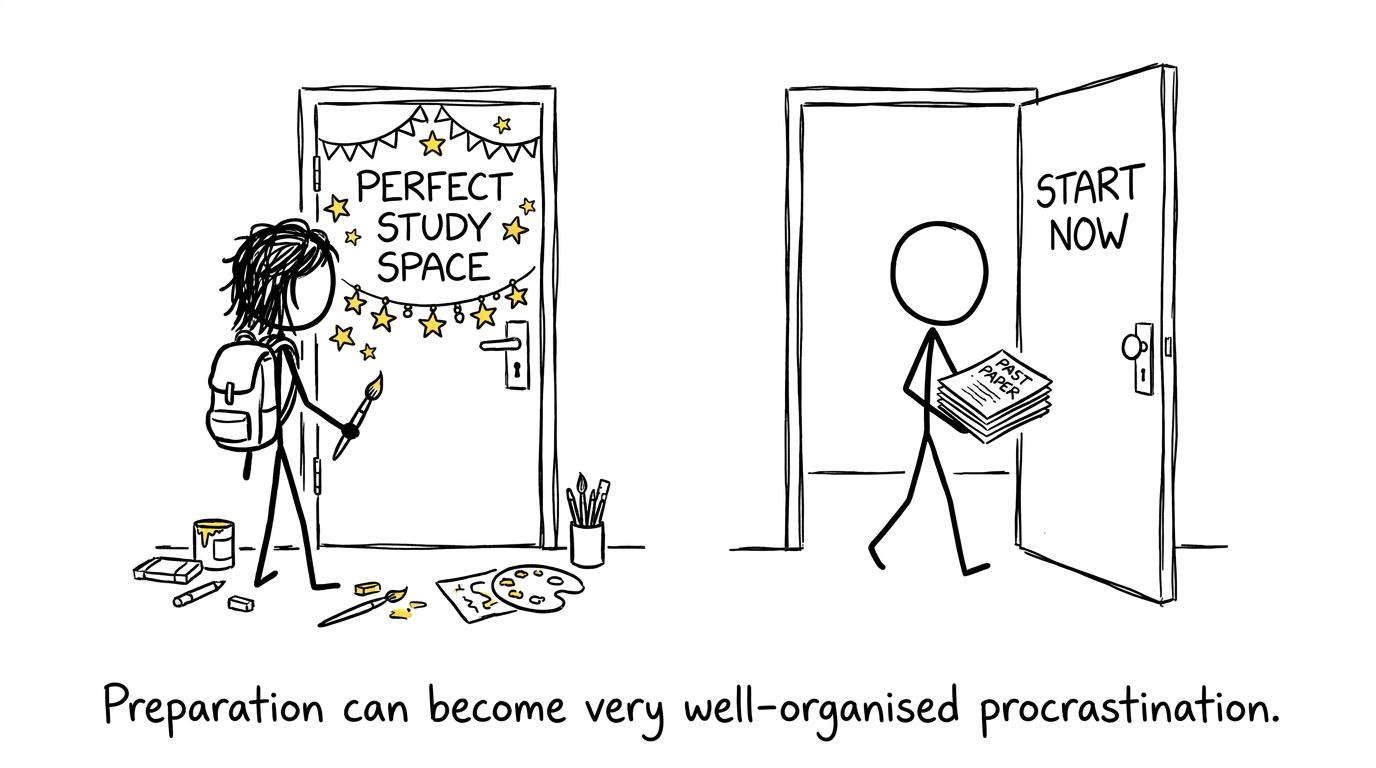 A student chooses starting revision over decorating the perfect study space
Common mistakes with revision environments
Treating organisation as achievement
Tidying can help you begin, but colour-coding folders for an hour is not equivalent to retrieving vocabulary, speaking Arabic or answering questions. Set a strict limit on preparation, then start the task.
Keeping the phone visible
Silent mode removes the sound, not the temptation. Increase the physical distance so checking requires a deliberate decision.
Using one environment for every skill
Silent reading and spoken rehearsal need different conditions. Match the place to the task instead of forcing every activity onto the same desk.
Playing distracting background content
Music with prominent lyrics, videos and conversations compete with language processing. If background sound helps you settle, choose something predictable and unobtrusive, then test whether your recall remains accurate.
Practising only when conditions feel perfect
Exams rarely match your preferred routine exactly. Occasionally work in a different sensible location and practise without your usual comforts.
Completing work without checking it
A calm room cannot compensate for uncorrected errors. Use feedback deliberately. In maths, MathsGenie's guide to using Edexcel past papers properly explains how marking, diagnosing and reattempting questions convert paper practice into progress.
Your environment is a lever, not the engine
Your GCSE Arabic revision environment matters when it protects attention, suits the skill and makes starting easier. It is overrated when it becomes a promise that the right desk, playlist or stationery will make knowledge stick automatically.
Create conditions that are good enough. Put the phone away. Choose one clear task. Retrieve, check and revisit. Then practise in quiet, timed conditions often enough that the examination room feels familiar rather than strange.
Apply the same calm system to maths with MathsGenie. Start at the free GCSE maths revision area, learn through revision lessons and video solutions, strengthen methods with practice questions and mini tests, then use past papers, mark schemes and predicted papers to test what survives without support. The room can help you focus. The repeated cycle of attempt, feedback and correction is what moves your revision forward.