

GCSE Arabic Weak Topic: A Practical Fix
GCSE Arabic weak topic advice: diagnose the exact problem, practise one skill, use mark schemes, and retest until the weakness becomes reliable in exams.
A difficult topic can acquire a reputation in your mind. You see questions about school, translation or a picture stimulus and think, “I always get this wrong.” Soon, you avoid it. That gives the weakness room to grow.
The practical response to a GCSE Arabic weak topic is not to revise all of Arabic again. Identify the exact failure, rebuild one small skill, practise it without notes, check it against the assessment criteria and retest it later. The aim is not instant perfection. It is to turn an unpredictable weakness into a familiar process.
Your weak-topic repair checklist
Use this sequence whenever one area keeps costing you marks:
- Name the weakness precisely.
- Attempt a short question before revising.
- Separate vocabulary, grammar, comprehension and exam-technique errors.
- Relearn only the missing knowledge.
- Practise the skill from memory.
- Check the official mark scheme or assessment criteria.
- Record one correction for each mistake.
- Retest after a short gap.
- Finish with the skill inside a mixed or timed task.
This is the same disciplined cycle that makes MathsGenie’s GCSE revision resources effective for maths: diagnose, learn, practise, mark and return. The subject changes, but the habit of repairing mistakes does not.
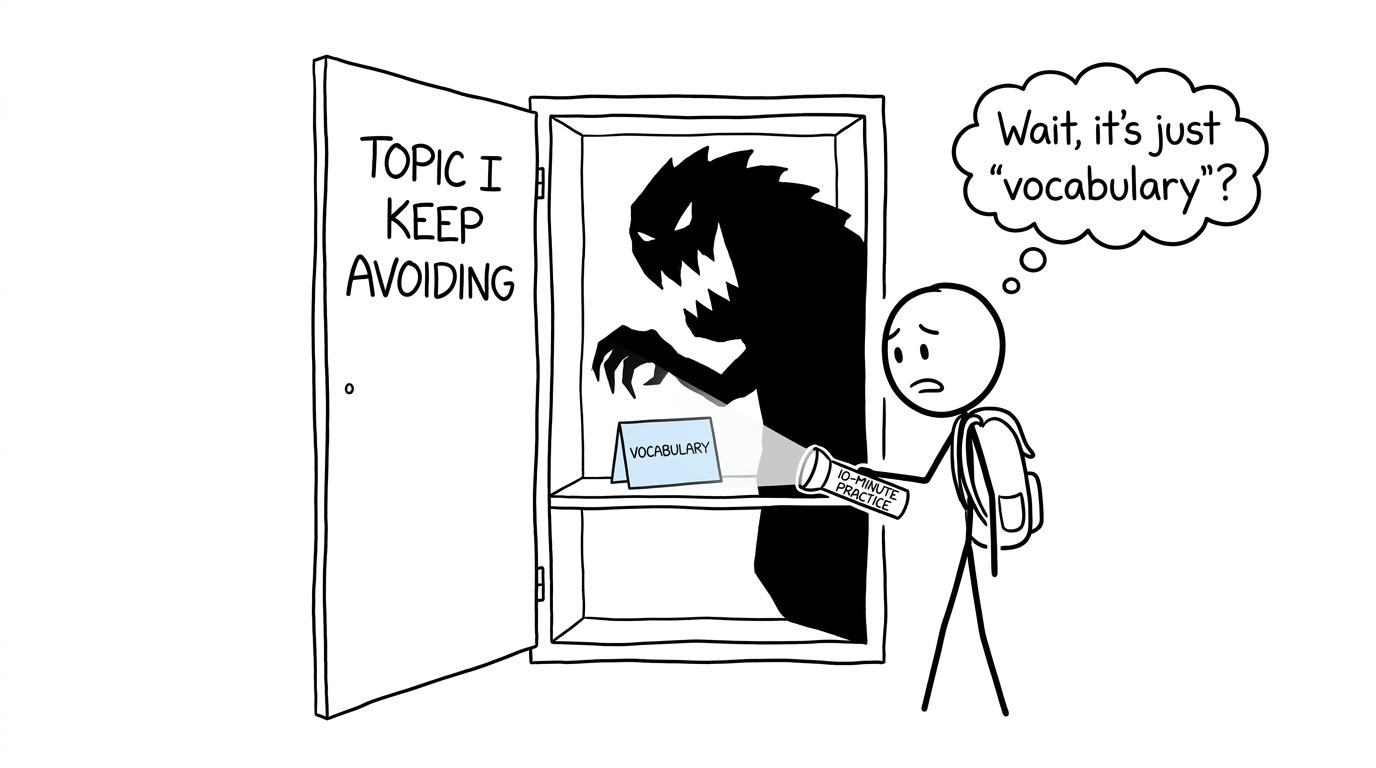 A student discovers that an avoided revision topic casts a much larger shadow than the topic itself
Define the topic before trying to fix it
“Arabic” is not a weak topic. Neither is “writing”. Both labels are too broad to guide a useful revision session.
A precise weakness sounds more like this:
- recognising vocabulary about future employment in listening tasks;
- answering every bullet point in an extended writing question;
- changing verbs accurately when describing past events;
- translating short sentences into Arabic;
- developing opinions with reasons;
- understanding instructions written in Arabic;
- responding spontaneously in the speaking conversation;
- distinguishing similar-sounding words under time pressure.
Pearson Edexcel GCSE Arabic assesses listening, speaking, reading and writing, with each skill contributing 25%25\%25% of the qualification. Its current specification uses five broad themes: identity and culture; local area, holiday and travel; school; future aspirations, study and work; and the international and global dimension.
That structure helps you diagnose a weakness using two labels. First identify the theme, such as school. Then identify the skill, such as understanding school vocabulary in a recording. “School listening vocabulary” is a workable target. “Arabic” is not.
Check your school’s current specification, tier and assessment arrangements rather than assuming that every language qualification follows the same format. GCSE Arabic availability and structure should not be inferred from AQA, OCR or Eduqas qualifications in other languages.
Diagnose why you keep losing marks
A repeated wrong answer does not always have the same cause. Before opening your notes, attempt a small set of relevant questions and classify each mistake.
A knowledge gap
You did not know the word, grammatical form or sentence structure. This requires focused learning followed by retrieval. Reading the information again may feel comfortable, but you need to produce or recognise it without support.
A recognition gap
You knew the vocabulary when looking at a list but did not recognise it in connected speech or a longer text. The solution is exposure in the form that caused the problem. Listening weaknesses require listening practice; reading weaknesses require reading practice.
A question-reading error
You understood the Arabic but missed a bullet point, tense, negative word or instruction. Recent Pearson examiner guidance for GCSE Arabic writing has specifically emphasised reading the question and all bullet points carefully. Your revision must therefore include task analysis, not just language recall.
A production problem
You understood the material but could not say or write it independently. This often happens when recognition has been mistaken for mastery. Close the book and retrieve complete responses, then check accuracy afterwards.
A pressure problem
You could complete the task slowly but struggled when timed. Do not begin by making every session timed. Build accurate performance first, then reduce the support and introduce realistic time limits.
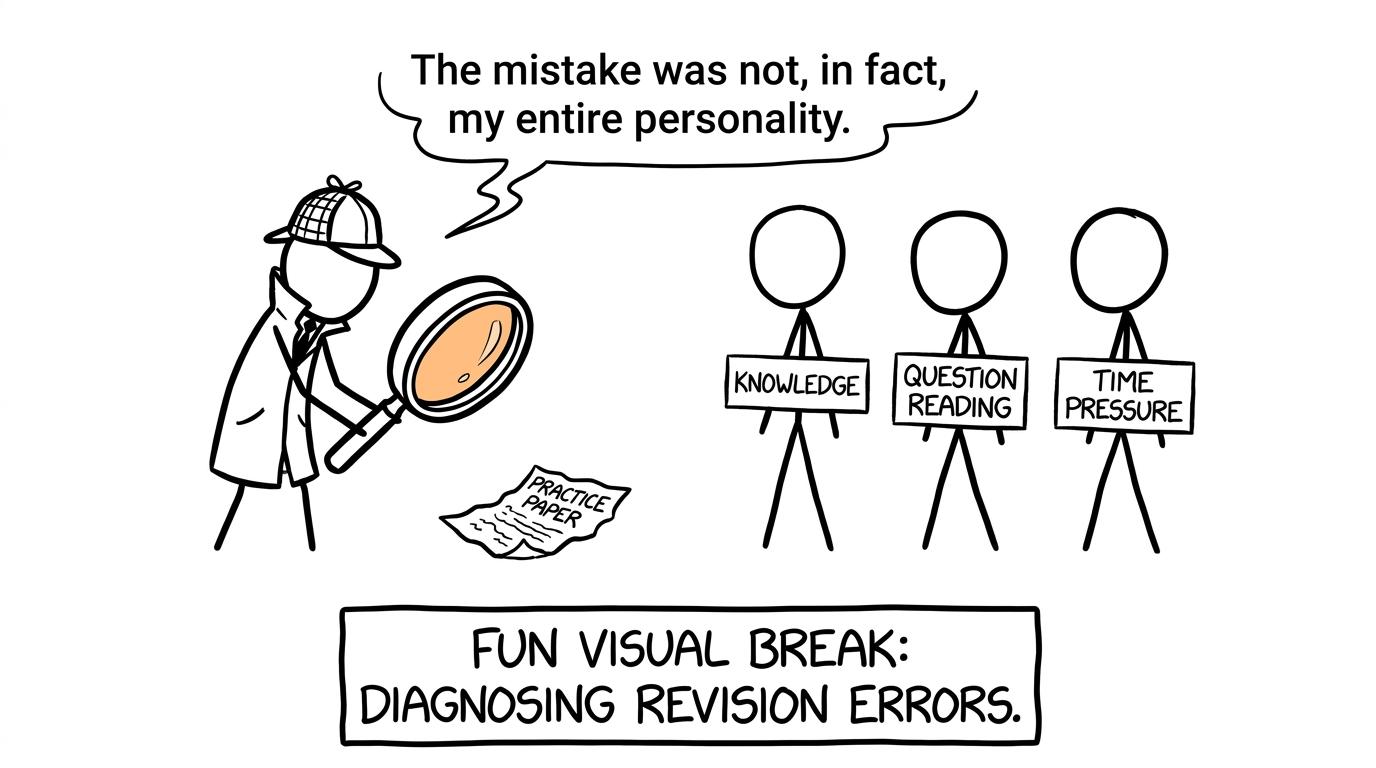 A revision detective investigates whether a mistake came from knowledge, question reading or time pressure
Use a short repair cycle for a GCSE Arabic weak topic
Long sessions can hide weak practice. A smaller cycle makes the evidence clearer.
Attempt before reviewing
Start with one short task without notes. This gives you a genuine baseline and stops revision becoming passive copying. Keep the attempt so you can compare it with your later retest.
This principle also sits behind MathsGenie’s guide to using GCSE past papers properly: the useful work happens when an attempt is marked, diagnosed and repaired.
Relearn the smallest missing unit
If vocabulary is the problem, select a manageable group connected to one subtopic. If verb forms are the problem, focus on the form required by the task. If you missed bullet points, practise identifying task requirements before composing an answer.
Do not respond to one mistake by rereading an entire revision guide. Precision saves time. It also makes the next test meaningful because you know what was supposed to improve.
Retrieve rather than recognise
Look away from the source and recall the material. For vocabulary, move in both directions where appropriate. For speaking, say answers aloud rather than rehearsing them silently. For writing, produce sentences without copying a model. For listening, replay only after committing to an answer.
Retrieval feels harder than rereading because it exposes uncertainty. That difficulty is useful information.
Mark against the real demand
Use an official mark scheme, sample assessment material, assessment grid or teacher feedback. Check more than whether an answer appears broadly correct.
For writing, ask whether you communicated the required content, addressed every bullet point and used language accurately. For speaking, consider clarity, relevance and interaction. For reading and listening, inspect the precise detail that changed the answer.
Pearson’s examiner feedback also recommends regular vocabulary revision, translation practice, exam-style questions and leaving time to review answers. These are practical responses to identifiable mark losses, not decorative revision tasks.
Maths students can see the same feedback habit in MathsGenie’s guide to learning from GCSE mark schemes. A mark scheme is most useful when it changes what you do next.
Retest without immediate support
Redo the skill with a different question. If you use the identical prompt immediately, you may only remember the correction. A new task reveals whether the underlying skill has improved.
Return again after a gap. Keep the topic on your revision schedule until you can handle it in a mixed task, where the question does not announce which vocabulary or grammatical structure you need.
Keep an error log that leads to action
An error log should be short enough to use. For every significant mistake, record:
- the theme and skill;
- what went wrong;
- the evidence from the mark scheme or feedback;
- one rule for next time;
- the date of your retest;
- whether the retest was secure, uncertain or still weak.
Write “missed the negative word in a listening sentence”, not “bad at listening”. Write “answered two of three bullet points”, not “writing was poor”. Specific language prevents a mistake from becoming an identity.
The approach mirrors the focused planning in MathsGenie’s GCSE maths revision timetable: weak areas return at planned intervals instead of disappearing beneath whichever topic feels easiest that day.
Match the practice to the assessed skill
A vocabulary list can support all four papers, but it cannot replace four different kinds of performance.
Listening and reading
Read the question carefully, predict the kind of information required and commit to an answer before checking. Record whether the difficulty came from unknown language, a missed detail or misunderstanding the instruction.
The Edexcel reading assessment includes a translation from Arabic into English. Listening and reading also contain questions with instructions in both English and Arabic, depending on the section. Familiarity with question language matters alongside topic vocabulary.
Speaking
Practise aloud. The Edexcel speaking assessment includes a role play, picture-based questions and a conversation. A silent plan does not test pronunciation, retrieval speed or your ability to continue after hesitation.
Build flexible response ingredients: opinions, reasons, time frames and follow-up detail. Avoid memorising one long answer that works only when the question arrives exactly as expected.
Writing and translation
Plan briefly around every requirement, then write from memory. Check verb forms, agreement, spelling, clarity and whether English words have slipped into the response. Pearson’s examiner guidance advises candidates to avoid English words except where transliteration is appropriate.
Editing must be practised before exam day. Reserve a small review period during timed work and give it a job: inspect omissions, repeated errors and unclear sentences.
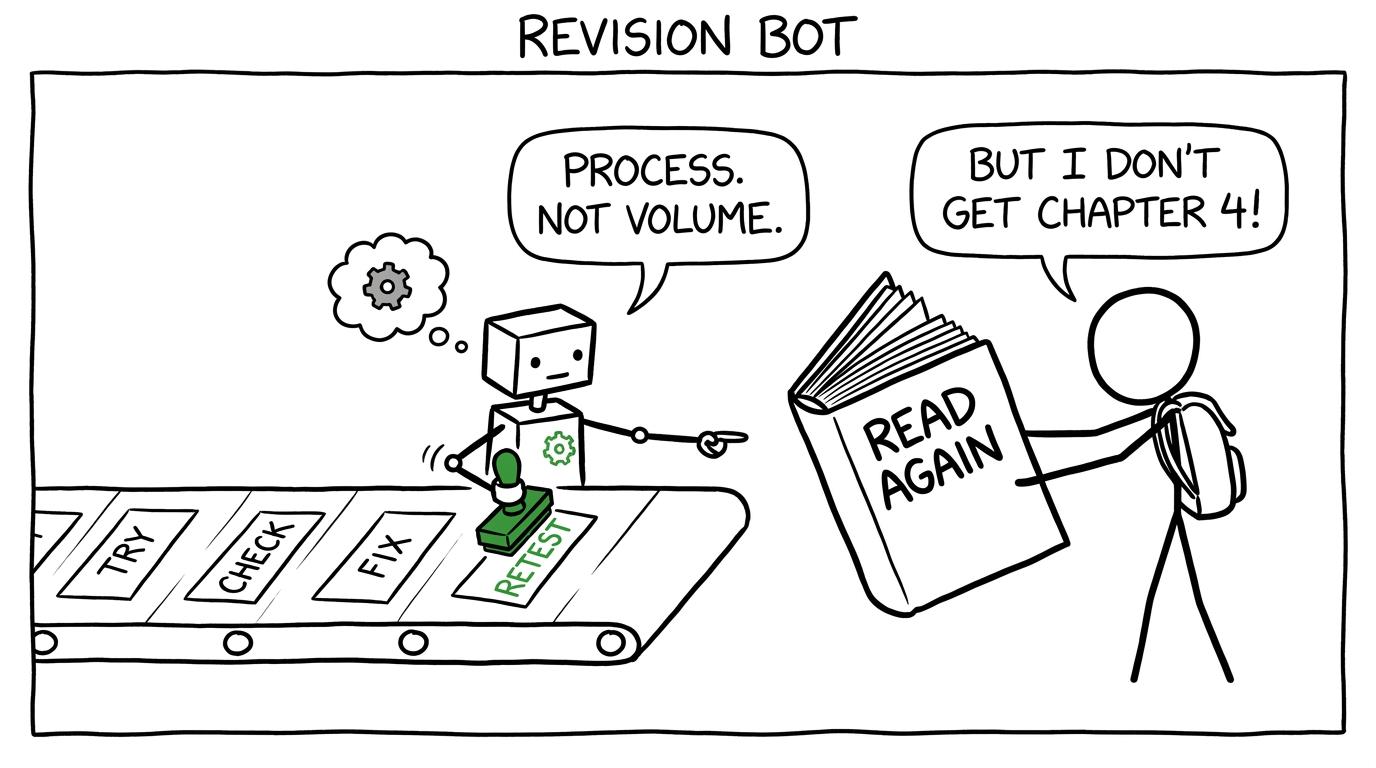 A revision robot favours the cycle try, check, fix and retest over simply reading the same book again
Move from isolated practice to exam conditions
Weak-topic practice should become progressively less comfortable:
- Begin with one clearly labelled skill.
- Remove notes and prompts.
- Use an unfamiliar question on the same area.
- Mix the weakness with stronger topics.
- Add an appropriate time limit.
- Place it within a complete paper or speaking sequence.
Do not jump straight from a vocabulary list to a full paper and then conclude that nothing has improved. Equally, do not remain with flashcards forever. The final test is whether you can use the language when the topic is mixed with other demands.
For maths revision, GCSE mini tests provide the same bridge between isolated questions and complete papers. Edexcel GCSE maths past papers then test performance in context, while GCSE predicted papers can support final exam preparation. For Arabic, use equivalent official materials supplied by your exam board and school.
Common mistakes when fixing a weak topic
Avoiding it until the final weeks
Avoidance protects confidence briefly but preserves the weakness. Put the difficult area near the start of a session, when your attention is strongest.
Revising a label that is too broad
“Do travel” is not a clear task. “Recognise transport vocabulary in short listening extracts” tells you what to practise and how to test it.
Copying correct answers
Copying can improve presentation without improving recall. Study the correction, close it, then produce the response independently.
Counting time instead of evidence
An hour of revision does not prove that a skill changed. A more useful measure is whether you can answer a fresh question accurately without help.
Checking only the final answer
A wrong response may come from vocabulary, grammar, task interpretation or pressure. Unless you identify the cause, you may practise the wrong thing.
Never returning to the topic
One successful session is encouraging, not conclusive. Revisit the skill after a gap and then test it inside mixed material.
Turn the weakness into a routine
The topic you always get wrong usually feels permanent because every encounter begins from the same place. You attempt it, feel uncomfortable and move away. A repair cycle changes the ending: attempt, diagnose, relearn, retrieve, mark and retest.
Use your official GCSE Arabic specification and assessment materials for subject-specific preparation. For your maths exams, make MathsGenie your free revision base: choose a topic from the GCSE maths revision hub, use revision lessons and practice questions, check mark schemes and video solutions, then build towards mini tests, past papers and predicted papers.
Start with the weakness you have been avoiding. Name it precisely. Complete one honest attempt today, and let the mistake tell you what to do next.











