Spaced Repetition GCSE Classical Civilisation
Spaced repetition GCSE Classical Civilisation made simple: use paper cards, short recall sessions and a calm review rhythm alongside maths revision.
Revision often feels organised at the beginning. You make notes on Greek gods, Roman festivals or the Odyssey, understand them, and move on. A fortnight later, the details have become strangely distant.
A simple spaced repetition GCSE Classical Civilisation routine solves that problem by bringing information back at planned intervals. You do not need a complicated app. Make a small set of question cards, test yourself without notes, and place each card into a review pile based on how well you remembered it. Ten focused minutes can be enough.
This guide is especially useful if you are balancing Classical Civilisation with GCSE maths. Both subjects reward repeated retrieval, although what you retrieve is different: evidence and context in Classical Civilisation; facts, methods and question types in maths.
Your simple spaced repetition checklist
Start with this manageable system:
- Choose one small section of your Classical Civilisation course.
- Turn the essential knowledge into short question cards.
- Answer each card from memory before checking it.
- Sort cards into soon, next week and later piles.
- Return difficult cards to the soon pile.
- Add questions requiring explanation, comparison and source analysis.
- Keep each session short enough to repeat consistently.
The method works because revision becomes a series of encounters rather than one heroic attempt to remember everything.
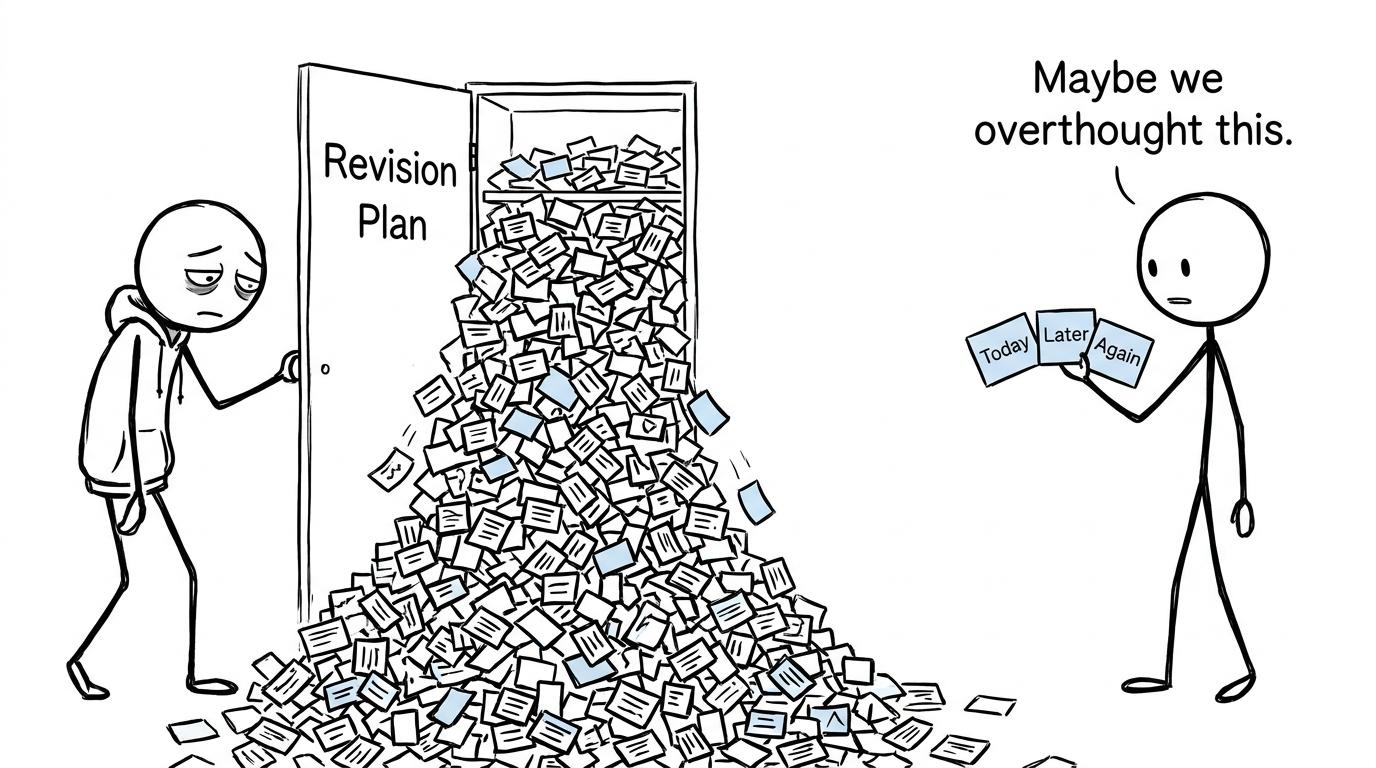 A simple revision habit survives an avalanche of complicated flashcards
What spaced repetition actually means
Spaced repetition means revisiting learning after a gap instead of repeating it continuously in one sitting. Retrieval practice adds another important condition: you try to recall the answer before looking at your notes.
These ideas are related but not identical. Spacing determines when you return. Retrieval determines what you do when you return.
Rereading a page may make it feel familiar, but familiarity is not the same as being able to produce an answer in an examination. A closed-book question reveals whether the knowledge is available when you need it. Feedback then prevents an incorrect answer from becoming established.
Research reviews from organisations including the Education Endowment Foundation support retrieval practice as a promising way to strengthen learning. However, the EEF also cautions that classroom implementation matters. Questions need an appropriate level of difficulty, misconceptions need feedback, and factual recall should not crowd out higher-order thinking.
That warning is particularly relevant to Classical Civilisation. Remembering the name of a source is useful. Explaining what it reveals, considering its context and evaluating its limitations are different demands.
Build a paper system without an app
You need blank cards, three envelopes or clips, and a pen. Label the groups:
- Soon: review during your next session
- Next week: review after several days
- Later: review after a longer gap
Begin with a modest batch from one specification section. A card should ask one clear question. Put the answer on the reverse, keeping it accurate but concise enough to check quickly.
During a review, say or write your answer before turning over the card. Then sort it honestly:
- Incorrect, incomplete or guessed answers go into soon.
- Secure answers requiring some thought go into next week.
- Fast, accurate and well-explained answers go into later.
The labels matter less than the principle. Weak knowledge should return sooner; secure knowledge can wait longer. There is no universally perfect interval for every student, topic or examination date, so adjust the gaps according to what your answers reveal.
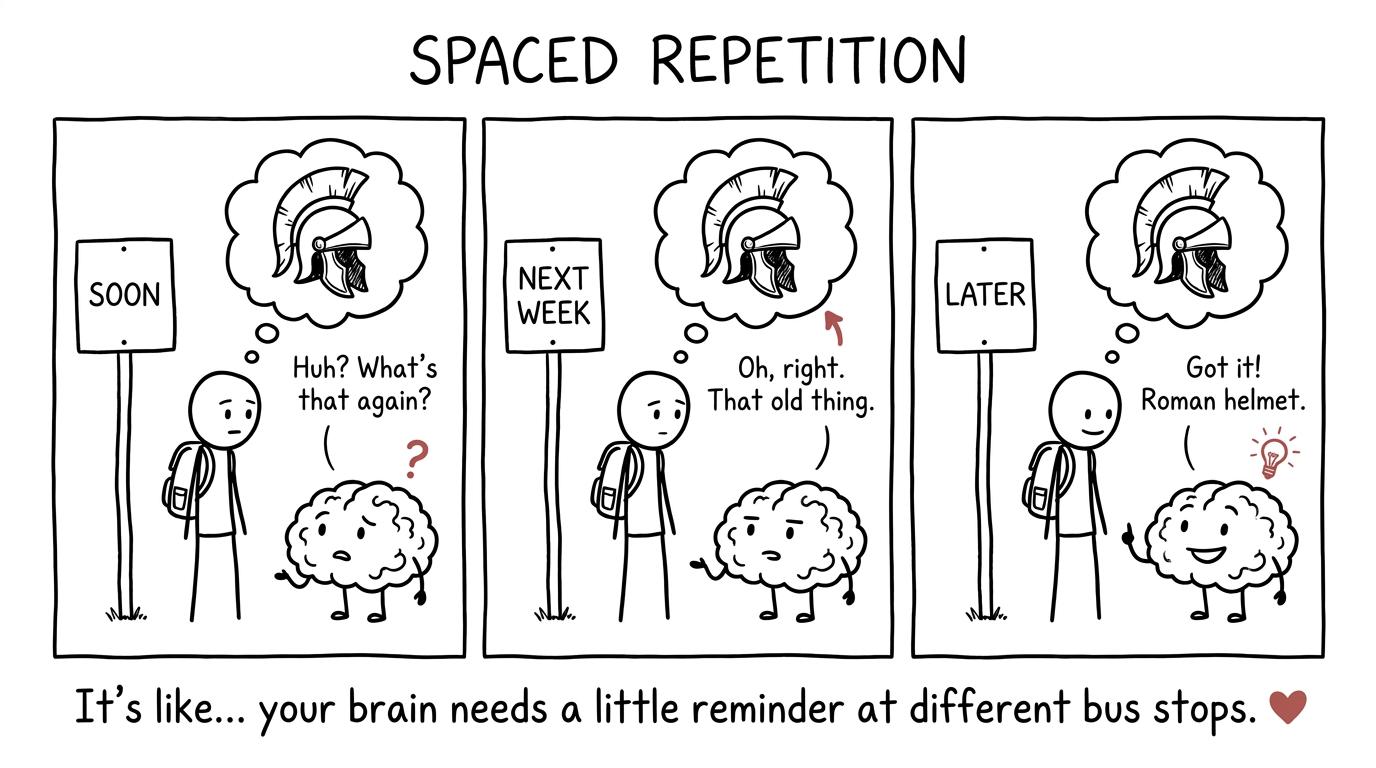 A student repeatedly meets a forgetful brain and its Roman helmet
Choose knowledge from your actual OCR course
GCSE Classical Civilisation is currently offered by OCR under specification J199. Students study one Thematic Study and one Literature and Culture option. Each component is assessed by a written examination lasting one hour and thirty minutes, worth half of the qualification.
Your school chooses the options, so do not copy another student's flashcard deck without checking that it matches your course. Your starting list should come from your teacher's scheme of work and the current OCR specification.
Useful card categories include:
- people, places, deities and events
- features of prescribed literary sources
- features of visual or material sources
- social, historical and cultural context
- similarities and differences between Greece and Rome
- interpretations of evidence
- reasons a source may be valuable or limited
- specialist terminology
OCR assesses knowledge and understanding through AO1, alongside analysis, interpretation and evaluation through AO2. A deck containing only names and definitions therefore covers only part of what you need.
Use three levels of question
A balanced set should move beyond simple factual prompts:
- Recall: identify a person, object, practice or event.
- Connection: explain how a fact relates to its cultural context or another source.
- Judgement: evaluate significance, reliability or the strength of an interpretation.
The first level supplies evidence. The second helps you connect it. The third begins to resemble the thinking required for extended responses.
Keep judgement cards narrow enough to answer briefly during retrieval. Full essay planning belongs elsewhere. A flashcard is a prompt for thought, not a miniature textbook.
Start with a calm weekly rhythm
A sustainable routine could contain three short Classical Civilisation sessions each week.
At the beginning of a session, review the soon pile. Continue with a selection from the next-week pile, then add only a few new cards. End by recording one area that needs attention.
Once a week, replace part of the card session with a different retrieval task:
- sketch a source from memory and label its important features
- create a brief comparison grid without notes
- plan the evidence for an extended response
- identify a source from an image and explain its context
- write everything you remember about one subtopic, then check it
This variation matters because the examination contains short and extended responses and may ask students to engage with literary and visual or material sources. Flashcards support the knowledge underneath those tasks, but they cannot replace them.
Fit Classical Civilisation around GCSE maths
When several subjects compete for time, revision systems can become the problem they were meant to solve. The answer is not a separate complicated timetable for every course. Use the same basic rhythm across subjects while changing the task.
For Classical Civilisation, retrieve names, source details, context and arguments. For maths, retrieve a method and then apply it to unseen questions. Maths revision must include written practice because recognising a method is not the same as carrying it out accurately.
The GCSE Maths revision hub provides free lessons, flashcards, practice questions and board-specific resources. Choose the correct area for your specification, such as AQA GCSE Maths revision or OCR GCSE Maths revision.
A practical evening might pair a short Classical Civilisation card review with one focused maths topic. The twenty-minute GCSE maths revision routine is useful when schoolwork is busy and you need a repeatable structure rather than a long session.
There is a deeper advantage here. Both routines remove the question, “What should I revise?” Your card piles identify weak Classical Civilisation content. In maths, a marked mini test or paper identifies the topics costing marks. The guide to finding your weakest GCSE topics explains how to turn mistakes into a focused revision list.
Make every review active
The most important rule is simple: answer first, check second.
Covering an answer and immediately deciding that you “basically knew it” weakens the process. Produce something observable. Say the complete answer aloud, write key words or make a brief plan. Only then should you turn the card over.
Check for more than a familiar phrase. Ask:
- Did I identify the correct source or feature?
- Did I include the relevant context?
- Could I connect it to the question being asked?
- Did I confuse Greek and Roman evidence?
- Could I use this knowledge in a reasoned judgement?
Apply the same honesty to maths. Use a question before viewing the method, mark the result and revisit the topic later. MathsGenie's guide to stopping forgotten GCSE maths content follows this cycle of active recall, spaced practice and exam-style application.
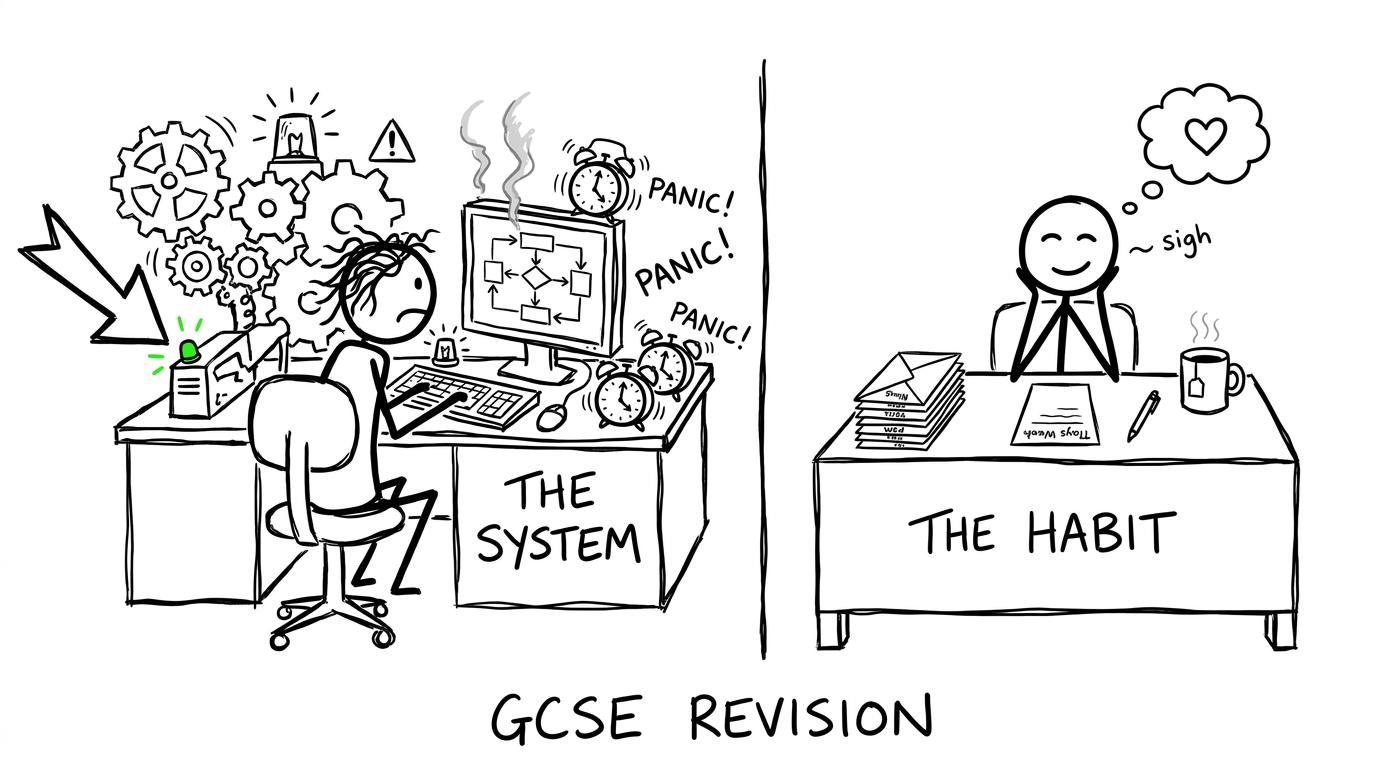 The simple paper habit quietly defeats an over-engineered revision system
Know when to move beyond cards
Spaced repetition stores and strengthens the material from which good answers are built. It does not automatically teach examination timing, source handling or coherent argument.
As the exams approach, combine your review system with:
- timed short-answer questions
- source analysis
- comparative planning
- extended responses
- marking against official criteria
- corrections completed without copying
The same progression applies to maths. Topic recall should eventually lead to mixed and timed questions. Edexcel GCSE Maths past papers, for example, place papers alongside mark schemes and available solutions. The guide on when to start GCSE past papers explains why paper practice should begin while there is still time to repair the gaps it exposes.
Common spaced repetition mistakes
Making too many cards at once
Card-making can feel productive while quietly consuming all your revision time. Start with the knowledge you most often forget and add cards gradually.
Writing prompts that are too broad
“Tell me everything about Roman religion” is difficult to answer and difficult to mark. Split broad areas into precise prompts, then use separate comparison or judgement cards to reconnect them.
Turning cards over too quickly
Retrieval should require an honest attempt. A little effort is useful; staring helplessly for several minutes is not. Try, check, correct and schedule the card sooner.
Revising facts without analysis
A list of names may support AO1, but Classical Civilisation also requires analysis and evaluation. Include cards asking what evidence suggests, how sources differ and why an interpretation may be convincing.
Never checking the specification
Only revise the options taught by your school. Confirm prescribed texts, visual or material sources and component codes against current OCR information supplied by your teacher.
Treating the timetable as sacred
If a card is consistently easy, lengthen the interval. If you forget it, shorten the interval and improve the prompt or answer. The schedule exists to respond to learning, not control it.
A small system you can keep using
The best revision system is rarely the most impressive one. It is the one that survives ordinary school days.
Begin with one Classical Civilisation subtopic, three paper piles and a short closed-book review. Let forgotten material return sooner. Let secure material wait. Then add source analysis and examination questions so that remembered knowledge becomes usable knowledge.
For maths, build the same habit around MathsGenie's free revision lessons, practice questions, mini tests, past papers, predicted papers, mark schemes and video solutions. Open the GCSE Maths revision hub, choose one weak topic and schedule the first return before you finish today's session. Progress often starts not with doing more, but with deciding when you will come back.