Spaced Repetition GCSE Chemistry: A Simple Start
Spaced repetition GCSE chemistry made simple: build an app-free revision routine, remember key facts and protect time for GCSE maths practice too.
Revision can feel productive long before it becomes effective. You read a page on electrolysis, highlight three sentences and recognise every word. Then, two days later, the same idea feels strangely unfamiliar.
A simple spaced repetition GCSE chemistry routine solves that problem by making you retrieve key knowledge on several different days. You do not need a complicated app. Start with paper cards, three envelopes and a calendar. Test yourself briefly, check each answer and return difficult material sooner than material you remember securely.
The aim is not to spend more time revising. It is to stop asking one long evening to do the work of several well-timed encounters.
Your simple spaced repetition checklist
Use this as the entire system:
- Choose one small chemistry topic from your exam board specification.
- Create short prompts rather than pages of notes.
- Answer each prompt without looking.
- Check against a reliable source or mark scheme.
- Review uncertain prompts soon and secure prompts later.
- Include calculations and required practicals, not only definitions.
- Use a weekly mixed quiz to check whether knowledge transfers.
- Keep chemistry revision alongside, rather than instead of, GCSE maths practice.
That last point matters. Chemistry contains ratios, percentages, graphs, standard form, substitution and rearranging formulae. If those skills need attention, the free GCSE Maths revision hub lets you choose your exam board and practise them directly.
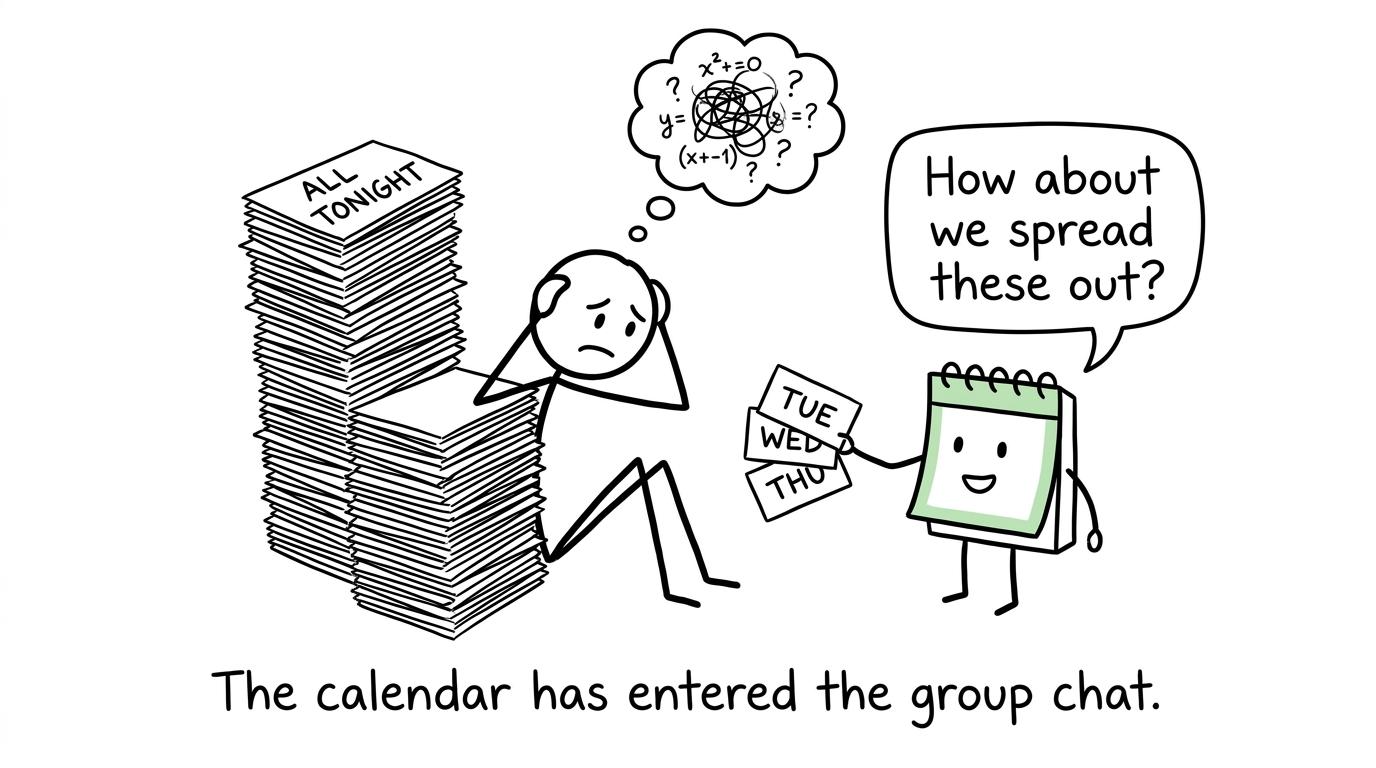 A student chooses a calm calendar instead of revising every chemistry card at once
What spaced repetition actually means
Spaced repetition means revisiting material across separate sessions instead of concentrating all the repetitions into one block. Retrieval practice means attempting to recall the material before checking your notes. Put them together and you get spaced retrieval: repeated self-testing over time.
Research on learning generally supports both spacing and retrieval for long-term retention, although the size of the benefit varies between settings and subjects. The practical message is more modest than many revision claims suggest: short tests spread across several days are usually a better foundation for remembering than repeatedly reading the same page in one sitting.
This does not mean rereading is forbidden. You may need to read or watch an explanation when first learning a topic. The important change is what happens next. Close the source and ask yourself what you can reproduce.
Recognition feels smooth because the answer is already in front of you. An examination requires something harder: selecting and using knowledge when the answer is hidden.
The three-envelope method
You need some index cards or folded paper, three envelopes and a calendar. Label the envelopes:
- Soon for material you could not recall
- Developing for partly correct or hesitant answers
- Secure for accurate answers given without help
Begin with no more than 101010 to 151515 prompts from one topic. Keeping the first set small matters because a revision system only helps if it survives an ordinary school week.
Write prompts that demand an answer
A useful card has one clear task. Suitable chemistry prompts include:
- define a key term precisely;
- state the observations for a test;
- recall the stages of a required practical;
- identify variables and control measures;
- explain a trend using particles, bonding or reactivity;
- recall an equation, unit or conversion;
- interpret what a graph’s shape suggests.
Avoid writing “revise bonding” or “know electrolysis”. Those are topics, not retrieval prompts. A prompt should make it obvious whether your response was complete.
Keep answers brief but mark-scheme aware. Chemistry questions often reward precise scientific language. If your answer changes “particles” into “atoms” when ions are required, that distinction belongs on the card.
Review at simple intervals
There is no universally perfect spacing schedule. A practical starting pattern is:
- first review later the same day or the next day;
- second review after about 222 or 333 days;
- third review after about 111 week;
- fourth review after about 222 weeks;
- later reviews every few weeks until the examination.
Treat these as adjustable appointments, not scientific laws. If you forget something, shorten the next gap. If recall is quick, accurate and explainable, extend it.
After each review, move the card:
- incorrect cards return to Soon;
- incomplete cards go to Developing;
- secure cards move to Secure.
Write the next review date on the card or place it in a dated section of your planner. Students already organising several subjects may find the structure in a realistic GCSE maths revision timetable useful for protecting short, repeatable sessions.
What to include for GCSE chemistry
Your exact content must follow the specification used by your school. AQA, Edexcel, OCR and Eduqas organise and assess material differently, while Combined Science and separate GCSE Chemistry do not always contain identical detail. Check your qualification, tier and current specification rather than relying on a generic online checklist.
Core knowledge
Create prompts for definitions, particle models, bonding, reactivity, chemical analysis, rates, energy changes, organic chemistry, the atmosphere and resources where these appear in your course.
Do not turn every sentence into a card. Prioritise information that must be recalled accurately or used to construct explanations.
Required practical knowledge
Practical work deserves its own cards. Depending on your specification, you may need to recall apparatus, methods, variables, safety decisions, expected observations, graph interpretation and evaluation.
Separate these into focused prompts. One enormous card asking for an entire method encourages vague self-marking. Several smaller prompts reveal exactly what has been forgotten.
Equations, quantities and units
Chemistry calculations need more than factual recall. A card can test whether you remember an equation, what each quantity represents and the required units. But cards alone cannot develop the full process of interpreting an unfamiliar question and completing a calculation.
Pair recall with written question practice involving skills such as:
- ratios and proportional reasoning;
- percentages;
- converting units;
- substituting into formulae;
- rearranging equations;
- reading scales and graphs;
- standard form.
For example, concentration may be expressed in units such as $ m{mol,dm^{-3}}$, and quantitative chemistry can require careful ratio reasoning. Use the MathsGenie GCSE maths resources when the mathematical method, rather than the chemistry fact, is causing the difficulty.
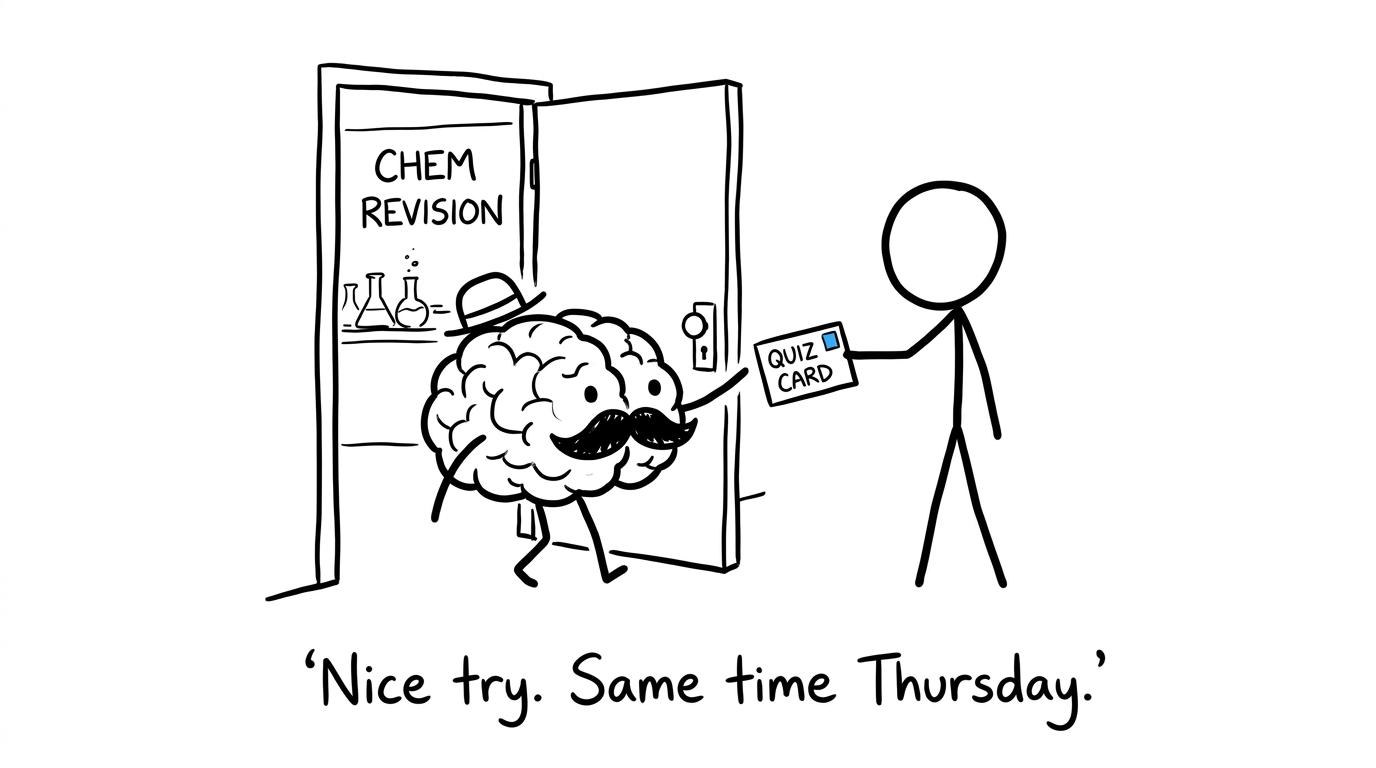 A forgetful brain is caught by a small self-quiz card
A weekly routine without an app
A calm routine might use four short chemistry sessions rather than one large block.
At the start of the week
Learn one small section using your class materials and specification. Create a limited set of prompts, then test them once after learning. This first attempt tells you whether the cards are clear.
During the week
Spend around 101010 to 151515 minutes reviewing cards that are due. Say or write the answer before turning the card over. Correct errors immediately, but do not count an answer as secure merely because it looks obvious once revealed.
The same principle works in maths. Finding your weakest GCSE topics is more useful than repeatedly practising comfortable material.
At the weekend
Use a mixed quiz containing old and new chemistry material. Include at least one calculation, one explanation and one practical question where appropriate. Mark it and turn mistakes into specific future prompts.
As exams approach, shift some time from isolated recall to full exam questions. Spaced repetition supplies accessible knowledge; papers test whether you can select and apply it. Maths students can follow the same paper-to-feedback cycle using guidance on using GCSE past papers properly.
Protecting your GCSE maths revision
If you are preparing for maths exams as well as chemistry, do not allow chemistry cards to consume every available revision slot. Flashcards can expand indefinitely because making them feels organised.
Set a boundary. For example, complete a short chemistry review, then move to a maths lesson, practice questions or a mini test. Maths requires active problem-solving, so reading formula cards cannot replace writing complete solutions.
A one-month GCSE maths revision plan can help you balance retrieval, targeted topics and paper practice. If you are sitting Edexcel, the Edexcel GCSE maths past papers provide timed practice with mark schemes and solutions where available.
The useful connection between the subjects is the revision loop:
- retrieve without notes;
- attempt an authentic question;
- check the answer carefully;
- record the precise error;
- return to it after a gap.
That is stronger than measuring revision by pages read or hours spent.
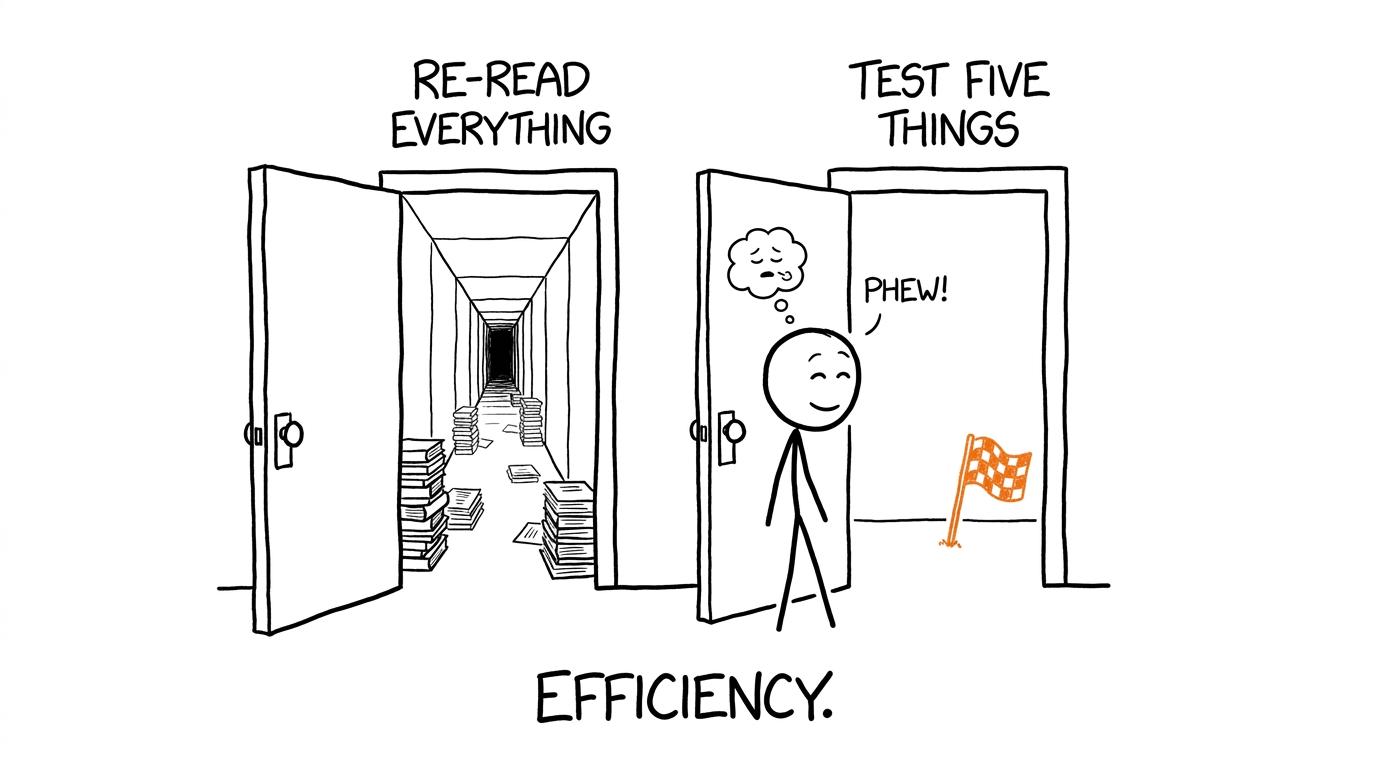 A short self-test offers a quicker route than an endless rereading corridor
Common spaced repetition mistakes
Making too many cards
A deck of hundreds can become another unfinished task. Begin with one weak topic and a small set of high-value prompts. Add cards only when a question or mark scheme reveals a genuine gap.
Looking before trying
Turning a card over after two seconds trains recognition, not retrieval. Pause, commit to an answer and then check. The effort is part of the method.
Marking vague answers as correct
“Basically right” can hide missing terminology, units or reasoning. Compare your response with trusted class materials and relevant mark schemes. Record the missing detail.
Revising facts but avoiding application
Knowing definitions is necessary, but chemistry papers also assess explanations, calculations, data and practical understanding. Mix cards with exam-style questions.
Using fixed gaps regardless of performance
A forgotten card should return sooner. A genuinely secure card can wait longer. The envelopes exist to make that adjustment without an algorithm.
Letting the system replace learning
Spaced repetition strengthens material you have understood. If an explanation still makes no sense, return to the lesson, textbook or teacher before trying to memorise the wording.
Start small and let the routine earn your trust
The best revision system is rarely the most elaborate one. It is the one you can repeat when homework is due, energy is low and the exam still feels distant.
Choose one GCSE chemistry topic today. Write no more than 101010 clear prompts, put three review dates in your calendar and test yourself before looking. Then protect time for the mathematical skills that chemistry and your GCSE maths papers demand.
MathsGenie can be your free home base for that side of the plan. Use advice on stopping GCSE maths content from being forgotten, then combine revision lessons and practice questions with mini tests, past papers, predicted papers, mark schemes and video solutions. Learn, retrieve, practise, correct and return. Simple systems become powerful when they are repeated.