

Spaced Repetition for GCSE Biblical Hebrew
Spaced repetition GCSE Biblical Hebrew: build a simple paper-card routine for vocabulary and grammar, then fit it around your GCSE maths revision.

Revision often feels manageable until two demanding subjects compete for the same evening. Biblical Hebrew needs secure vocabulary and grammar; GCSE maths needs methods that can be recalled under exam pressure. Rereading either subject may feel productive, but recognition is not the same as independent recall.
Spaced repetition GCSE Biblical Hebrew revision offers a simple answer: test a small amount today, revisit it after a short gap, and increase the interval when recall becomes reliable. You do not need a complicated app. A pack of paper cards, five labelled sections and a few minutes each day are enough to begin.
The same principle can protect your maths revision. By giving memory work a clear boundary, you leave focused time for questions, marking and corrections.
Your simple starting checklist
Use this as the entire system for your first week:
- Choose one trustworthy vocabulary or grammar source supplied by your teacher.
- Make no more than ten to fifteen cards at a time.
- Test from memory before turning each card over.
- Sort cards into five groups: today, tomorrow, three days, one week and two weeks.
- Move a successful card forwards and a forgotten card back to tomorrow.
- Keep sessions to about 101010 to 151515 minutes.
- Record recurring grammar errors separately.
- Preserve another revision block for active GCSE maths practice.
The important idea is not the exact interval. It is arranging another retrieval attempt after some forgetting has begun, rather than repeatedly looking at an answer while it still feels familiar.
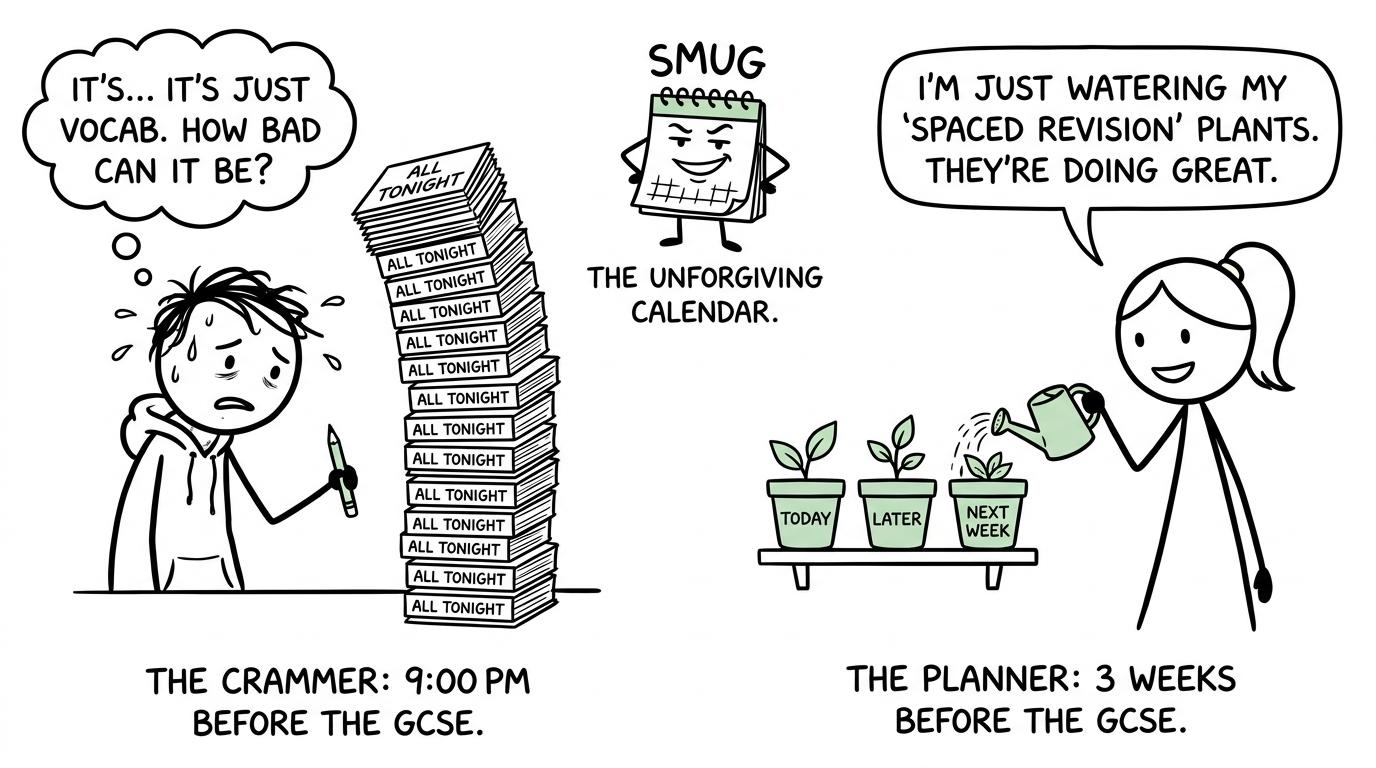 A student compares a tower of cramming cards with small pots of spaced revision
What spaced repetition actually means
Spaced repetition combines two useful habits: retrieval and spacing.
Retrieval means trying to produce an answer without looking. Spacing means returning to that material across separate sessions. Together, they turn revision into a series of honest memory checks.
This is different from copying vocabulary, highlighting notes or reading a paradigm several times. Those activities can support initial learning, but they do not prove that you can retrieve the information independently. A GCSE paper will not show you the reverse of your flashcard first.
A convenient starter pattern is:
0→1→3→7→14→300 \rightarrow 1 \rightarrow 3 \rightarrow 7 \rightarrow 14 \rightarrow 300→1→3→7→14→30These figures represent days after first learning an item. They are a practical starting point, not a scientific law or a promise that every learner should use identical gaps. Difficult material should return sooner; secure material can wait longer.
Build a five-section paper system
Take a small box, envelope folder or bundle held with clips. Label five sections:
- New
- Tomorrow
- Three days
- One week
- Two weeks
Begin with a small batch from the vocabulary, grammar and prescribed material relevant to your current course. Because specifications and set texts can change, use your teacher's list and the current qualification documents rather than an old online deck.
Each day, test only the sections that are due. If an answer is prompt and accurate, move the card to the next interval. If it is wrong, incomplete or guessed, return it to the tomorrow section. A hesitant answer is useful information, not a failure.
This creates a system that responds to your memory. Easy cards gradually appear less often, while difficult cards receive more attention.
Make cards that test one clear thing
A card should pose a question you can mark decisively. Useful card types include:
- a Biblical Hebrew word with its required English meaning;
- an English meaning prompting the Hebrew form;
- a grammatical label prompting its identifying features;
- a form prompting the relevant root or parsing information;
- a short teacher-approved phrase prompting an accurate translation;
- a grammar rule with one missing element to recall.
Keep one main prompt per card. A card asking for a translation, full parsing, rule, exception and contextual explanation at once is difficult to diagnose. If you miss it, you will not know which part needs attention.
For vocabulary, test in both directions where your course requires productive as well as receptive knowledge. For grammar, do not rely only on reciting labels. You also need to recognise forms in context and explain what the form contributes to a passage.
Use a daily routine that does not consume the evening
A sustainable session can be brief:
- Spend about two minutes preparing the due pile.
- Use roughly eight minutes for closed-book retrieval.
- Spend three minutes checking against an authoritative source.
- Use two minutes to record one recurring difficulty.
Stop when the planned session ends. Spaced repetition works through repeated contact, not through turning every evening into a vocabulary marathon.
If you miss a day, do not attempt to clear every overdue card at once. Test the most urgent material, reduce the number of new cards and rebuild the routine over several days. A system should survive ordinary school life.
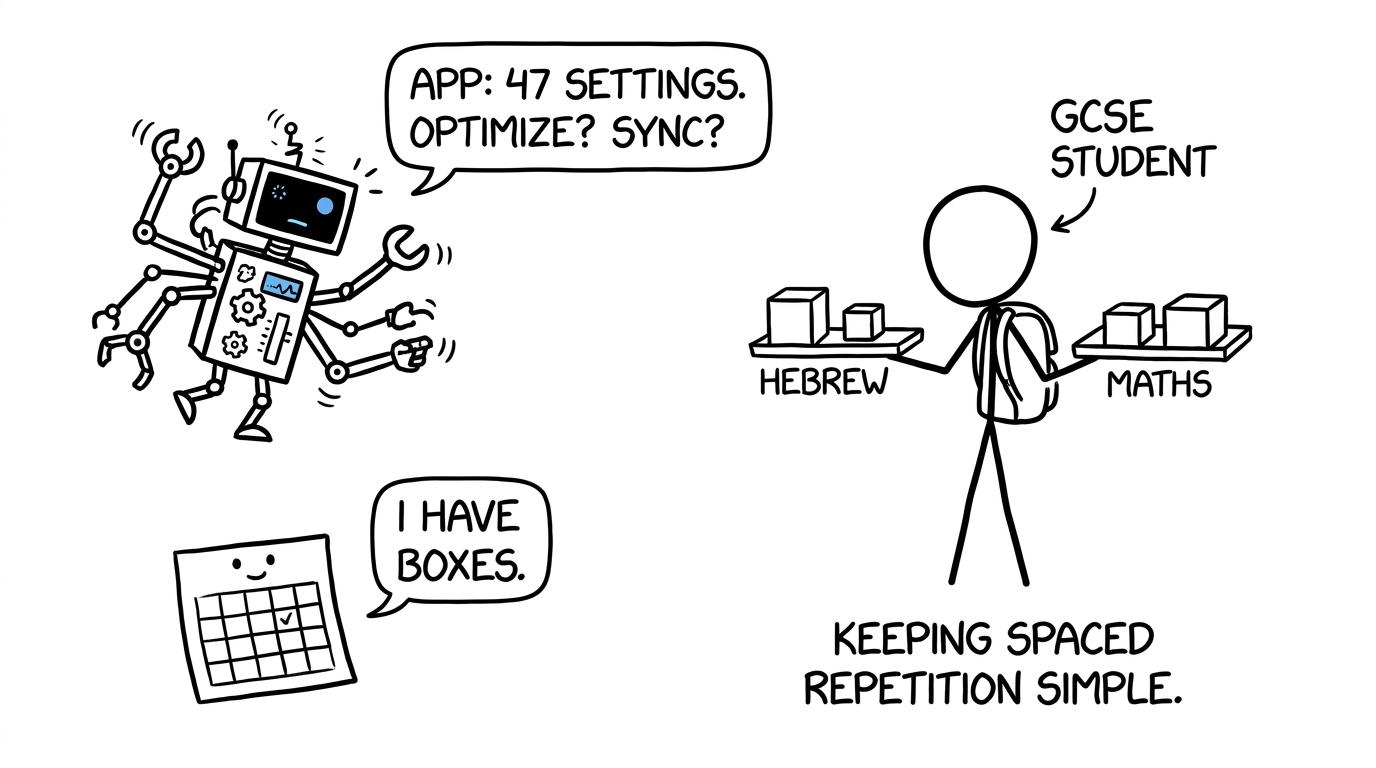 A paper calendar quietly competes with an absurdly complicated revision robot
Connect flashcards to real Biblical Hebrew
Flashcards are strongest at preserving compact knowledge. They are not a complete GCSE Biblical Hebrew revision programme.
Vocabulary must eventually be recognised inside passages, where spelling, form and context affect interpretation. Grammar knowledge must support parsing, translation and comprehension rather than remain an isolated list of terms. Prescribed literature also requires the precise preparation set out by your teacher and current specification.
Build a weekly bridge from cards to exam work:
- retrieve the week's due cards;
- read a short passage selected from your course materials;
- identify where recalled vocabulary and grammar appear;
- complete an appropriate translation, comprehension or analysis task;
- check the response using teacher guidance or an official mark scheme where available;
- turn repeated errors into a few new cards.
Do not put an entire passage or model answer onto one card. Flashcards should isolate facts and distinctions; exam questions should develop connected reasoning.
Fit Hebrew recall around GCSE maths revision
For a student preparing for maths exams, the danger is not that Biblical Hebrew takes time. It is that an unbounded task expands until maths becomes whatever is left at the end.
Give the two subjects different jobs. A short Hebrew session can handle vocabulary and grammar retrieval. A separate maths block should involve solving questions, checking answers and repairing methods. Maths flashcards can help with formulae or definitions, but they cannot replace written problem-solving.
A balanced weekday might contain:
- 151515 minutes of due Biblical Hebrew cards;
- 303030 to 454545 minutes of one GCSE maths topic;
- 101010 minutes marking and correcting maths errors.
You can choose an appropriate maths topic from the free GCSE Maths revision hub. If deciding what to revise is the difficult part, use MathsGenie's GCSE self-assessment resources to identify weak areas rather than repeatedly choosing comfortable topics.
The subjects benefit from the same honest loop:
retrieve→check→correct→retest\text{retrieve} \rightarrow \text{check} \rightarrow \text{correct} \rightarrow \text{retest}retrieve→check→correct→retestIn Hebrew, that might mean recalling a form and verifying it. In maths, it means attempting a question without notes, using the mark scheme or video solution, and returning to a similar question later.
For a broader structure, adapt the GCSE maths revision timetable or the shorter one-month GCSE revision plan. Both can accommodate a small daily language-retrieval block without allowing it to displace exam-question practice.
Know when a card is genuinely secure
A correct answer is not automatically a secure answer. Ask three questions:
- Was it accurate?
- Was it recalled without a clue?
- Was it produced reasonably promptly?
If the answer relied on the card's position, a visible first letter or a guess, keep the interval short. Shuffle cards so that order cannot provide hidden prompts.
It is also helpful to distinguish a memory lapse from a misunderstanding. If you repeatedly forget a vocabulary item, another retrieval may help. If you repeatedly confuse why a form is parsed in a particular way, stop cycling the card and return to your notes, teacher or textbook. Spacing cannot repair an explanation that was never understood.
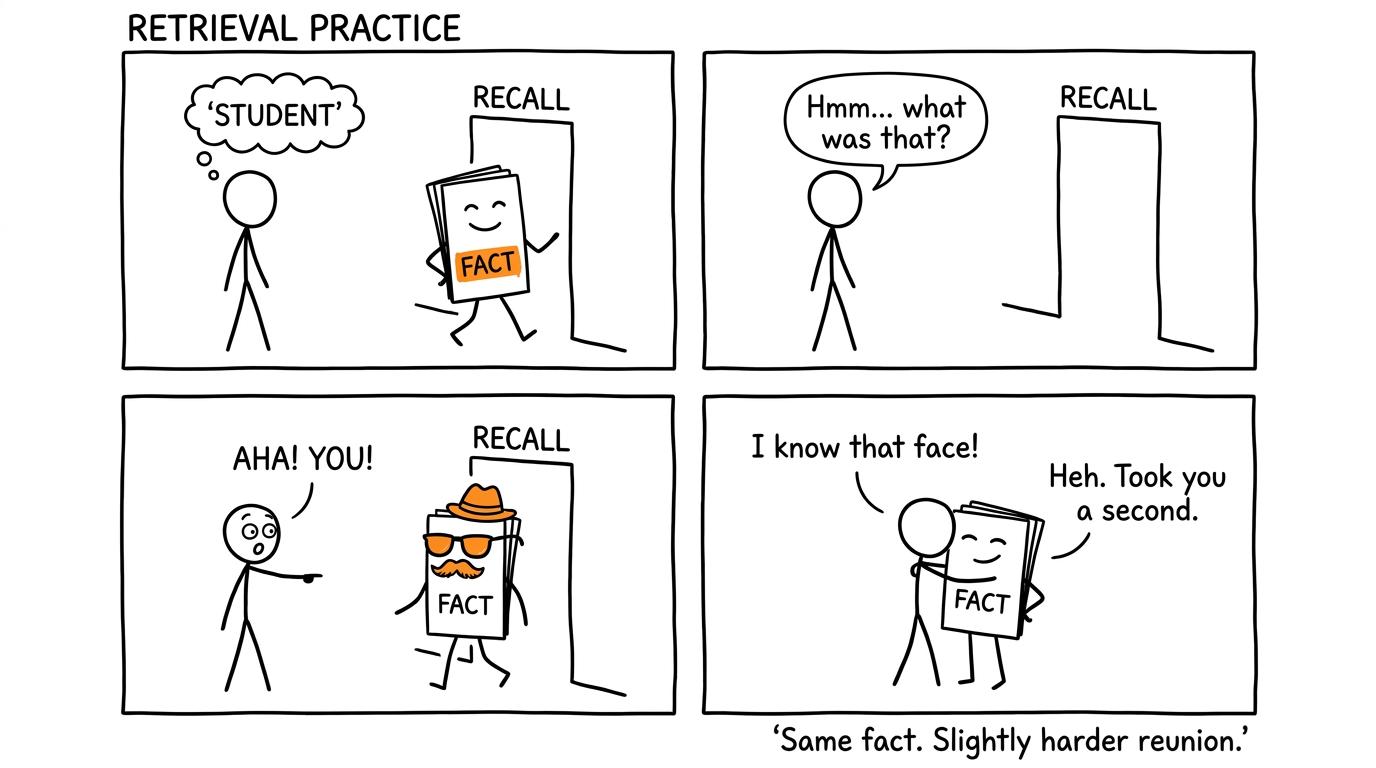 A disguised flashcard discovers that the student still recognises it
Common mistakes with spaced repetition
Adding too many new cards
A large first batch feels ambitious, but each new card creates future reviews. Start with ten to fifteen and add more only when the daily pile remains manageable.
Looking before attempting recall
Turning the card over after one second trains recognition. Pause, commit to an answer, then check it carefully.
Marking nearly correct answers as correct
Biblical Hebrew forms and grammatical details can matter. Decide the required answer when creating the card and mark consistently against your approved source.
Memorising errors
Do not create cards from memory or unverified online lists. Copy carefully from current teacher-approved materials, then check every card before it enters rotation.
Using cards instead of exam questions
Cards preserve components of knowledge. They do not reproduce the demands of translating, interpreting or responding under timed conditions. Likewise, formula cards cannot replace maths calculations and reasoning.
Never changing the schedule
If everything returns at the same interval, the system ignores difficulty. Bring weak material back sooner and allow genuinely secure cards to wait.
Cramming overdue reviews
An enormous catch-up session often leads to careless marking. Pause new cards, deal with a sensible due batch and rebuild steadily.
Make the routine last until the exams
The best revision system is rarely the cleverest. It is the one that still works on a wet Wednesday when motivation is ordinary.
Keep the card box visible. Attach the session to a stable cue, such as arriving home or beginning revision. Once a week, remove duplicates, correct unclear prompts and check that card content still matches your course. As the examination approaches, add timed passage work while continuing short retrieval sessions.
For maths, gradually move from topic practice to mixed and timed papers. MathsGenie's one-week GCSE maths plan shows how to prioritise diagnosis and correction when time is short, while the OCR GCSE maths revision guide demonstrates the same learn, practise, mark and retest cycle for board-specific preparation. Always select resources matching your actual exam board and foundation or higher tier.
Start small and let repetition do the work
You do not need an algorithm, a perfect timetable or hundreds of cards. Start with a verified batch, test it honestly and place each card into its next section. Tomorrow, return to what is due. That small return is the whole idea.
Then protect time for the other work your exams demand. Use MathsGenie's free GCSE revision resources for revision lessons, practice questions, past papers, predicted papers, mark schemes, mini tests and video solutions. Choose one weak maths topic, practise it actively, mark it carefully and schedule a retest. Memory improves through return; grades improve when that return is paired with the right kind of practice.










