GCSE OCR Maths Revision Without Wasting Time
GCSE OCR maths revision without wasting time: a focused plan using past papers, topic practice, and mark schemes so every session improves grades 9-1.
The moment revision turns into… everything else
GCSE revision has a sneaky failure mode: you sit down to “revise OCR Maths”, and two hours later you’ve reorganised folders, colour-coded headings, and convinced yourself you were productive. It feels like progress because it’s busy. But OCR GCSE Maths isn’t marked for neat notes; it’s marked for methods, accuracy, and the habit of finishing questions under time pressure.
If you’re an OCR student, the fastest route to better GCSE marks is not more material. It’s less friction: know what to practise, practise it the way the exam demands, and use feedback that actually changes what you do tomorrow. This post gives you a time-efficient OCR GCSE revision plan using YesGenie’s free lessons, question bank, past papers, and mark schemes.
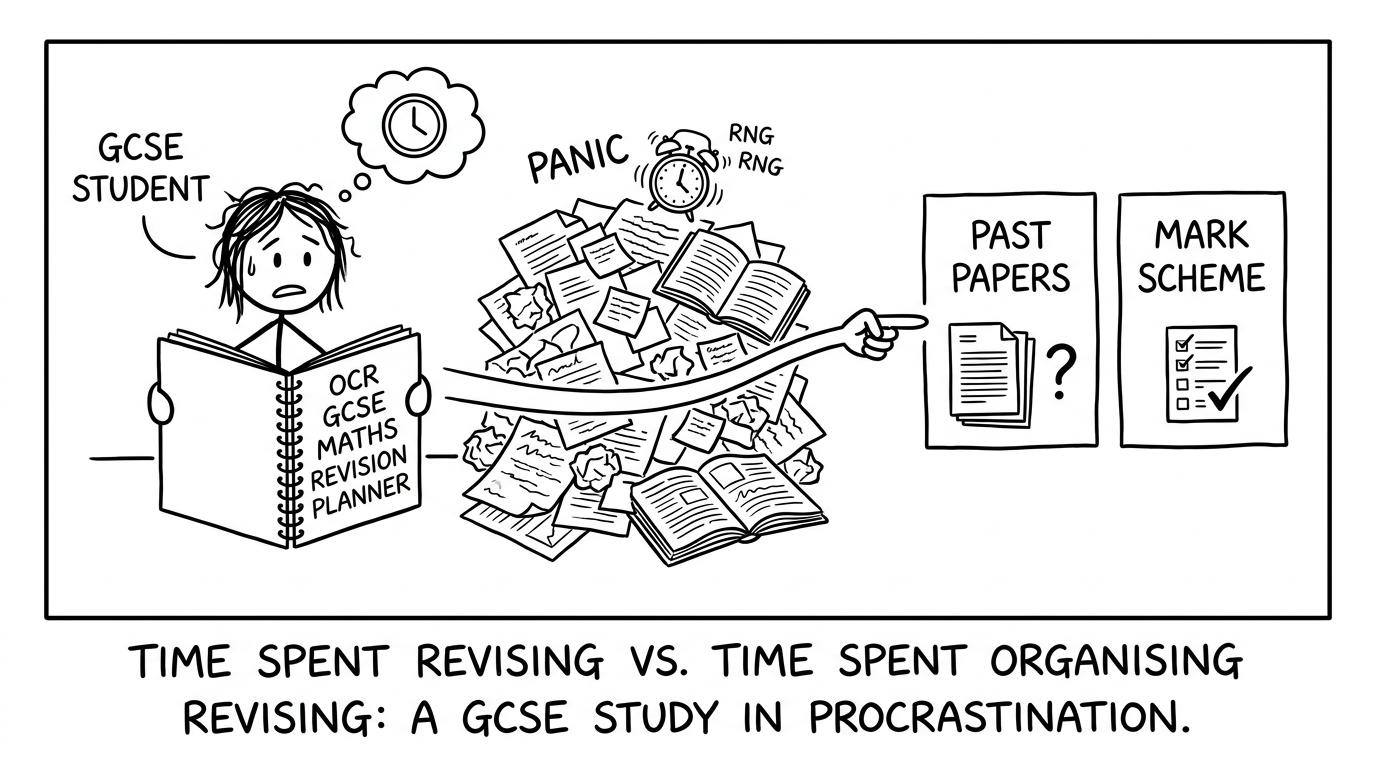 A revision planner calmly fighting the chaos of random notes
A quick checklist for time-efficient GCSE revision (OCR)
Use this as your “no-wasted-time” filter. If a session doesn’t include at least two of these, it’s probably drifting.
- One clear target (a topic or paper skill you’re improving)
- Active practice (questions, not rereading)
- Immediate feedback (mark scheme or worked solutions)
- Error log (write what went wrong and the fix)
- Repeat (do a second, similar question to prove it’s fixed)
On YesGenie, start here for OCR GCSE Maths resources: OCR GCSE Maths hub. It’s the cleanest way to keep your GCSE revision pointed at what OCR actually assesses.
Why OCR students waste time (and how to stop)
You’re revising “maths”, not a skill
GCSE maths is not one subject. It’s a pile of skills that look similar but behave differently under pressure: rearranging formulae, interpreting graphs, ratio reasoning, standard form, probability, and more. OCR papers reward students who can choose a method quickly, set it out clearly, and avoid unforced errors.
Time-saving rule: revise one skill until you can do it twice in a row without help. Then move on.
You’re collecting notes instead of collecting feedback
Notes feel safe because nothing can go wrong. Past-paper questions feel risky because they show what you don’t know yet. But GCSE grades improve when you shorten the gap between:
- attempting a question
- seeing what OCR wanted
- changing your method
YesGenie is built around that loop: lessons and revision guides for understanding, then question bank and past papers for practice.
The OCR GCSE revision loop (the only one that compounds)
Here’s a simple loop you can run in 25-45 minutes. It’s boring in the best way, because it works.
Start with a topic, not a timetable
Pick one topic from the OCR list and do a short warm-up using the question bank or a revision guide. For example, if trigonometry is shaky, use a focused page like The Sine Rule (OCR GCSE).
Then practise 6-10 exam-style questions. Mark them. Write down the single most common reason you lost marks.
Then switch to exam conditions (small doses)
Once you’ve done topic practice, do a short paper segment: 20-30 minutes with a timer. You’re training the real GCSE skill: staying accurate while the clock is running.
You can also use the broader paper collections on: GCSE past papers.
Use the mark scheme like a coach, not a judge
When you mark, don’t just label answers right/wrong. Look for:
- method marks (what OCR rewards even if you slip)
- set-up quality (did you turn words into maths cleanly?)
- avoidable errors (signs, units, rounding, calculator slips)
That’s where time is saved: you stop repeating the same mistake for weeks.
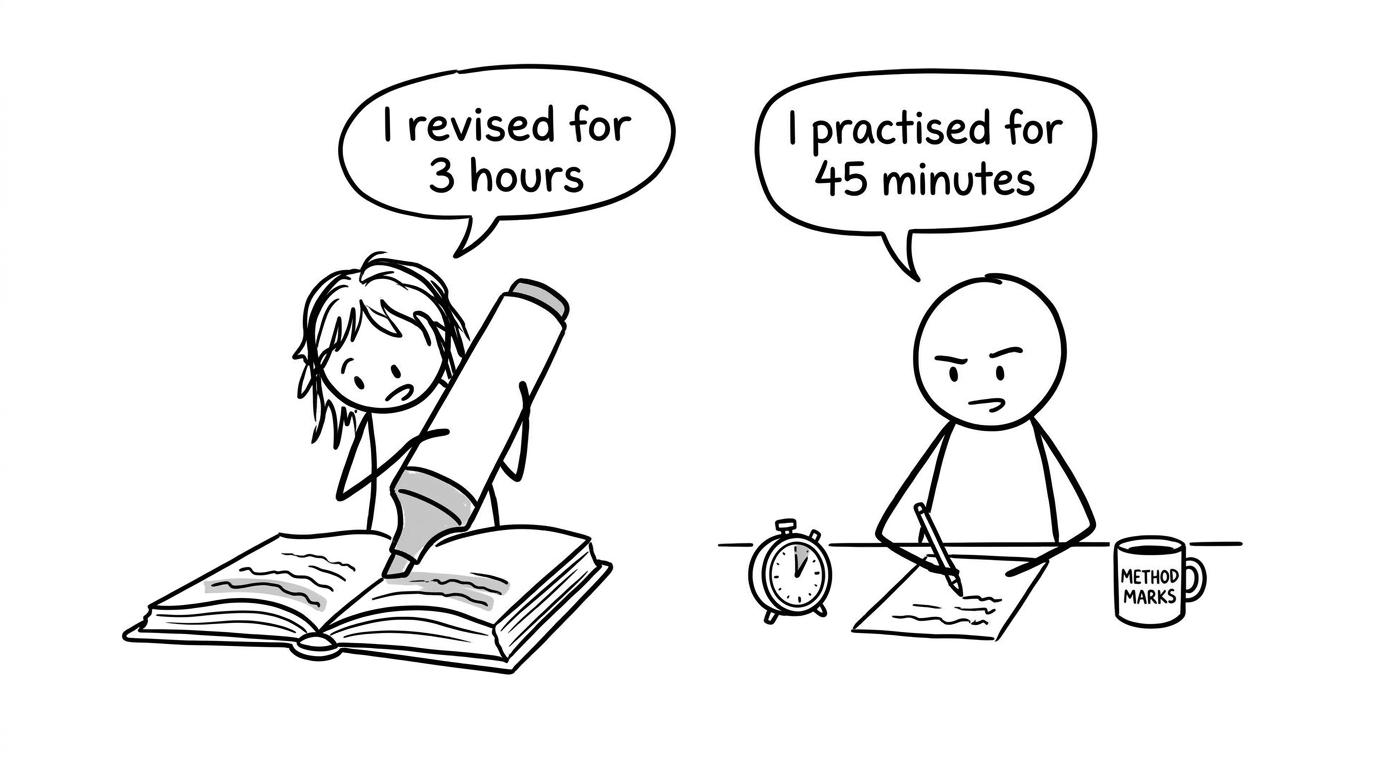 Highlighting vs practising: the stopwatch wins
Worked examples: fast methods OCR GCSE rewards
These examples are not “tricks”. They’re the kind of tidy, repeatable method OCR mark schemes tend to reward.
Rearranging formulae (high-impact GCSE skill)
Rearrange v=u+atv = u + atv=u+at to make ttt the subject.
Start by subtracting uuu from both sides:
v−u=at v - u = at v−u=atThen divide by aaa:
t=v−ua t = \frac{v-u}{a} t=av−uWhy this saves time: it’s linear, it’s clean, and you’re less likely to tangle steps. In OCR GCSE questions, clear rearrangement often earns method marks even if a later substitution goes wrong.
Standard form without losing the plot
Write 0.000560.000560.00056 in standard form.
Move the decimal to make a number between 111 and 101010:
0.00056=5.6×10⁻⁴ 0.00056 = 5.6 \times 10^{-4} 0.00056=5.6×10⁻⁴Check: 10−4=0.000110^{-4}=0.000110−4=0.0001, and 5.6×0.0001=0.000565.6 \times 0.0001 = 0.000565.6×0.0001=0.00056.
Time-saver: always do the quick check. Ten seconds of checking prevents a full-mark loss.
Angles in parallel lines (method that avoids guesswork)
If you see parallel lines, you’re usually collecting equal angles before doing any subtraction.
Suppose you find corresponding angles give x+20x + 20x+20 equals 110110110.
x+20=110 x + 20 = 110 x+20=110 x=90 x = 90 x=90Time-saver: write the angle fact (e.g. “corresponding”) on the line. It steadies you when the diagram is busy.
Reverse percentages (a GCSE classic)
An item is reduced by 20%20\%20% and now costs £48. Find the original price.
After a 20%20\%20% reduction, the new price is 80%80\%80% of the original.
Let the original price be PPP:
0.8P=48 0.8P = 48 0.8P=48 P=480.8=60 P = \frac{48}{0.8} = 60 P=0.848=60So the original price was £60.
Time-saver: do not “add 20%20\%20% back on”. OCR GCSE questions often punish that shortcut because percentage changes are multiplicative, not additive.
The OCR GCSE time plan (what to do each week)
You don’t need heroic sessions. You need repeatable ones.
Two short sessions (25-35 mins)
- Pick one topic.
- Use a revision guide or lesson to refresh.
- Do 6-10 questions.
- Mark and update your error log.
If you need a foundation-level reset on order of operations, use something like: BIDMAS revision guide (the maths is the same across boards; the skill transfers).
One longer session (45-75 mins)
- Do a paper section under time.
- Mark it carefully.
- Redo the hardest 3 questions two days later.
The OCR hub makes it easier to keep your GCSE revision aligned: OCR GCSE Maths hub.
One “maintenance” session (15 mins)
This is where GCSE grades quietly rise.
- Practise calculator fluency (fractions, powers, brackets).
- Memorise a small set of facts (e.g. squares, cubes, exact trig values if higher tier).
- Redo one past mistake from your error log.
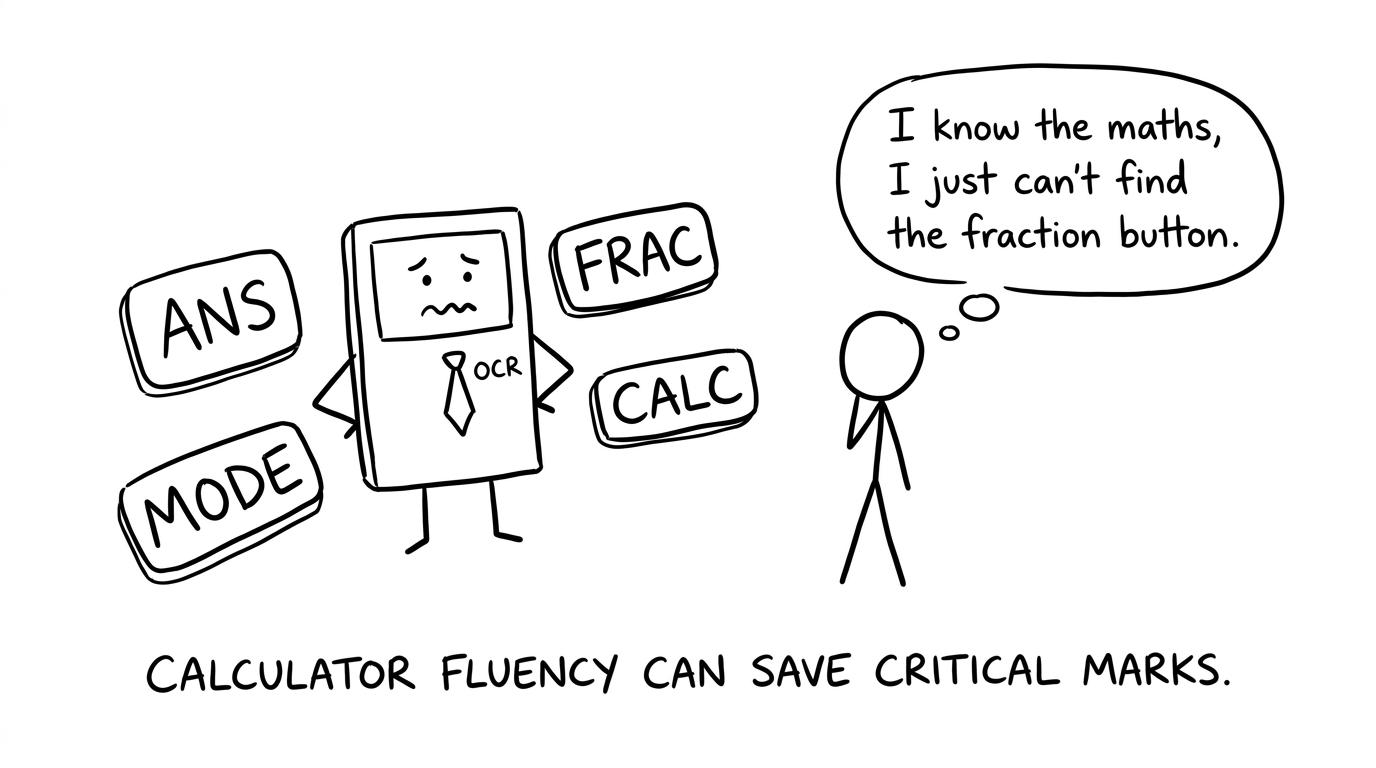 A calculator begging you to learn its buttons
Common mistakes that waste OCR GCSE marks
Writing nothing when you’re stuck
OCR mark schemes often allow method marks for setting up correctly. If you leave it blank, you guarantee zero. Even a correct diagram, formula, or substitution can earn marks.
Rounding too early
If a question leads to a final rounded answer, keep full calculator values until the end. Rounding mid-way can drift enough to lose the final mark.
Mixing up area and perimeter (or surface area and volume)
Perimeter is a length, area is squared units, volume is cubed. In GCSE questions, missing units can be a clue you’ve used the wrong concept.
“Looks right” algebra
Algebra needs rules, not vibes. For example:
1x+1x=2x \frac{1}{x} + \frac{1}{x} = \frac{2}{x} x1+x1=x2but
1x+1y≠2x+y \frac{1}{x} + \frac{1}{y} \neq \frac{2}{x+y} x1+y1=x+y2OCR GCSE questions are good at tempting you into illegal simplifications.
Not checking calculator mode
Degrees vs radians matters (and GCSE trigonometry expects degrees). Also check you can enter brackets correctly. A tiny mode error can waste a whole topic.
A calm ending: make GCSE revision smaller, not bigger
Most OCR GCSE students don’t need a new brain. They need a cleaner system. The wasted time usually isn’t laziness; it’s uncertainty: not knowing what to do next, so you do something that looks like revision. The fix is simple: choose one skill, practise real questions, mark them properly, and repeat until the mistake disappears.
If you want your GCSE revision to stay efficient, keep everything in one place: start with the OCR GCSE Maths hub, use YesGenie’s revision lessons and revision guides to rebuild understanding, then move quickly into question practice, past papers, and mark schemes. Finish by timing yourself on paper sections so your method survives the clock. That’s how you revise OCR GCSE Maths without wasting time, and how you turn effort into marks.