Sleep Before a GCSE Spanish Exam: How Much?
Sleep before GCSE Spanish exam: discover how much teenagers need, why rest supports memory and focus, and what to do on the final evening.
The night before a Spanish paper can create a strange bargain: another hour of vocabulary feels useful, while sleep feels like time in which you are doing nothing. Yet if you are deciding how much sleep before GCSE Spanish exam day you need, the practical answer is clear. Most teenagers should aim for around 888 to 101010 hours, ideally within a consistent routine rather than as a one-night rescue attempt.
Sleep cannot replace revision. What it can do is help your brain retain material you have already learnt, sustain attention and retrieve words more reliably. Those abilities matter in every GCSE, but they are especially visible when you must follow spoken Spanish, read carefully or construct accurate sentences under time pressure.
Your quick night-before checklist
- Work backwards from the time you must wake up and allow roughly 888 to 101010 hours for sleep.
- Finish demanding revision at least an hour before bed.
- Use the final session for calm retrieval, not a new topic marathon.
- Pack your equipment, check the exam time and set your alarms.
- Avoid late caffeine and notifications that can disturb your wind-down.
- If one night goes badly, do not decide that the exam is ruined.
The aim is not a mathematically perfect bedtime. It is to give yourself a realistic sleep opportunity and arrive with enough attention to use what you know.
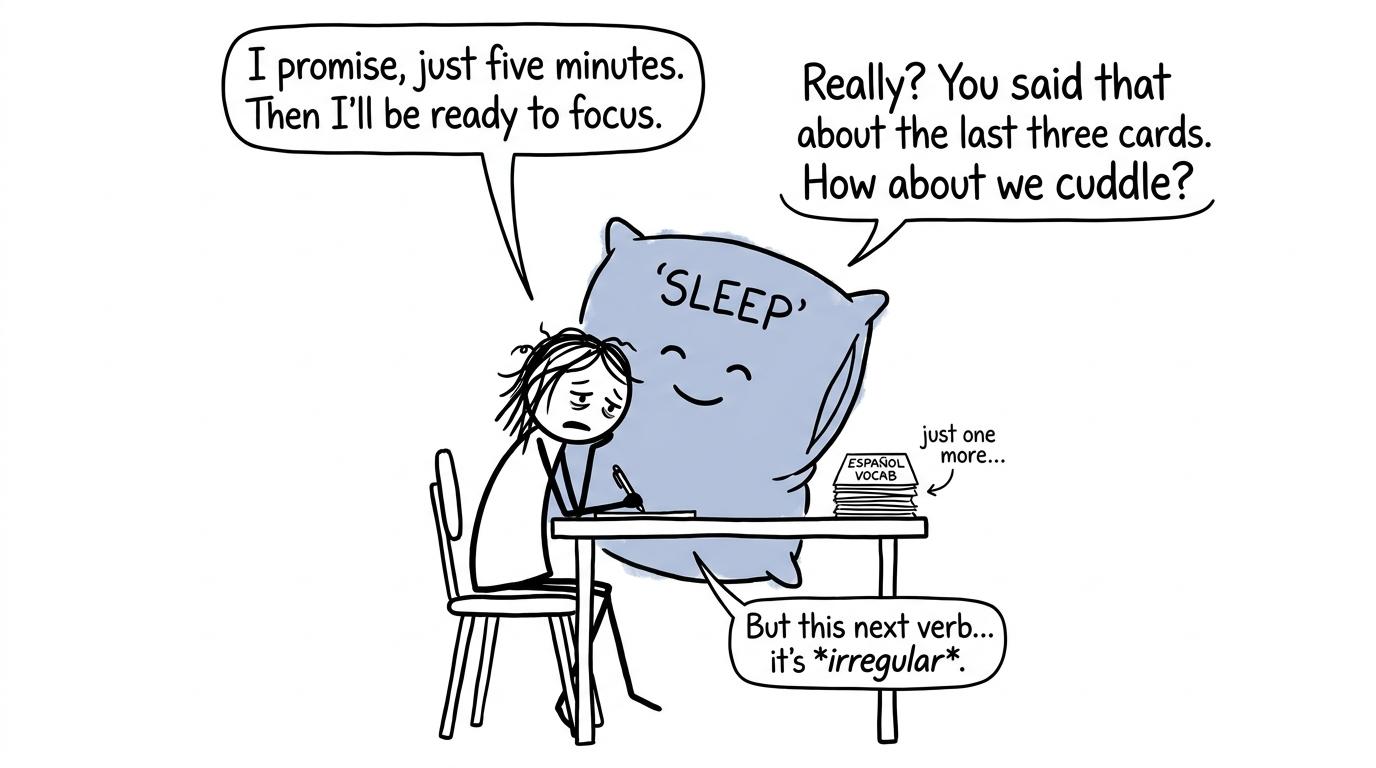 A tired student negotiates with sleep while vocabulary cards demand one more round
How much sleep do GCSE students actually need?
Current NHS-linked guidance commonly recommends around 888 to 101010 hours per night for teenagers aged 131313 to 181818. Individual needs vary, so this range is guidance rather than an exact prescription. A student who normally functions well with nine hours should not suddenly plan for six simply because an exam is approaching.
Work backwards from your wake-up time. If you need to get up at 6:45 am6{:}45\text{ am}6:45 am, aiming to be asleep by about 10:15 pm10{:}15\text{ pm}10:15 pm would provide approximately 888 hours 303030 minutes of sleep. Your bedtime needs to be earlier than that because falling asleep is not instantaneous.
One important distinction is often missed: time in bed is not always the same as time asleep. Building in a calm buffer is more sensible than switching off a revision video at the exact moment your calculated sleep window begins.
Sleep also works best as a pattern. A single long night does not necessarily erase a week of very short nights, just as one short night does not erase months of preparation. During exam season, protecting sleep across several nights is usually more valuable than chasing a dramatic final-night fix.
What sleep does for Spanish memory
When you revise Spanish, your first task is to encode information. You meet a word, phrase, grammatical structure or pronunciation and create a new memory. That memory is initially fragile.
Research involving children and adolescents generally supports a role for sleep in memory consolidation. Consolidation is the process through which newly learnt information becomes more stable and less vulnerable to interference. Reviews also suggest that sleep after learning can support declarative memory, the type involved in remembering facts and vocabulary.
This does not mean that sleeping places vocabulary into your brain without revision. It means sleep can help strengthen material that has already been encoded. The useful sequence is therefore:
learn⟶retrieve⟶sleep⟶retrieve again\text{learn} \longrightarrow \text{retrieve} \longrightarrow \text{sleep} \longrightarrow \text{retrieve again}learn⟶retrieve⟶sleep⟶retrieve againFor Spanish, that might involve recalling vocabulary without looking, checking your answers and then stopping. Re-reading a page until midnight may feel fluent because the words remain visible. Retrieval gives you better evidence about what you can produce independently.
The same principle helps with maths. Once Spanish is finished, use MathsGenie's GCSE maths revision hub to organise future revision into lessons and practice rather than allowing every subject to become a late-night emergency.
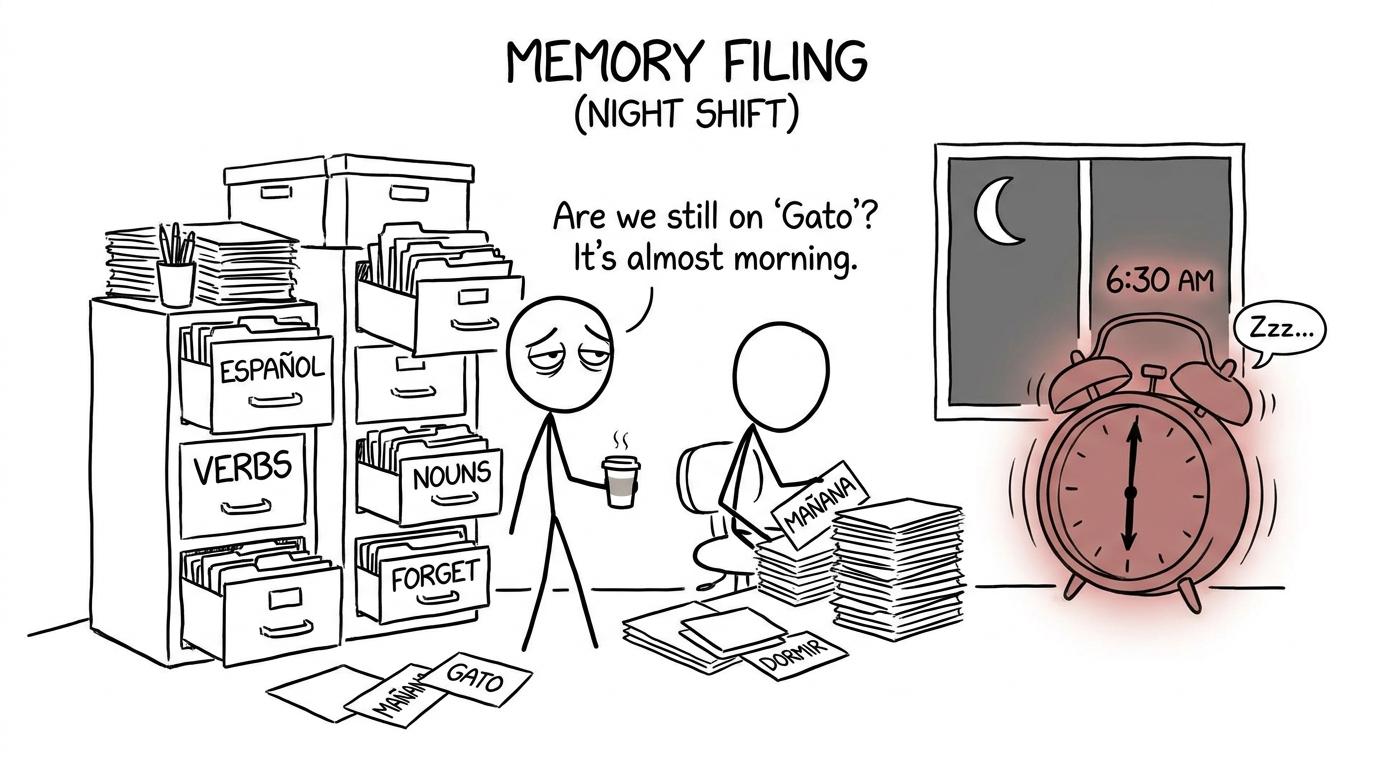 Night-shift memory clerks file Spanish words while the student sleeps
Why sleep matters for focus in the exam
Memory is only half the story. You also need to notice what the question is asking.
Depending on your exam board and specification, GCSE Spanish assessment can involve listening, speaking, reading, writing, translation and dictation tasks. Edexcel, AQA, OCR and Eduqas do not necessarily use identical formats, so check your own specification and teacher's guidance. Across these tasks, however, sustained attention matters.
In a listening paper, your attention must remain attached to the recording. A brief lapse can mean missing a negative, a time reference or a change of opinion. In reading, tiredness can encourage hurried scanning instead of precise interpretation. In writing, reduced concentration can make it harder to monitor verb endings, agreements and accents while also developing an answer.
Evidence on restricted sleep and every individual cognitive skill is not perfectly uniform. Students also vary in how strongly they feel one short night. Even so, adolescent sleep research consistently links sleep with attention, vigilance, learning and working memory. The sensible conclusion is not that a precise amount guarantees a grade. It is that severe sleep restriction introduces an avoidable risk.
That lesson applies equally to GCSE maths. A tired student may know a method but misread a scale, copy a value incorrectly or overlook an instruction. MathsGenie's guide to a calm GCSE maths night-before plan follows the same idea: choose a short, useful task and protect your stopping time.
A sensible final-evening routine
Finish with retrieval, not discovery
Your last Spanish session should be narrow. Test a manageable set of familiar vocabulary, review a few recurring corrections or speak several prepared structures aloud. Avoid opening an entire unfamiliar theme late in the evening. New material can increase anxiety while offering little time for meaningful practice.
Set an end time before you begin. If stopping depends on whether you eventually feel completely prepared, you may never stop. Exams always contain uncertainty.
Remove tomorrow's small decisions
Check your timetable and know where you need to be. Pack permitted equipment, prepare clothes and arrange breakfast. Set an alarm and, if it reduces anxiety, a backup alarm.
These jobs do not improve your Spanish directly. They reduce the number of loose ends competing for attention when you are trying to settle.
Create a genuine wind-down
NHS sleep guidance for teenagers recommends a regular routine and a calm, dark sleeping environment. It also commonly advises avoiding caffeinated drinks later in the day and switching off electronics during the hour before bed.
The issue is not only light from a screen. A phone can keep revision, conversations and exam predictions mentally active. Put it out of reach, silence notifications and choose a low-stimulation activity instead.
Do not use alcohol, unprescribed medication or unfamiliar supplements as a sleep strategy. If sleep problems are persistent or significantly affect daily life, speak to a parent or carer, your GP or another qualified health professional.
What to do if you cannot fall asleep
Trying to force sleep often creates a second problem: anxiety about being awake. Avoid repeatedly checking the clock and calculating how many hours remain. That turns bedtime into another exam.
If you remain awake, keep the environment quiet and dim. A calm activity away from your phone may help until you feel sleepy. Slow breathing can also give your attention something neutral to follow, but it does not need to become another performance target.
Most importantly, do not treat wakefulness as proof that tomorrow will go badly. Rest quietly, return to your routine and avoid starting a new revision session in bed. One imperfect night changes how you may feel; it does not delete what you have learnt.
The morning of your Spanish exam
Get up with enough time to avoid rushing. Seek some morning daylight, eat a familiar breakfast if you normally do, drink water and follow your usual caffeine habits rather than experimenting with an unusually large energy drink.
A short review can be useful, but keep it selective. Look at a small number of high-value reminders rather than attempting to process the whole course. Your goal is to activate knowledge, not test your courage.
If you have another GCSE soon afterwards, resist the temptation to analyse every Spanish answer for hours. Move calmly to the next planned task. A realistic GCSE maths revision timetable or one-month maths revision plan can stop the next exam from becoming another late-night crisis.
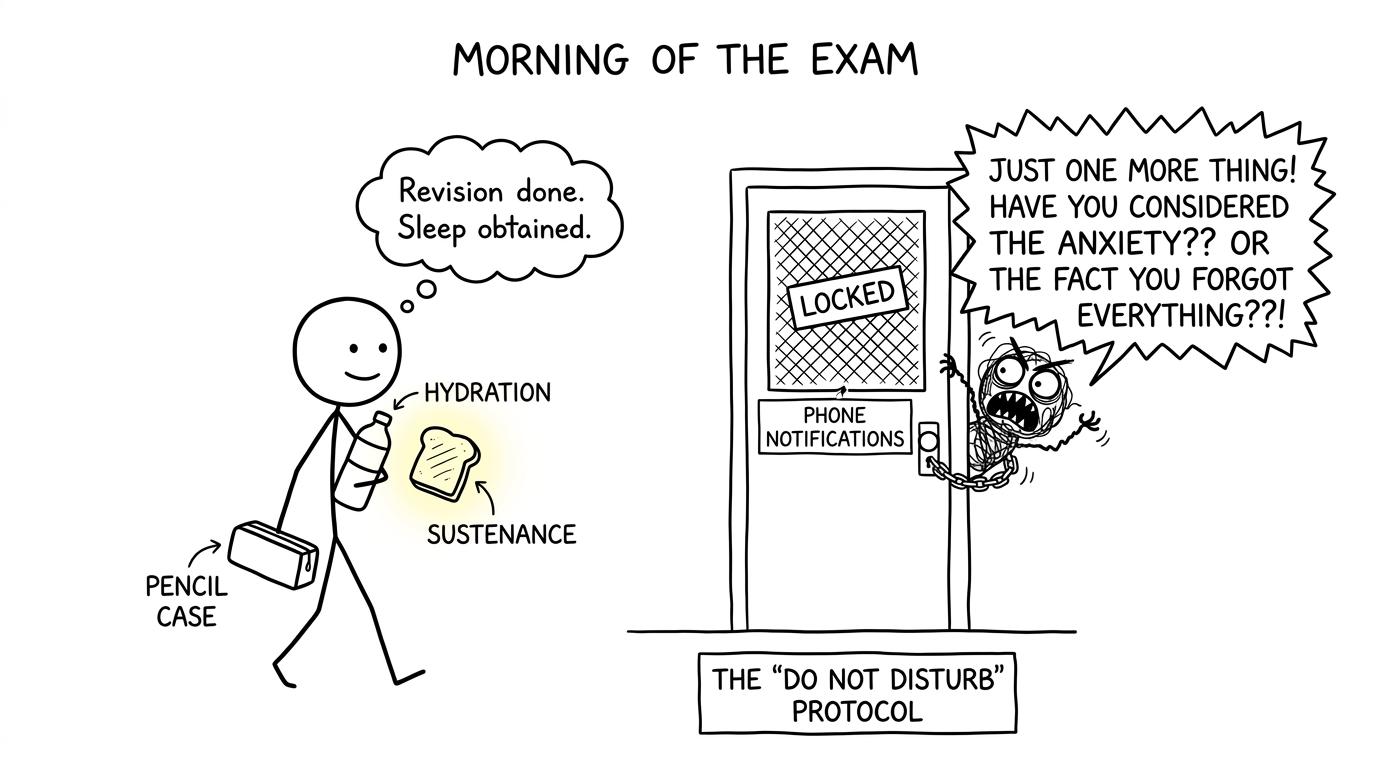 A calm exam morning while the phone notification monster stays locked away
Common mistakes before a GCSE Spanish exam
Trading several hours of sleep for passive revision
Late rereading can create familiarity without reliable recall. A shorter retrieval session followed by sufficient sleep is usually a more rational final-night choice.
Trying to learn every remaining word
Prioritise recurring vocabulary, useful structures and mistakes you already understand. The final evening is for stabilising preparation, not rebuilding the entire course.
Changing your routine dramatically
An unusually early bedtime may leave you frustrated, while excessive caffeine can delay sleep. Make modest adjustments and keep the evening recognisable.
Panicking after one poor night
Sleep matters, but catastrophic thinking consumes more attention. Use your normal exam routine and focus on the next controllable action.
Letting every subject become a night-before problem
A revision plan protects sleep by moving important work earlier. For maths, start with short topic practice before progressing to timed Edexcel GCSE maths past papers. The guide to using Edexcel past papers properly explains how to mark, diagnose and revisit errors, while the GCSE past-paper timing guide helps you avoid saving everything for exam week.
Protect the brain that has to sit the exam
Aim for around 888 to 101010 hours of sleep before your GCSE Spanish exam, while remembering that your usual needs and your pattern across the week both matter. Finish with brief active recall, stop at a planned time and remove practical worries before bed.
The deepest lesson is simple: revision only helps if you can access it when the paper begins. Sleep supports the memory and attention needed to do that.
For the maths exams surrounding your Spanish paper, make MathsGenie your free revision base. Use revision lessons and practice questions to repair weak topics, mini tests to check recall, then past papers and predicted papers to build timing. Mark schemes and video solutions show where marks are won, and a sensible plan lets you learn those lessons before bedtime, not instead of it.