Sleep Before a GCSE Geography Exam: How Much?
Sleep before GCSE Geography exam: aim for 8-10 hours. Learn how sleep supports memory and focus, with a calm, practical plan for the night before.

The revision is open. Your case-study notes are unfinished. It is late enough for every remaining topic to feel urgent. At that point, another hour at the desk can look more valuable than an hour in bed.
Usually, it is not. For sleep before a GCSE Geography exam, most teenagers should aim for roughly 888 to 101010 hours. That is the widely accepted sleep recommendation for adolescents, although individual needs vary. Sleep helps stabilise memories, sustain attention and manage emotions. It is part of your preparation, not time stolen from it.
The night before cannot replace weeks of learning. But it can help you retrieve what you already know when the paper begins.
The night-before checklist
Keep the final evening simple:
- Aim for a sleep opportunity of around 888 to 101010 hours.
- Stop intensive revision early enough to wind down properly.
- Review a small selection of case-study facts, processes and command words.
- Avoid beginning an unfamiliar topic late at night.
- Pack your equipment and check the exam time.
- Put your phone beyond easy reach.
- Keep your normal routine rather than trying an extreme sleep strategy.
- If one night goes imperfectly, stay calm and follow your usual morning routine.
The useful question is not, “How late can I keep revising?” It is, “What stopping time gives tomorrow’s brain the best chance?”
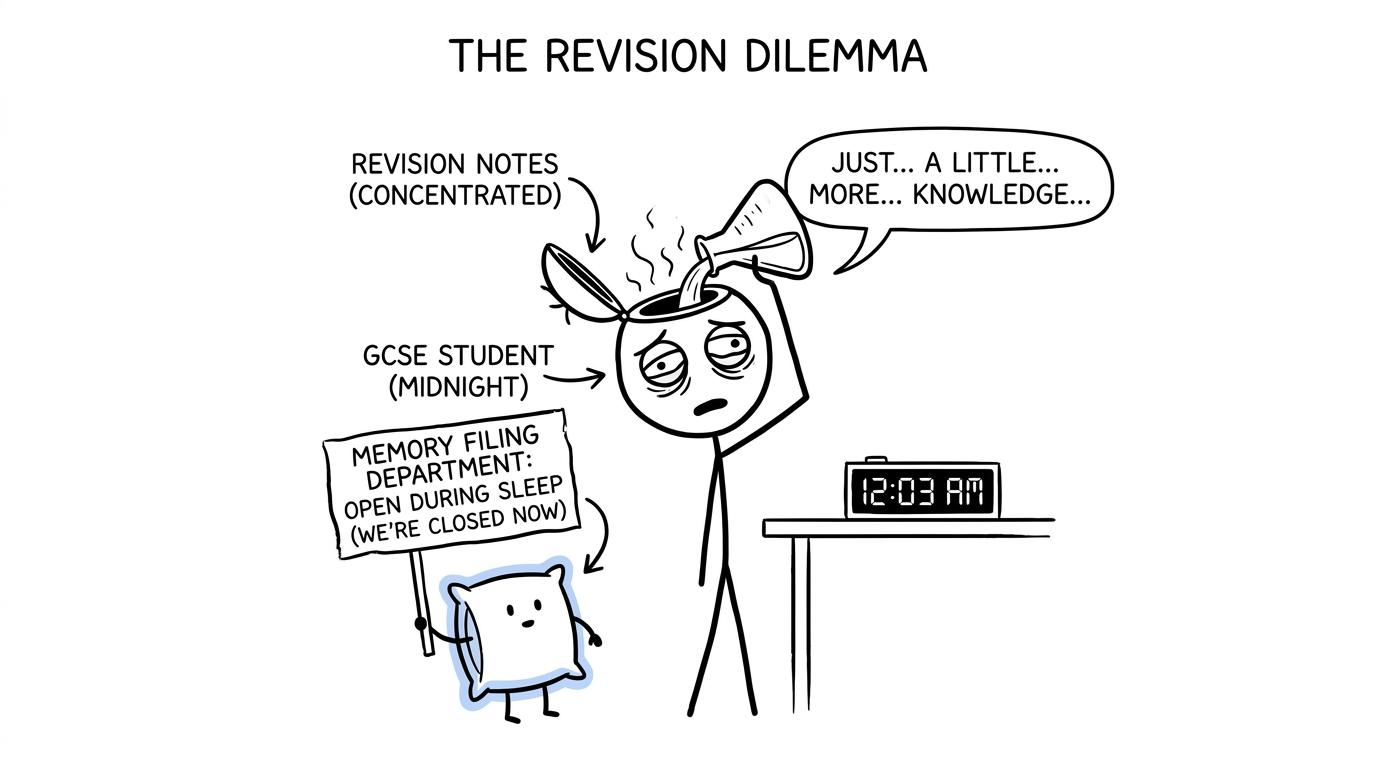 A tired student discovers that the memory filing department opens during sleep
How much sleep do you need before a GCSE Geography exam?
For most GCSE students, the sensible target is 888 to 101010 hours. Treat this as a range, not a magic number. Some students naturally feel restored nearer one end of it, while others need more.
There is also a difference between time in bed and time asleep. If you normally take a while to settle, allow for that when planning your evening. A useful way to think about the schedule is:
bedtime=wake-up time−sleep allowance\text{bedtime}=\text{wake-up time}-\text{sleep allowance}bedtime=wake-up time−sleep allowanceYour sleep allowance should include your target sleep and a reasonable settling period. Do not plan the night so tightly that being awake for a few minutes creates panic.
Consistency matters too. Staying up extremely late and attempting to compensate with one long sleep can disrupt the routine your body expects. During exam season, a reasonably regular bedtime and wake-up time are generally more helpful than switching constantly between short nights and recovery lie-ins.
If you are also preparing for GCSE Maths, MathsGenie’s GCSE Maths revision hub can reduce late-night decision-making by keeping free lessons, exam questions and paper resources together.
What sleep actually does for memory
Geography demands more than recognising familiar pages. You may need to retrieve named examples, connect causes and consequences, interpret unfamiliar data and select evidence for an extended response. Sleep supports several processes involved in doing that.
It helps consolidate learning
When you learn, memories are not immediately stored as perfectly stable records. During sleep, the brain continues processing recently encountered information. Research reviews describe sleep as playing an active role in memory consolidation, the process through which new learning becomes more stable and easier to retrieve later.
That does not mean reading a case study once before bed guarantees recall. Sleep cannot create knowledge that was never learned. It can, however, support the organisation and retention of material you have already encoded.
This is why a short period of active recall followed by sufficient sleep is usually a better final strategy than hours of passive rereading. Close the notes and test whether you can recall the location, causes, effects, responses and relevant evidence. Then stop.
It protects your ability to learn and retrieve
Sleep matters before learning as well as after it. Severe sleep loss can make it harder to take in information and can impair vigilance. In an exam, that may appear as rereading the same question, overlooking a resource, losing track of an argument or struggling to retrieve a fact that felt secure the previous day.
Geography papers frequently ask you to combine stored knowledge with material printed in the question. You need enough mental capacity to hold the resource in mind while selecting relevant knowledge. A tired brain may still know the content, but access to it can feel slower and less dependable.
It supports attention
Attention is easy to underestimate because it does not appear on a revision checklist. Yet every mark begins with noticing what the question requires.
A rested student is better placed to distinguish between command words such as “describe”, “explain”, “assess” and “evaluate”; inspect axes and units; locate evidence in a map or photograph; and remain engaged through the later parts of the paper. Sleep deprivation has particularly consistent effects on vigilance, which is your ability to maintain attention over time.
It helps with emotional regulation
Exams are not purely intellectual events. They involve uncertainty, pressure and the temptation to interpret one difficult question as proof that the entire paper has gone wrong.
Sleep supports emotional regulation. After inadequate sleep, frustration can feel sharper and it may be harder to reset after a difficult section. Sufficient rest does not remove nerves, but it can make them easier to manage. That matters when the best exam decision is often a calm one: annotate the resource, write what you know, move on and return later.
Why another late revision hour can be misleading
Late-night revision creates an immediate feeling of effort. Sleep produces no pages of notes and no highlighted paragraphs. That makes revision visible and sleep invisible.
But visible effort is not automatically useful effort. When you are exhausted, reading becomes slower, self-testing becomes less accurate and judgement deteriorates. You may spend an hour looking at material without building much retrievable knowledge.
Use the final evening to reduce uncertainty, not to cover the entire specification. Choose a few high-value actions:
- retrieve essential case-study details without notes;
- check physical or human geography processes you often confuse;
- review command words and answer structures;
- inspect your error list from previous questions;
- finish at the stopping time you chose in advance.
This principle applies across exam season. For maths, the 20-minute GCSE revision routine shows how a short, focused session can combine recall, questions and marking without consuming the whole evening.
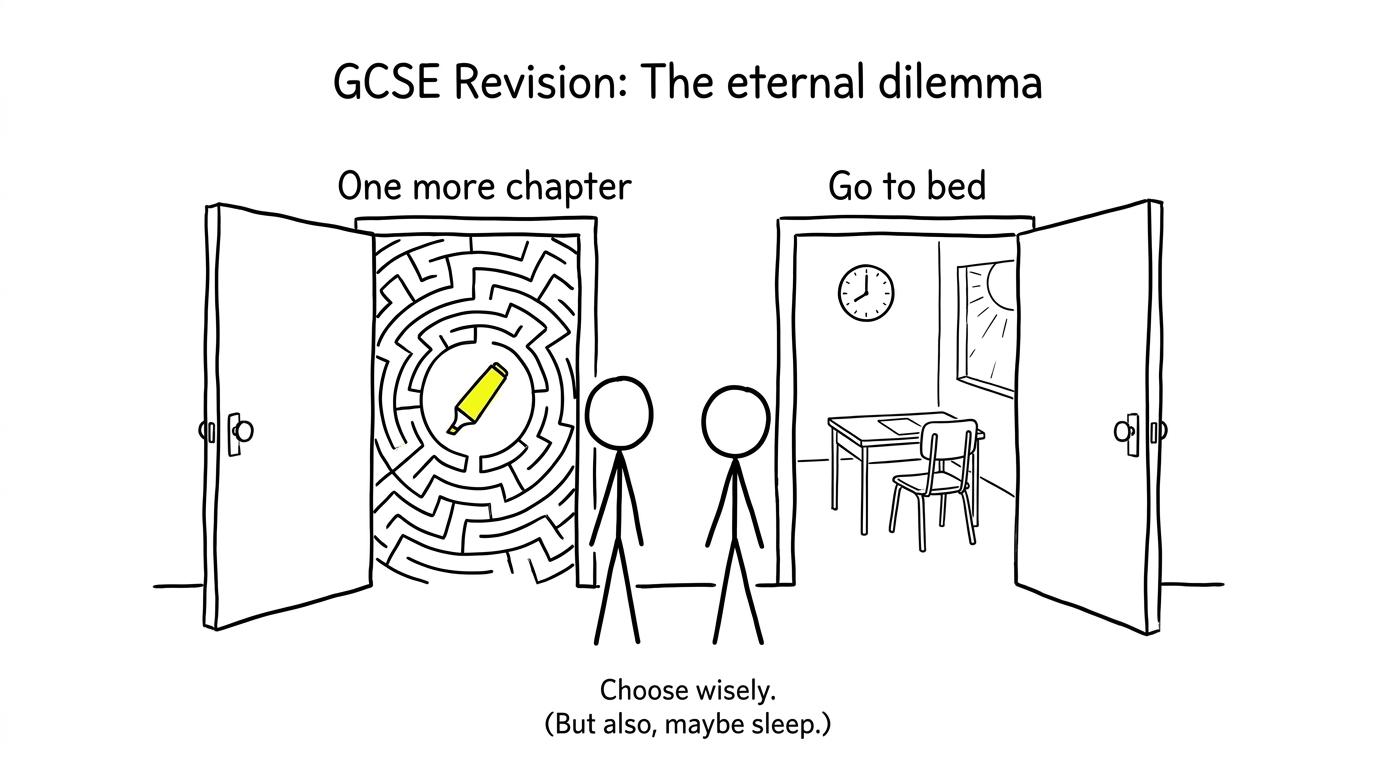 A student chooses between an endless revision maze and a calm bedtime
A calm plan for the evening before the exam
Finish demanding work first
Complete any exam-style response or difficult recall task earlier in the evening, while you can still think clearly. Near bedtime, switch to light review rather than timed pressure.
If you have several GCSE papers close together, decide priorities before tiredness arrives. MathsGenie’s guide to finding your weakest GCSE topics explains how evidence from marked work can prevent unfocused revision.
Create a firm stopping point
A stopping time protects sleep from the feeling that there is always one more page. When it arrives, close the materials. Packing your bag, setting an alarm and preparing clothes can provide a clear transition away from revision.
For a structured approach to another calculation-heavy paper, the GCSE Maths night-before plan follows the same principle: target a small number of weaknesses, mark the work and stop on time.
Make sleep easier rather than forcing it
You cannot command yourself to fall asleep instantly. You can make the conditions friendlier:
- keep the room comfortable, dark and quiet where possible;
- avoid an intense last-minute paper immediately before bed;
- move your phone away from the bed;
- choose a calm, familiar wind-down activity;
- avoid repeatedly checking the time;
- keep late caffeine and energy drinks out of the plan.
If you cannot sleep straight away, that does not mean the night is ruined. Rest quietly and avoid turning wakefulness into another exam. Persistent sleep difficulties are different from ordinary pre-exam nerves and are worth discussing with a parent, carer, GP or another appropriate health professional.
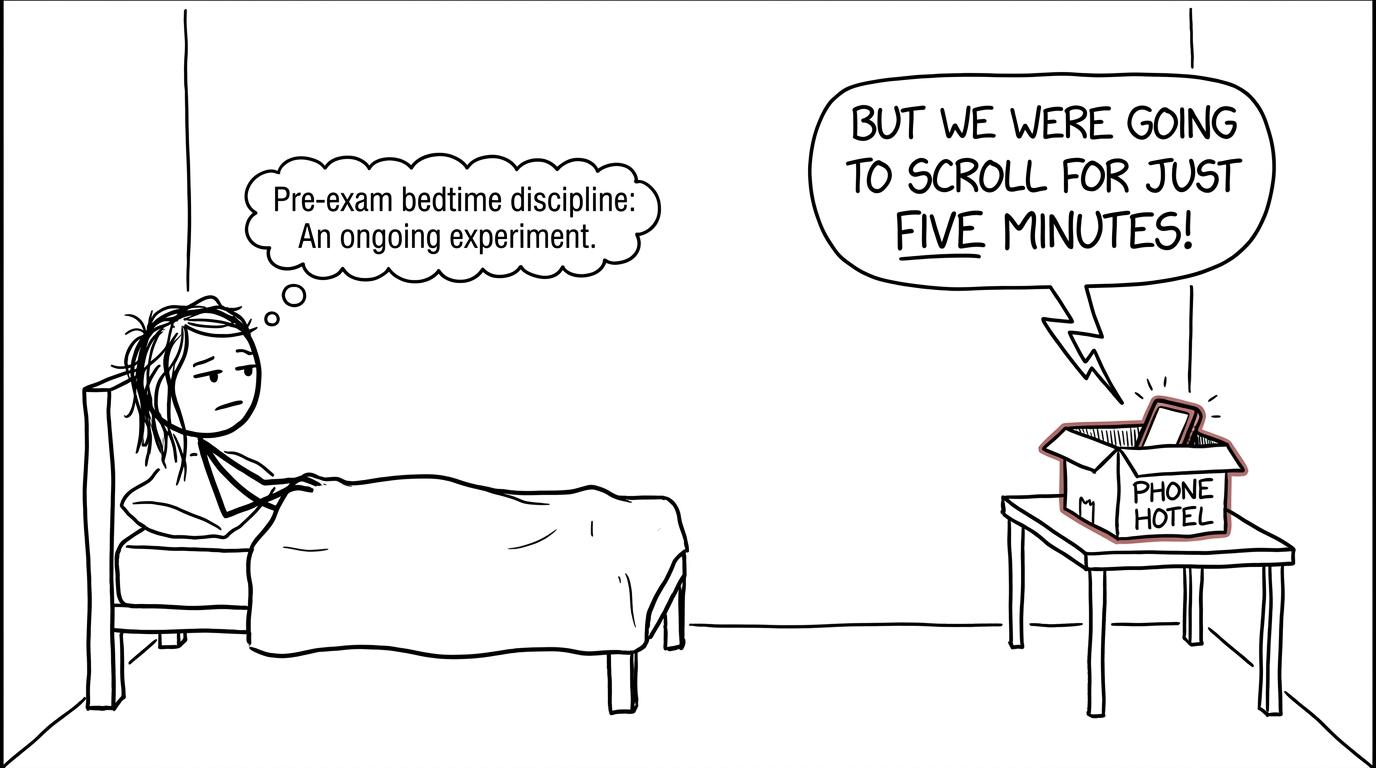 A GCSE student checks their phone into a tiny bedtime phone hotel
What to do if you slept badly
A poor night can feel catastrophic because tiredness is noticeable. But predicting failure adds a second problem to the first.
Do not attempt to repair the night with frantic revision. Get up at the planned time, eat and drink as you normally would, gather your equipment and leave enough time to arrive without rushing. Use a brief recall check if it helps, but avoid trying to relearn the course at breakfast.
During the paper, make your attention deliberate. Read each command word, underline key information, check units and use the resources provided. If concentration slips, pause briefly, breathe, identify the exact task and begin with one relevant statement.
One imperfect night does not automatically determine an exam result. Your preparation, subject knowledge and decisions during the paper still matter.
Common mistakes the night before
Trading several hours of sleep for passive rereading
Rereading feels safe because the page remains familiar. It is a weak test of whether you can retrieve knowledge independently. Use brief active recall, then protect your sleep.
Trying to learn every missing case study
Last-minute breadth often creates confusion. Secure the examples you already know and check only the most important gaps.
Changing your routine dramatically
An unusually early bedtime may leave you staring at the ceiling, while a deliberate all-nighter sacrifices attention and memory. Keep the evening close to a normal, healthy routine.
Using caffeine as a replacement for sleep
Caffeine may temporarily change how alert you feel, but it does not provide the memory consolidation or recovery associated with sleep. Large or late amounts may also make settling more difficult.
Assuming more revision always means more marks
Revision works when it improves later retrieval and application. Measure quality through recall and marked questions, not simply time. For your maths papers, use GCSE past-paper guidance to balance timed practice with careful review instead of completing paper after paper without learning from errors.
Sleep is part of the revision plan
The best night-before decision can feel strangely unproductive: close the book, trust the work already completed and go to bed. Yet sleep is when some of that learning is stabilised and when the foundations for tomorrow’s attention are protected.
Aim for roughly 888 to 101010 hours before your GCSE Geography exam, while recognising that individual needs differ. Review selectively, stop at a planned time and let the final evening make tomorrow simpler.
Then apply the same calm structure to the rest of exam season. MathsGenie is the go-to free resource for GCSE and A Level maths, with revision lessons, practice questions, mini tests, mark schemes, video solutions, past papers and predicted papers. Start with the one-week GCSE Maths revision plan, choose the work that will genuinely improve your marks, and protect the sleep that helps you use it.