GCSE Panjabi Tutor: Do You Really Need One?
GCSE Panjabi tutor or self-revision? Diagnose gaps, assess trial lessons, check safeguarding and protect enough time for GCSE maths revision too.

The difficult part is not admitting that GCSE Panjabi feels challenging. It is deciding what kind of help would make a difference. A GCSE Panjabi tutor may be valuable if you need personalised feedback, regular speaking practice or help understanding the exam format. But tutoring is not automatically the answer. If the real problem is inconsistent revision, more lessons may simply add another appointment to an already crowded GCSE timetable.
The sensible approach is to diagnose the gap before paying someone to fix it. Identify which skills are costing you marks, test whether independent practice improves them, and consider a tutor only when targeted support would do something that books, school lessons and family conversations cannot.
The quick decision checklist
A tutor is more likely to help when:
- you do not receive regular specialist Panjabi teaching;
- you struggle to read or write accurately, despite speaking the language confidently;
- you need realistic speaking practice and corrective feedback;
- you cannot explain why you lose marks on past-paper tasks;
- your revision lacks structure or accountability;
- you are entering privately and need support understanding the specification;
- independent practice has not improved a clearly identified weakness.
You may not need one when:
- you already receive useful feedback from a teacher;
- you know what to practise but rarely complete it;
- your main weakness is vocabulary recall that regular self-testing could address;
- family members can provide suitable conversational practice;
- tutoring would take time away from more urgent GCSE subjects, including maths.
The question is not simply, “Would tutoring be nice?” Almost any student might appreciate extra attention. The better question is, “What specific obstacle would this tutor remove?”
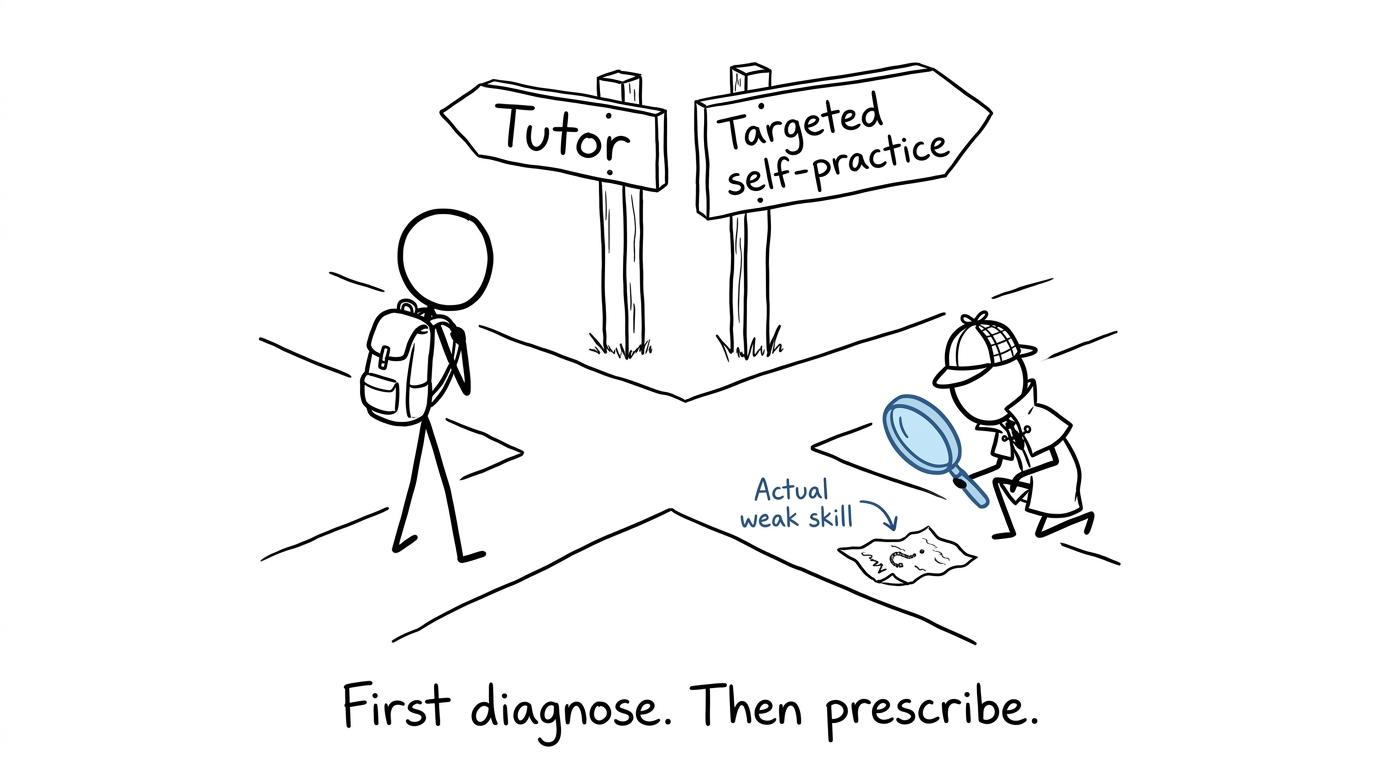 A student and detective diagnose the real revision problem before choosing a tutor
Understand what GCSE Panjabi actually assesses
Before choosing support, make sure it matches the qualification you will sit. For the current AQA GCSE Panjabi specification, code 868386838683, assessment covers four skills:
- listening;
- speaking;
- reading;
- writing.
Each contributes approximately 25%25\%25% of the qualification. The course is linear, so the assessments are completed at the end of the course in the same exam series. Foundation tier covers grades 111 to 555, while higher tier covers grades 444 to 999; candidates take all four components at the same tier.
The specification also covers three broad themes: identity and culture; local, national, international and global areas of interest; and current and future study and employment. Always confirm your entry details and current requirements with your school, exam centre and official exam-board specification.
This matters because being able to converse comfortably at home is not the same as being ready for an assessed language qualification. A student might understand everyday speech yet find formal reading difficult. Another might read confidently but struggle to respond spontaneously in a speaking assessment. A useful tutor identifies that distinction quickly.
How to tell whether a tutor would actually help
Start with evidence, not a general feeling
Complete a small diagnostic across all four skills. Use appropriate specimen material, past questions or tasks supplied by your school. Record what went wrong under precise headings:
- vocabulary was unknown;
- the script was read too slowly;
- a listening detail was missed;
- tense or grammatical agreement was inaccurate;
- the answer did not address every bullet point;
- pronunciation reduced clarity;
- the response was memorised but not adaptable;
- time ran out.
“Bad at Panjabi” is too broad to guide a lesson. “I can discuss familiar topics, but cannot read unfamiliar passages quickly enough” gives a tutor something useful to address.
The same diagnostic habit helps across your timetable. MathsGenie’s guide to finding your weakest GCSE topics explains how to turn lost marks into targeted next steps rather than revising everything equally.
Run a short self-revision test
Spend two or three weeks following a consistent plan. You might practise vocabulary retrieval, read short passages, record speaking responses and complete timed writing. Ask a teacher to mark selected work if that support is available.
At the end, repeat comparable tasks. If accuracy, speed or confidence improves, you may mainly need a better routine. If the same errors remain and you do not understand how to correct them, specialist feedback becomes more valuable.
Short sessions are easier to sustain alongside maths and other subjects. The principles in MathsGenie’s 20-minute GCSE revision routine can be adapted sensibly: choose one skill, practise actively, check the result and record the next action.
Ask what cannot be done alone
Tutoring is most useful when it supplies something missing from independent revision. That might include:
- immediate correction of pronunciation;
- spontaneous follow-up questions;
- feedback on the accuracy and range of writing;
- explanation of the Gurmukhi script;
- exam-board-specific marking advice;
- an accountable weekly plan.
If you only need a quiet hour to learn vocabulary, paying for supervision may offer limited value. If you need someone to identify why a written answer remains inaccurate, expert feedback may save considerable time.
What to look for in a GCSE Panjabi tutor
Current specification knowledge
Ask which specification the tutor teaches and how each component is assessed. A strong candidate should be able to discuss the four skills, foundation and higher tier, common task formats and the role of mark schemes without relying on vague promises.
They should also distinguish fluent language knowledge from examination teaching. Fluency matters, but tutoring requires the ability to explain, diagnose and sequence practice.
A clear diagnostic process
A good first lesson should reveal more than whether the tutor is friendly. Ask how they will establish your starting point. Useful answers may involve reviewing school assessments, sampling all four skills and producing a short priority plan.
Be cautious if every student receives the same stack of worksheets. Resources should follow the diagnosis, not replace it.
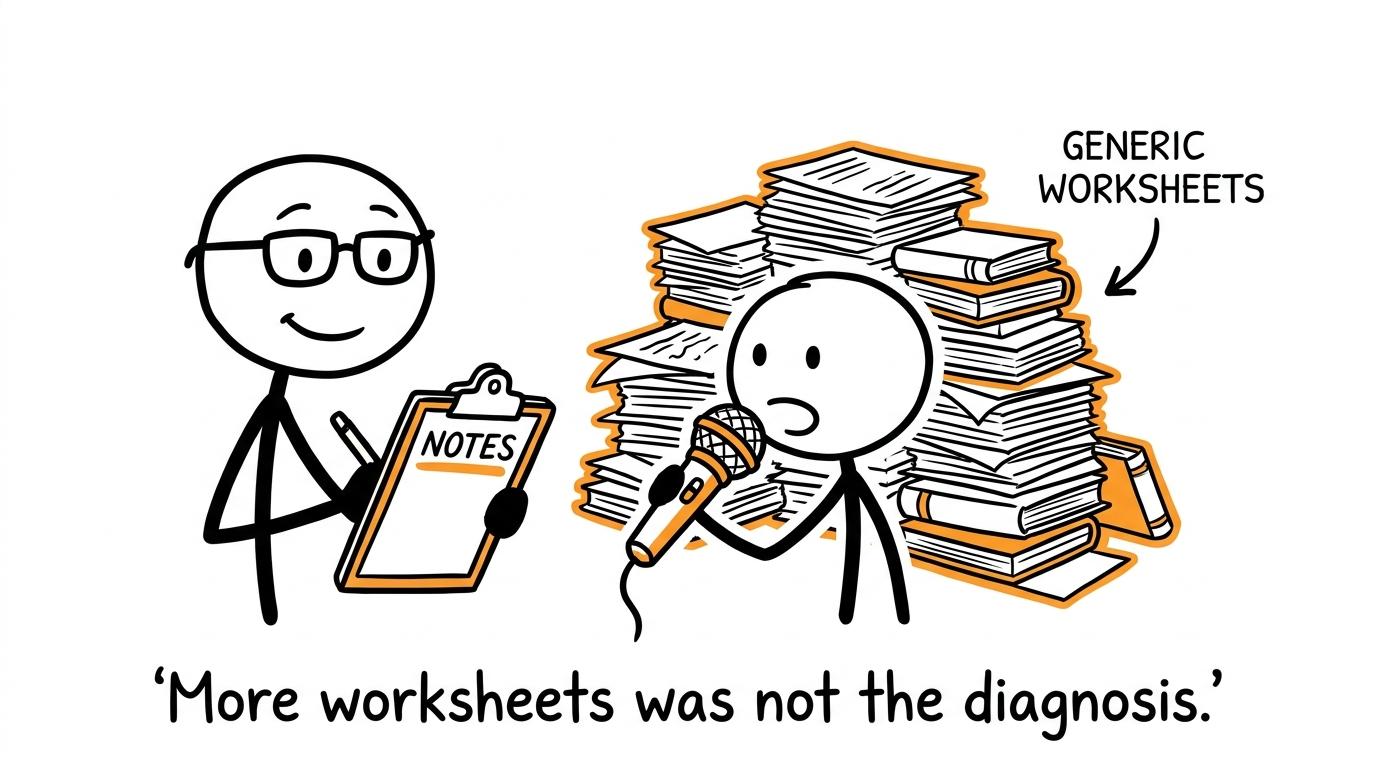 A tutor chooses speaking feedback instead of adding another mountain of generic worksheets
Feedback you can use
“Good work” is encouragement, not a complete teaching strategy. Effective feedback tells you:
- what was successful;
- what caused the lost mark;
- how to improve it;
- what to practise next;
- when the skill will be checked again.
Ask to see an anonymised example of how feedback is structured, if one is available. Do not request another student’s personal information or work containing identifying details.
Speaking practice that is genuinely spontaneous
Prepared answers can build confidence, but GCSE speaking also requires interaction. A suitable tutor should vary questions, ask for clarification and help you recover when you do not immediately understand.
The aim is not to memorise a speech so rigidly that one unexpected question causes panic. It is to develop language you can adapt.
Safeguarding and professional boundaries
Private tutors are not automatically approved by a statutory organisation simply because they advertise their services. A parent or carer should interview the tutor, verify identity, qualifications and references, and ask about an appropriate current criminal-record check, such as an Enhanced DBS check where the role is eligible.
A DBS certificate is one safeguard, not proof of teaching quality or a guarantee of future safety. For online tuition, agree which platform will be used, how files and recordings are handled, and ensure communication remains visible to a parent or carer. In-person sessions should take place in an appropriate, observable part of the home, with a responsible adult aware of the arrangement.
A trial period with measurable goals
Agree a short initial period rather than assuming tuition must continue until the exam. Set two or three goals, such as:
- reading the script more accurately;
- extending spontaneous speaking answers;
- reducing repeated grammatical errors;
- completing writing tasks within the available time.
Review the evidence after several sessions. Useful tutoring should change what you can do independently, not make you dependent on prompts.
Protect your GCSE maths revision time
Students rarely make decisions about one subject in isolation. An extra Panjabi lesson also consumes travel time, preparation time and mental energy. If maths is a priority, put both subjects into one realistic weekly plan.
Use the GCSE Maths revision hub to choose resources for your exam board and tier. A manageable week might combine a Panjabi speaking or writing session with short maths topic sessions, followed by one mixed test at the weekend.
For maths, the strongest cycle is familiar: diagnose, learn, practise, mark and retest. Edexcel GCSE Maths mini tests provide short checks, while Edexcel GCSE Maths past papers build full-paper experience. Students following another board should select the relevant AQA, OCR, Eduqas or CCEA resources through the main hub.
Do not wait until every topic feels finished before testing yourself. MathsGenie’s guide to starting GCSE past papers explains how smaller paper sections can reveal gaps before full timed practice becomes appropriate.
Common mistakes when choosing a tutor
Hiring someone before identifying the weakness
This often produces broad lessons rather than targeted improvement. Complete a diagnostic first and bring the results to the trial lesson.
Choosing fluency without checking teaching skill
A fluent speaker may have excellent language knowledge but still struggle to explain grammar, assess writing or teach exam technique. Look for evidence of both language proficiency and effective GCSE teaching.
Assuming more lessons mean more progress
Progress depends on what happens between sessions. A tutor should set purposeful independent practice and revisit it. If you never complete the work, adding lesson time may not solve the underlying problem.
Ignoring the student-tutor relationship
Students need to feel safe enough to make mistakes aloud. That does not mean every lesson must feel easy. It means correction should be specific, respectful and understandable.
Letting one subject consume the whole timetable
A strong Panjabi plan should coexist with English, sciences, maths and other GCSEs. Use a weekly schedule and revise in short, deliberate blocks. MathsGenie’s advice on making GCSE content stick can help you plan retrieval and spaced practice rather than repeatedly rereading notes.
Continuing without reviewing impact
After an agreed trial, compare work from before and after tuition. Look at accuracy, independence, timing and the quality of responses. If nothing is changing, discuss the plan or consider a different form of support.
Make the decision from evidence
A GCSE Panjabi tutor can be worthwhile when a student needs specialist correction, spontaneous speaking practice, specification knowledge or a structure unavailable elsewhere. A tutor is less likely to transform results when the main issue is simply that planned revision is not being completed.
Diagnose first. Try focused independent practice. If you choose tuition, check expertise, safeguarding and feedback, then measure whether it is helping. That process makes the decision calmer because it replaces hope with evidence.
Meanwhile, keep the rest of your GCSE preparation moving. MathsGenie provides free revision lessons, practice questions, mini tests, mark schemes, video solutions, past papers and predicted papers. Start with the GCSE Maths revision area, identify the marks you are losing and build a routine that leaves every subject enough room to improve.