

Should You Drop GCSE Polish Mid-Year?
Drop GCSE Polish only after checking evidence, exam entries and consequences. See what withdrawal affects and how to protect your GCSE maths revision plan.

The thought often arrives during a crowded week: Polish homework is unfinished, a maths mock is approaching, and every subject seems to want the same hour. If you are wondering whether to drop GCSE Polish, the short answer is this: do not decide from one difficult result or one stressful week. First check your performance across all four language skills, speak to your school and establish exactly what would happen to your exam entry.
Dropping may be sensible when sustained evidence shows that the subject is taking disproportionate time from essential qualifications and there is no realistic support plan. But speaking Polish at home does not automatically make the GCSE easy, and finding formal writing difficult does not automatically mean you are out of your depth.
The decision checklist
Before asking to withdraw, answer these questions honestly:
- Have you completed recent listening, speaking, reading and writing assessments?
- Are the results consistently weak, or was one component responsible for most lost marks?
- Are you entered for foundation or higher tier, and could a tier change be considered?
- Have you shown your teacher timed work rather than relying on predicted grades alone?
- What support is available for Polish between now and the assessments?
- How many hours does Polish genuinely consume each week?
- What would you do with that time if you withdrew?
- Would dropping affect your language entry for the English Baccalaureate, your sixth-form plans or a school requirement?
- Has your exams officer explained the withdrawal process and any relevant deadline?
The final question matters. Students cannot normally remove themselves from an exam entry. Your school or examination centre manages entries, tier changes and withdrawals, and internal deadlines may be earlier than awarding-body deadlines.
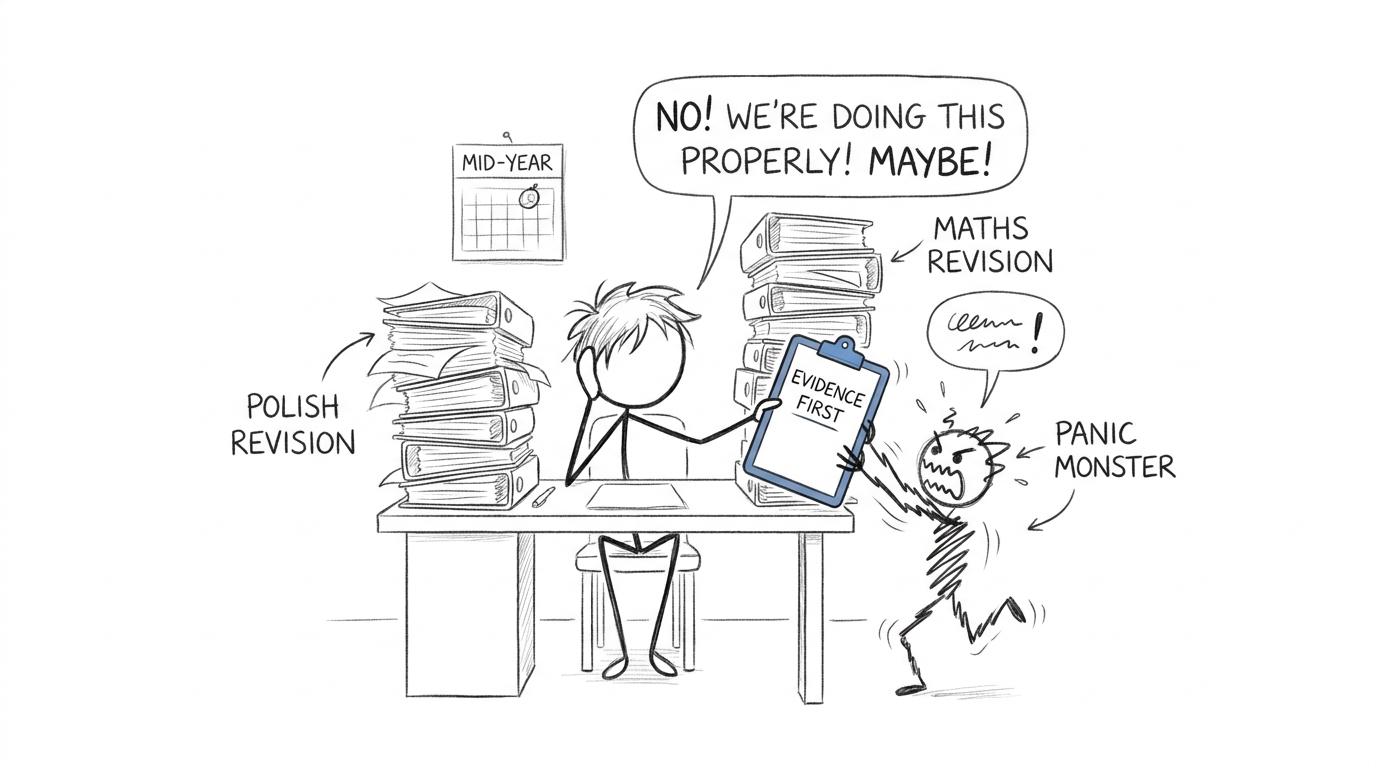 A student choosing evidence over panic while revision piles wobble
What GCSE Polish actually assesses
The current AQA GCSE Polish qualification is linear, so all assessments are completed at the end of the course in the same exam series. It has four components:
- listening
- speaking
- reading
- writing
Each contributes 25%25\%25% of the qualification. Students take every component at the same tier. Foundation tier normally covers grades 111 to 555, while higher tier normally covers grades 444 to 999.
This structure explains why informal fluency can be misleading. You might speak comfortably with relatives but struggle to translate accurately, understand unfamiliar recordings or produce extended formal writing. Conversely, one poor speaking task does not prove that the whole qualification is beyond reach when the other three components are secure.
Your diagnosis therefore needs to be skill-specific. Replace “I am bad at Polish” with something testable: “I understand most reading passages, but my writing loses marks for accuracy and incomplete bullet points.” A precise problem may have a practical solution. A vague judgement usually produces only more anxiety.
How to tell if you are genuinely in over your head
Feeling stretched is normal during a GCSE course. Being in over your head is different: the gap remains large after appropriate teaching, regular practice and honest feedback.
Look for a sustained pattern
Use several recent assessments completed under realistic conditions. Teacher-marked work is more useful than comparing yourself with friends or guessing a grade from how difficult a paper felt.
| Evidence | What it may suggest |
|---|---|
| One unexpectedly low mark | A bad day, unfamiliar task or isolated knowledge gap |
| Weakness concentrated in one skill | A targeted revision problem rather than a reason to withdraw |
| Low marks across all four skills over time | A broader gap requiring an urgent teacher discussion |
| Better untimed work but weak timed work | Exam technique, recall or timing may be the main issue |
| Little improvement despite regular support | The course may no longer be a realistic use of limited time |
Do not use an unofficial grade boundary from a different year as a verdict. Boundaries can vary by exam series, and teachers are better placed to interpret raw marks against current assessment evidence.
Separate difficulty from lack of preparation
A subject can feel impossible because you have not yet followed a consistent routine. Before withdrawing, consider a short evidence-gathering period agreed with your teacher. During it, complete representative tasks from all four components, attend available support and record how long the work actually takes.
If performance improves with structured practice, the issue may have been organisation. If the evidence remains weak despite suitable help, you have a firmer basis for a conversation about withdrawal.
Measure the real opportunity cost
The important question is not simply whether Polish is hard. It is what continuing prevents you from doing elsewhere.
Suppose Polish takes several evenings but those hours consist mostly of worried rereading rather than focused practice. The answer may be to change the method, not the subject. If Polish requires sustained additional preparation that is damaging attendance, sleep or work in essential GCSEs, the trade-off becomes more serious.
For maths, establish the need with evidence. Start at the GCSE maths revision hub, choose your exam board and tier, and complete a short diagnostic task. If your maths gaps are substantial, build a realistic schedule using the GCSE maths revision timetable. That tells you whether more time would have a defined purpose rather than merely becoming empty space.
What dropping GCSE Polish does affect
If your centre withdraws your entry and you do not complete the required assessments, you will not receive that GCSE qualification. It may therefore:
- reduce the number of GCSE qualifications you complete;
- remove Polish as evidence of a modern language qualification;
- affect the language pillar of your EBacc subject combination, unless another eligible language fills it;
- change your timetable or supervised study arrangements;
- affect plans that depend on your particular subject combination;
- create administrative or fee implications for your centre, depending on timing.
The EBacc is a school performance measure rather than a separate certificate awarded to students. Nevertheless, Polish can count as its language component, so ask your school to explain the consequence for your own subject combination rather than relying on assumptions.
You should also check future entry requirements directly with any sixth form or college you are considering. Many courses focus on English, maths and subjects relevant to the chosen programme, but requirements differ. Do not drop a qualification because someone says it “never matters”, or keep it because someone says it “always looks impressive”. Both claims are too broad.
What dropping GCSE Polish does not affect
Withdrawing from Polish does not automatically:
- change your GCSE maths grade, tier or exam board;
- remove results already achieved in other subjects;
- guarantee higher marks elsewhere;
- make your overall workload manageable;
- prove that you are poor at languages;
- prevent you from continuing to use or develop Polish outside school.
Most importantly, free time does not convert itself into marks. It needs a destination.
If maths is the reason for considering withdrawal, decide in advance how the released time would be used. You might follow the best order for learning GCSE maths topics, use Edexcel GCSE maths mini tests for short diagnostic sessions, or begin paper practice at an appropriate stage using the guide to when to start GCSE past papers.
A withdrawal without a replacement plan can leave you with the same stress and one fewer qualification.
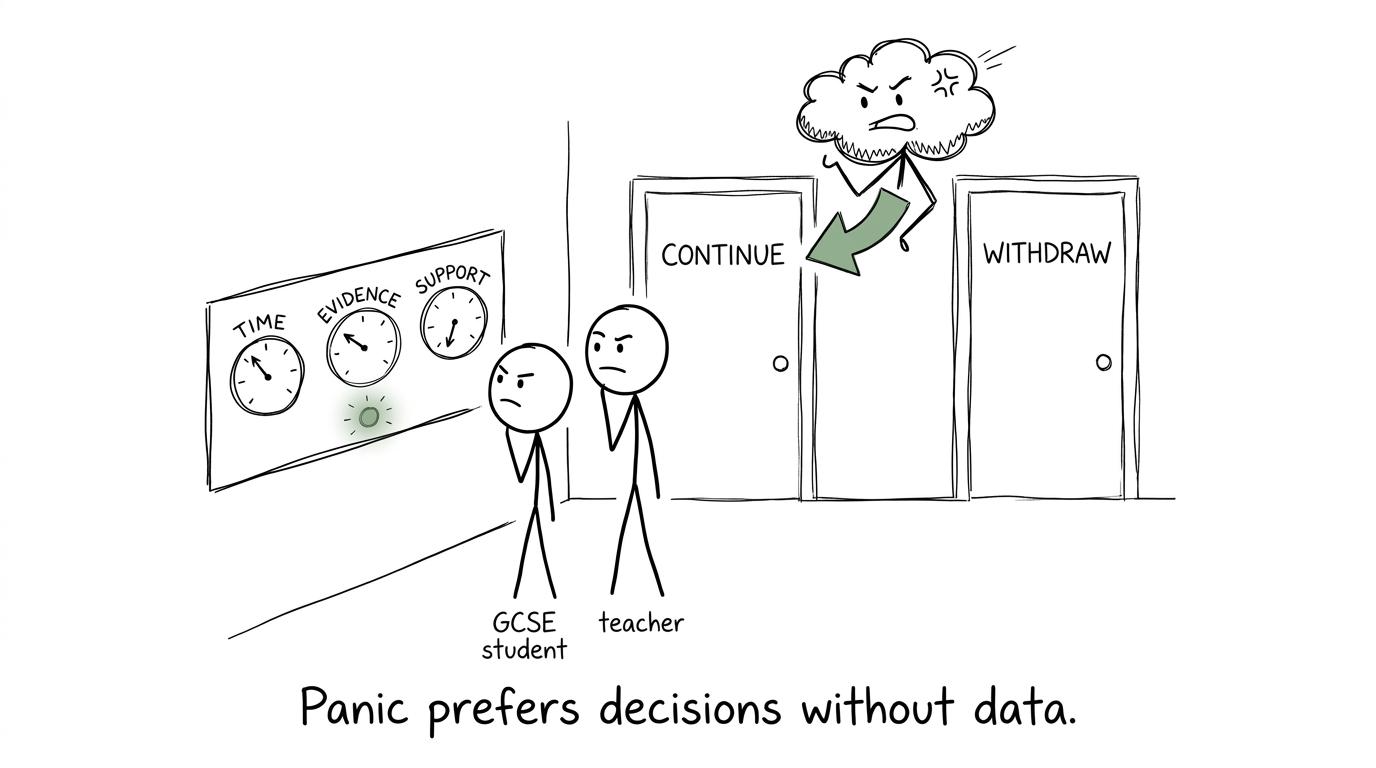 A student and teacher checking evidence before choosing whether to continue
Have the right conversation with your school
Ask for a meeting with your Polish teacher, form tutor or head of year. An exams officer may need to explain the administrative position. A parent or carer can help you ask questions and remember the answers.
Bring useful evidence:
- recent marks for each component;
- teacher feedback;
- your current tier;
- the hours you spend on Polish in a normal week;
- your wider mock results;
- details of any missed teaching or support needs;
- a proposed revision plan for the time you hope to recover.
Ask direct questions. What grade range does the evidence currently support? Is foundation tier appropriate? Which component is limiting the result? What improvement would be realistic before the assessments? What is the centre's withdrawal deadline? What would replace the lesson time?
This changes the discussion from “I cannot cope” to “Here is the evidence; what are my realistic options?”
Build a plan whether you stay or withdraw
If you continue, narrow the problem. Give each Polish component a separate status, prioritise the weakest high-impact area and agree regular feedback with your teacher. Avoid spending every session on the skill you already enjoy.
If you withdraw, assign the recovered time before it disappears. A sensible maths cycle is:
- identify one weak topic;
- use a revision lesson to rebuild the method;
- complete practice questions;
- check the mark scheme or video solution;
- record the precise error;
- retest the topic later;
- move gradually into timed papers.
MathsGenie's guide to self-studying GCSE maths explains how to make independent work structured. Nearer the exams, use Edexcel GCSE maths predicted papers alongside past papers, not instead of full specification revision.
Common mistakes when deciding whether to drop
Deciding after one mock
One assessment is evidence, not a complete trend. Look across time and across all four components.
Assuming home fluency guarantees an easy grade
Everyday conversation and examination writing are different skills. Translation, spelling, grammatical accuracy and formal responses still require preparation.
Comparing subjects only by current grades
A lower grade in Polish does not automatically make it the wrong subject to continue. Consider likely improvement, required revision time, qualification value and the effect on essential subjects.
Believing withdrawal will automatically fix maths
Maths improves through focused practice and feedback, not through spare time alone. Create the replacement timetable first.
Ignoring entry arrangements
Do not simply stop attending or assume the entry has disappeared. Obtain confirmation from the school about your status, tier and remaining responsibilities.
Making the decision alone
Your teacher has assessment evidence; the exams officer understands entries; your family understands the wider pressure. A strong decision uses all three perspectives.
Make an evidence-led decision
Whether you should drop GCSE Polish mid-year depends on more than whether the subject feels hard. Check all four skills, establish your realistic grade range, investigate support and tier options, measure the genuine impact on maths and other subjects, and ask your school exactly what withdrawal changes.
Then make the time accountable. MathsGenie gives you free revision lessons, practice questions, mini tests, past papers, predicted papers, mark schemes and video solutions for GCSE maths across boards including Edexcel, AQA, OCR and Eduqas. Start with the GCSE maths revision hub, diagnose the marks you are losing and give every recovered revision hour a clear job.
The aim is not to keep every subject at any cost. Nor is it to remove the first subject that becomes uncomfortable. It is to make a calm decision that protects both your qualifications and your capacity to prepare well.











