Should I Take GCSE Sociology? Honest Questions
Should I take GCSE Sociology? Ask honest questions about its topics, essays, research methods and workload before choosing your GCSE options.
Choosing a GCSE option can feel strangely permanent. A subject name sits in one box on a form, yet the decision shapes lessons, homework and revision for the next two years. It is reasonable to wonder: should I take GCSE Sociology, or will I regret seeing it on the timetable every week?
The short answer is that Sociology may suit you if you are curious about how society works, comfortable explaining competing viewpoints and willing to learn evidence for extended written answers. It may be less suitable if you strongly dislike reading, structured writing or evaluating ideas. Do not choose it simply because a friend has, because it sounds easy or because you have ruled out everything else.
The best decision comes from asking better questions before the timetable is fixed.
A quick GCSE Sociology checklist
GCSE Sociology may be a sensible choice if you can honestly say yes to most of these statements:
- I am interested in families, education, inequality, crime and wider social issues.
- I like asking why patterns exist rather than only learning what happened.
- I can consider two explanations without needing one immediate correct answer.
- I am prepared to learn sociological concepts, theories, studies and evidence.
- I am willing to develop concise and extended written responses.
- I can manage another content-heavy subject alongside maths, English and science.
- I have checked which exam board and specification my school teaches.
A few uncertain answers do not automatically mean Sociology is wrong for you. They simply show what you need to investigate.
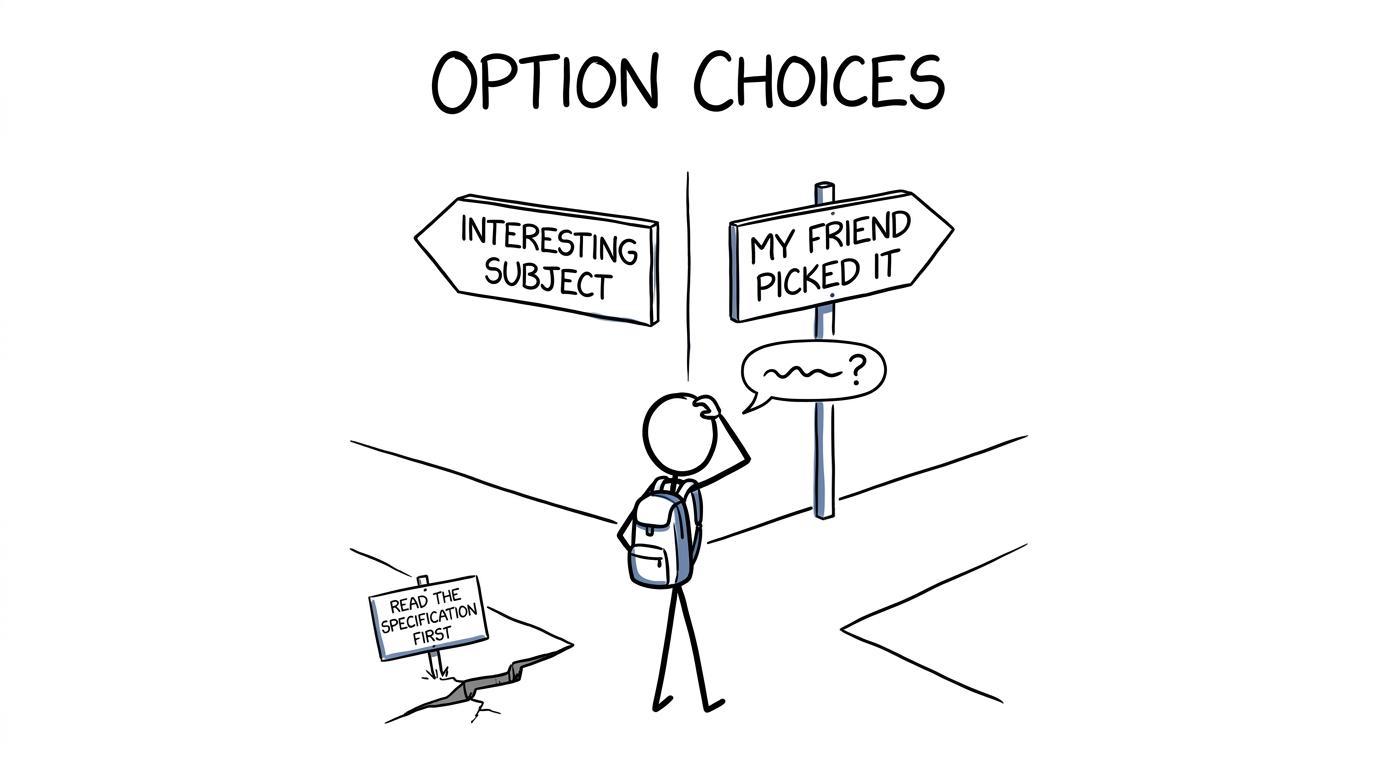 A student choosing between genuine interest and following a friend
Are you interested in questions without simple answers?
Sociology examines social structures, processes and issues. On the current AQA specification, students study areas including families, education, crime and deviance, social stratification, sociological approaches and research methods. Eduqas covers closely related territory, although its organisation and terminology differ.
This means lessons are not simply conversations about current affairs. You may examine how sociologists explain educational achievement, how families have changed or why definitions of deviance can vary. You must learn to use sociological language and evidence rather than relying on personal opinion.
Ask yourself whether the questions themselves interest you. Would you like to explore how schools influence identity? Are you curious about why opportunities may differ between social groups? Can you examine a familiar institution, such as the family, from several theoretical perspectives?
Interest matters because novelty fades. A topic that sounds fascinating on options evening still requires careful notes, retrieval practice and exam preparation months later.
Do you enjoy constructing written arguments?
GCSE Sociology involves short responses and extended writing. For example, the current AQA qualification is assessed through two written papers, each lasting 111 hour 454545 minutes and carrying 50%50\%50% of the qualification. Its questions include multiple-choice items, short responses and extended responses. The current Eduqas course also uses two written components, each worth 50%50\%50%, with short, structured and extended questions.
Your school may teach AQA or Eduqas, so read its exact specification rather than assuming every course is identical.
The important point is not merely that you will write essays. It is that strong answers usually require a chain of reasoning:
- identify a relevant concept or explanation;
- develop it accurately;
- apply it to the question;
- use appropriate evidence;
- analyse or evaluate the argument;
- reach a reasoned judgement when required.
That process has something in common with showing working in maths. A correct conclusion matters, but the route to it must be visible. In Sociology, unsupported assertions rarely do the same job as developed sociological reasoning.
If you dislike writing now, ask a more useful question: do you dislike all writing, or do you simply lack confidence? Confidence can improve. A complete refusal to practise extended answers is a more serious warning sign.
Can you separate evidence from opinion?
Sociology deals with subjects on which almost everyone has a personal view. That creates both its appeal and its difficulty.
You might have strong opinions about school rules, crime, family life or inequality. In an examination, however, personal certainty is not enough. You need to understand sociological theories, concepts, evidence and methods. You must then apply, analyse and evaluate them according to the question.
This is where Sociology can sharpen habits that also help in maths. In both subjects, you need to read the wording precisely, select relevant information and avoid claiming more than the evidence supports. The form of the answer changes, but disciplined thinking remains valuable.
For students who enjoy this evidence-led side of the course, GCSE Statistics revision can strengthen related confidence with sampling, data presentation and interpretation. Sociology is not a calculation-heavy version of statistics, but research methods do require you to think carefully about how evidence is collected and what conclusions it can support.
 A curious student discovers that evidence comes with paperwork
Are research methods genuinely interesting to you?
Research methods are central rather than decorative. Current specifications include ideas such as qualitative and quantitative data, primary and secondary sources, sampling, questionnaires, interviews, observations, practical issues and ethical considerations. The precise coverage depends on the board.
You might be asked to consider whether a method produces valid evidence, whether participants are representative or whether a study faces ethical and practical limitations. This is less about performing pages of arithmetic and more about judging the quality of an investigation.
Your maths experience can still help. Work on averages, charts, sampling and misleading representations teaches a useful principle: data do not interpret themselves. A large sample is not automatically representative, and a graph can look persuasive while hiding important context.
If this connection appeals to you, explore the MathsGenie GCSE maths revision hub, where statistics topics sit alongside revision lessons, practice questions and exam resources for Edexcel, AQA, OCR and Eduqas maths.
Will Sociology fit your whole subject workload?
A GCSE choice should not be judged in isolation. The better question is whether it fits the combination of subjects you will actually take.
Sociology can involve substantial factual recall and repeated written practice. If several of your other options also demand extensive reading and extended answers, consider whether you enjoy that balance. Equally, choosing one essay-based subject alongside more numerical or practical subjects may give you welcome variety.
Look at a typical week rather than an ideal one. Where will homework fit around maths practice, science content and English preparation? When mock examinations approach, will you have time to retrieve Sociology knowledge and practise timed answers rather than merely rereading a textbook?
A workable plan need not be elaborate. The principles in the GCSE maths revision timetable guide transfer well: choose realistic sessions, revisit material and reserve time for feedback. The one-month GCSE revision plan also shows why diagnosing gaps is more productive than revising comfortable material repeatedly.
 A student balancing essay practice and the rest of GCSE revision
Have you investigated your school’s actual course?
The subject title alone cannot tell you what your experience will be. Before choosing, ask your school:
- Which exam board do we follow?
- Which topics will we study?
- How often is the subject taught?
- What do typical homework tasks involve?
- How are extended answers developed and marked?
- Can I see the specification and a recent assessment paper?
- Are there school-specific entry requirements or option-block clashes?
The current AQA and Eduqas specifications share major themes, but their structure and question arrangements are not identical. Your teacher can explain the course that will actually appear on your timetable.
If possible, look at a paper rather than judging the subject from a poster or a single sample lesson. You are not expected to answer it yet. Notice the command words, the balance of short and extended responses, and the amount of knowledge candidates are expected to apply.
This is the same reason maths students benefit from seeing real papers. AQA GCSE maths past papers, for example, reveal how familiar skills are presented under examination conditions. Specifications tell you the destination; papers show you the road.
Are you choosing it for yourself?
Friends matter, but they are poor substitutes for fit. You may not be placed in the same class, your interests may develop differently and one person’s easy subject can be another person’s weekly frustration.
Be cautious about choosing Sociology because somebody says it is an easy GCSE. The course requires accurate knowledge, application, analysis and evaluation. A subject can feel manageable when its style suits you, but that is different from requiring no effort.
Also avoid rejecting it because it is unfamiliar. Many students have not studied Sociology as a separate subject before GCSE. Eduqas explicitly states that its specification has no previous learning requirements. What matters is your willingness to learn the discipline, not arriving with a collection of advanced terminology.
A useful final test is simple: if your friends chose something else, would you still want to learn this course?
What might Sociology add to your wider GCSE skills?
A well-chosen Sociology course can develop careful reading, evidence-based argument, comparison, evaluation and written communication. Research methods can also reinforce awareness of sampling, bias and data quality.
These skills are useful across GCSEs, but Sociology should not be treated merely as a tool for improving another subject. Choose it because you are prepared to engage with Sociology itself.
Your maths revision still needs its own deliberate routine. Use the best order for learning GCSE maths topics to organise foundations before moving towards mixed examination practice. Nearer the exams, GCSE predicted topics guidance can help you use predictions sensibly without mistaking them for guarantees.
Common mistakes when choosing GCSE Sociology
Assuming it is mostly discussion
Class discussion may help you explore ideas, but assessment requires precise knowledge and structured written responses. Check a paper before committing.
Confusing personal opinion with evaluation
Evaluation means examining strengths, limitations, evidence and alternative explanations. A strongly held view is not automatically a sociological argument.
Ignoring research methods
Families, education or crime may attract you first, but research methods are part of the course. Make sure you are willing to learn how sociological evidence is produced and assessed.
Following friends or avoiding a teacher
Class allocations can change. Choose the subject content and assessment style, not an imagined timetable.
Looking only at the final grade
A target grade matters, but so does the work required to reach it. Consider whether you can sustain the reading, recall and writing practice alongside your other GCSEs.
Failing to confirm the exam board
AQA and Eduqas organise their courses differently. Advice based on the wrong specification can create confusion before revision even begins.
Make the decision, then protect your maths revision
So, should you take GCSE Sociology? Choose it if its questions genuinely interest you, you are willing to build evidence-based written arguments and its workload fits your wider timetable. Think again if your decision rests mainly on friends, rumours about an easy grade or the hope that lessons will be informal discussion.
Ask your teacher for the specification. Read the topic list. Inspect an assessment paper. Then make the choice based on what the course actually is.
Whichever option you select, keep maths revision steady rather than waiting for mock season. Start with the free MathsGenie resources hub, then combine revision lessons with practice questions, mini tests, past papers and predicted papers. Mark your work, use mark schemes and video solutions, and turn each lost mark into one clear next step.
A good timetable is rarely the one with the easiest-looking subjects. It is the one built from honest choices and supported by repeatable revision.