Should I Take GCSE English Literature? Honest Advice
Should I take GCSE English Literature? Ask honest questions about workload, exam style, future choices and keeping enough time for focused maths revision too.
The question “should I take GCSE English Literature?” often appears when an options form turns an ordinary school week into a collection of long-term decisions. The honest answer is this: if Literature is genuinely optional at your school, take it if you can tolerate sustained reading, enjoy exploring different interpretations and are willing to practise analytical essays. Do not choose it only because you like stories, achieved a good English Language mark or think it automatically looks impressive.
First, check whether you actually have a choice. Many schools enter students for both English Language and English Literature, while others make decisions according to their timetable, curriculum or individual pathways. Ask your English teacher what applies to you before comparing it with another option.
A quick decision checklist
Before choosing, find out:
- whether English Literature is compulsory at your school;
- which exam board you will follow;
- which novels, plays and poems your class will study;
- how the papers are assessed;
- whether you enjoy analysing language rather than simply following a plot;
- how much reading and quotation revision you can manage each week;
- what subject would replace Literature if you did not take it;
- whether your overall timetable still leaves enough space for maths, science and your other priorities.
This is not a test of whether you are a “literature person”. It is a practical decision about the work you are willing to repeat for roughly two years.
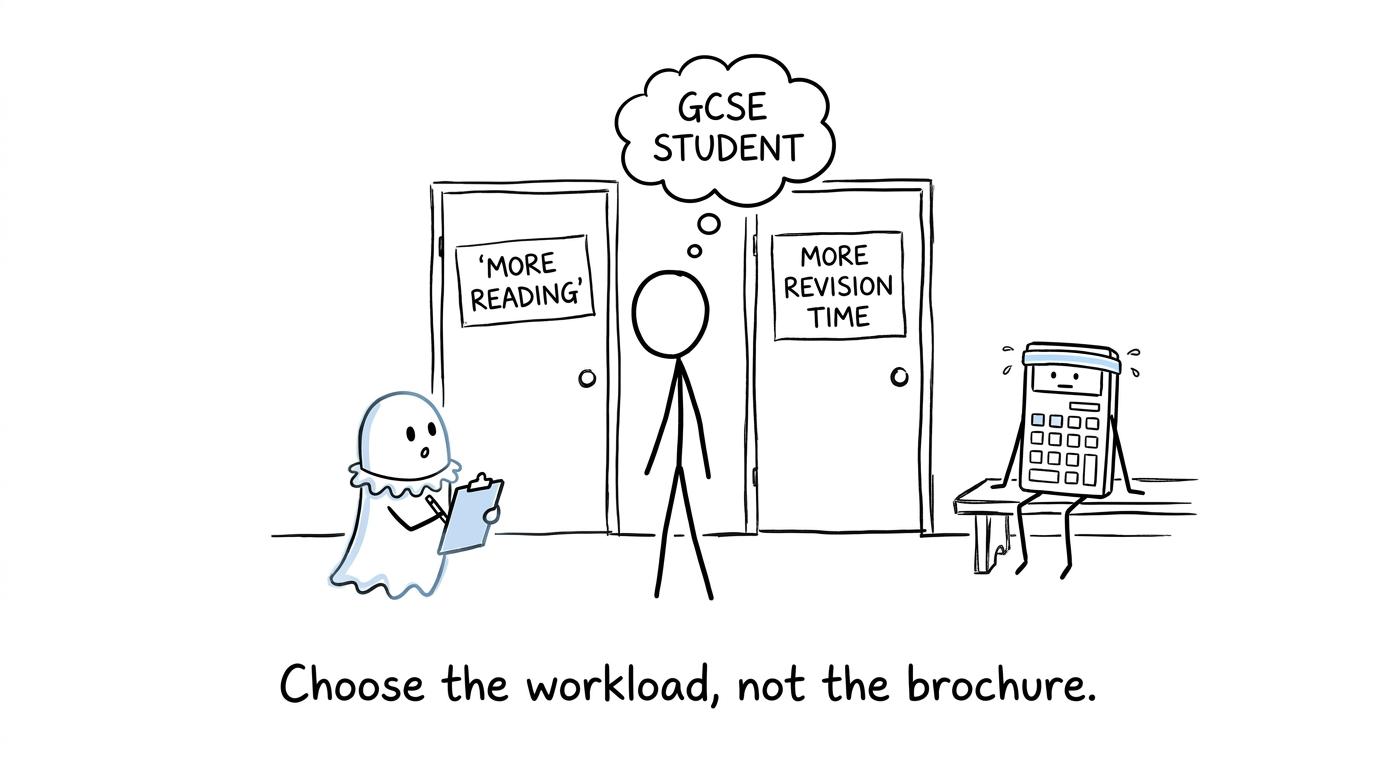 A student choosing between reading and revision while Shakespeare holds a clipboard
Is GCSE English Literature really optional?
That depends on your school and where in the UK you are studying. In England, the English element of the English Baccalaureate, or EBacc, requires entry in both English Language and English Literature. The EBacc is a school performance measure and a combination of subjects, not a separate qualification that students receive.
Schools may therefore expect most students to sit both English GCSEs. However, school policies and individual arrangements differ. Qualifications and curriculum structures also differ across England, Wales and Northern Ireland, so advice from a friend in another school may not apply to you.
Ask your school three precise questions:
- Am I expected to take both English Language and English Literature?
- If Literature is optional, what can I choose instead?
- Would dropping it affect my school pathway or any course I am considering?
Do not make the decision from the title printed on an options booklet. Make it from the timetable you will actually receive.
Do you enjoy analysis, not just reading?
Enjoying novels helps, but GCSE English Literature is not a reading club. You must construct an interpretation, select textual evidence and explain how a writer’s language, form and structure create meaning.
Current GCSE subject content in England includes Shakespeare, a nineteenth-century novel, poetry from 178917891789 onwards and British fiction or drama from 191419141914 onwards. It also includes unseen material. The exact texts and paper structure depend on your exam board and your school’s selections.
A useful test is to ask how you react after reading an important scene. Do you want to explore why the writer chose a particular image, contrast or stage direction? Can you accept that two interpretations may both be convincing when supported by evidence?
If that sounds interesting, Literature may suit you. If you enjoy finding out what happened but strongly dislike discussing how and why it was written, investigate the course carefully before committing.
Are you comfortable with the assessment style?
GCSE English Literature in England is untiered, unlike GCSE Maths, where students normally sit foundation or higher tier. Literature is assessed through written examinations, and common specifications from AQA, Edexcel, OCR and Eduqas require extended analytical responses.
Exact arrangements vary. For example, AQA currently assesses its qualification through 222 closed-book written papers covering Shakespeare, a nineteenth-century novel, a modern text, anthology poetry and unseen poetry. OCR and Eduqas organise their components differently. Your teacher should show you the specification for your board rather than giving you a vague summary of “some essays and poems”.
Ask to see a sample paper. Look at the amount of writing, the command words and the way extracts are used. Then ask yourself whether you are willing to build the necessary skills through regular timed practice.
You do not need to be brilliant at essays already. You do need to be prepared to improve them.
Do the actual set texts interest you?
Students sometimes choose Literature because they like one novel they read independently. The school, however, usually selects the set texts from the exam board’s permitted list. Your personal favourite may never enter the classroom.
Find out the likely texts before deciding. A course might involve a Shakespeare play, poetry anthology, nineteenth-century prose and modern drama. Interest is not essential every minute, but complete indifference makes sustained revision harder.
Also ask how the department teaches those texts. A thoughtful teacher can make a difficult play accessible by connecting character, structure and context. Conversely, choosing the subject only because you hope for one particular teacher is risky because staffing can change.
The better question is not “Do I love every book?” It is “Can I stay curious when a text is difficult?”
Can your weekly timetable carry the workload?
Every GCSE option has an opportunity cost. Literature brings reading, annotation, quotation recall, essay planning and timed writing. Another option may bring coursework, practical preparation, vocabulary learning or problem sets. The fairest comparison is workload against workload.
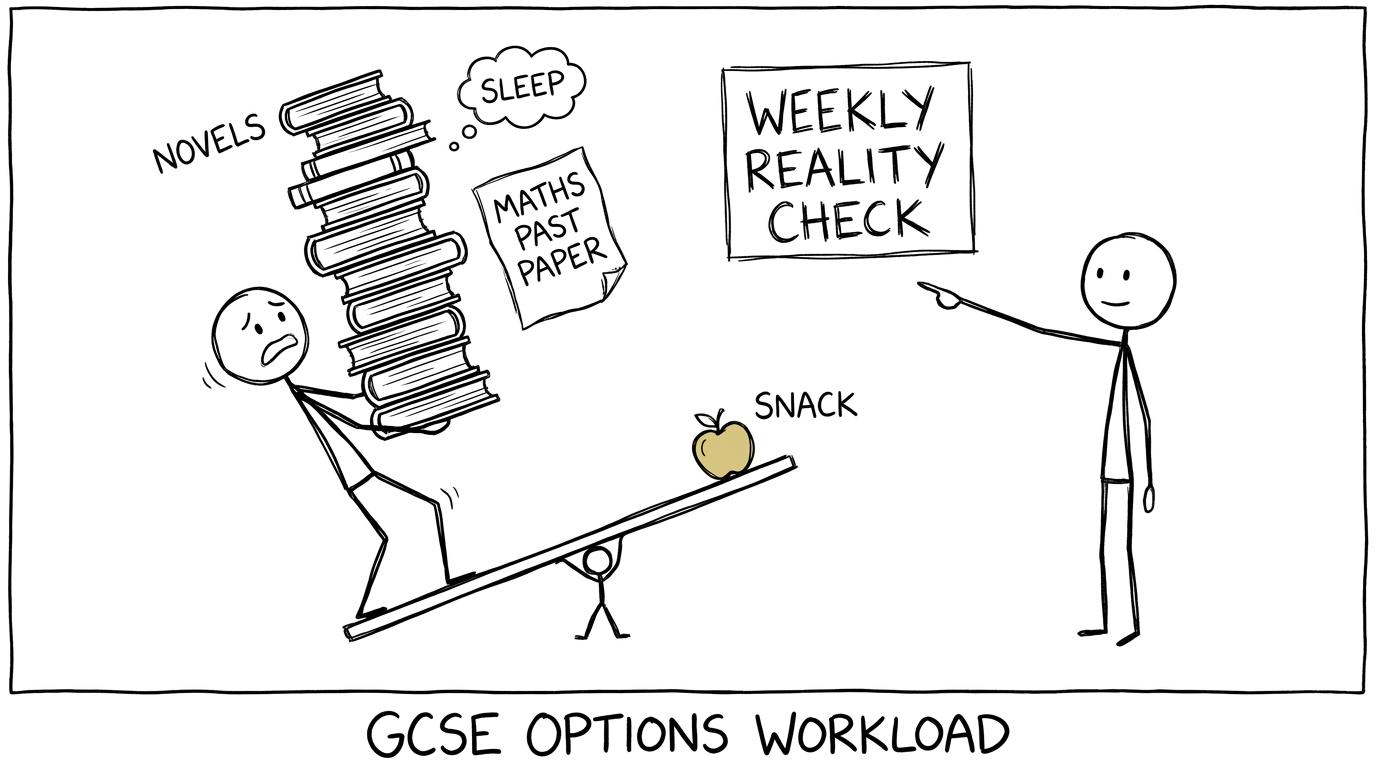 A student balancing novels, a maths paper, sleep and a snack on a tiny seesaw
Sketch a realistic week containing:
- lessons and homework;
- Literature reading and essay practice;
- maths topic practice;
- revision for your other subjects;
- activities, travel and responsibilities;
- rest and unplanned catch-up time.
Do not design a perfect week that only works when nothing goes wrong. A useful timetable survives an ordinary tired Wednesday.
Maths students can use the GCSE maths revision timetable guide to protect regular practice rather than leaving everything until mock season. If exams are closer, the one-month GCSE maths revision plan provides a more concentrated structure.
Would Literature support your future plans?
GCSE English Literature can prepare you for subjects involving close reading, argument and extended writing, including A Level English Literature. Its habits may also support history, law-related pathways and essay-based humanities. However, it is not a universal requirement for every sixth-form, apprenticeship, university course or career.
Requirements vary. If you have a particular course in mind, check its published entry criteria and ask the relevant school, college or training provider. Do not rely on the claim that a subject is either “essential for everything” or “useless unless you become a writer”. Both statements flatten a more complicated decision.
If you are uncertain about your future, consider whether Literature adds useful breadth without overwhelming your timetable. Keeping options open matters, but so does performing well across the subjects you actually take.
How does English Literature fit beside GCSE Maths?
English Literature and maths look different, yet both reward disciplined reasoning. A strong Literature response makes a claim, chooses evidence and explains the connection. A strong maths solution identifies what is known, selects a method and communicates enough working to justify the result.
Literature will not teach algebra or trigonometry. It may, however, strengthen your ability to read closely, notice command words and organise an argument. Those habits can help with multi-step and reasoning questions.
The risk is not Literature itself. The risk is an overcrowded timetable in which maths practice becomes occasional. Maths methods fade when they are only reread rather than used.
Keep your mathematical preparation visible. The GCSE Maths revision hub organises lessons, worksheets and practice by exam board. The GCSE topic list by board and tier helps you distinguish foundation and higher content across Edexcel, AQA, OCR and Eduqas.
For quick evidence of your current level, use GCSE maths mini tests. Then move from the result to focused practice rather than simply recording a mark.
Try the work before choosing the label
A small trial is more informative than a long list of imagined advantages. Ask your English teacher for a sample extract and exam question. Read the extract, plan a response and attempt one paragraph under a sensible time limit. You are not trying to predict your final grade. You are testing your reaction to the process.
Notice what happens:
- Did the analysis become more interesting once you looked closely?
- Could you support an idea with evidence?
- Did writing feel demanding but learnable, or consistently miserable?
- Would you be willing to practise this skill repeatedly?
 Two students meeting an unseen poem wearing sunglasses
You can apply the same evidence-first thinking to maths. Use MathsGenie past papers to identify genuine weaknesses, or follow the guide to finding your weakest GCSE topics. Decisions become calmer when they are based on completed work rather than assumptions.
Common mistakes when choosing GCSE English Literature
Assuming English Language and Literature are the same
They overlap in reading and writing skills, but they assess different content. A strong English Language result does not automatically mean you will enjoy studying whole literary texts, poetry and context.
Choosing it because it sounds impressive
A subject title cannot compensate for two years of reluctant work. Choose according to content, assessment and your wider programme.
Dropping it because one text seems difficult
Difficulty is not proof that the whole course is wrong for you. Ask whether teaching, discussion and practice make the text more manageable before deciding.
Ignoring the replacement option
If Literature is optional, compare it with the subject that would occupy the same timetable space. The decision is between real alternatives, not between Literature and unlimited free time.
Underestimating revision across all subjects
Quotations, essays and unseen analysis must sit beside maths, science and other GCSE preparation. Build a weekly plan before the workload becomes urgent. Near the maths exams, Edexcel GCSE Maths predicted papers can provide fresh timed practice, but they should support rather than replace real past papers and topic revision.
Make an honest choice, then build a workable routine
So, should you take GCSE English Literature? Take it if the course is genuinely available as a choice, you are interested in analytical reading and you can make room for regular essay practice. Think twice if you are choosing from pressure, prestige or an unrealistic idea of the workload. Most importantly, confirm your school’s rules, exam board and set texts before deciding.
Whichever subjects appear on your timetable, revision works best when it becomes a repeatable system. Use MathsGenie for free revision lessons, practice questions, mini tests, past papers, predicted papers, mark schemes and video solutions. Start with one weak maths topic today, practise it, mark it carefully and let the evidence guide what you do next.