

Should I Take GCSE Bengali? Honest Questions
Should I take GCSE Bengali? Consider fluency, writing, exam demands and revision time before committing to the subject on your school timetable.
Choosing a GCSE can feel strangely permanent. A subject that occupies one small box on an options form may shape hundreds of lessons, several exams and many evenings of revision. So, should I take GCSE Bengali? The honest answer is yes if you have enough skill across speaking, listening, reading and writing, genuinely want the qualification, and can fit the preparation around your other subjects. It may be the wrong choice if you are relying only on conversational fluency or assuming it will be an effortless extra GCSE.
The decision is not about proving how Bengali you are. Nor is it about choosing the subject that sounds most impressive. It is about understanding the assessment, checking what support exists and deciding whether the course deserves a place in your timetable.
Your quick GCSE Bengali checklist
Before committing, ask yourself:
- Can I read Bengali accurately without guessing too often?
- Can I write extended answers, not merely messages or isolated sentences?
- Can I understand different speakers and unfamiliar recordings?
- Can I speak spontaneously rather than reciting memorised paragraphs?
- Does my school provide lessons, feedback and speaking practice?
- Will Bengali reduce the time available for maths, English, science or another priority?
- Would I still choose it if nobody described it as an “easy GCSE”?
A mostly positive answer suggests that the subject may suit you. Several uncertain answers do not automatically mean no, but they do mean you need more information before choosing.
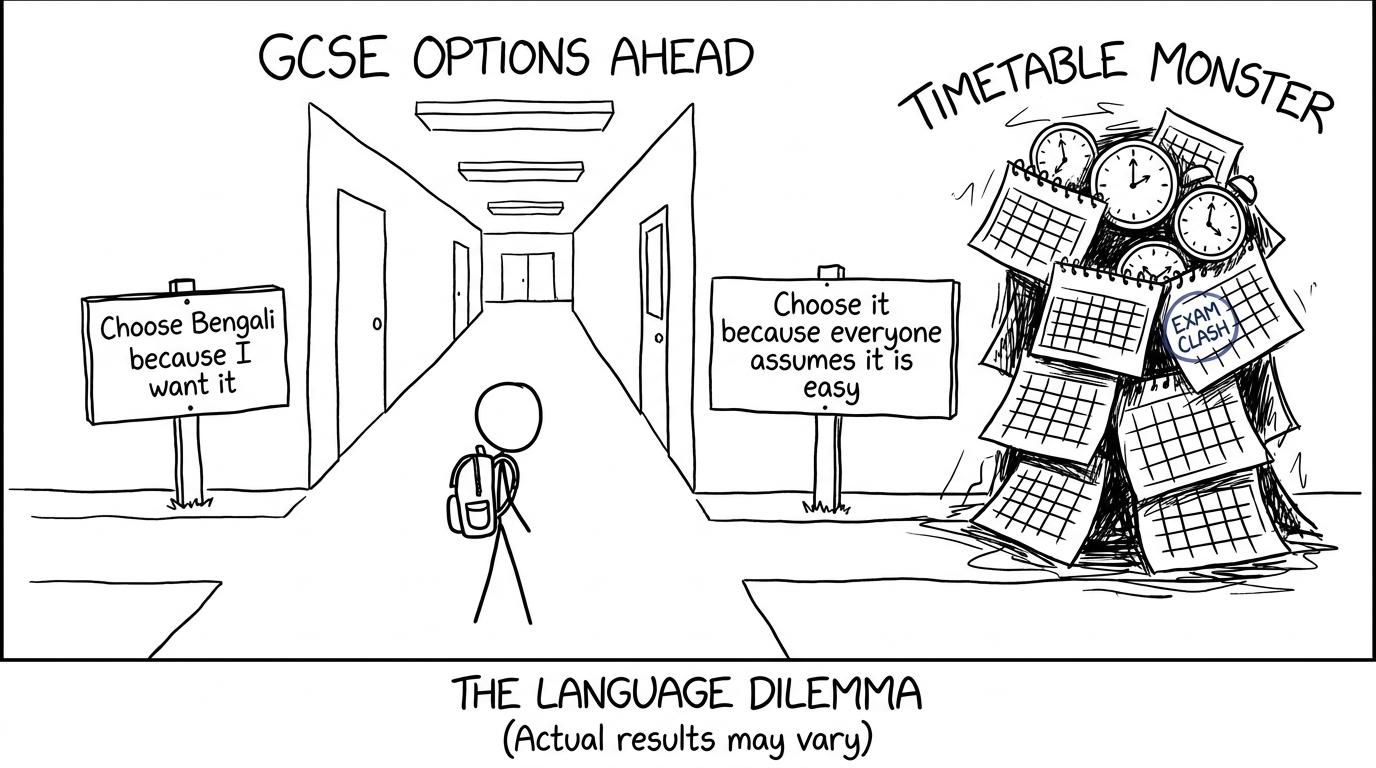 A student discovers that the supposedly easy path leads to a timetable monster
What does GCSE Bengali actually involve?
In England, the currently accredited GCSE Bengali qualification is offered by AQA. That matters because Bengali is not available from every exam board: do not assume that Edexcel, OCR or Eduqas offers an equivalent simply because your school uses one of those boards for maths.
The AQA course assesses four skills:
- listening;
- speaking;
- reading;
- writing.
Each skill contributes approximately 25%25\%25% of the qualification. Students take all four components at the same tier and in the same exam series. Foundation tier covers grades 111 to 555, while higher tier covers grades 444 to 999, with an allowed grade 333 available in the circumstances defined by AQA.
The speaking assessment includes a role-play, a photo-card discussion and a general conversation. Reading can include literary material and translation into English. Writing requires responses in Bengali and translation from English into Bengali. The course covers themes such as identity, culture, technology, local and global issues, education and employment.
This is why family conversation alone is not a complete preparation plan. Everyday fluency is valuable, but an examination also tests accuracy, unfamiliar vocabulary, formal writing and performance under timed conditions.
Can you read and write as well as you speak?
This is the most important question for many bilingual students.
Perhaps you speak Bengali comfortably with relatives. That gives you an excellent foundation: pronunciation, natural vocabulary and listening instincts may already be familiar. But speaking at home and writing a developed exam response are different skills.
Try looking at an official sample paper through your school. Can you read the instructions and passages independently? Can you spell accurately, use suitable grammar and organise a longer answer? If you recognise words when somebody says them but struggle to produce them on paper, you have found the real revision task.
That gap can be closed. It simply should not be ignored when choosing the subject.
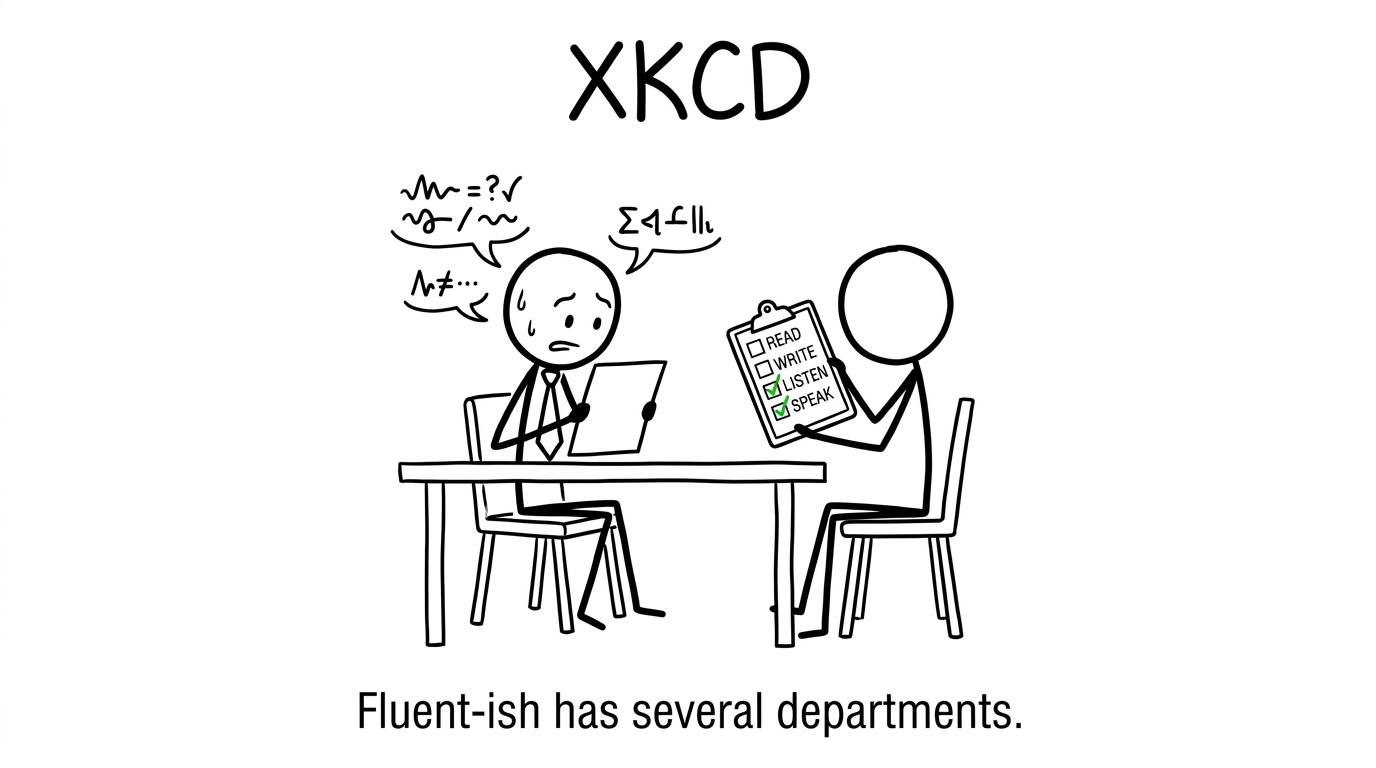 A confident speaker meets the reading, writing, listening and speaking departments
Do you have proper teaching and feedback?
Ask exactly how the qualification will be taught. “The school can enter you” is not the same as “the school will teach you”.
Find out:
- whether Bengali appears as a regular timetabled lesson;
- who will assess and correct your writing;
- how often you will practise listening;
- who will conduct speaking preparation;
- whether past papers and mark schemes are available;
- whether the course happens after school or at weekends;
- which tier the teacher expects you to take.
Independent preparation can work for a strong reader and writer with reliable support. However, it requires organisation. Someone must notice repeated spelling errors, weak grammar and answers that sound natural but do not fulfil the task. Feedback is especially important because practising an error repeatedly makes it more familiar, not more correct.
Are you choosing Bengali for the right reason?
A good reason does not need to be grand. You might enjoy the language, want formal recognition of an existing skill, value a closer connection with Bengali-speaking communities or wish to continue languages later.
A weaker reason is that somebody has promised you an easy grade.
Prior knowledge can make a subject more accessible, but accessibility is not the same as certainty. Grade boundaries are applied to assessed work, not to your background or the language spoken at home. A fluent speaker can still lose marks through inaccurate writing, incomplete answers or weak exam technique.
Ask yourself a useful counterfactual question: if Bengali required steady weekly practice, would I still want to take it? If the answer is yes, your motivation is probably sturdy enough to survive the timetable.
What will GCSE Bengali displace?
Every option has an opportunity cost. An extra subject does not create extra hours; it claims hours that already belonged to something else.
This matters particularly when maths needs consistent practice. Maths rarely improves through one heroic session at the end of term. It improves through a repeated cycle: learn a method, answer questions, mark the work and return to mistakes. The MathsGenie GCSE maths revision hub brings those stages together with free lessons, practice questions, papers and solutions.
Before adding Bengali, sketch an honest week containing school, travel, homework, sleep and existing commitments. Then include Bengali reading, writing, vocabulary and speaking practice. Finally, protect regular maths sessions rather than leaving them to whatever time remains.
If your current plan already feels crowded, use the GCSE maths revision timetable guide to build a realistic structure. A subject choice is sustainable only when the week can hold it.
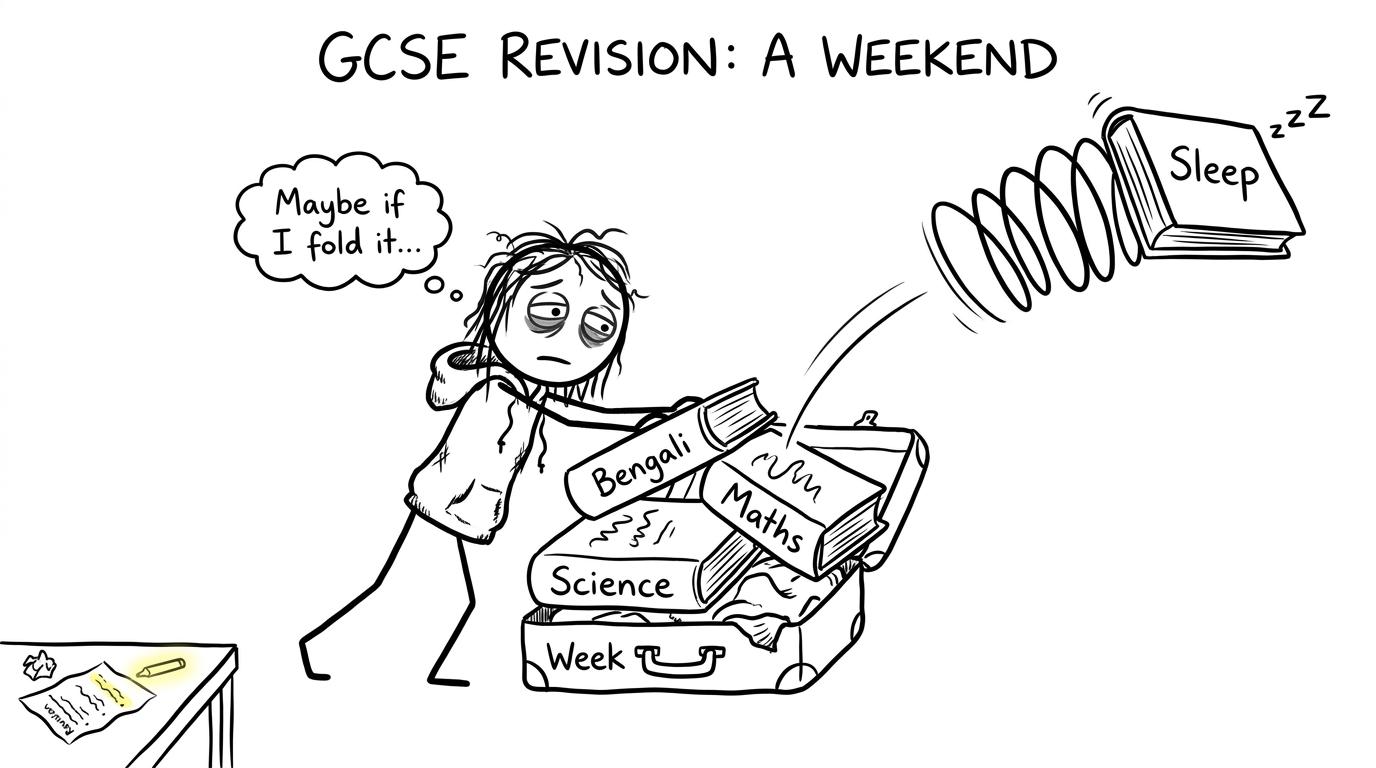 A GCSE student tries to pack Bengali, maths, science and sleep into one week
Will the qualification support your wider goals?
GCSE Bengali can demonstrate language knowledge and commitment, but it should be considered alongside the entry requirements that matter most for your next step.
Sixth forms, colleges and apprenticeships commonly pay close attention to English and maths, as well as subjects connected to the course being taken. Requirements vary, so check the actual institutions and courses you may apply to rather than relying on playground advice.
If Bengali would complement a secure set of core results, it may be a valuable addition. If taking it would seriously weaken the time available for essential subjects, the calculation changes. The right question is not simply, “Would another GCSE look good?” It is, “Can I prepare for this GCSE without undermining the results I need most?”
For maths, start by identifying gaps rather than revising everything equally. The best order for learning GCSE maths topics provides a clear route from core number skills to algebra, geometry, probability and exam technique.
Have you tested the reality before choosing?
Do not make the decision entirely in your imagination. Ask your teacher for a sample listening task, reading paper, writing prompt and speaking activity at the tier you might enter.
You do not need to perform perfectly. You are looking for evidence:
- Which skills already feel secure?
- Which require teaching rather than light revision?
- Can you understand the wording of exam tasks?
- How much correction does your writing need?
- Does the work feel satisfying enough to continue?
A short trial is more informative than repeated reassurance. It turns “I think I am good at Bengali” into a specific picture of what you can do and what remains to be learnt.
The same principle works in maths. A mini test or paper section reveals more than rereading notes. When you are ready to introduce exam practice, the guide to when to start GCSE past papers explains how to move from topic work towards timed papers without rushing.
Can you maintain two different revision habits?
Languages and maths reward different forms of practice.
Bengali benefits from frequent reading, vocabulary retrieval, listening, spontaneous speech and corrected writing. Maths requires methods, problem solving, accurate working and repeated exposure to exam-style questions. Both suffer when revision is reduced to passive rereading.
A sensible week might contain short Bengali sessions alongside protected maths blocks. If exams are approaching, the one-month GCSE maths revision plan can help you organise mini tests, targeted practice and timed papers.
Past papers should also be used actively. Completing a paper is only the first step; improvement comes from marking, diagnosing and correcting it. The guide to using Edexcel GCSE maths past papers properly explains that process, while the Edexcel GCSE maths past-paper collection provides papers and official mark schemes for students on that board.
Common mistakes when deciding whether to take GCSE Bengali
Assuming home fluency guarantees a high grade
Conversational skill is a strength, not a guarantee. Check reading, spelling, formal writing, translation and unfamiliar listening as separate abilities.
Choosing before checking the school arrangements
Confirm the exam board, tier, teacher, lesson time and speaking support. Also establish whether the subject replaces another option or becomes an additional commitment outside the normal timetable.
Letting family expectations make the whole decision
Family advice may be thoughtful and well informed, but you will attend the lessons and sit the assessments. Listen carefully, then make a decision based on your skills, motivation and workload.
Treating an extra GCSE as automatically better
More qualifications are not automatically more useful if the extra workload weakens important grades. Quality, relevance and sustainability matter.
Forgetting the cost to core-subject revision
Do not plan Bengali first and give maths whatever time survives. Keep a clear revision routine, especially if you are working towards a particular foundation or higher-tier grade. MathsGenie offers free revision lessons, practice questions, mini tests, mark schemes and video solutions so that limited revision time can remain focused.
Make a decision you can live with
So, should you take GCSE Bengali? Choose it when the assessment matches your real abilities, the teaching arrangements are dependable, the language matters to you and the workload fits beside your core subjects. Pause when the plan depends on vague promises, untested literacy or the belief that bilingual students never need to revise.
An options form records a decision, but your weekly routine determines what that decision becomes. Ask the honest questions now. Look at real assessment materials. Speak to the relevant teacher. Build a timetable that protects Bengali and maths rather than forcing them to compete every evening.
Then make MathsGenie your free maths revision base. Begin with the GCSE maths revision hub, learn through revision lessons, strengthen each topic with practice questions, and test your progress using mini tests, past papers, predicted papers, mark schemes and video solutions. A good subject choice should expand your education without making the rest of it harder to manage.











