

Self Study GCSE Maths Numeracy: A Realistic Plan
Self study GCSE Maths Numeracy with a realistic 12-week plan covering the specification, topic practice, marking, past papers and exam technique.
It is easy to mistake being alone for being stuck. A teacher normally chooses the next topic, checks your working and decides when you are ready for a paper. Without that structure, even opening the specification can feel like a test.
The practical answer is that you can self study GCSE Maths Numeracy, provided you know exactly which qualification you are taking, have enough time and mark your work honestly. If you have already met most of the content, a focused twelve-week revision plan is realistic. If you are learning from scratch, allow at least six to nine months rather than trying to compress an entire course into one term.
Your plan needs five things:
- the correct specification, tier and examination dates
- a diagnostic paper before serious revision begins
- regular topic lessons followed by independent questions
- an error log and prompt marking
- timed papers during the final phase
First, identify the qualification you are taking
“GCSE Maths Numeracy” usually refers to qualifications in Wales. It is not the separate title used for standard GCSE Mathematics offered in England by Edexcel, AQA or OCR. Eduqas also offers qualifications across different regulatory contexts, so you should not choose resources from the board name alone.
This distinction matters particularly now. Learners in Wales who began the reformed course in September 2025 take WJEC GCSE Mathematics and Numeracy (Double Award). It combines mathematics and numeracy in one qualification worth two GCSEs. The course has three externally examined units:
- Unit 1: Financial Mathematics and Other Applications of Numeracy, worth 30%30\%30%
- Unit 2: Non-calculator Mathematics, worth 30%30\%30%
- Unit 3: Calculator Mathematics, worth 40%40\%40%
Units 1 and 2 first became available in summer 2026, while Unit 3 is first available in November 2026. The new qualification has Foundation and Higher tiers, uses Welsh letter grades and allows centres to enter learners at different tiers across units.
The older, separate WJEC Mathematics and Numeracy qualification is now in its final resit period for eligible candidates. Do not assume that an old textbook or past paper matches your entry. Ask your school, college or examination centre for the exact qualification title, specification, unit, tier and entry series.
If you mean the numeracy parts of an English GCSE graded 999 to 111, begin with the GCSE Maths revision hub and select Edexcel, AQA, OCR or Eduqas. The GCSE topic list by board and tier will help you separate shared skills from board-specific assessment details.
Is self-studying actually realistic?
Yes, but there is an important difference between learning the entire course and revising a course you have already encountered.
The reformed WJEC Double Award was designed around approximately 240240240 to 280280280 guided learning hours across two years. That does not mean every independent learner needs exactly that number of hours. It does show why twelve weeks cannot realistically replace two years of teaching when you are starting from zero.
A twelve-week plan is suitable if you can already perform basic calculations, work with fractions and interpret straightforward graphs. Aim for four or five sessions each week, giving roughly six to eight hours in total. From scratch, use the same sequence but spread it over two or three terms.
Self-study becomes workable when each session has a visible output. “Revise percentages” is vague. Completing a lesson, answering a set without notes, marking it and recording two errors is measurable.
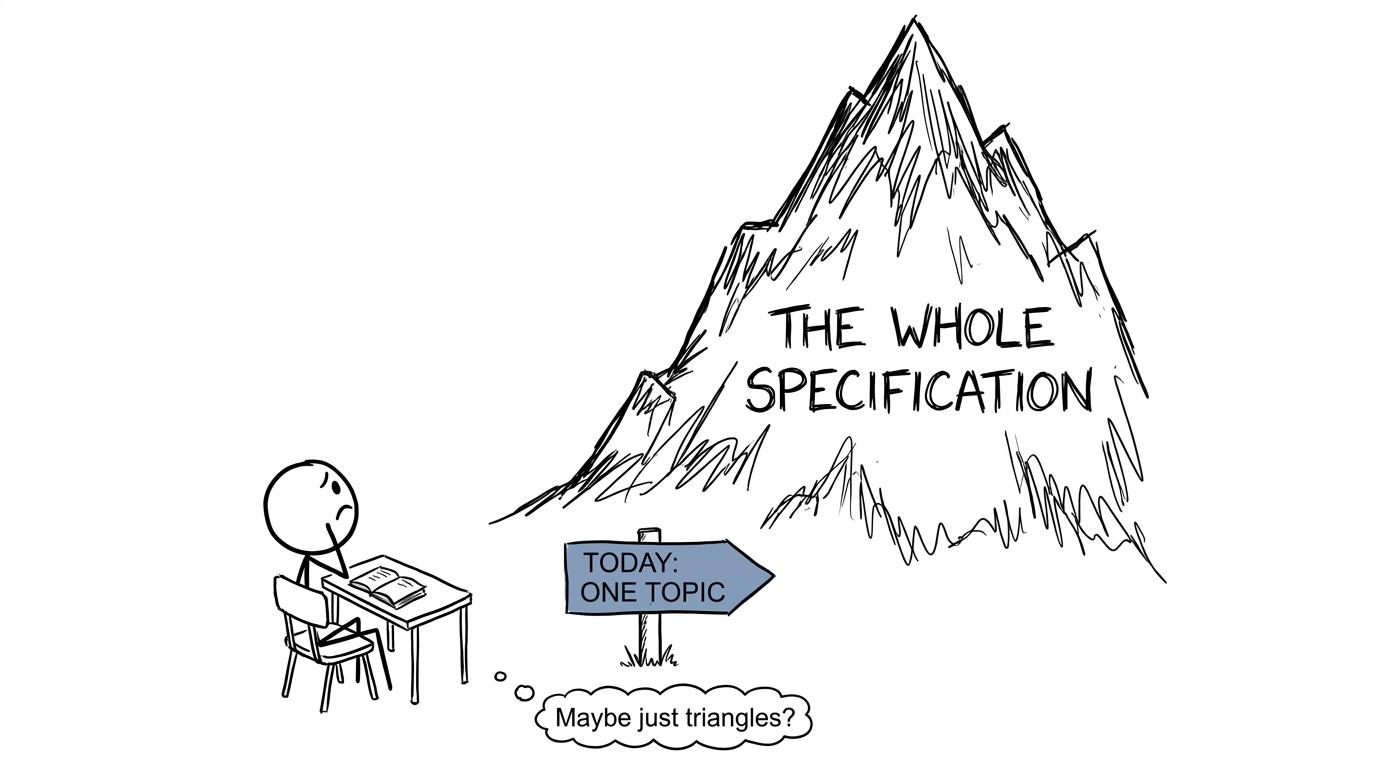 A student chooses one manageable topic instead of climbing the whole specification at once
Set up a system before the twelve-week plan
Confirm your examination arrangements
If you are outside school, contact a centre that accepts private candidates before building your timetable. Confirm that it can enter your exact WJEC qualification and units. Ask about deadlines, fees, tier decisions, identification requirements and calculator arrangements directly, because these details depend on the centre and examination series.
Create four simple revision tools
You need:
- a specification checklist
- a weekly timetable
- an error log
- a folder for completed assessments
A useful error log has four labels: knowledge, method, accuracy and interpretation. Losing a mark because you did not know how to calculate a percentage change is different from knowing the method but misreading the required unit. Different errors need different repairs.
For a sustainable routine, adapt the structure in the GCSE Maths revision timetable. Your week should contain learning, practice, retrieval and timed assessment rather than five identical note-taking sessions.
A realistic twelve-week self-study plan
Weeks one and two: diagnose and rebuild number skills
Sit a suitable diagnostic paper or mixed assessment without revising first. It may feel uncomfortable, but that is useful: the result shows what you can do unaided.
Mark it and identify no more than five immediate weaknesses. Then rebuild calculation skills, including integers, decimals, fractions, percentages, rounding, estimation and calculator use. Practise non-calculator arithmetic separately because a calculator cannot rescue insecure number sense on Unit 2.
The best order for learning GCSE maths topics provides a sensible progression when your diagnostic reveals several connected gaps.
Weeks three and four: ratio, proportion and financial numeracy
Move into ratio, rates, proportion, percentage change, repeated change, exchange rates, best buys and personal finance. These topics often hide familiar calculations inside realistic information.
Train yourself to underline the requested quantity, identify relevant data and attach units to the result. Do not merely memorise isolated procedures. Numeracy questions assess whether you can select and apply mathematics in context, then interpret what your answer means.
Finish week four with a mixed, timed set. Revisit every lost mark before moving on.
Weeks five and six: measures, geometry and real-life graphs
Cover unit conversions, scale, perimeter, area, volume, compound measures and appropriate accuracy. Then practise coordinates, conversion graphs, travel graphs and other representations relevant to your specification.
Context can make straightforward mathematics look unfamiliar. Build the habit of translating a paragraph into a diagram, table or short list before calculating. Check whether an answer is sensible in the original situation, not merely whether it appeared on your calculator screen.
Weeks seven and eight: statistics, probability and algebra
Revise averages, charts, tables, sampling, scatter diagrams and the interpretation of data. Probability should include single events and the combined-event methods listed for your tier. MathsGenie’s WJEC probability trees revision resources provide lessons and questions for one important combined-probability skill.
Numeracy still requires algebra. Include substitution, formulae, equations, sequences and graphs at the depth required by your specification. Algebra is often the quiet machinery behind a financial or measurement problem.
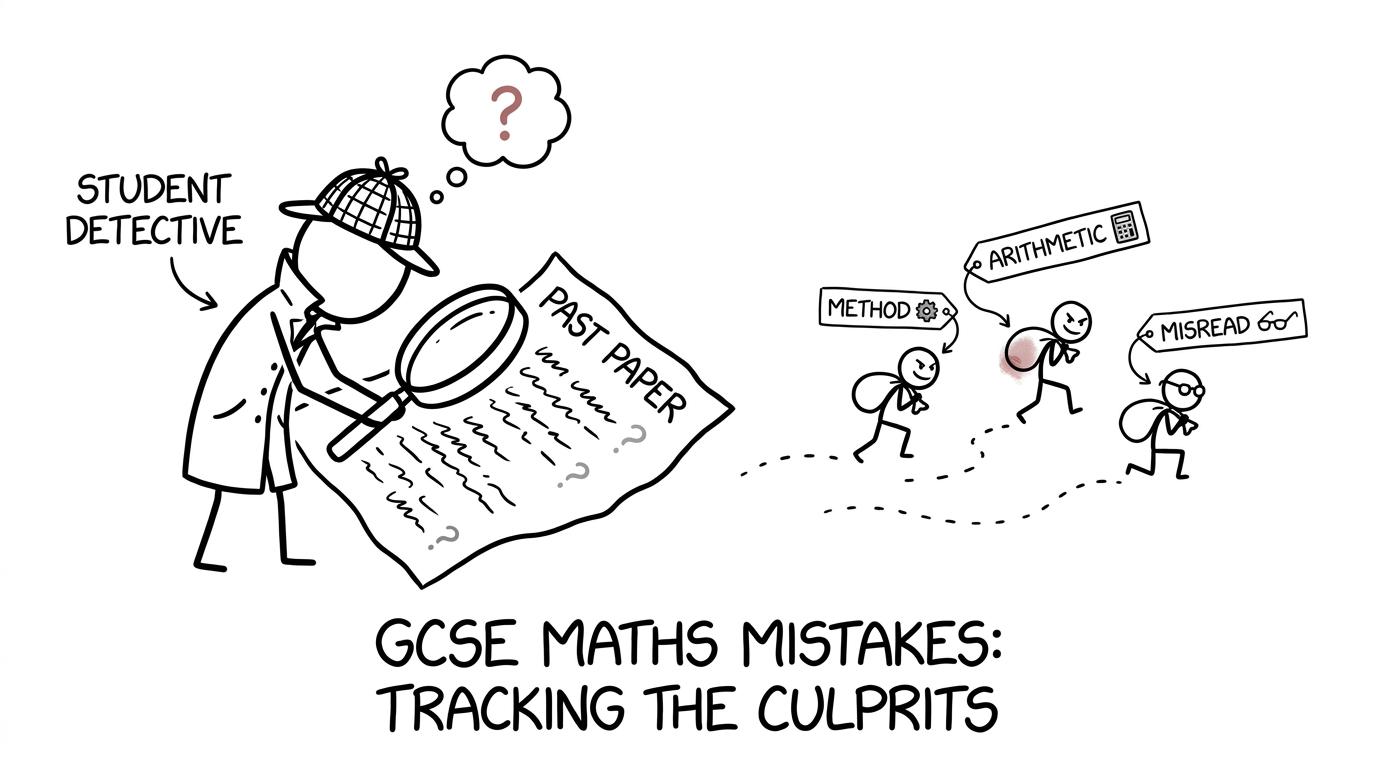 A student detective identifies whether a lost mark came from method, arithmetic or misreading
Weeks nine and ten: connect topics through mixed questions
Stop revising in neat topic boxes. Complete mixed questions where the method is not announced in advance. This is where genuine independence develops: you must decide whether a problem involves proportion, area, an average or several ideas together.
Use mini tests and timed paper sections. After marking, return to a revision lesson only for the skill that failed, then answer fresh questions without copying the solution. The advice in when to start GCSE past papers can help you move from topic practice to full assessments without using your limited supply of papers too early.
Week eleven: complete full papers properly
Use official papers or sample assessment materials matching your qualification, unit and tier. Work under the correct time and calculator conditions. Put your phone away and do not pause the clock to look up a formula.
A paper is not finished when the timer stops. Mark it, categorise every lost mark and repair the three biggest weaknesses. The guide to using GCSE Maths past papers properly describes a marking and correction cycle that can be adapted to any board, although you must use WJEC papers for a WJEC examination.
Week twelve: retest, refine and reduce the load
Complete one final timed assessment early in the week. Reattempt previously incorrect questions, review units and check the instructions for each examination. Use predicted papers only as fresh practice, never as a reason to ignore part of the specification.
Reduce the volume in the final days. Short retrieval, corrected questions and calculator familiarity are more useful than beginning several new topics. Sleep and organised equipment are part of examination preparation, not time stolen from it.
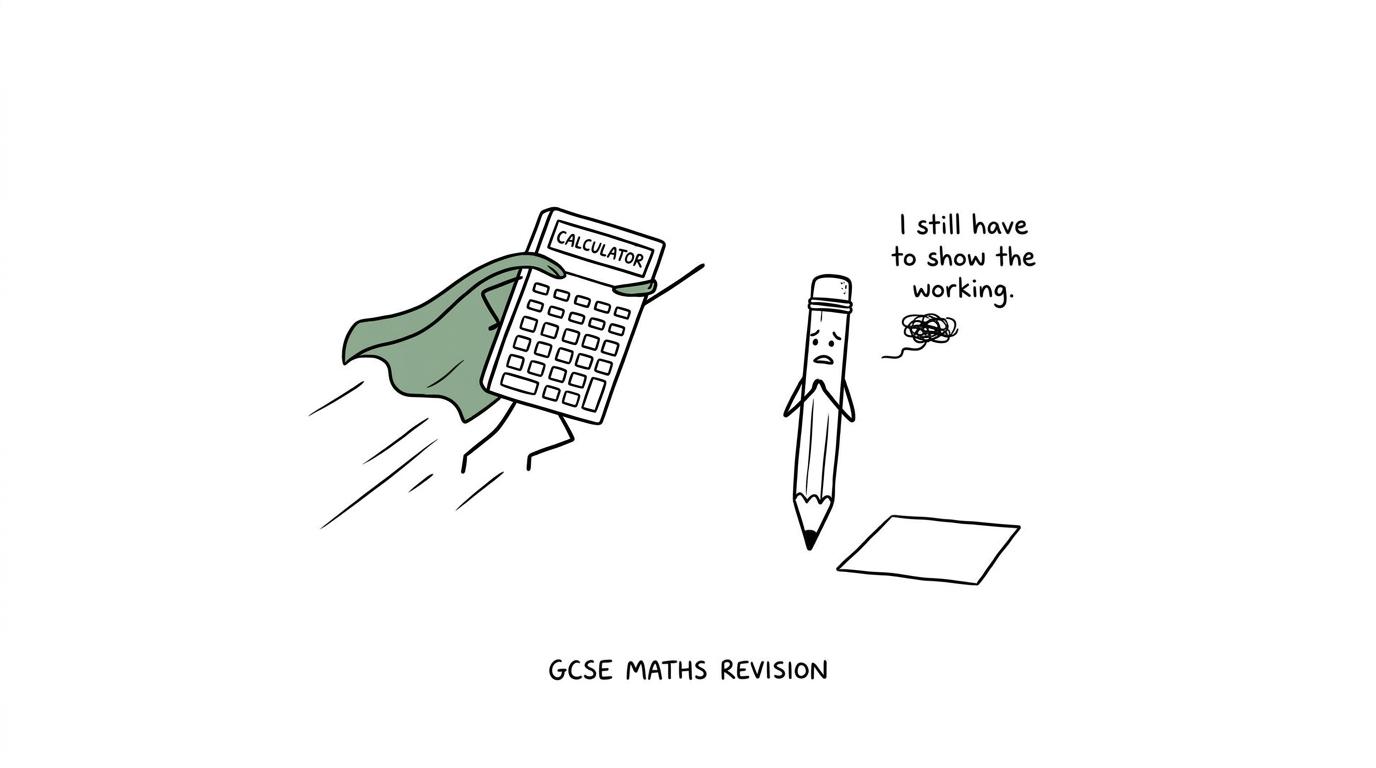 A heroic calculator arrives while a pencil reminds it that working still matters
Common mistakes when self-studying Maths Numeracy
Using resources for the wrong specification
Old WJEC Numeracy papers remain useful only when they match your actual qualification. The reformed Double Award has a different unit structure, so verify every resource before using it as an examination simulation.
Watching solutions instead of answering questions
A clear video can create the feeling of understanding without the ability to reproduce the method. Close the lesson and answer questions independently. Use video solutions afterwards to diagnose where your reasoning changed direction.
Avoiding written interpretation
A numerical result may not fully answer a contextual question. Include units, state a decision where required and explain what the value means. The current WJEC assessment also rewards communicating, organising and writing accurately.
Rounding too early
Keep full calculator values during intermediate stages unless instructed otherwise. Round once, at the end, to the requested degree of accuracy.
Counting completed papers rather than corrected errors
Ten unreviewed papers can preserve the same mistake ten times. One carefully marked paper, followed by targeted practice and a later retest, produces more useful learning.
Make independent revision feel less independent
Self-study does not mean inventing every explanation, question and assessment yourself. It means taking responsibility for the sequence: learn, practise, mark, correct and retest.
Start with the MathsGenie GCSE Maths revision hub, select the closest matching board resources and keep your official WJEC specification beside you. Use free revision lessons and practice questions to repair individual topics, mini tests to check recall, and past papers to develop timing. Near the examination, add appropriate predicted papers, mark schemes and video solutions to expose the final gaps.
The whole course may look like a mountain. Your task today is smaller: confirm your qualification, complete one diagnostic assessment and choose the first topic that will stop costing you marks.










