Self Study GCSE Geography: A Realistic Plan
Self study GCSE geography with a realistic 12-week plan covering specifications, fieldwork, case studies, exam practice and independent entry.
The hardest part of learning Geography alone is not understanding rivers or remembering case studies. It is knowing whether you are learning the right material at all.
The short answer is yes: self study GCSE geography is realistic. The subject is assessed through written examinations, so independent learners can build much of the required knowledge, geographical understanding and exam technique at home. The important complication is fieldwork. GCSE Geography specifications require fieldwork outside the classroom, and a private candidate needs an approved examination centre that can confirm the relevant requirements have been met.
Find that centre first. Then build your revision around one exam board specification, regular retrieval and properly marked exam questions.
Your self-study checklist
Before opening a textbook, establish these essentials:
- Choose one specification from AQA, Edexcel, OCR or Eduqas.
- Find an approved centre willing to enter private candidates.
- Ask the centre how its fieldwork declaration process works.
- Download the current specification and assessment information.
- Create a checklist of every required topic, case study and geographical skill.
- Plan approximately four focused sessions each week.
- Start exam questions early rather than saving them for the end.
- Keep a record of lost marks and topics requiring another attempt.
The exam centre and fieldwork arrangements are the parts that cannot safely be left until the final weeks.
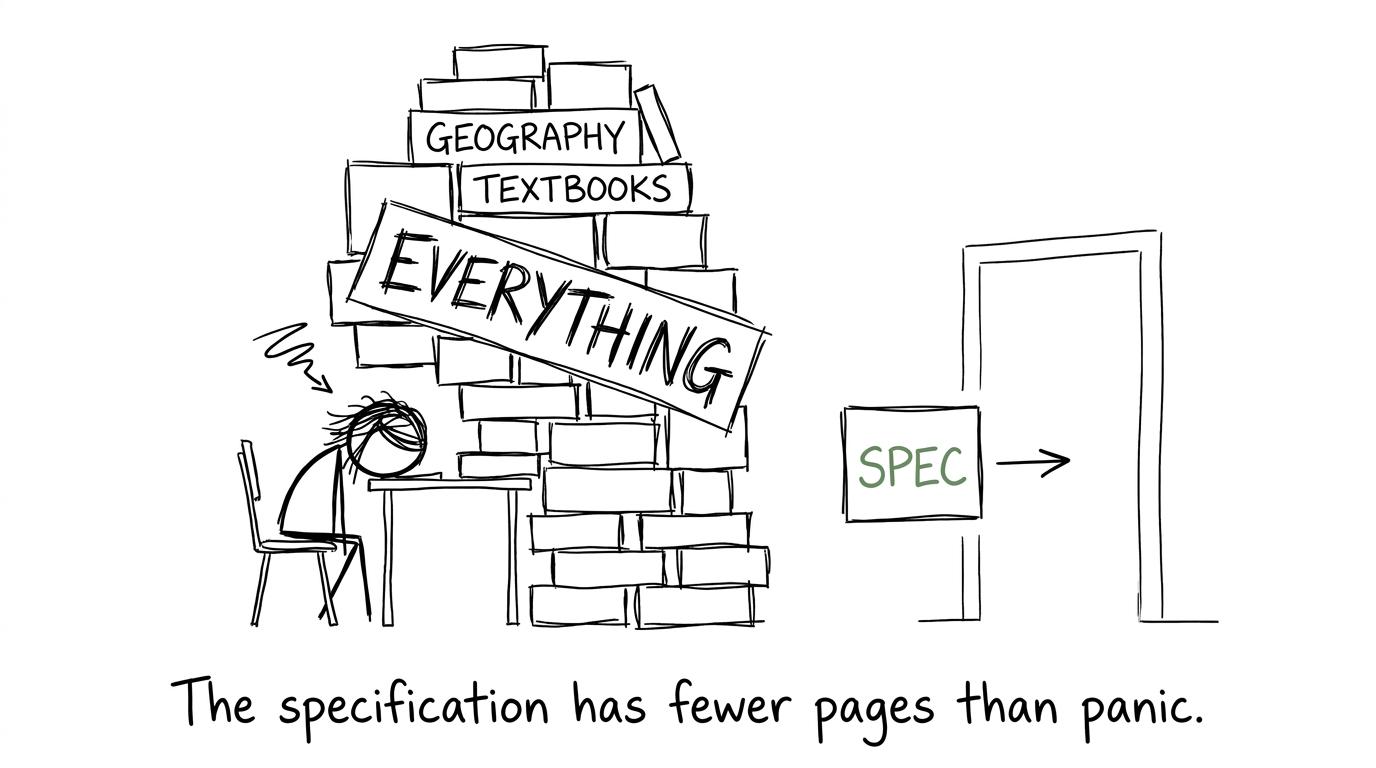 A student discovers that the specification is smaller than panic
Is self-studying GCSE Geography actually doable?
It is doable if you are comfortable creating your own structure. Geography rewards more than memory. You must explain processes, interpret unfamiliar resources, apply knowledge and make supported judgements. These skills can be developed independently because you can compare your answers with mark schemes and examiner guidance.
However, there are three realities to accept.
You must follow one exact specification
GCSE Geography is not a single universal course. Exam boards organise content, optional topics, case studies, fieldwork assessment and papers differently. A video about glaciation may be excellent but irrelevant if your chosen route requires coastal landscapes instead.
Print or save the current specification. Turn each statement into a checkbox and record whether you have:
- learnt the underlying process;
- recalled it without notes;
- answered an exam question on it;
- corrected that answer using the mark scheme.
This prevents the common self-study trap of learning interesting geography without covering the examinable course.
Fieldwork needs advance planning
Current GCSE Geography subject requirements include fieldwork outside the classroom and school grounds on at least two occasions in contrasting environments. Specifications require experience of physical and human geography, primary data collection and the geographical enquiry process.
Exam boards place formal responsibilities on centres. For example, AQA permits private candidates, but the accepting centre must submit the required declaration and confirm that fieldwork conditions have been met. Other boards and centres may administer private entries differently.
Do not assume that visiting a river or shopping area alone will automatically satisfy the requirement. Before collecting data, ask your intended centre:
- whether it accepts private Geography candidates;
- which specification it offers;
- what fieldwork evidence it requires;
- whether it supervises fieldwork or accepts documented evidence;
- what its registration and internal deadlines are.
The precise arrangements should come from the centre and current exam-board documents, not an old online discussion.
You need feedback, even when learning alone
Reading can create a misleading sense of progress. The page looks familiar, so the knowledge feels secure. An exam question exposes the difference between recognition and recall.
Use a simple cycle: learn, close the notes, retrieve, answer, mark and revisit. The approach in MathsGenie’s guide to stopping forgotten GCSE content transfers well to Geography because it combines active recall, spaced practice and exam-style questions.
A realistic 12-week self-study plan
This plan assumes that you already have an examination centre and can complete the necessary fieldwork arrangements. Allow four sessions each week: three sessions of around 454545 minutes and one longer session of 606060-909090 minutes.
If you have more time, expand the practice rather than adding new resources. One specification, one reliable course text and repeated exam practice are usually more manageable than a crowded folder of disconnected notes.
| Week | Main focus | Evidence to produce |
|---|---|---|
| 111 | Confirm board, centre, papers, options and fieldwork arrangements | Specification checklist and examination calendar |
| 222 | First physical geography unit | One-page retrieval sheet and marked questions |
| 333 | Second physical geography unit | Process diagrams, key vocabulary and corrections |
| 444 | Physical landscapes and relevant case studies | Closed-book case-study summaries |
| 555 | First human geography unit | Marked short and extended responses |
| 666 | Second human geography unit | Comparison table and retrieval test |
| 777 | Resources, development or board-specific option | Completed specification checks and exam questions |
| 888 | Maps, graphs, statistics and numerical skills | Timed skills set and corrections |
| 999 | Fieldwork enquiry process and your own evidence | Fieldwork summary organised by enquiry stage |
| 101010 | Mixed questions and extended writing | First timed paper or substantial paper section |
| 111111 | Repair the weakest topics | Re-tests showing whether errors were corrected |
| 121212 | Full-paper practice and final retrieval | Timed paper, mark log and final priority list |
Weeks 1 to 4: build the physical framework
Start by mapping the course, not by making beautiful notes. Identify which hazards, ecosystems and UK landscapes your specification requires. Learn processes as connected sequences: cause, process, immediate effect, wider consequence and possible management.
Case studies should add located evidence to this framework. For each one, know the setting, causes, effects, responses and an evaluative judgement. Avoid memorising paragraphs word for word. Examinations can alter the wording, and flexible knowledge survives that change better.
Weeks 5 to 7: connect people, places and decisions
Human geography often involves competing priorities. Urban growth may create employment while increasing pressure on housing and transport. Resource management can improve security while producing economic or environmental costs.
Organise each topic around relationships rather than isolated facts. Ask:
- What changed?
- Why did it change?
- Who benefited or lost?
- At what geographical scale?
- How effective was the response?
This creates the reasoning needed for explain, assess, evaluate and justify questions.
Week 8: practise geographical maths and data
Geography papers assess maps, graphs, tables, sampling, averages, spread and percentage change. These are valuable marks, but only if you practise interpreting data rather than merely copying definitions.
MathsGenie’s AQA Geography statistical skills guide covers averages, range, quartiles, cumulative frequency, percentage change and scatter graphs. Check its coverage against your own board’s specification.
Useful supporting resources include the GCSE Statistics revision hub, the wider GCSE Maths revision hub and the guide to the best order for learning GCSE maths topics. These can strengthen percentages, ratio, graphs and statistical interpretation without replacing board-specific Geography practice.
For percentage change, remember the structure:
percentage change=new value−original valueoriginal value×100\text{percentage change}=\frac{\text{new value}-\text{original value}}{\text{original value}}\times 100percentage change=original valuenew value−original value×100Always include appropriate units and distinguish correlation from causation when discussing data.
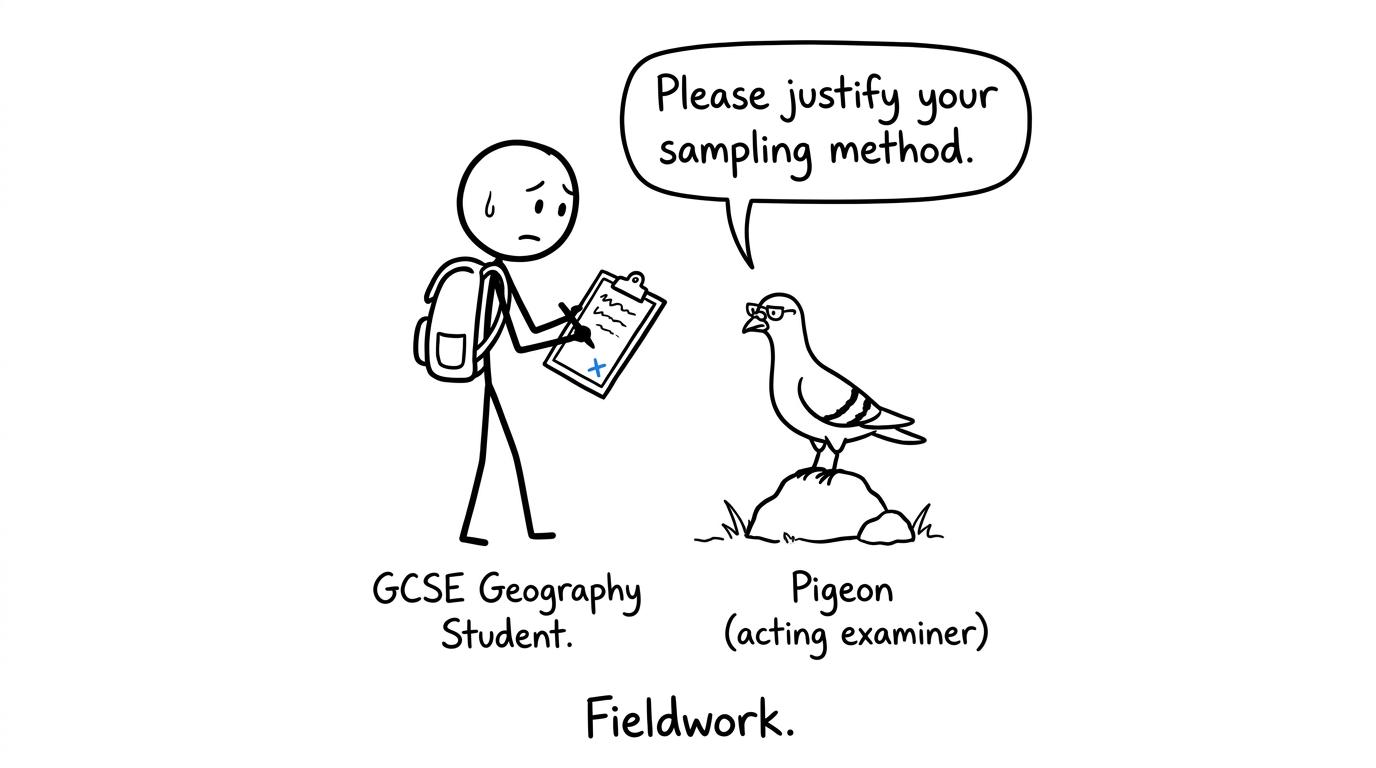 A pigeon takes the role of a demanding fieldwork examiner
Week 9: organise fieldwork as an enquiry
Fieldwork is not simply a trip. It is a chain of decisions. Organise each investigation under these headings:
- enquiry question or hypothesis;
- geographical theory;
- site and risk considerations;
- primary and secondary data;
- sampling and collection methods;
- presentation and analysis;
- conclusion;
- limitations, reliability and improvements.
Be able to justify why a method was suitable, identify anomalies and explain how limitations affect confidence in the conclusion. Generic comments such as “collect more data” are weak unless you state what additional data should be collected and why it would improve reliability.
Weeks 10 to 12: turn knowledge into marks
Now complete timed sections and full papers from your chosen board. Mark them strictly. Record each lost mark as one of four types:
- missing knowledge;
- weak application to the resource;
- incomplete explanation;
- timing or question-reading error.
MathsGenie’s advice on finding weak GCSE topics quickly explains how a marks log can direct revision. Its guide to starting GCSE past papers also shows why reviewing a paper matters as much as completing it.
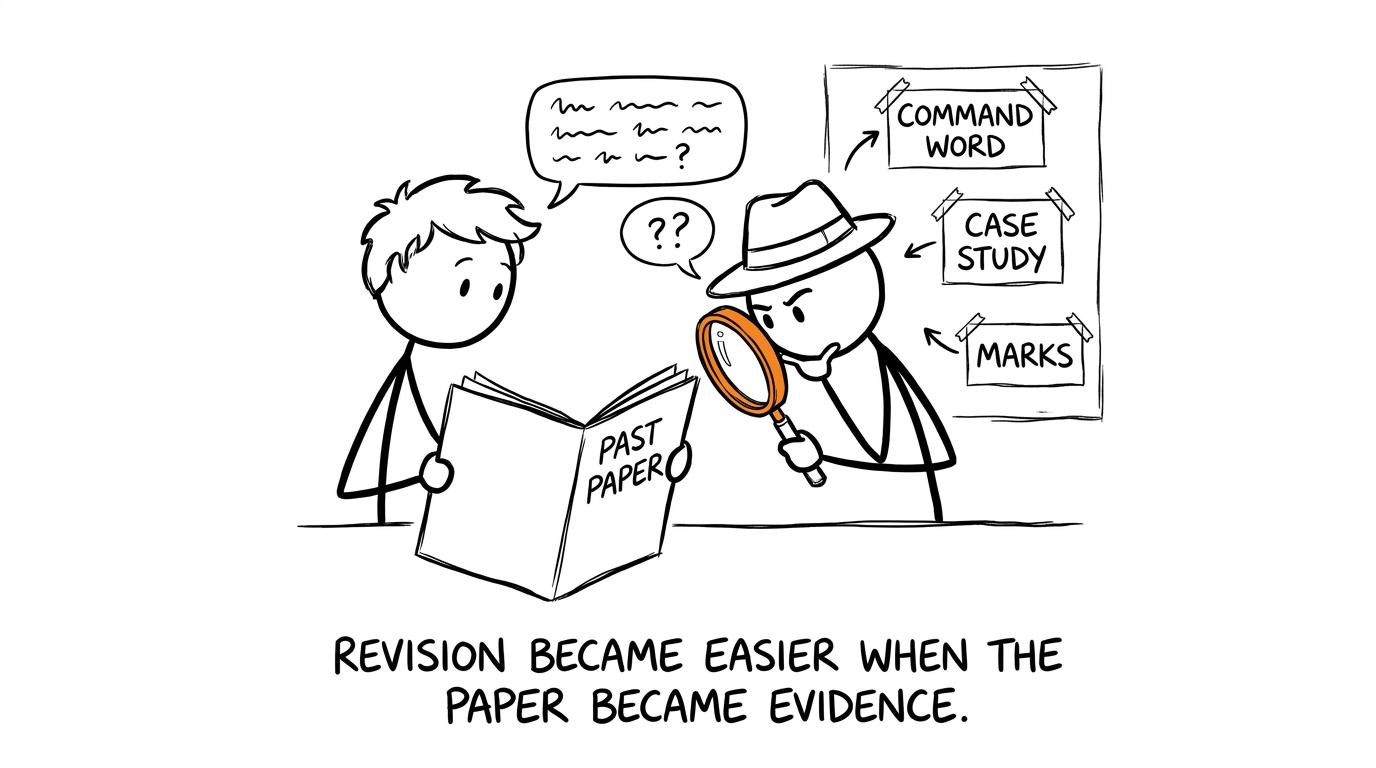 A student treats a past paper as useful evidence
How to structure each revision week
A sustainable week might look like this:
- Session A: learn one small specification section and create questions from it.
- Session B: retrieve the previous section without notes, then correct omissions.
- Session C: answer short and extended exam questions.
- Weekend session: mark everything, update the specification checklist and revisit the weakest area.
Near the examination, replace some topic sessions with timed papers. The principle behind MathsGenie’s one-week GCSE revision plan is useful here: diagnose, practise, mark and repair. Predicted papers can provide additional unseen practice, but official past papers and the current specification should remain your foundation.
Common self-study mistakes
Choosing resources before choosing an exam board
This produces gaps and unnecessary learning. Begin with the specification and let it decide which resources you use.
Delaying the examination centre and fieldwork
Knowledge can be learnt later; administrative deadlines cannot always be recovered. Confirm entry and fieldwork arrangements at the beginning.
Making notes without retrieval
Condensing a chapter may feel productive, but it does not prove that you can recall or apply it. Close the book and test yourself.
Memorising case studies as scripts
A fixed essay may not answer the question asked. Learn adaptable evidence and practise selecting only the facts relevant to the command word.
Ignoring maps, graphs and statistics
Geographical skills appear across papers. Practise them throughout the course, not as an isolated final topic.
Counting papers instead of correcting them
Five hurried papers can teach less than one carefully reviewed paper. Use mark schemes, rewrite weak responses and attempt similar questions again.
A realistic final judgement
You can self-study GCSE Geography outside school, but independence does not mean improvisation. Success depends on an approved examination centre, valid fieldwork arrangements, exact specification coverage and regular marked practice.
Begin by confirming your board and centre. Build a 121212-week checklist, learn in small sections and let exam questions reveal what still needs attention. For the numerical and data-handling skills that Geography shares with maths, use MathsGenie’s free revision lessons, practice questions, mini tests, mark schemes, video solutions, past papers and predicted papers. Start at the MathsGenie GCSE revision hub, then turn each weakness into a clear next task.