Self Study GCSE Classical Civilisation: A Plan
Self study GCSE Classical Civilisation with a realistic 20-week plan covering OCR options, private entry, source revision and exam practice alongside maths.
Trying to add an extra GCSE while keeping up with maths can feel like carrying two school bags at once. One contains equations and past papers. The other contains Greek temples, Roman households, ancient poetry and several gods with complicated family histories.
The practical answer is yes: you can self study GCSE Classical Civilisation outside school. The current OCR qualification is particularly accessible to independent learners because assessment is entirely through written examinations, with no coursework or controlled assessment. However, it is only realistic if you secure an exam centre early, follow the specification precisely and practise analysing sources rather than merely collecting interesting facts.
This guide gives you a manageable twenty-week route designed to sit alongside GCSE maths and your other subjects.
The quick feasibility checklist
Before buying books or making elaborate notes, check the foundations:
- You can arrange entry for OCR GCSE Classical Civilisation, specification J199, through an approved exam centre.
- You have enough time for three focused sessions each week.
- You are willing to read prescribed literature in translation.
- You can obtain the current specification, prescribed source booklets, past papers and mark schemes.
- You will practise both short answers and extended responses.
- Your plan leaves protected time for core subjects, especially GCSE maths and English.
If those conditions are in place, independent preparation is achievable. If the exam-centre question remains unresolved, solve that first. A beautiful revision timetable cannot compensate for having nowhere to sit the examinations.
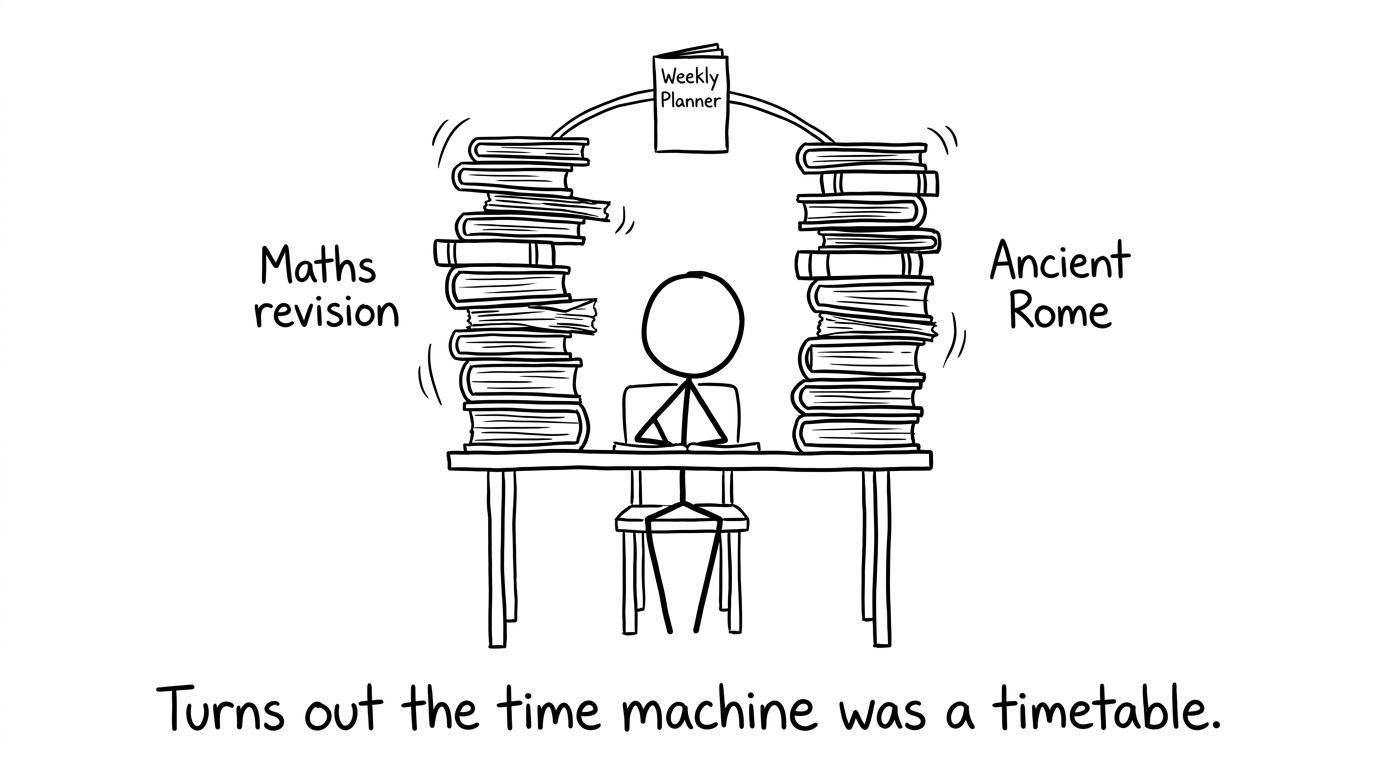 A student balancing maths revision and Ancient Rome with a weekly planner
What the GCSE actually requires
OCR GCSE Classical Civilisation J199 consists of two externally assessed components. You choose one Thematic Study and one Literature and Culture option.
For the Thematic Study, the choices are:
- Myth and Religion
- Women in the Ancient World
For Literature and Culture, the choices are:
- The Homeric World
- Roman City Life
- War and Warfare
Each component is worth 909090 marks, lasts 111 hour 303030 minutes and contributes 50%50\%50% of the qualification. The papers combine shorter questions with extended responses. Across the course, you must understand literary sources and visual or material evidence in their ancient contexts.
The qualification assesses more than factual recall. OCR gives substantial weight to analysing and evaluating sources, interpretations and ideas. Knowing that an object, building or passage exists is the beginning. You also need to explain what it reveals, consider its purpose or limitations and use it within a reasoned judgement.
There is no requirement to know Latin or Ancient Greek. The prescribed literature is studied in English translation, although you must use the correct passages and source lists for your chosen components.
Sort out private-candidate entry first
A self-taught student cannot enter directly with the awarding body. Private candidates must make their entry through an approved school, college or examination centre. The centre makes the formal entry and charges its own fees.
Contact centres before committing to the course. Ask specifically whether they accept private candidates for OCR J199 Classical Civilisation, not simply whether they offer GCSE examinations. Confirm:
- your exact component combination and entry code;
- the centre's registration deadline;
- all entry and administration fees;
- identification requirements;
- arrangements for access support, if applicable;
- when you will receive your statement of entry.
Centres may set deadlines earlier than the awarding body's final deadline, and availability can vary. Never assume that your school will enter you for a subject it does not teach. If you are already enrolled at a school, speak to its examinations officer before approaching other centres.
Choose options without creating extra difficulty
There is no universally easiest combination. The right choice depends on what you will keep reading when nobody is checking.
Begin by inspecting the complete content and prescribed sources for each option. Myth and Religion may appeal if you enjoy comparing Greek and Roman beliefs, rituals and stories. The Homeric World may suit a student interested in archaeology and the Odyssey. Roman City Life focuses attention on Roman society, buildings and literature, while War and Warfare combines military culture with ancient representations of conflict.
Use three filters:
- Interest: Would you willingly revisit these sources for several months?
- Resource access: Can you obtain the required texts and reliable teaching material?
- Scope: Can you describe every specification bullet in your own words?
Do not select an option because one topic sounds exciting. You are choosing the whole component, including its prescribed visual and literary material.
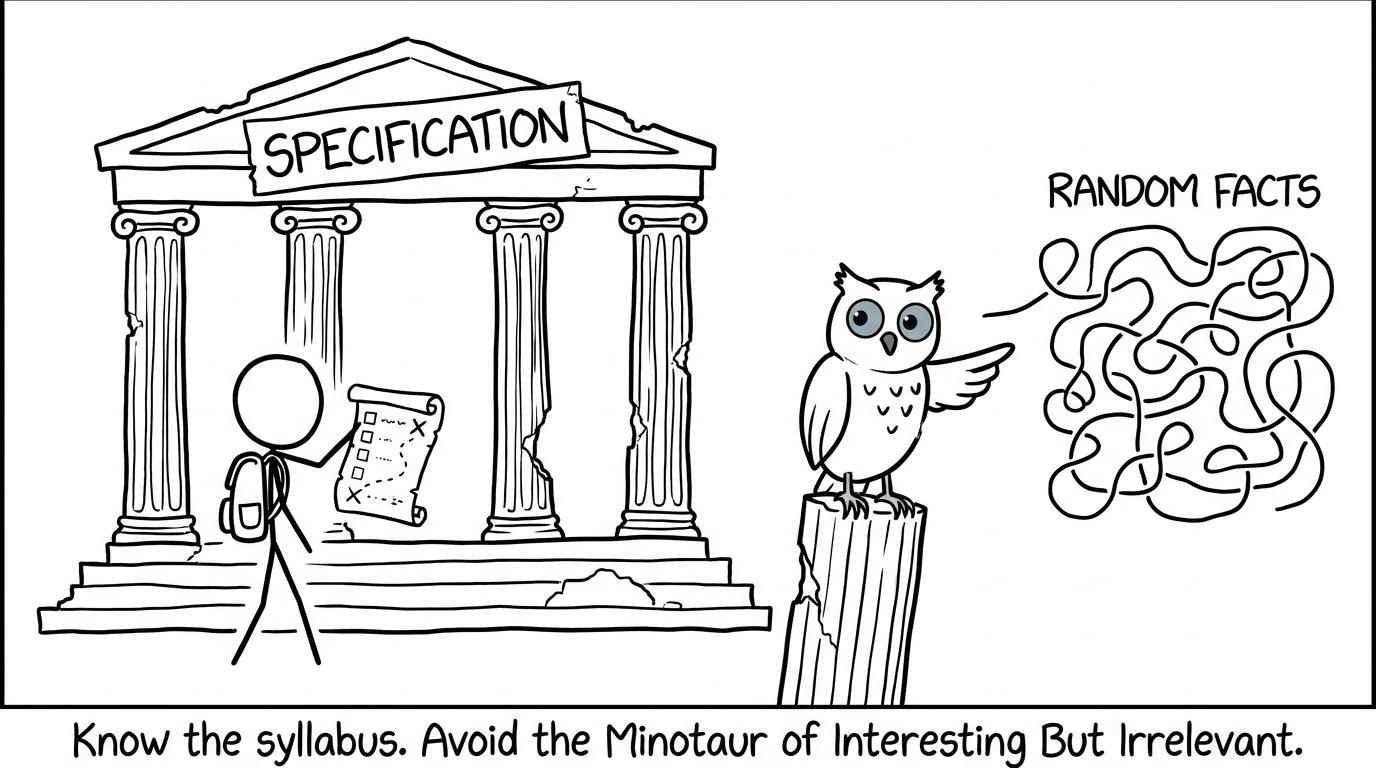 A student following the specification while avoiding a maze of irrelevant facts
A realistic twenty-week self-study plan
This plan assumes roughly three sessions per week: two sessions of about 454545 minutes and one longer session of 606060 to 909090 minutes. Reduce the volume during maths mock weeks rather than abandoning the course completely.
Weeks one to four: build the map
Week one: Download the current specification and assessment material. Confirm your two options, start contacting exam centres and create a checklist containing every specification bullet.
Week two: Gather the prescribed literary and visual sources. Divide both components into small topics. Create a calendar that includes school assessments, GCSE maths papers and holidays.
Week three: Survey the first half of your Thematic Study. Learn its chronology, geography and essential vocabulary. Keep notes short and tied to the specification.
Week four: Survey the second half. Attempt a few untimed short-answer questions to discover the level of factual precision required.
Weeks five to eight: learn the Thematic Study
Week five: Study the first Greek topic and its prescribed sources. For each source, record what it is, its context, what it suggests and where its usefulness may be limited.
Week six: Continue the Greek material. Begin closed-book retrieval at the start of every session instead of rereading yesterday's notes.
Week seven: Study the corresponding Roman material. Build direct comparisons as you go rather than leaving comparative thinking until the examination.
Week eight: Complete the remaining Roman content and write one extended response under a generous time limit. Mark it against the published criteria and improve it.
Weeks nine to twelve: learn Literature and Culture
Week nine: Establish the historical and social context for your chosen option. Study the first group of material or archaeological sources.
Week ten: Complete the culture material. Practise extracting specific evidence from images, buildings, objects or inscriptions rather than describing them vaguely.
Week eleven: Read the first half of the prescribed literature closely. Make brief notes on character, values, themes, context and memorable evidence.
Week twelve: Finish the prescribed literature. Test whether you can connect passages to the wider component without looking at your notes.
Weeks thirteen to sixteen: turn knowledge into answers
Week thirteen: Revisit weak areas in the Thematic Study. Complete mixed short questions and one source-based response.
Week fourteen: Practise comparative questions involving Greece and Rome. Organise answers around meaningful similarities and differences, not two disconnected mini-essays.
Week fifteen: Complete mixed Literature and Culture questions. Focus on using precise source evidence to support each claim.
Week sixteen: Sit one component under timed conditions. Mark it carefully and create an error log with three headings: missing knowledge, weak analysis and exam technique.
The same feedback principle works in maths. MathsGenie's guide to finding your weakest GCSE topics explains why errors should become specific next actions rather than disappointing totals.
Weeks seventeen to twenty: rehearse the examination
Week seventeen: Repair the three largest gaps from your timed paper. Return to the relevant sources, then answer fresh questions without notes.
Week eighteen: Sit the other component under timed conditions. Check pacing as well as content and analysis.
Week nineteen: Complete targeted practice on recurring weaknesses. Rehearse planning extended responses quickly and selecting evidence efficiently.
Week twenty: Sit both papers on separate days, review your error log and finish with light retrieval. Do not attempt to relearn the entire ancient world in the final evening.
How to balance Classics with GCSE maths
The hidden risk is not that Classical Civilisation is impossible. It is that an interesting extra subject quietly consumes the time needed for compulsory GCSEs.
Give each week a fixed Classics allowance. When it is used, stop. During a normal week, three focused sessions are enough to make progress. During maths mocks, one retrieval session may be enough to preserve continuity.
Keep your maths revision evidence-led. Start from the GCSE Maths revision hub, choose your exam board and tier, and use topic questions to address actual gaps. AQA students can use the AQA GCSE Maths revision resources, while Edexcel students can combine lessons with Edexcel GCSE Maths past papers.
A weekly rhythm might place Classical Civilisation on two quieter evenings and at the weekend, while maths receives shorter, more frequent practice. The GCSE maths revision timetable guide can help you build a schedule that includes rest and catch-up space.
The most effective independent study method
Use the same loop for every Classical Civilisation topic:
- Learn one narrow specification section.
- Retrieve its key knowledge without notes.
- Analyse at least one relevant source.
- Answer an examination question.
- Compare your response with the mark scheme.
- Record one precise improvement.
- Retest the material several days later.
This is slower than highlighting a chapter, but far more honest. Highlighting records what passed before your eyes. Retrieval and question practice reveal what you can actually produce.
When maths also needs attention, use similarly short feedback loops. MathsGenie's advice on when to start GCSE past papers shows how topic practice can gradually develop into timed papers. Nearer the examinations, Edexcel predicted papers can complement official papers without replacing specification-wide revision.
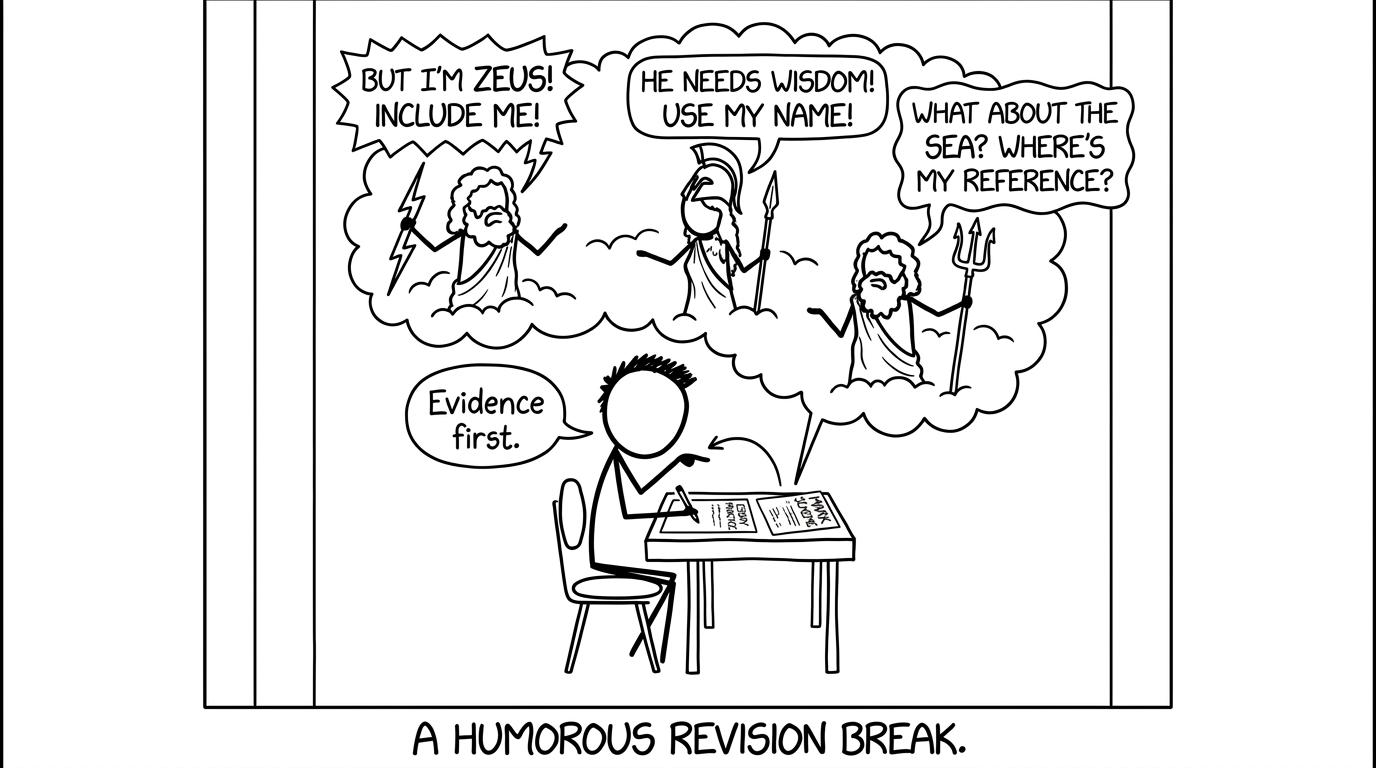 A student insisting on evidence while Greek gods argue above an essay
Common mistakes when studying alone
Treating the subject as general ancient history
The examination assesses specified content and sources. Interesting documentaries and books can enrich understanding, but they must not replace the official course map.
Memorising stories without analysing sources
Retelling a myth or plot may demonstrate some knowledge, but stronger answers explain how evidence supports an interpretation and acknowledge context or limitations.
Writing essays but neglecting shorter questions
Both papers contain different question styles. Lost factual marks accumulate quickly, so practise concise identification and explanation alongside longer arguments.
Waiting too long to use mark schemes
A mark scheme is not merely for calculating a score. It shows the distinction between knowledge, analysis and supported judgement. Use it while there is still time to change your approach.
Leaving exam entry until revision is complete
Entry is an administrative task with real deadlines. Arrange it near the beginning, confirm the correct option code and check your statement of entry.
Allowing the extra GCSE to displace maths
Classical Civilisation should fit around a sustainable core-subject plan. Use the GCSE one-month maths revision plan when exams approach, and reduce Classics sessions temporarily if your maths evidence shows urgent gaps.
A realistic final verdict
Self-studying GCSE Classical Civilisation is doable because the OCR course has clearly defined options, published prescribed sources and written examinations rather than coursework. But its accessibility should not be confused with ease. Success depends on disciplined source study, regular writing, accurate exam entry and a timetable that survives busy school weeks.
Begin with two actions: confirm an examination centre and turn the specification into a twenty-week checklist. Then protect your other GCSEs. For maths, make MathsGenie your free revision base: use revision lessons and practice questions to strengthen individual topics, mini tests to check progress, past papers and mark schemes to expose lost marks, and video solutions or predicted papers when you need focused exam preparation.
Ancient civilisations were built over time. A strong revision plan works the same way: one deliberate layer at a time.