

Revision Order GCSE Arabic: Does It Matter?
Revision order GCSE Arabic advice: learn when subject sequence matters, how to balance Arabic with maths, and build a calm, effective GCSE timetable.
The first slot in a revision timetable can feel strangely important. Put Arabic there and you may worry that maths will be neglected. Start with maths and you may reach Arabic when your concentration has already faded. So, does revision order for GCSE Arabic genuinely matter?
The short answer is: a little, but not in the way most students imagine. There is no universal rule that Arabic must come before or after maths. Order matters when it affects your concentration, the quality of your practice or how often you revisit each skill. Spacing, active recall and feedback matter far more than finding one supposedly perfect sequence.
The best order is therefore personal, purposeful and flexible. It should reflect your energy, weakest skills and approaching assessments rather than habit alone.
The quick revision order checklist
Before rearranging your entire timetable, ask:
- Which subject requires the most concentration today?
- Am I avoiding Arabic speaking or writing because it feels uncomfortable?
- Am I leaving maths until I am too tired to solve unfamiliar problems?
- Which examination or school assessment comes first?
- Have I revisited both subjects across the week?
- Does each session involve active practice rather than passive reading?
If your timetable answers those questions honestly, the exact order matters less.
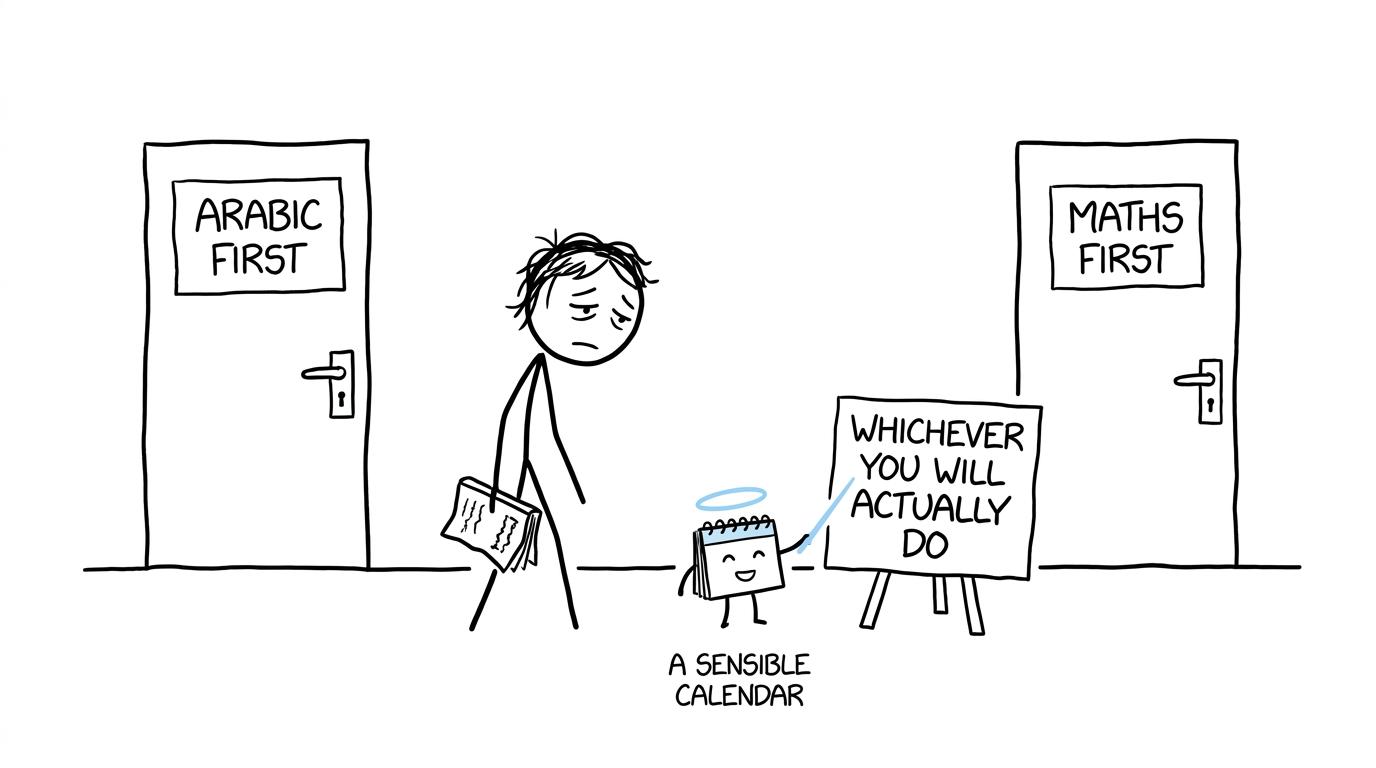 A student choosing between Arabic first and maths first while a calendar offers a more practical answer
When revision order for GCSE Arabic does matter
Order becomes useful when it protects the task that needs your best attention. A demanding Arabic writing task, for instance, may require vocabulary retrieval, accurate grammar and careful organisation. A difficult higher-tier maths session may require equally sustained reasoning.
If you usually concentrate best immediately after school, place the harder of those tasks first. If you need time to settle, begin with a short retrieval activity and move to the demanding task once you are focused.
Put Arabic first when it is being postponed
Students naturally prefer work that feels fluent. That can make a favourite maths topic or familiar vocabulary list attractive while Arabic speaking practice is repeatedly pushed to “later”. Later often disappears.
In that situation, Arabic should go first because the order removes avoidance. Begin with a precise task: record a speaking response, retrieve vocabulary without notes or plan one writing answer. Starting with “revise Arabic” is too vague to create momentum.
Put maths first when you need full problem-solving energy
Maths should take the first substantial slot when your planned work includes unfamiliar questions, a timed paper or a weak higher-tier topic. Concentration matters because genuine maths practice involves selecting methods, showing reasoning and checking whether an answer is sensible.
Use the GCSE Maths revision hub to choose a lesson or topic rather than losing time deciding what to revise. If you are unsure where the gaps are, the process in finding your weakest GCSE topics helps turn lost marks into a practical priority list.
Change the order as assessments approach
The current Pearson Edexcel GCSE Arabic specification assesses listening, speaking, reading and writing in four separate papers, each worth 25%25\%25% of the qualification. Speaking is assessed in the earlier April or May window, while the other assessments take place in May or June. Students take either foundation or higher tier across all four papers, and dictionaries are not permitted.
That structure gives order a real purpose. As your speaking assessment approaches, speaking practice may deserve the freshest part of the day. Later, the balance can move towards listening, reading and writing. Always check the current specification and dates supplied by your school because arrangements can change.
Maths deadlines deserve the same treatment. Once paper practice becomes a priority, use resources for your own board and tier. The MathsGenie revision planner can help you see the week as a whole rather than letting the nearest worry consume every session.
When subject order is mostly irrelevant
Suppose one student revises Arabic before maths and another does the reverse. Both complete focused practice, check their work and return to each subject several days later. There is little reason to assume that the sequence alone will separate their results.
Research-informed guidance from the Education Endowment Foundation and government teacher-development resources supports spaced practice and retrieval rather than relying on rereading. The evidence does not establish a special Arabic-before-maths rule. What matters is that learning is distributed over time and that students actively recall and apply what they know.
This is reassuring. You do not need to solve your timetable as if there were one hidden correct answer. A workable plan repeated consistently is more valuable than an elaborate plan repeatedly redesigned.
Build your timetable around energy, not superstition
A useful timetable has three types of session:
- High-energy work: Arabic writing or speaking, unfamiliar maths problems and timed paper sections.
- Medium-energy work: reading comprehension, maths topic practice and error correction.
- Lower-energy work: vocabulary retrieval, reviewing an error log or organising the next session.
Place high-energy work when you are usually most alert. This might be early evening, but it could be later for you. Judge it from experience rather than copying somebody else's routine.
Do not label an entire evening “Arabic” or “maths”. Give each block an observable result. “Complete and mark one maths mini test” is clearer than “do maths”. “Record two Arabic speaking answers without a script” is clearer than “learn speaking”.
MathsGenie's guide to a realistic GCSE maths revision timetable explains how to combine topic learning, question practice and timed work without filling every spare hour.
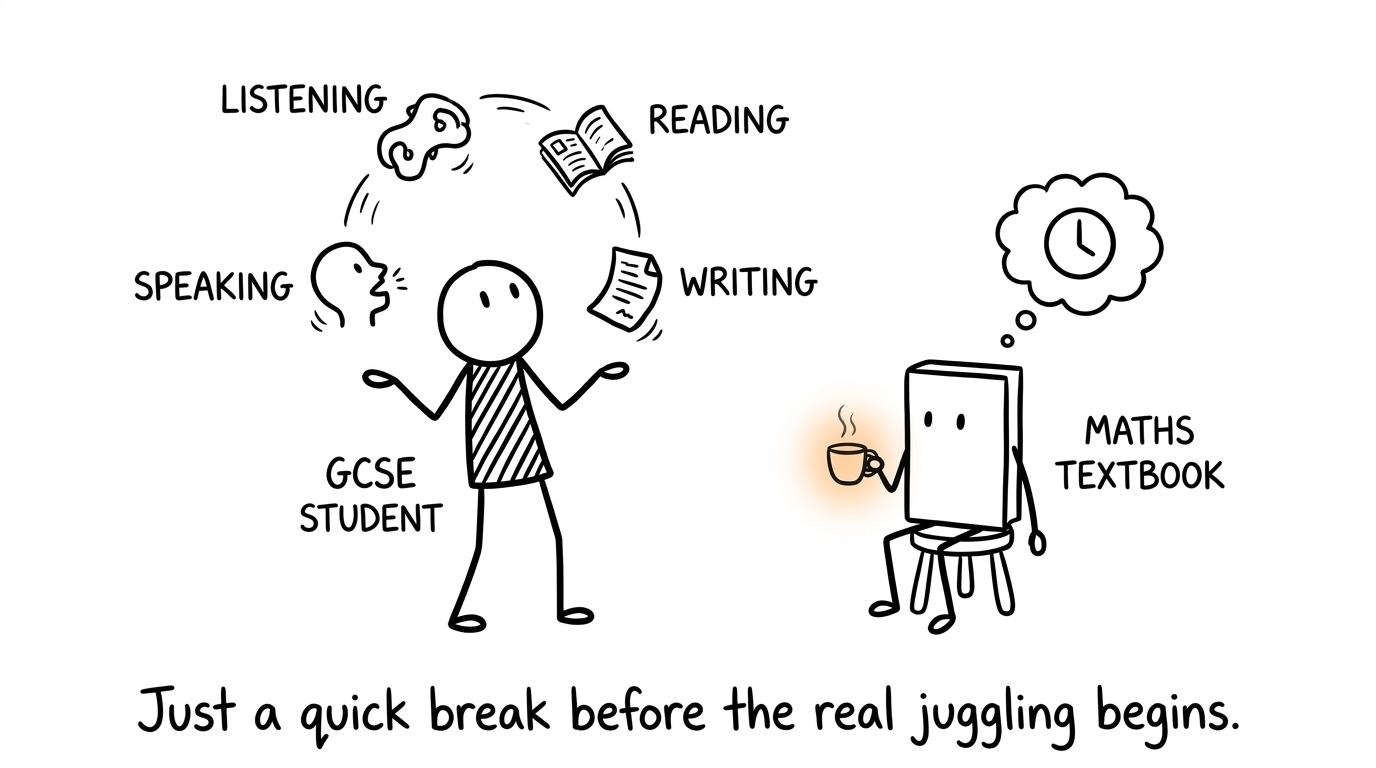 A student juggling the four Arabic skills while a maths book waits with tea
Rotate the four Arabic skills instead of treating them as one subject
GCSE Arabic is not a single revision activity. Listening, speaking, reading and writing place different demands on you, even when they share themes and vocabulary.
Listening and speaking
Listening practice requires close attention, so it is usually poor end-of-evening work if you are already exhausted. Listen without a transcript first, answer the questions and then use the transcript to identify what prevented understanding.
Speaking improves through retrieval aloud. Reading a polished answer silently can create familiarity without proving that you can produce it. Practise responding without a full script, record yourself and note where vocabulary or structures disappear under pressure.
Reading and writing
Reading can work well after a short maths block because it changes the type of thinking required. However, it must still be active: answer questions, infer meaning from context and check precisely why an answer was wrong.
Writing often deserves an early slot. It combines vocabulary, grammar, accuracy and communication, so it is easy to underestimate. Alternate shorter plans with timed responses and use your teacher's feedback to identify recurring problems.
Across the week, all four skills should return. One long Sunday session cannot replace repeated contact with the language.
A practical way to pair Arabic and maths
The two subjects can complement each other because switching between them changes the mental task. A focused Arabic block followed by maths questions may feel fresher than extending either subject beyond the point of useful concentration.
Try this sequence:
- Start with brief retrieval from yesterday's subject.
- Complete the day's most demanding task.
- Take a genuine break away from the desk.
- Switch subject and complete a smaller active task.
- Mark or review both while the decisions are still fresh.
- Schedule the next revisit before finishing.
Reverse the subject order on another day. This makes the plan robust: neither subject is permanently assigned to your tired hours.
For mathematics, a short session can still have structure. The 20-minute GCSE maths revision routine combines recall, exam-style questions and marking. Longer sessions can use Edexcel GCSE maths past papers, or the appropriate collection for AQA, OCR or Eduqas through the main revision hub.
Past papers should not simply occupy time. Attempt them under suitable conditions, use the mark scheme, identify the topic behind each lost mark and then repair that skill. The guide to using GCSE past papers properly sets out that cycle clearly.
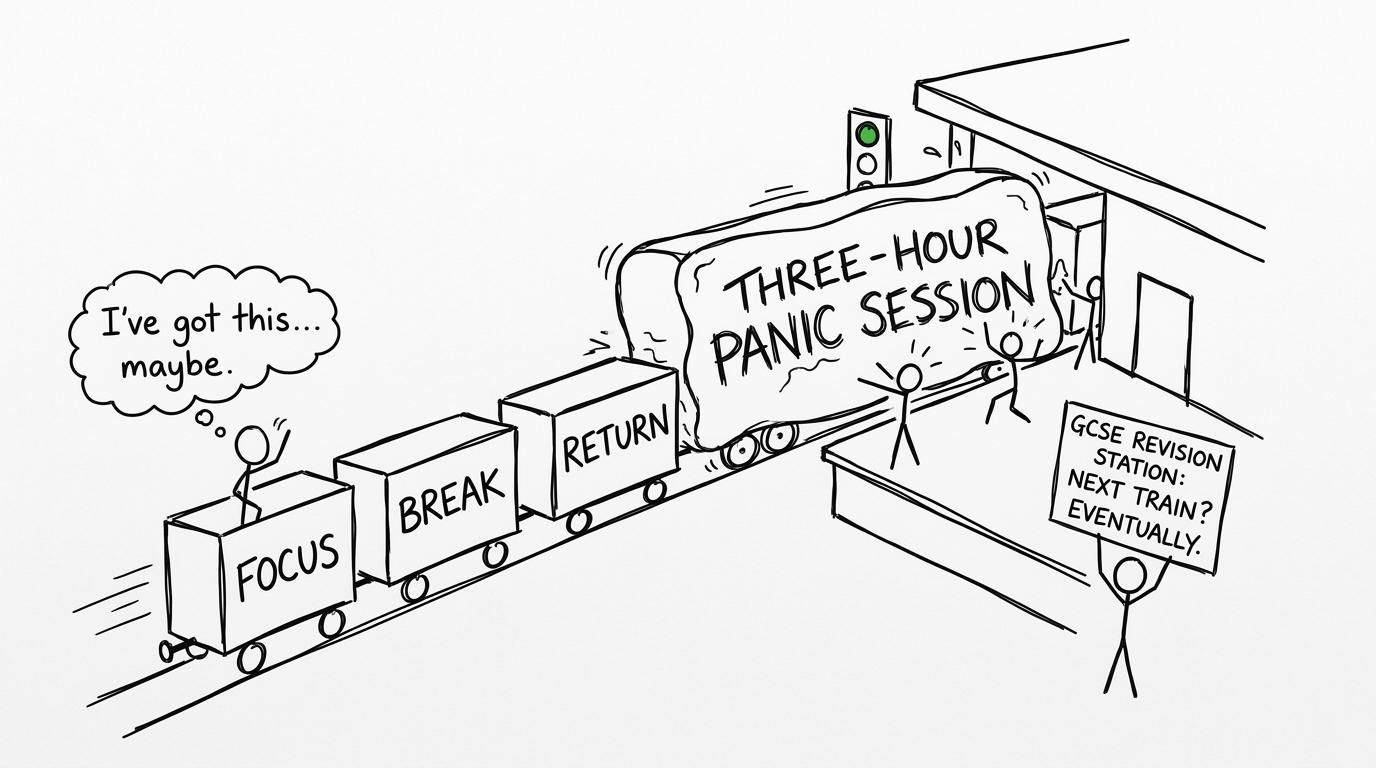 A sensible revision train leaving an enormous panic session behind at the station
Common revision-order mistakes
Always putting your favourite subject first
Starting comfortably can build momentum, but it can also protect the work you already enjoy while difficult tasks remain untouched. If Arabic is repeatedly postponed, give it the first focused block on selected days.
Giving one subject every high-energy slot
If maths is always first and Arabic is always last, the timetable contains a hidden judgement about importance. Alternate priority slots so both subjects sometimes receive your best concentration.
Confusing time spent with work completed
A long session of rereading may feel serious while producing little evidence of recall. Define each session by an output: questions answered, speaking recorded, vocabulary retrieved or mistakes corrected.
Revising all Arabic skills in one block
The four papers require distinct practice. A timetable that says only “Arabic” may drift towards the easiest skill. Name the skill and task before you begin.
Changing the plan after one unproductive day
Fatigue, homework and school events will occasionally disrupt revision. That does not prove the whole order is wrong. Review the pattern after a week, not after one difficult evening.
The best order is the one that protects good practice
There is no academic advantage in placing GCSE Arabic first every day, nor in always saving it until after maths. Revision order matters only when it changes the quality, frequency or timing of your practice.
Give approaching assessments and difficult tasks access to your strongest concentration. Rotate Arabic's four skills. Revisit material across several days. Keep maths active through lessons, exam questions, mark schemes and timed papers. Most importantly, build a plan you can continue when motivation is ordinary rather than exceptional.
Start today with the free MathsGenie GCSE revision resources. Choose one revision lesson, complete the related practice questions and mark them carefully. Then schedule your next Arabic task. As the exams approach, add mini tests, past papers, predicted papers and video solutions so that each revision block has a clear purpose, whichever subject comes first.










