Revising GCSE Arabic With Music: Does It Help?
Revising GCSE Arabic with music can distract from vocabulary and reading. Learn when silence, instrumentals or music breaks work best for focus and recall.
Is music helping your revision or sharing your attention?
You open your Arabic vocabulary list, put on a familiar playlist and settle down to revise. The room feels less quiet. Starting feels easier. But twenty minutes later, which words can you actually remember?
The practical answer is that revising GCSE Arabic with music is usually less effective when the music contains lyrics, particularly during vocabulary learning, reading, translation and writing. Silence is the safest choice for demanding language work. Quiet instrumental music may be acceptable if it helps you begin or remain settled, but research does not show that it reliably improves learning.
That distinction matters. Music can make revision feel better without making recall better. Enjoyment is useful when it gets you to the desk, but the exam rewards what you can understand and produce when the playlist is gone.
The same principle applies to students balancing Arabic with GCSE maths. Use music deliberately rather than automatically, and judge it by your accuracy, recall and concentration, not simply by how pleasant the session felt.
The quick music and revision checklist
Before pressing play, ask:
- Does the task involve words, meaning or memorisation? Prefer silence.
- Does the music contain lyrics in any language you understand? Turn it off.
- Are you completing listening practice? Use only the assessment audio.
- Are you doing a timed paper? Recreate quiet exam conditions.
- Is the task simple organisation, such as sorting notes? Music is less likely to matter.
- Do you need music to get started? Use one song before beginning, then stop it.
- Are instrumentals genuinely helping? Compare your results with a silent session.
The goal is not to prove that music is always good or always bad. It is to choose the environment that fits the task.
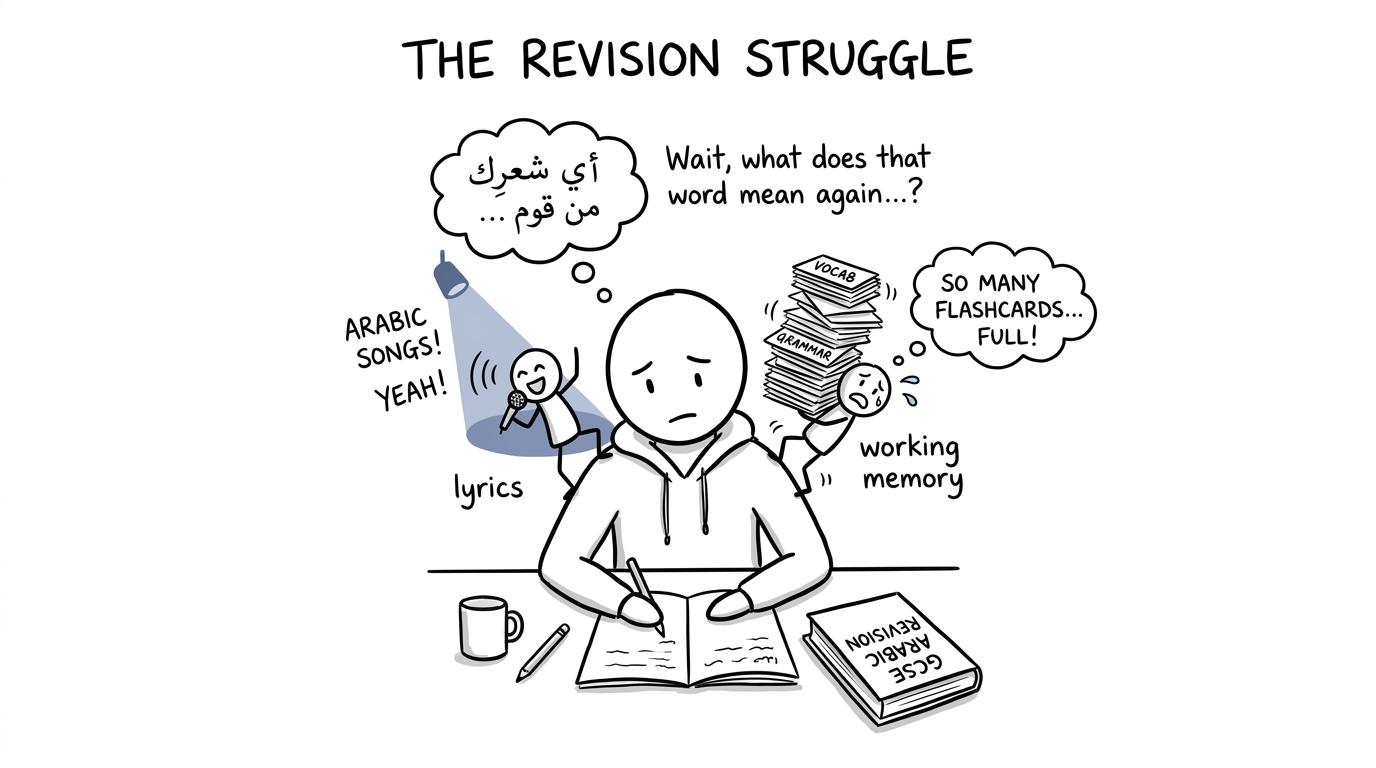 A GCSE student's working memory struggles while song lyrics compete with vocabulary revision
What research says about background music and focus
Research into background music is mixed because the answer depends on the music, the task and the listener. However, several patterns are reasonably consistent.
A large systematic review covering research across memory, language, attention and problem-solving found that background music tended to be detrimental for memory and language-related tasks. Music with lyrics was more likely to interfere than instrumental music, while difficult tasks were generally more vulnerable than easy ones.
A controlled study comparing silence, instrumental lo-fi music and lyrical music found that lyrics harmed verbal memory, visual memory and reading comprehension. Instrumental music did not reliably improve or damage performance. This is an important result for students: feeling that an instrumental playlist helps is not the same as demonstrating better learning.
Research published in 2024 also found that pop music with lyrics reduced reading comprehension compared with silence. In that study, interference was stronger when the language of the lyrics matched the language being read. These findings came from university-age participants rather than GCSE Arabic candidates, so they should not be treated as a precise prediction of an individual student’s grade. They do, however, support a sensible rule: when the task depends heavily on language, avoid adding another stream of language.
Why lyrics are particularly risky for GCSE Arabic
GCSE Arabic revision asks your attention to handle vocabulary, script, grammar, meaning and recall. Lyrics introduce more words for your mind to process, even when you are trying to ignore them.
Vocabulary and spelling
Learning vocabulary is not passive exposure. You must retrieve a meaning, recognise the written form and often reproduce the spelling accurately. A familiar chorus can compete with that verbal process.
This is especially relevant when learning similar words, verb forms, gender agreements or precise spellings. The harder the distinction, the less spare attention you have for a song.
For vocabulary sessions, use silence while testing yourself. Music can be saved for the break after a completed set.
Reading and translation
Reading Arabic requires you to follow meaning across a sentence rather than identify isolated words. Translation adds another demand because you must move accurately between languages while preserving tense, detail and tone.
Lyrics can slow reading and encourage small lapses: skipping a negative, overlooking a time phrase or settling for the general meaning instead of the exact one. These errors may feel minor during revision, but they are precisely the details on which exam marks can depend.
Writing
Writing requires planning and monitoring at the same time. You are choosing vocabulary, checking grammar, varying structures and making sure the response answers the task. Music with lyrics creates another verbal track beside your own internal sentence.
Use silence for extended responses and translation into Arabic. If you enjoy music during preparation, switch it off before you begin composing the answer.
Listening and speaking
Background music should never accompany listening practice. The assessment is testing spoken Arabic, so an unrelated soundtrack changes the task and may hide sounds, endings or key details.
Speaking practice also benefits from a clean audio environment. You need to hear your pronunciation, pauses and fluency. Record yourself without background music, listen back and repeat the response more clearly.
Under the current Pearson Edexcel GCSE Arabic specification, listening, speaking, reading and writing each contribute 25%25\%25% of the qualification, with Foundation and Higher tier papers. Your revision environment should therefore support all four skills rather than make one of them feel more entertaining.
When instrumental music may be reasonable
Instrumental music is usually less distracting than songs with lyrics, but “less distracting” does not automatically mean “helpful”. It may be reasonable when:
- the task is routine and already secure;
- the volume is low and consistent;
- the track is familiar enough not to demand attention;
- the music reduces distracting environmental noise;
- you can work without changing tracks or checking your phone.
Avoid dramatic film scores, sudden changes in volume and highly energetic tracks. Music that repeatedly captures your attention is no longer functioning as background sound.
Instrumentals may also help with the transition into revision. For example, you might play quiet music while arranging resources, setting a target or reviewing yesterday’s error list. Once retrieval or exam-style work begins, move to silence.
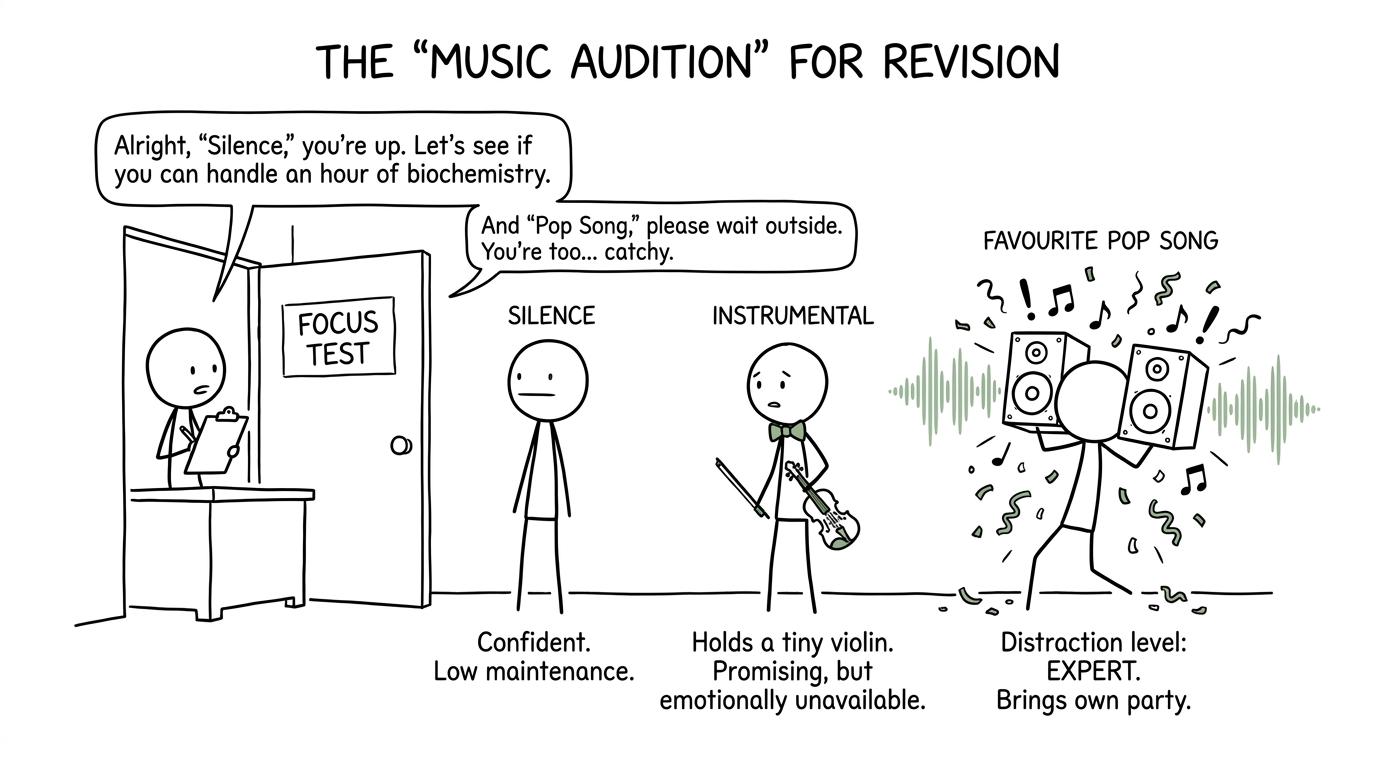 Silence, instrumental music and a favourite pop song audition for a place in a revision session
Test what works instead of trusting the feeling
Students respond differently to background sound, so a small personal comparison is more useful than a strong opinion.
Choose two similar Arabic vocabulary sets. Learn one in silence and the other with your normal background music. Keep the time, difficulty and testing method as similar as possible. Test both sets immediately, then test them again the next day without music.
Record:
- how many meanings you recalled correctly;
- how many spellings were accurate;
- how long the task took;
- how often you changed tracks or touched your phone;
- how many words survived the delayed test.
Do not judge the conditions only by which felt easier. Learning often feels smooth when the material is familiar or when the environment is enjoyable. Delayed recall gives you better evidence.
This evidence-first approach also works for maths. Start with the GCSE Maths revision hub, complete comparable question sets in silence and with music, then compare accuracy and concentration. Maths contains fewer verbal demands than Arabic vocabulary, but multi-step reasoning, worded questions and unfamiliar problems still need undivided attention.
Match the sound to the stage of revision
A useful routine separates preparation, learning, testing and rest.
Before the session
Music is unlikely to damage learning while you organise books, select a task or prepare flashcards. If a favourite song helps you move from procrastination to action, use it as a starting signal rather than a permanent soundtrack.
For maths, a realistic plan reduces the temptation to spend the session choosing what to do. MathsGenie’s GCSE maths revision timetable guide explains how to combine topic work, marking and timed practice.
During active learning
Turn lyrical music off for vocabulary retrieval, reading, translation, writing and difficult grammar. If silence feels uncomfortable, try quiet instrumental audio at a low volume, but keep checking performance.
The same applies when using MathsGenie revision lessons and practice questions. Learn one method, close the explanation and attempt questions independently. The guide to finding your weakest GCSE topics can help you direct that concentration towards skills that actually cost marks.
During testing
Use silence. A practice paper is partly a test of knowledge and partly rehearsal for the real environment. Music can become a cue that you will not have in the examination.
For maths, GCSE mini tests provide a manageable way to practise quiet, focused retrieval. When you are ready for longer work, follow the MathsGenie past-paper method: attempt, mark, repair the weak topic and retest.
During breaks
This is where your playlist can help without competing with learning. Stand up, move away from the desk and listen to a song. A defined break is better than repeatedly leaving the task to choose another track.
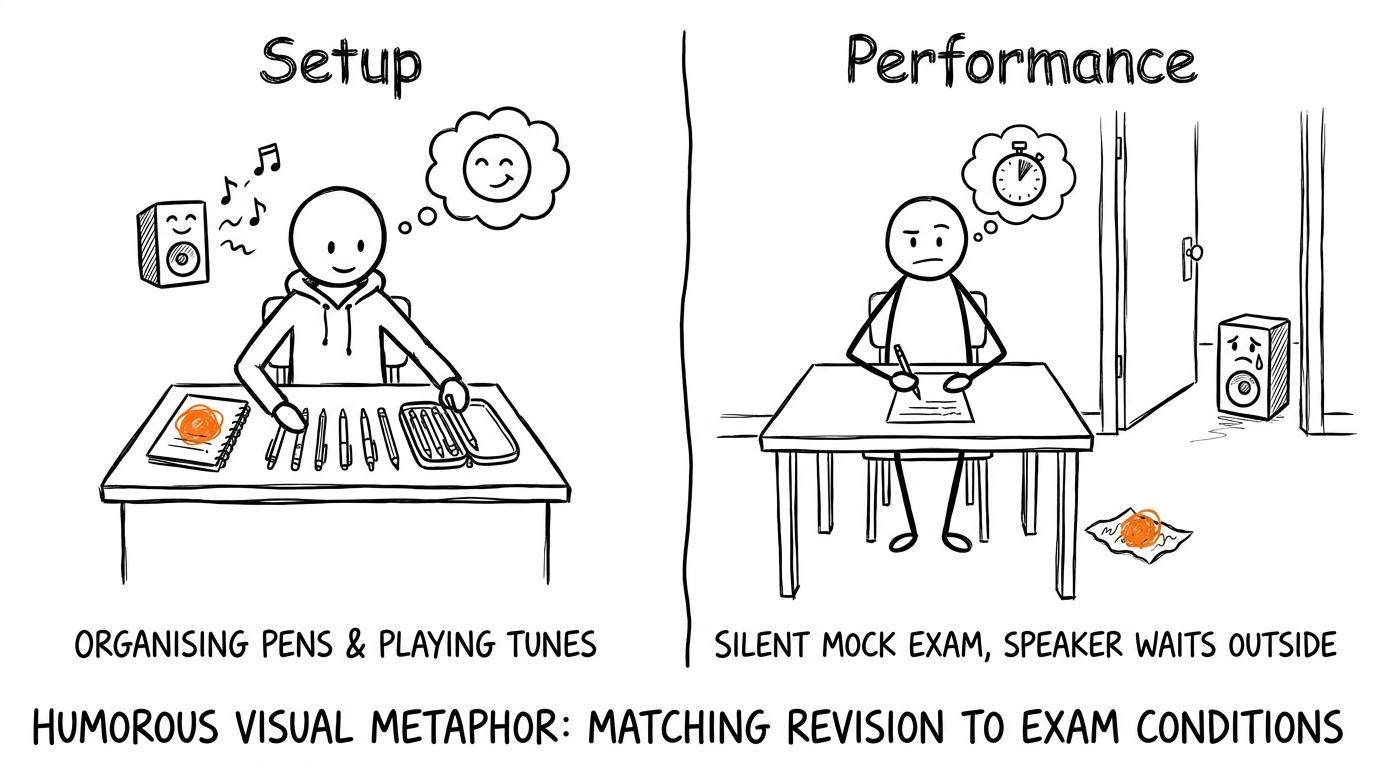 A student uses music for setting up but sends the speaker away for silent exam practice
Build revision that transfers to the exam
There is a quiet trap in revision: becoming good at performing only under your favourite conditions. If every vocabulary test happens with headphones, every maths question happens with a playlist and every difficult moment leads to changing tracks, the routine is training dependency as well as knowledge.
You do not need every session to resemble an examination. Early learning can be flexible. But the closer you get to assessments, the more of your practice should happen quietly, with a timer, no phone and no hints.
MathsGenie’s GCSE predicted papers are useful for this transition in maths. Choose the correct board and tier, whether Edexcel, AQA, OCR or Eduqas, complete the paper in silence, then use the mark scheme and video solutions to diagnose mistakes. If the exam is approaching quickly, the one-month GCSE maths revision plan shows how to combine focused practice with timed papers.
For Arabic, apply the same pattern using resources provided by your school and exam board: complete skill-specific practice, mark it carefully and revisit the exact vocabulary or grammar that caused the error.
Common mistakes when revising with music
Choosing songs because they are familiar
Familiar lyrics can be more tempting to follow, not less. Knowing every word does not make the song cognitively silent.
Playing Arabic songs during Arabic revision
Arabic music may be valuable as separate cultural or listening exposure, but it is not neutral background sound. During vocabulary, reading or writing, Arabic lyrics can compete directly with the language you are trying to process.
Letting the playlist control the session
Searching for songs, skipping tracks and responding to notifications fragments attention. If you use instrumentals, prepare a fixed playlist and keep the phone out of reach.
Using music during every task
Copying headings and retrieving unfamiliar vocabulary do not place the same demands on attention. Make the decision task by task.
Never practising in silence
GCSE examinations do not include a personal soundtrack. Timed work should increasingly match the conditions in which you must perform.
Confusing concentration with comfort
A session can feel calm yet produce weak recall. Use marked work, delayed testing and an error log as evidence.
Make music a tool, not the default
The best answer is not a dramatic ban on headphones. It is a more careful habit.
For demanding GCSE Arabic tasks, silence is the strongest default. Instrumental music may be tolerable for routine work or useful when beginning a session, but lyrical music is more likely to interfere with vocabulary, reading and writing. Keep music for preparation and breaks, then practise the skills that matter under quiet conditions.
Apply the same discipline to maths revision. Open the MathsGenie GCSE Maths area, choose your board and tier, and begin with one revision lesson or set of practice questions. Mark the work, use video solutions where necessary, then retest with mini tests, past papers or predicted papers.
A playlist can change the atmosphere. Focused practice changes what you can do. When exam day arrives, that is the difference that earns marks.