

Revising Before Bed for GCSE Arabic: Help or Hurt?
Revising before bed GCSE Arabic can aid recall if it stays short and protects sleep. Learn what to review, when to stop and how to plan revision.
There is a familiar kind of revision panic that arrives late at night. Your Arabic vocabulary list is still open, tomorrow's maths tasks are unfinished, and stopping feels suspiciously like giving up.
So, does revising before bed GCSE Arabic content help? A short, calm session can support recall when it is followed by sufficient sleep. But revision becomes counterproductive when it delays bedtime, raises anxiety or turns into an unfocused hour on your phone. Sleep helps to stabilise newly learned material; it cannot rescue information that was barely understood, and sacrificing sleep may weaken attention and recall the next day.
The practical answer is simple: use the evening for light retrieval, stop before you become overtired, then sleep. Learn difficult material earlier in the day.
The quick bedtime revision checklist
Before revising late, ask:
- Am I testing myself rather than simply rereading?
- Can I finish in about 101010 to 202020 minutes?
- Do I already understand the material?
- Will I still have enough time to sleep properly?
- Can I revise away from my bed and ideally without a bright screen?
- Have I chosen one small task rather than an entire topic?
If the answer to several of these is no, sleep is probably the better choice. This is the same principle behind a sensible GCSE maths night-before plan: reduce decisions, protect your stopping time and avoid trying to rebuild a whole course after dark.
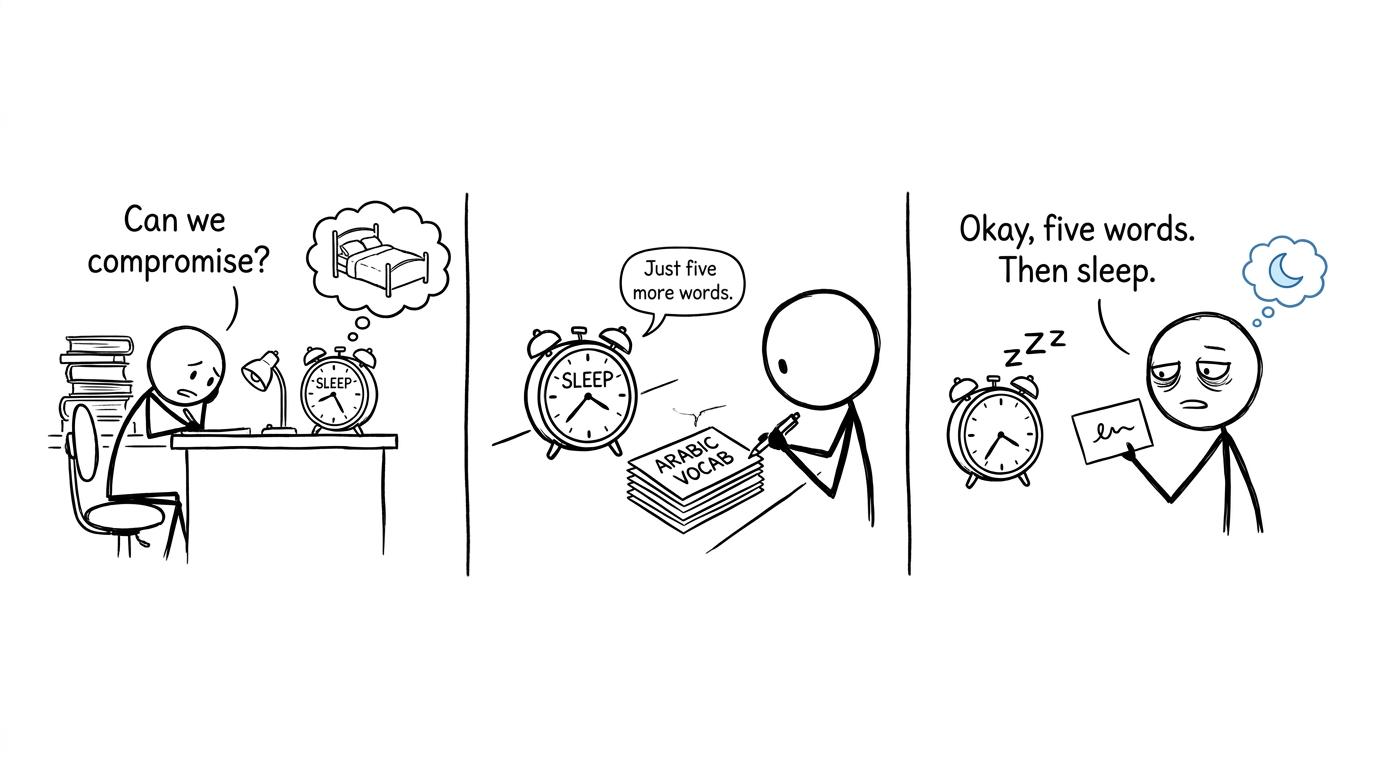 A tired student negotiating with an alarm clock and Arabic vocabulary cards
Why revision before sleep can help memory
Learning does not end when you close the book. After information is first encoded, the brain continues processing and stabilising it. Sleep is involved in this process, which is known as memory consolidation.
This makes bedtime revision sound like a shortcut: learn a list, fall asleep and wake up knowing it. The evidence is more nuanced.
Research involving adolescents supports the broader conclusion that sleep can help retain newly learned information. Recent work on vocabulary learning has also found benefits from learning before sleep. However, earlier controlled research comparing afternoon and late-evening learning found that word-pair memory was not always better when learning happened immediately before bed. Different kinds of memory, task difficulty, prior knowledge and sleep quality can all affect the result.
The reliable lesson is therefore not that the final minutes before sleep are magical. It is that sleep after learning matters, and shortening that sleep to squeeze in more revision is a poor trade.
Arabic vocabulary is suited to brief retrieval
GCSE Arabic requires knowledge that can benefit from repeated recall, including:
- vocabulary across specification themes;
- common verb forms and sentence structures;
- accurate recognition of written words;
- phrases for speaking and writing;
- meanings heard in short listening extracts.
A brief review can reactivate this material before sleep. Cover the English meaning and retrieve it, reverse the direction, or say a phrase aloud from memory. The effort of recalling is more useful than looking at a word and thinking it seems familiar.
This principle also matters in maths. Recognising a formula is not the same as being able to choose and use it. MathsGenie's GCSE maths revision hub combines lessons, questions, flashcards and papers so that recognition can become independent recall.
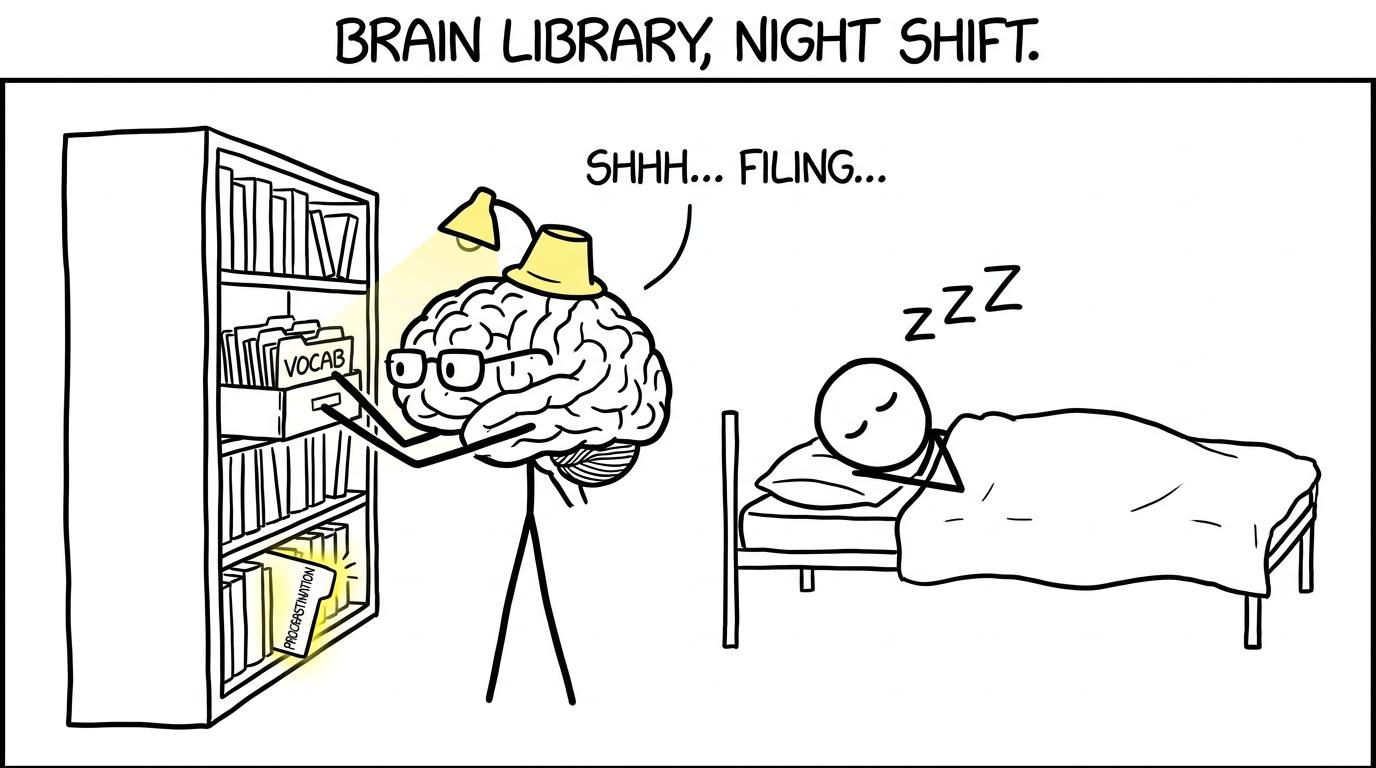 A stick-figure brain acting as a night-time librarian for vocabulary cards
When late-night GCSE Arabic revision hurts
The phrase "before bed" can describe two very different routines. One is a focused review followed by sleep. The other is an open-ended session that keeps moving bedtime later. Only the first has a reasonable chance of helping.
It costs you sleep
Most teenagers need substantial sleep, with NHS guidance commonly placing the healthy range around 888 to 101010 hours. Individual needs vary, but repeatedly cutting sleep short can affect alertness, concentration and mood.
Those effects matter across the Arabic papers. Listening requires sustained attention. Reading demands careful discrimination between similar forms and meanings. Speaking relies on retrieval under pressure. Writing requires vocabulary, grammar and planning to work together.
They matter equally in maths, where a tired student may misread a condition, overlook a negative sign or struggle to hold several stages of a problem in working memory. One more hour at the desk is not automatically one more hour of useful learning.
The task is too demanding
Late evening is not the best time to begin an unfamiliar grammar point, write a complete response or attempt a full listening paper. These tasks need sustained attention and feedback.
Use earlier sessions for learning and application. Save the final review for material that is already partly known. A useful division is:
- Earlier revision: new vocabulary, grammar, extended writing, listening practice and corrections.
- Pre-bed review: short retrieval, a few troublesome phrases and a quick check of previous errors.
For maths, the equivalent is using a focused 20-minute GCSE maths revision routine earlier, rather than opening a full paper when you should be winding down.
Screens turn revision into delay
A vocabulary app may be useful, but the same phone also carries messages, videos and notifications. NHS sleep guidance encourages teenagers to create a screen-free wind-down period and maintain regular sleeping hours. The problem is not only light; stimulating content and endless scrolling can also delay the moment you stop.
If possible, use paper flashcards or a small notebook. If you must use a device, remove notifications, set a firm timer and keep the task narrow. Do not revise in bed. Let the bed remain a cue for sleep rather than a second desk.
A better evening plan for Arabic and maths
The best plan separates serious revision from the final wind-down.
Complete demanding work earlier
Do your Arabic listening, writing and grammar practice while you still have enough attention to learn from mistakes. Complete maths problem-solving and paper practice earlier too, using resources matched to your board and tier.
MathsGenie provides dedicated collections of Edexcel GCSE maths past papers and AQA GCSE maths past papers, while students following OCR can begin with the OCR GCSE maths revision hub. Past papers belong in alert revision time, not in the final few minutes before sleep.
Choose one Arabic retrieval target
A bedtime task should be small enough to finish. Choose one of the following:
- a compact set of vocabulary you have met before;
- several phrases for one speaking theme;
- a few verbs that you commonly confuse;
- corrections from a previous writing task;
- words missed in an earlier listening activity.
Try to retrieve each item before checking it. Separate secure items from uncertain ones. The uncertain set becomes tomorrow's starting point.
Stop deliberately
Finish at the time you planned, even if the list is incomplete. An unfinished list is useful information for tomorrow, not a command to remain awake.
Set out what you need for the morning, write down the first task for the next day, then begin your normal wind-down. Avoid caffeine late in the day and seek support from a parent, carer, school or GP if sleep difficulties are persistent or affecting daily life.
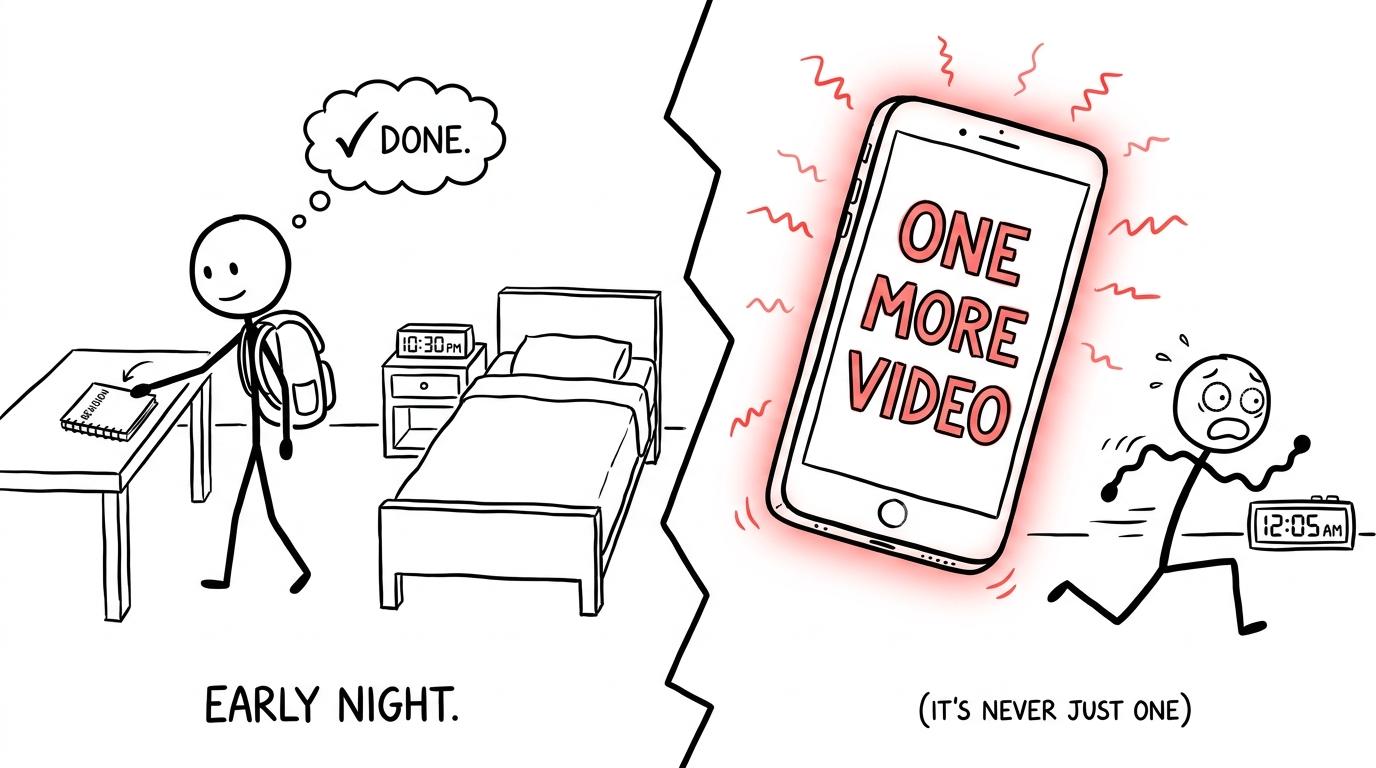 A calm student heads to bed while a giant phone offers one more video
Match revision to the GCSE Arabic assessment
For Pearson Edexcel GCSE Arabic, the qualification assesses listening, speaking, reading and writing in four externally examined papers. Each skill contributes 25%25\%25% of the qualification, and students enter either foundation or higher tier across all papers. Always check the current specification and instructions provided by your school.
That balance matters. Vocabulary cards are useful, but vocabulary-only revision cannot prepare you fully for all four skills.
Listening and reading
Use active comprehension practice earlier in the day. After marking, collect the small number of words or structures that blocked your understanding. Those specific items are suitable for a brief evening review.
Speaking and writing
Practise producing language, not merely recognising it. Earlier sessions should include complete spoken or written responses followed by correction. At night, retrieve a few adaptable phrases or accurate structures from memory. Avoid memorising a long script without understanding how it works.
This attempt-mark-correct cycle resembles effective maths revision. A GCSE maths revision timetable can help you distribute demanding work across the week instead of allowing every subject to compete for the same late-night hour.
Common mistakes when revising before bed
Treating tired rereading as learning
Familiarity can feel like knowledge. Close the notes and retrieve first. If nothing comes back, check briefly and schedule proper practice for tomorrow.
Starting without a stopping time
"I will revise some Arabic" has no boundary. Choose a small target and a fixed finish. Your plan should protect sleep, not depend on willpower at midnight.
Learning a large new list
A long unfamiliar list creates interference and frustration. Review a limited set already encountered, then revisit it on later days. Spacing matters more than one heroic session.
Using bedtime revision instead of exam practice
Flashcards cannot replace listening, speaking, reading and writing tasks. Nor can formula recall replace mathematical problem-solving. Use GCSE predicted topics guidance and predicted papers to focus maths practice, but treat predictions as extra preparation rather than guarantees.
Sacrificing sleep because the exam is close
The night before an exam is not the moment to repay weeks of missed revision. Check a few secure facts, prepare your equipment and stop. A rested mind with partial knowledge is usually more useful than an exhausted mind that has seen more pages.
The verdict: help memory without borrowing from sleep
Revising GCSE Arabic immediately before bed can help when it means a short session of active recall followed by sufficient sleep. It hurts when it becomes cramming, screen time or a reason to postpone bedtime. The strongest principle is not "revise as late as possible". It is "learn actively, revisit briefly and protect sleep".
Apply the same discipline to maths. Use MathsGenie's free revision lessons and practice questions to learn during your alert hours, then build exam technique with mini tests, past papers, predicted papers, mark schemes and video solutions. Organise the work with a realistic revision plan, and let bedtime remain what makes tomorrow's revision possible.











