Revise Your Weakest GCSE Statistics Topic First?
Revise weakest topic first GCSE Statistics: decide when to tackle difficult areas, plan each session and turn weak spots into dependable exam marks.
Revision often begins with a quiet negotiation. You know which statistics topic needs attention, but an easier worksheet feels more inviting. You promise to face the difficult material at the end. Then the session runs long, concentration fades, and the weak topic survives untouched.
So, should you revise weakest topic first GCSE Statistics? Usually, yes, but not necessarily in the first minute. The most effective order for many students is a short warm-up, followed by the weakest topic while attention is still strong, then a brief mixed review at the end. This gives difficult work protected time without asking a cold brain to begin with the most intimidating question on the page.
The principle applies whether you mean the statistics strand within GCSE Maths or a separate GCSE Statistics qualification. Your exact content will depend on your specification, exam board and tier.
The short answer: use a revision sandwich
A sensible statistics session has three parts:
- Warm up: spend about 555 minutes retrieving something familiar without notes.
- Repair: give the weakest topic the main 202020 to 303030 minute block.
- Check: finish with a short question from an older topic or a mini test.
This is better than always leaving the difficult topic until last. Starting with a brief success reduces friction, but moving quickly to the weakness prevents comfortable tasks from consuming the whole session.
If you are unsure what your weakest area really is, use a marked paper rather than instinct. The MathsGenie guide to finding your weakest GCSE topics explains how to turn lost marks into a focused revision list.
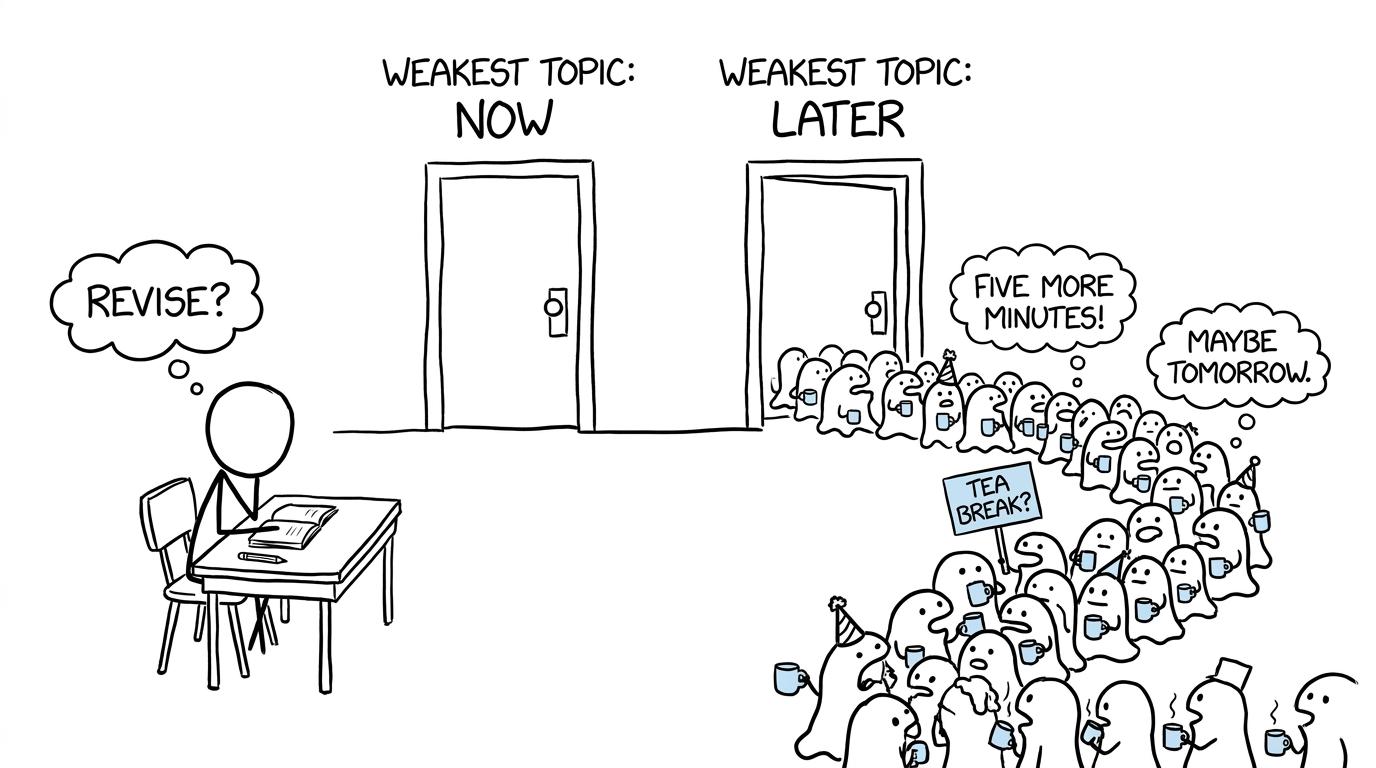 A student choosing between revising a weak topic now and joining the long queue for later
Why tackling the weakest topic early usually works
The main advantage is not that the clock possesses special learning powers. It is that priorities become real only when they receive protected time.
Your attention is usually less fragmented
At the beginning of a planned session, you have not yet spent half an hour checking answers, changing resources or deciding what to do next. That makes early attention valuable. A topic such as cumulative frequency, sampling, histograms or interpreting scatter graphs may require several connected decisions. It deserves more than the final tired minutes.
This does not mean every student concentrates best at the same time of day. It means that within your chosen revision period, the difficult task should normally appear before your energy noticeably declines.
Weak topics offer greater potential mark gains
Practising a topic you already answer accurately may maintain fluency, but it has limited immediate upside. A genuine weakness contains more recoverable marks.
You can estimate the size of a gap using:
gap rate=marks lost on the topicmarks available on the topic\text{gap rate}=\frac{\text{marks lost on the topic}}{\text{marks available on the topic}}gap rate=marks available on the topicmarks lost on the topicDo not trust this calculation after a single tiny question. Look across several exam-style questions or more than one paper. A repeated pattern is better evidence than one careless error.
Official GCSE mathematics content expects students to do more than calculate. Statistics questions can require students to represent data, compare distributions, interpret results, discuss sampling and draw conclusions. A weakness may therefore be about reasoning or communication rather than remembering a procedure.
Early practice exposes the real problem
“I am bad at statistics” is too broad to revise. Starting the topic while you still have time lets you identify the smaller issue:
- confusing the median and mean;
- reading a graph scale inaccurately;
- using frequency instead of frequency density;
- describing correlation without discussing context;
- making an unsupported conclusion from a sample;
- calculating correctly but failing to compare distributions.
Once the gap is specific, revision becomes manageable. Students taking Edexcel GCSE Statistics can use the GCSE Statistics revision hub to move from lessons and worksheets into exam-style questions.
When the weakest topic should not come first
“Do the hardest thing first” sounds disciplined, but rigid rules can become unhelpful. There are situations where a different order makes sense.
You need a brief warm-up
If beginning with the weakest topic makes you stare at the page for 101010 minutes, start with one familiar retrieval task. The warm-up should be short and active, not a long tour through everything you already know.
Think of it as opening the door, not changing the destination.
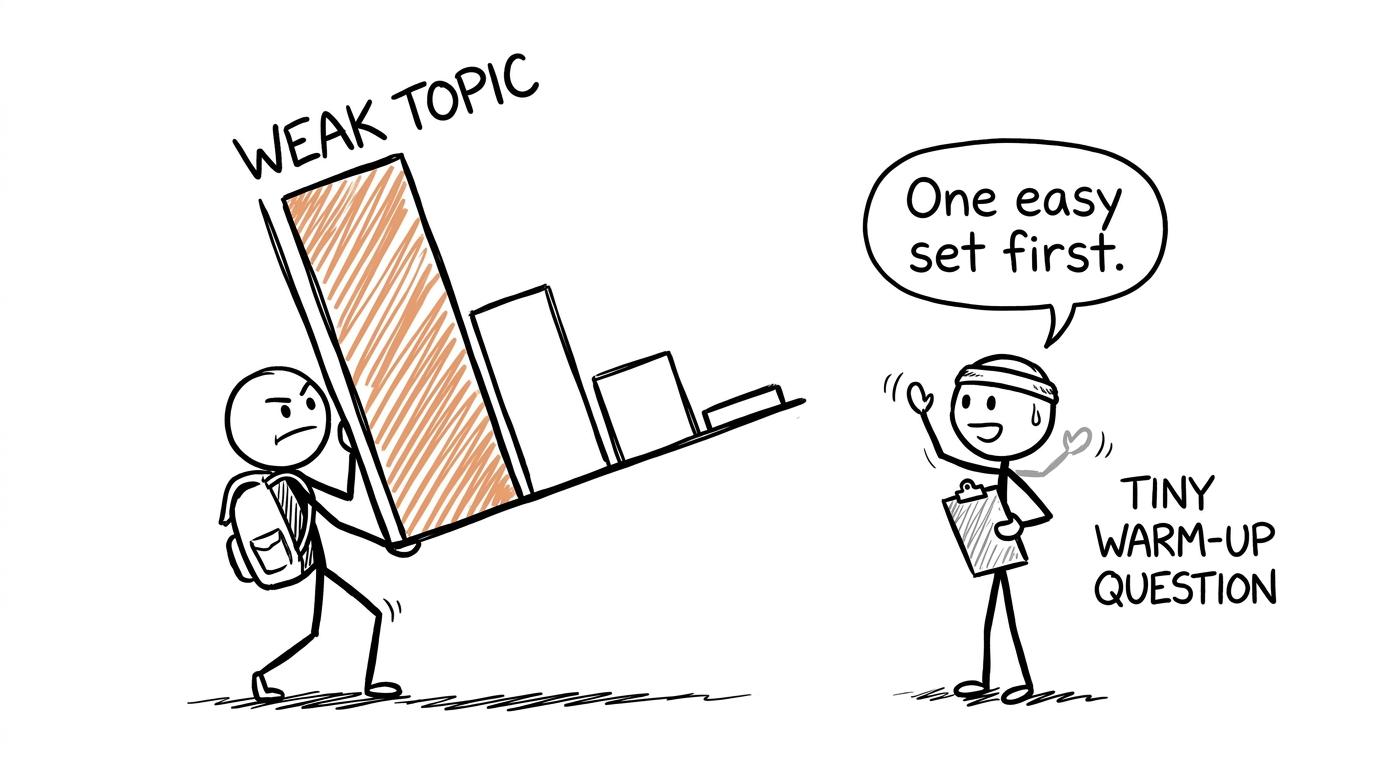 A tiny warm-up question coaches a student trying to lift a giant weak-topic bar chart
The weak topic depends on missing prior knowledge
Sometimes the named weakness is only the visible symptom. Difficulty with histograms, for example, may come from weak division, scales or area reasoning. Problems with estimated means may reveal uncertainty about frequency tables.
In that case, revise the prerequisite first. This is not avoiding the weak statistics topic. It is repairing the foundation that allows the topic to make sense.
You are sitting a timed paper
A full past paper should usually be attempted in paper order under realistic conditions. Changing the order to chase weak areas can distort your timing and make the diagnostic less useful.
Complete the paper, mark it, and let the results decide the order of later revision sessions. The Edexcel GCSE Statistics past papers include mark schemes so you can see whether marks were lost through knowledge, interpretation, accuracy or incomplete communication.
The examination is extremely close
The night before an exam is not the ideal moment for an exhausting attempt to master an entire unfamiliar unit. Use a short, contained repair session, secure accessible methods and avoid replacing sleep with panic.
Near the exam, a weak topic should still receive attention, but it should not consume every remaining minute. Mixed questions matter because the real paper will not announce which method you need.
Does revising it at the start or end really make a difference?
It can make a practical difference, although there is no universal rule proving that every student must study a particular topic first.
Research-informed revision principles support active retrieval, repeated practice and revisiting material across separate sessions. They do not turn session order into a magic formula. The benefit of tackling a weakness early is mainly behavioural: it protects the task from procrastination and gives you enough time to receive feedback and correct errors.
The end of a session still has a valuable role. Use it to test, not to begin the main learning. A final closed-book prompt can reveal whether the method remains available after you have switched attention.
A productive pattern is:
- attempt a short diagnostic question;
- review the relevant lesson or explanation;
- complete focused practice questions;
- mark them immediately;
- record one precise correction;
- finish with an unsupported retrieval check;
- revisit the skill in a later session.
Use the MathsGenie revision planner to schedule the return. Without a planned revisit, one successful session can create confidence that disappears under exam pressure.
How to identify the topic that deserves priority
Do not rank topics by how unpleasant they feel. Rank them using evidence.
Complete a suitable mini test, mixed set or past-paper section without notes. When marking, place each lost mark into one of four categories:
- Knowledge: you did not know the fact, term or method.
- Selection: you knew several methods but chose the wrong one.
- Accuracy: the approach was correct, but the calculation or graph reading was not.
- Interpretation: you did not explain the result in context.
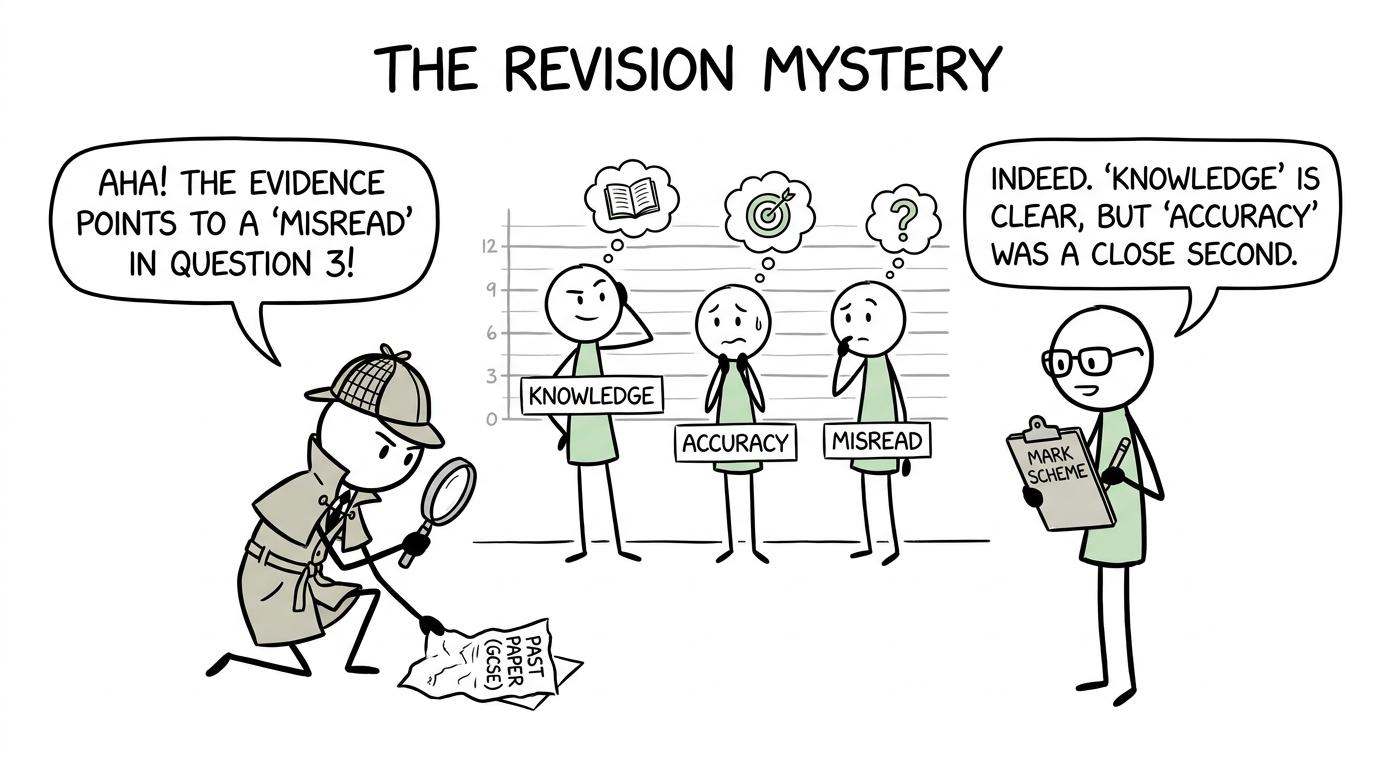 A student detective investigates Knowledge, Accuracy and Misread with a mark-scheme sidekick
This distinction matters. Watching another explanation may help a knowledge gap, but it will not automatically fix careless scale reading. Likewise, repeating calculations alone will not improve conclusions about bias or representativeness.
Keep the priority list small. Choose one main weakness and one maintenance topic per session. The GCSE maths revision timetable guide offers a broader structure for balancing topic practice with timed papers.
A flexible plan for different session lengths
For a 303030-minute session, use approximately:
- 555 minutes for retrieval;
- 202020 minutes for the weak topic;
- 555 minutes for marking and recording the next step.
For a 606060-minute session, use approximately:
- 555 minutes for retrieval;
- 303030 minutes for focused repair;
- 151515 minutes for exam-style questions;
- 101010 minutes for marking and corrections.
These are templates, not rules. If the mark scheme reveals a serious misunderstanding, spend longer correcting it. If you are repeatedly accurate, move the topic from “repair” to “maintenance” and identify the next gap.
For a longer campaign, the MathsGenie one-month GCSE revision plan shows how focused sessions can sit alongside regular paper practice. Predicted papers can also provide fresh questions, but they should test your preparation rather than replace full specification coverage. Read the guide to using predicted GCSE topics without guessing before narrowing your revision.
Common mistakes when prioritising weak topics
Leaving every difficult topic until the weekend
This creates a growing queue of intimidating work. Schedule one precise weakness into the next realistic session instead.
Spending the whole session reading
Revision notes and videos can rebuild understanding, but recognition is not the same as independent performance. Move into questions while there is still time to discover what you can do without support.
Calling an entire subject a weakness
“Statistics” is not an actionable target. “Comparing two distributions using a measure of centre and spread” is much clearer.
Never returning to stronger topics
A weakest-first strategy should not become a weakest-only strategy. Previously secure skills can fade. Keep short retrieval questions and mixed mini tests in the plan.
Counting papers instead of repairing errors
Completing more papers does not guarantee improvement if the same mistakes keep returning. The guide to how many GCSE past papers to complete explains why marking, diagnosis and follow-up practice matter as much as the total.
Make the weak topic smaller, then start
Your weakest GCSE Statistics topic should normally come near the beginning of a revision session, after a short warm-up and before easier work expands to fill the available time. Use the end to check retention, record mistakes and schedule a revisit.
The deeper lesson is simple: weakness is not an identity. It is information. A marked question tells you where the next useful block of effort belongs.
Start on MathsGenie with a revision lesson, move directly into practice questions, and check your work with the mark scheme or video solution. Then use mini tests, past papers and predicted papers to find out whether the skill survives in an unfamiliar question. Put the revisit in your revision planner and repeat the cycle until the topic no longer earns first place.