Revise Weakest Topic First: GCSE Chemistry
Revise weakest topic first GCSE Chemistry? Learn when to tackle it, when to wait, and how recall, exam questions and spaced review improve revision.
There is a familiar moment in revision: you open your topic list, notice the chapter you understand least, and quietly choose something easier. The easier topic feels productive. The weak one remains waiting.
So, should you revise weakest topic first GCSE Chemistry, or save it until the end? Usually, the best answer is to tackle it near the beginning of a session, after a short warm-up, when your attention is strongest. But position alone is not decisive. What matters more is whether you retrieve knowledge, answer questions, check your work and revisit the topic after a gap.
In other words, start early enough to give the weakness your best effort, then return to it later. One heroic session is rarely as valuable as several honest encounters.
The short answer: begin early, but not completely cold
A strong GCSE Chemistry session normally follows this pattern:
- Begin with around 555 minutes of familiar recall to get moving.
- Spend the main part of the session on one clearly defined weak area.
- Answer exam-style questions without relying on notes.
- Check your answers and classify each error.
- Finish with a brief recap or a more secure topic.
- Revisit the weakness on another day.
This avoids both extremes. You are not beginning with the most intimidating question while still distracted, but you are not leaving important work until your energy has disappeared either.
If you do not yet know which topic is weakest, use the process in MathsGenie's guide to finding your weakest GCSE Chemistry topics. A weakness should be diagnosed from questions and marking, not simply from which chapter feels unpleasant.
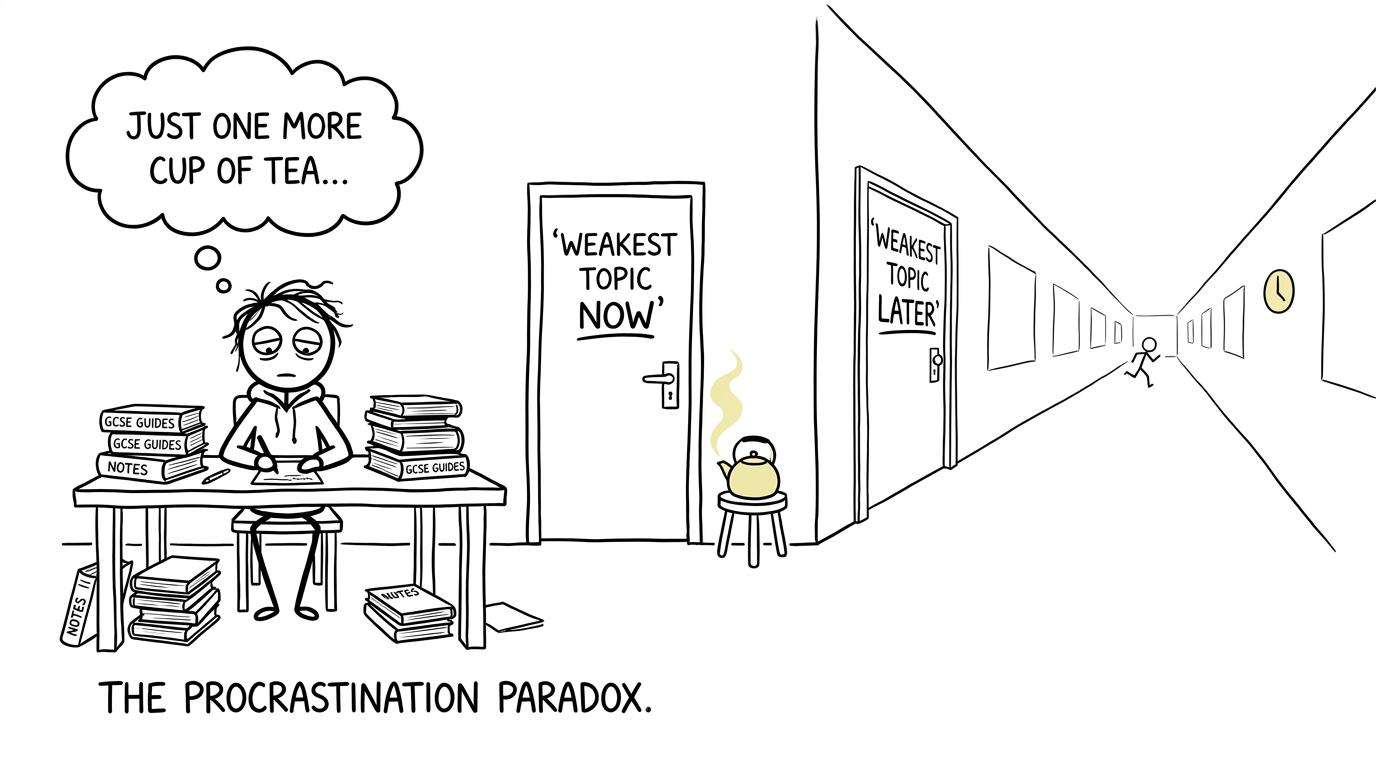 A student chooses between revising a weak topic now and postponing it forever
Why revising the weakest topic first can help
Your best attention goes to the largest gap
Weak topics usually require more than memorising a definition. You may need to connect several ideas, interpret unfamiliar information or repair a misconception. That work is easier before a long revision session has made you tired.
This is particularly important for topics such as quantitative chemistry, electrolysis, bonding, rates of reaction and required practicals. A question may combine recall with application, calculations, graphs or evaluation. Official GCSE specifications from AQA, Edexcel, OCR and Eduqas vary in organisation, so always use the specification for your own board rather than a generic topic checklist.
Starting early also prevents avoidance from becoming a routine. If the difficult topic is always scheduled last, it is remarkably easy for every session to finish just before you reach it.
Weaknesses often hide underneath other weaknesses
Suppose quantitative chemistry feels impossible. The underlying difficulty may not be the chemistry alone. It could be:
- ratio and proportion;
- rearranging formulae;
- converting units;
- percentages;
- reading graphs;
- using a calculator accurately.
That distinction matters. Re-reading a chemistry page will not repair an insecure mathematical skill.
MathsGenie's GCSE Maths revision hub provides free lessons, practice questions, worksheets and exam resources for these foundations. If proportional reasoning is the problem, the direct and inverse proportion revision resources can help you isolate and practise it. For Edexcel Chemistry students, the calculations involving masses resources connect those skills directly to specification content.
Early attempts give you time to return
Evidence reviews of learning strategies generally support retrieval practice and spacing. Retrieval means trying to bring knowledge to mind before looking at the answer. Spacing means returning to material after a delay rather than compressing every attempt into one sitting.
This is why tackling a weak topic early in your revision period matters more than whether it appears first or last in one evening. If you first address it several weeks before the exam, you have time to forget a little, retrieve it again and strengthen it through repeated practice.
When should you leave the weakest topic until later?
Starting with weakness is a useful default, not an unbreakable rule.
When you need a short warm-up
If opening immediately with your hardest topic makes you freeze, begin with a small task you can complete. This might be a brief recall quiz, several key definitions or one familiar calculation skill.
Keep the warm-up short. Its purpose is to create momentum, not to become an escape route. A session containing 555 minutes of familiar recall followed by 252525 minutes of targeted weakness is still a weakest-topic-first session in practical terms.
When the topic depends on missing foundations
You cannot revise every topic in isolation. If reacting-mass calculations are weak because ratio is insecure, repair the ratio first. If electrolysis answers are confused because ions and bonding are not understood, revisit those foundations before attempting demanding exam questions.
This is sequencing, not avoidance. The important question is whether the earlier task directly prepares you for the weak topic.
When an examination is extremely close
The night before an exam is not the ideal time to rebuild an entire chapter from the beginning. At that stage, prioritise gaps that are narrow enough to improve safely: a forgotten test, a recurring unit conversion, a required-practical variable or a familiar calculation method.
Do not spend the final evening wrestling indefinitely with one difficult area while neglecting the knowledge you can secure. A calm review, suitable sleep and correctly packed equipment are more useful than an exhausted attempt to conquer the whole specification.
When repeated failure is damaging the session
Challenging retrieval is useful, but revision should not become blind guessing. If you cannot begin a question, reduce the difficulty. Review a concise explanation, identify the missing component and answer a more focused question before rebuilding towards full exam standard.
The goal is productive struggle: enough challenge to reveal and repair a gap, but enough support to make progress possible.
A better session structure for weak GCSE Chemistry topics
Use a repeatable cycle rather than making a new plan every evening.
Recall before opening your notes
On blank paper, write what you can remember about one micro-topic. Keep it precise: not “chemical changes”, but perhaps “products at electrodes” or “variables in a rate experiment”.
This first attempt gives you diagnostic evidence. Notes opened too early can create familiarity without proving that you can recall the information independently.
Repair one specific gap
Check your specification, class materials or revision resource. Correct only what the recall attempt revealed. If the issue is mathematical, switch briefly to focused maths practice rather than repeatedly reading the chemistry explanation.
MathsGenie's guide to revising GCSE Chemistry efficiently explains how recall, examination questions and mathematical foundations can work together.
Answer questions and mark immediately
Knowledge must survive contact with an exam question. Attempt a small set without copying a model answer, then check it using the mark scheme. Classify each lost mark as:
- missing knowledge;
- incorrect application;
- calculation or unit error;
- practical-method error;
- misreading the command word;
- insufficient detail.
Immediate feedback matters because retrieving an incorrect idea repeatedly can strengthen the misconception. The check is part of the learning, not administrative work at the end.
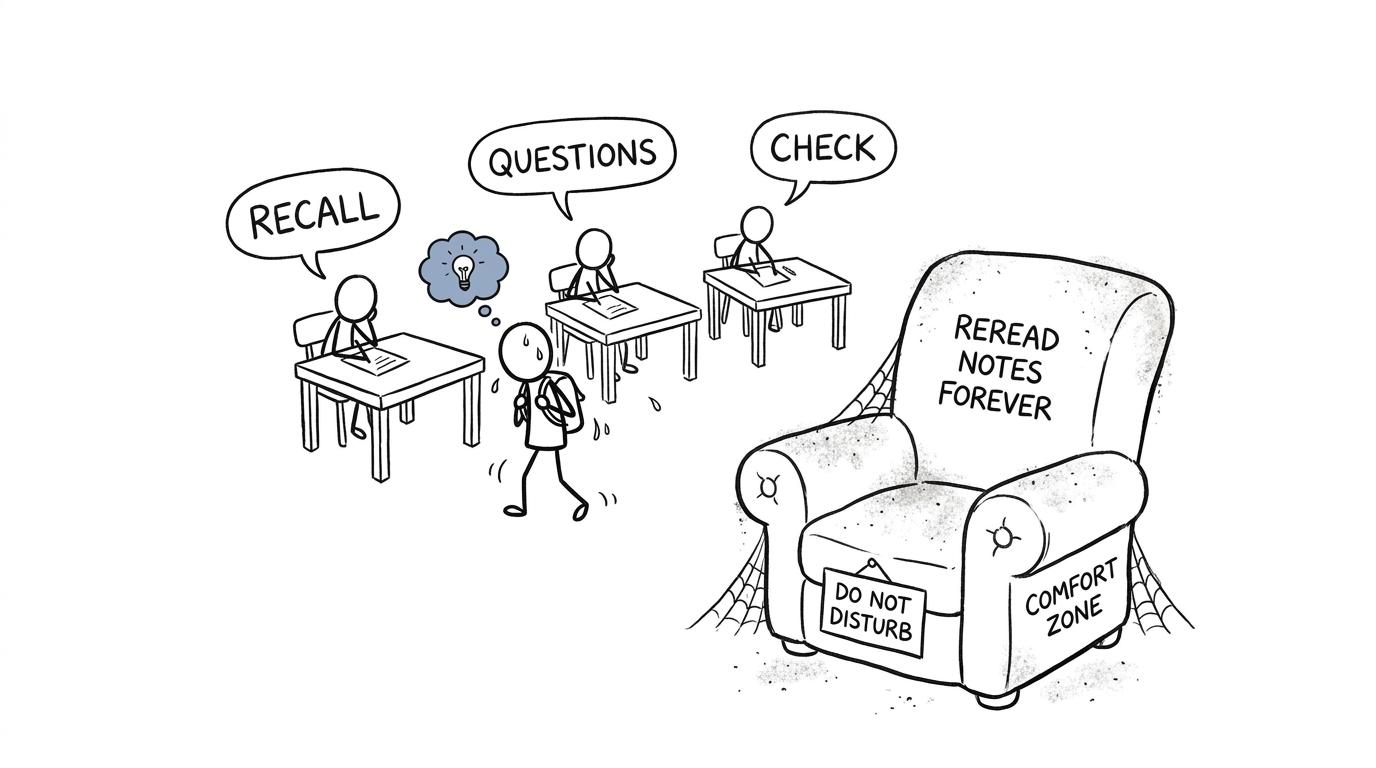 A student rotates between recall, questions and checking instead of rereading forever
Schedule the return before you stop
Write down when you will retest the topic. A simple pattern might revisit it after roughly 222 days, then after 777 days, with the gaps adjusted according to performance.
On the return visit, do not merely reread the same notes. Use fresh questions or recall prompts. Maths students can use Edexcel GCSE Maths mini tests to check calculation foundations, while GCSE Maths past papers help test those skills under more realistic pressure.
Balance weak topics with full-paper preparation
Revision should not become an endless sequence of isolated weak chapters. Chemistry papers assess knowledge, application, analysis and practical understanding across the specification. You must eventually recognise which idea a mixed question is testing.
Use two layers:
- Focused practice: repair one weakness through retrieval and targeted questions.
- Mixed practice: use paper sections to test whether you can identify and apply the right knowledge independently.
If you are also preparing for GCSE Maths, the same principle applies. Short topic work repairs the method; mixed papers test selection, timing and accuracy. MathsGenie's guide to using GCSE past papers properly shows how to turn marking into the next revision decision rather than treating the final score as the end of the exercise.
Predicted papers can provide fresh practice close to the examination, but they should supplement official past papers, not replace them. No predicted paper can guarantee the content of the real examination.
Common mistakes when prioritising weak topics
Choosing by feeling rather than evidence
A topic can feel comfortable because you recognise the notes, yet collapse when you answer a question without help. Use marked questions, teacher feedback and mock papers to identify weaknesses accurately.
Defining the weakness too broadly
“Organic chemistry” is too large for one session. Narrow it to a process, question type or misconception. Smaller targets make progress visible and reduce the temptation to postpone starting.
Spending the whole session making notes
Neat notes may organise information, but they do not prove recall or application. Use notes briefly, then close them and answer questions.
Never revisiting the topic
One long session can create short-term fluency that fades. Schedule another attempt after a gap and use a different question set.
Ignoring the maths underneath Chemistry
Unit conversions, ratios, percentages, graphs and formulae can quietly drain marks from otherwise sound chemistry knowledge. Treat these as repairable skills, not evidence that you are “bad at Chemistry”.
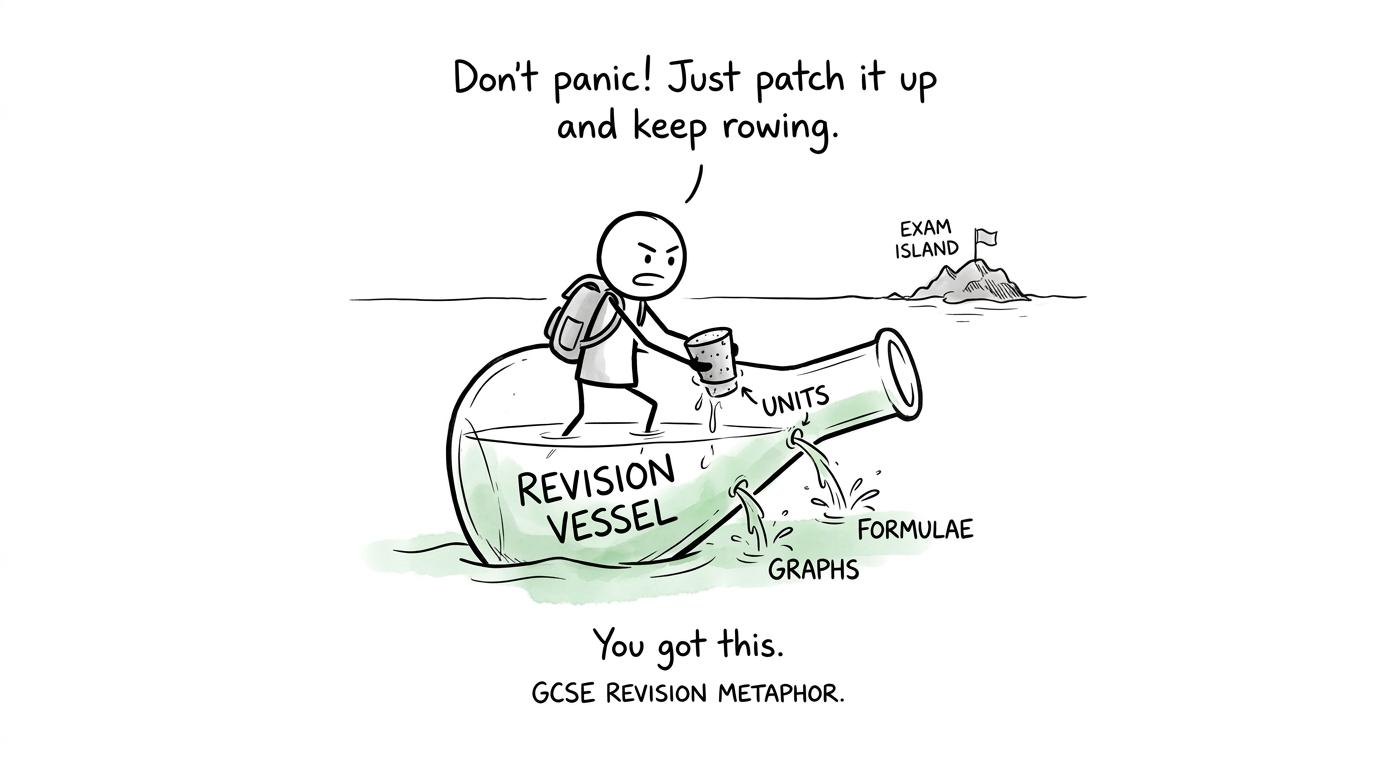 A student repairs leaks labelled units, graphs and formulae in a chemistry-shaped revision boat
Saving every difficult topic for the final week
Weaknesses need time for correction and retesting. Build them into a realistic schedule using the ideas in MathsGenie's GCSE revision timetable guide, leaving room for schoolwork, other subjects and rest.
Start early, finish with proof
Whether you tackle your weakest GCSE Chemistry area at the start or end of a session does make a difference, because attention and energy are limited. In most cases, use a short warm-up and then address the weakness while you can still think carefully. Do not routinely save it for the final few minutes.
But the larger lesson is more useful: position is not the same as progress. A weak topic improves when you retrieve it, repair a specific gap, answer exam questions, study the mark scheme and return after a delay.
Start today with one micro-topic. If the obstacle is mathematical, use MathsGenie's free revision lessons and practice questions to rebuild the underlying skill. Then test it through mini tests, past papers and predicted papers, using mark schemes and video solutions to make every lost mark instructive. The aim is not to make revision feel easy. It is to make the next question feel familiar for the right reason.