

GCSE: Find Your Weakest Topics (Chemistry via Maths)
GCSE revision: learn how to find your weakest GCSE Chemistry topics using maths-style tracking, exam questions, mark schemes, and smart practice.
You can revise for hours and still feel like you’re guessing on exam day. Not because you’re lazy, or even because you “don’t get” GCSE Chemistry. Usually it’s because you’re revising the wrong things: you’re polishing topics you already half-know, while your weakest topics stay hidden in the shadows.
That’s why this post is built around one simple GCSE idea: diagnose first, then treat. And because you’re a maths student (GCSE now, maybe A Level next), we’ll do it the way maths rewards most: with evidence, patterns, and a system you can repeat.
Along the way, you’ll see how to use the YesGenie platform to run that system quickly: topic lists, mini tests, question banks, and past papers. Even though YesGenie is a maths revision site, the method for finding weak topics transfers perfectly to GCSE Chemistry.
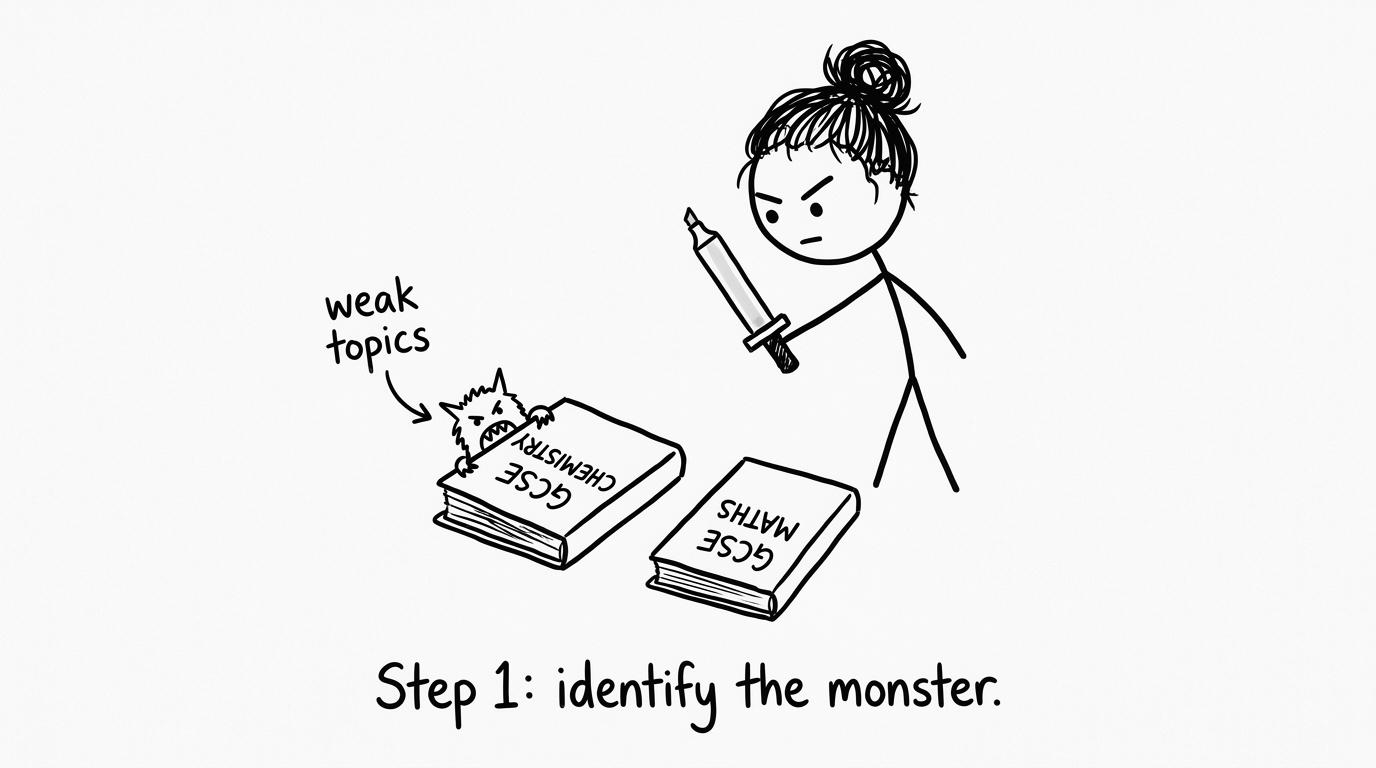 Student vs weak topics monster
The quick checklist: how to find your weakest topics
If you want the whole plan in one place, this is it:
- Pick one exam board (AQA, Edexcel, OCR, Eduqas) and stick to its specification language.
- Do a short diagnostic (30-45 minutes) using exam-style questions.
- Mark it properly using a mark scheme, not vibes.
- Tag every lost mark with a reason (knowledge gap, method, maths/units, interpretation, exam technique).
- Convert errors into topics (not just “I got Q6 wrong”).
- Rank topics by impact: frequency in papers, marks available, and how quickly you can improve.
- Target practice: small sets of questions, then re-test.
- Re-diagnose weekly so weaknesses don’t drift.
On YesGenie, the equivalent tools for maths are your diagnostic engine: GCSE Past papers, Edexcel GCSE Maths Mini Tests, and Edexcel GCSE Maths Lessons. Use the structure, then apply it to Chemistry.
Why “weakest topics” are usually invisible until you test
Most GCSE students revise with a comforting loop: re-reading notes, watching a video, doing one question, then moving on. It feels productive because your brain recognises the material. Recognition is not the same thing as recall.
In maths, you find this out the first time you try a past-paper algebra question and realise the steps aren’t there when you need them. GCSE Chemistry does the same, just with different clothing: ion equations, calculations, required practicals, and those questions where the mark scheme wants a specific phrase.
So the goal isn’t to “revise more”. The goal is to turn uncertainty into a list.
Build a weak-topic tracker (the maths way)
A good tracker is boring. That’s the point. It takes emotions out of the process.
Make a table with these columns:
- Topic (e.g. “moles and limiting reactants”, “rates of reaction graphs”)
- Question reference (paper + question)
- Marks available
- Marks scored
- Error type (see next section)
- Fix (one sentence)
- Re-test date
Then add one maths-friendly measure: your topic accuracy.
If you scored sss marks out of ttt marks on a topic, your accuracy is:
Accuracy=st×100% \text{Accuracy} = \frac{s}{t} \times 100\% Accuracy=ts×100%Worked example: turning messy results into a clear priority list
Imagine your last mixed Chemistry practice gave you these topic totals:
- Moles: 666 out of 121212
- Electrolysis: 777 out of 101010
- Bonding: 999 out of 121212
Compute accuracies:
- Moles: 612×100%=50%\frac{6}{12} \times 100\% = 50\%126×100%=50%
- Electrolysis: 710×100%=70%\frac{7}{10} \times 100\% = 70\%107×100%=70%
- Bonding: 912×100%=75%\frac{9}{12} \times 100\% = 75\%129×100%=75%
Your weakest topic is not “Question 5”; it’s Moles at 50%50\%50%.
This is exactly how you’d triage weak areas in maths using mini tests and mark schemes on YesGenie, then focus practice where the accuracy is lowest.
The five reasons you lose marks (and how to label them)
If you only write “I got this wrong”, you’ll repeat it. Instead, tag each lost mark with a cause.
Knowledge gap
You didn’t know the fact: reactivity series, required practical method, definitions like “oxidation is loss of electrons”.
Method gap
You knew what the topic was, but not the sequence of steps: setting up a moles calculation, using titration data, balancing equations before calculating.
Maths/units gap
You could do the chemistry, but slipped on ratios, unit conversions, or rearranging equations. This is where GCSE maths directly boosts GCSE Chemistry.
A classic unit conversion you might meet is volume:
1 dm3=1000 cm3 1\text{ dm}^3 = 1000\text{ cm}^3 1 dm3=1000 cm3So if you have 250 cm3250\text{ cm}^3250 cm3, then:
250 cm3=0.25 dm3 250\text{ cm}^3 = 0.25\text{ dm}^3 250 cm3=0.25 dm3Interpretation gap
You misread the question: “calculate mean rate” vs “describe trend”, or you ignored “give your answer to two significant figures”.
Exam-technique gap
You had the idea but didn’t write what the mark scheme awards: missing state symbols, forgetting to reference data, or failing to link cause and effect.
In maths, this mirrors dropping marks for not showing a key step. See how mark schemes reward method in topics like Fractions of an Amount and Algebraic Fractions: the lesson is the same: write what the examiner is looking for.
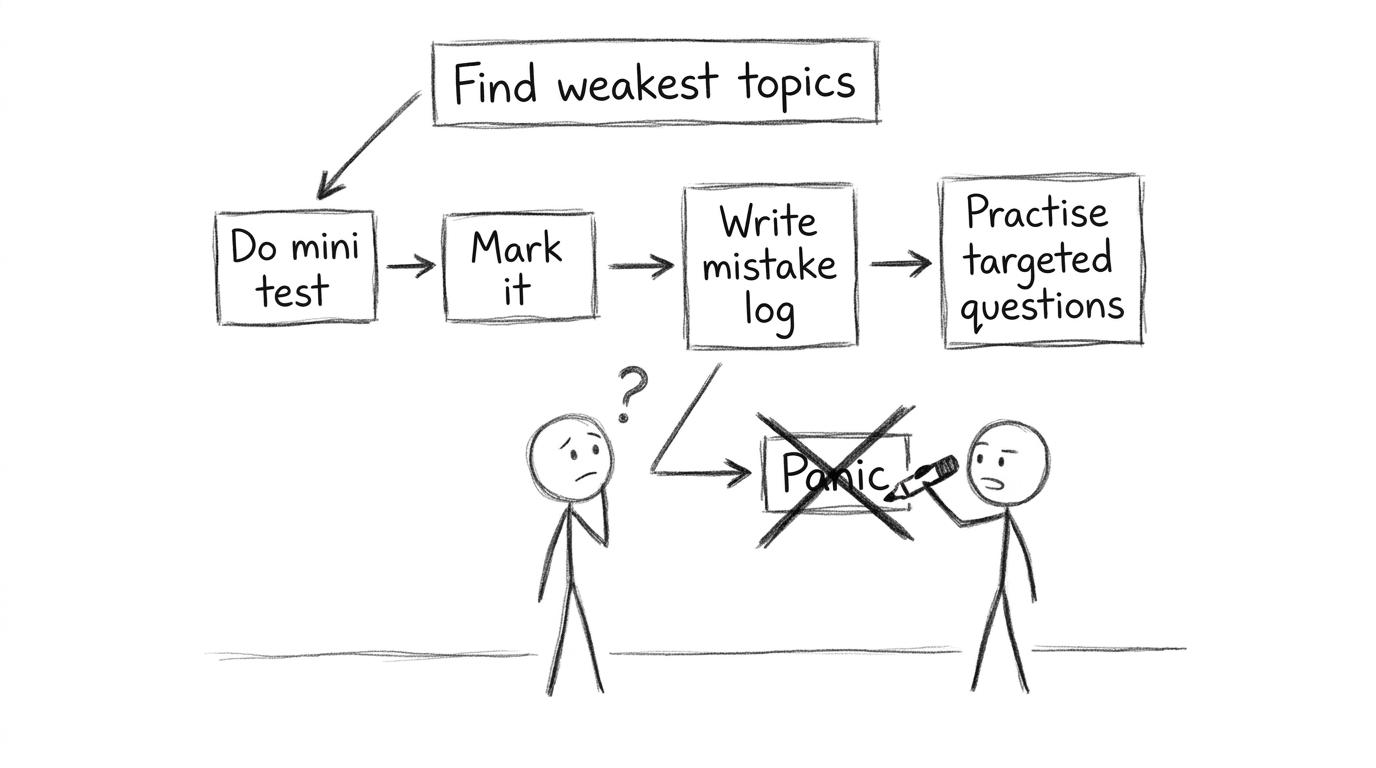 Flowchart with panic crossed out
How to run a 45-minute diagnostic that actually works
You don’t need a full mock to find weak topics. You need enough evidence to see patterns.
Pick your question source
For maths, YesGenie makes this easy through GCSE Past papers, predicted papers, and mini tests. For GCSE Chemistry, use an exam-board past paper or a mixed-topic booklet.
If you’re also sorting your maths revision, you can mirror the same approach using an exam-board page like WJEC GCSE Maths Revision and then doing a short paper.
Do it under light time pressure
Not brutal. Just enough that you can’t overthink. For example, 454545 minutes for a selection of questions across multiple topics.
Mark ruthlessly, then categorise
Use the mark scheme and be specific.
Instead of: “lost 2 marks”.
Write: “lost 2 marks: forgot to convert cm3\text{cm}^3cm3 to dm3\text{dm}^3dm3 (maths/units gap)”.
This is the moment weak topics reveal themselves.
A GCSE Chemistry calculation method powered by GCSE maths
A lot of “Chemistry weakness” is really “I can’t control the numbers when I’m stressed”. Let’s fix one common area: concentration calculations.
Worked example: concentration and volume
Suppose a question gives:
- Concentration c=0.20 mol dm−3c = 0.20\,\text{mol dm}^{-3}c=0.20mol dm−3
- Volume V=250 cm3V = 250\,\text{cm}^3V=250cm3
First convert volume:
250 cm3=0.25 dm3 250\,\text{cm}^3 = 0.25\,\text{dm}^3 250cm3=0.25dm3Use n=cVn = cVn=cV:
n=0.20×0.25=0.05 mol n = 0.20 \times 0.25 = 0.05\,\text{mol} n=0.20×0.25=0.05molIf you often miss this topic, your weakest topics list might say “concentration calculations”, but the fix might be “unit conversion + substitution”. That’s a maths revision target.
If rearranging is the issue, practise the skill directly in maths, because it transfers everywhere. A good starting point is a structured lessons page like Edexcel GCSE Maths Lessons, then follow it with exam questions.
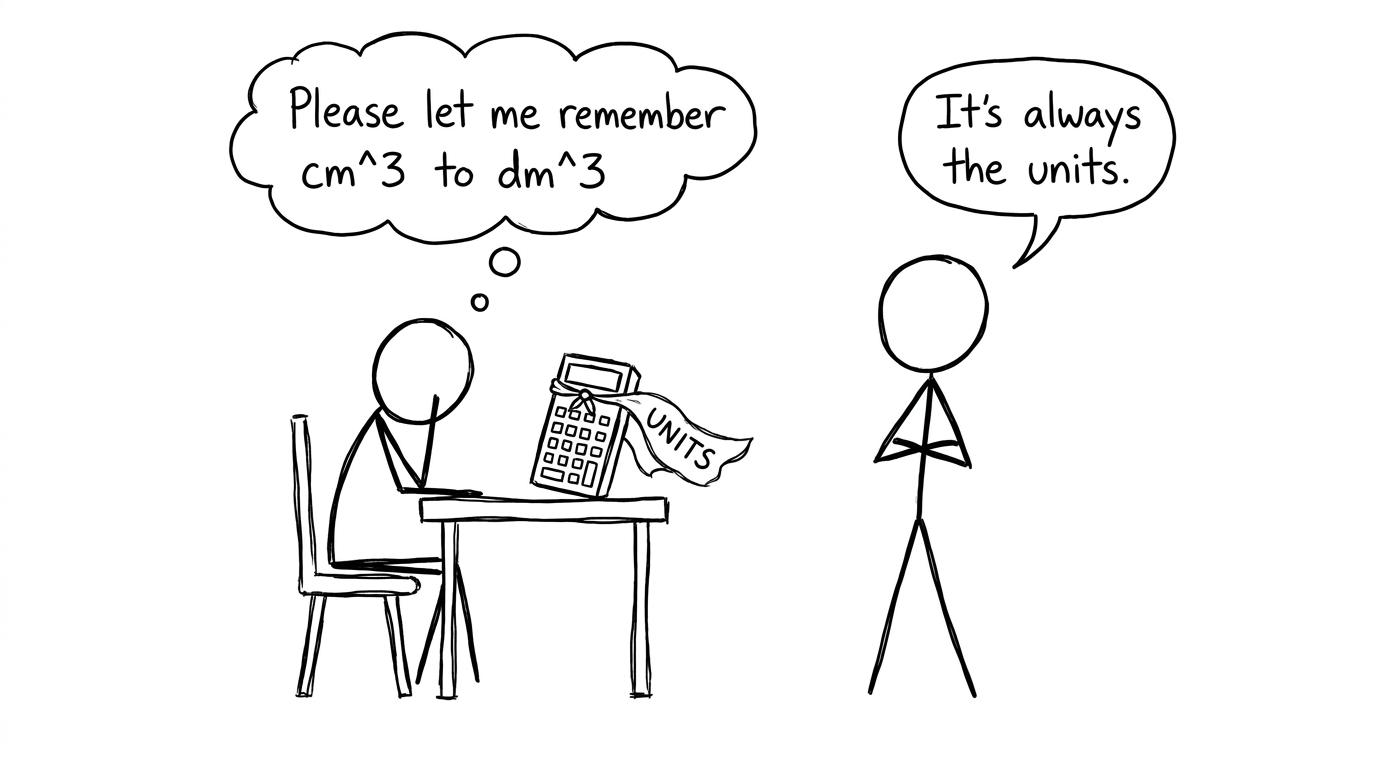 Calculator wearing a units cape
How to prioritise weak topics (so your revision actually moves your grade)
Not all weak topics are equal. Prioritise using three filters:
- Frequency: does it appear often in AQA/Edexcel/OCR/Eduqas papers?
- Marks: does it tend to be 333-666 marks at a time?
- Fixability: can you improve quickly with a clear method and practice?
In maths, students often jump to the hardest-looking topic. But grades move fastest when you fix medium-difficulty topics that appear a lot. On YesGenie, this is why students combine a topic list with timed practice such as Edexcel GCSE Maths Mini Tests and then step up to Edexcel GCSE Maths Predicted Papers.
Do the same with Chemistry: small targeted sets first, then mixed practice.
Common mistakes when finding your weakest topics
- Using feelings instead of data: “I hate electrolysis” isn’t evidence. A marked paper is.
- Tracking questions, not topics: “Q12” doesn’t help you revise. “Ionic equations” does.
- Ignoring the reason you lost marks: knowledge gap and maths/units gap need different fixes.
- Never re-testing: if you don’t re-test a week later, you don’t know if you improved.
- Only doing full papers: full papers are great later. Early on, they’re inefficient for diagnosis.
- Not leveraging maths revision: if your Chemistry errors are ratios, rearranging, or graphs, you can fix them faster through GCSE maths practice.
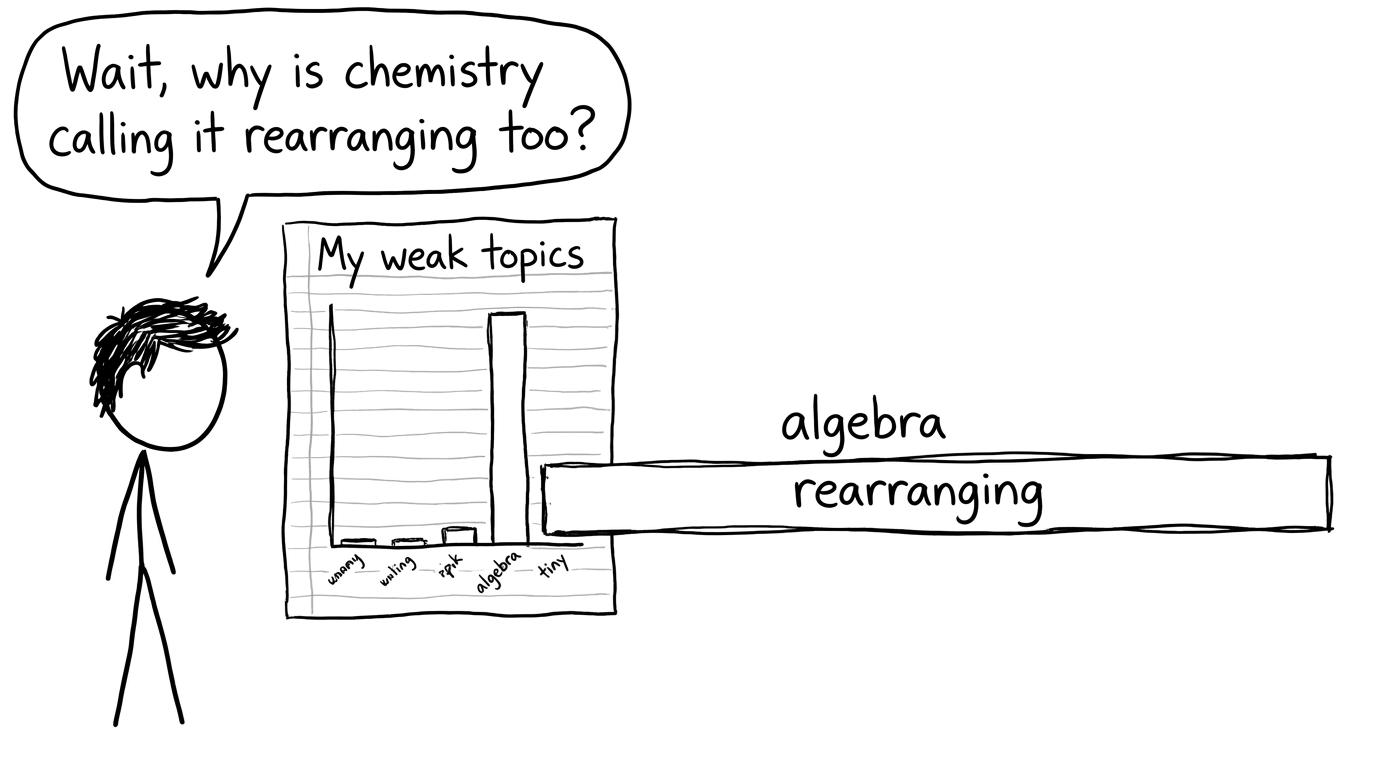 Bar chart of weak topics with one giant bar
Closing: turn GCSE weakness into a plan you can trust
Finding your weakest topics in GCSE Chemistry isn’t about proving you’re bad at something. It’s about removing uncertainty. When you diagnose properly, revision stops being a fog and becomes a list of small, fixable actions.
And if a chunk of that weakness is really numbers, ratios, rearranging, graphs, units; you can fix it fast through consistent maths practice. Use YesGenie to make the system easy: revision lessons for methods, practice questions for repetition, mark schemes for honesty, and timed practice through mini tests, past papers, and predicted papers.
Start today by doing one short diagnostic, writing a mistake log, and choosing your top three weak topics. Then open YesGenie and build the habit: Edexcel GCSE Maths Mini Tests for quick evidence, GCSE Past papers for exam realism, and Edexcel GCSE Maths Predicted Papers when you’re ready to pressure-test your progress.
GCSE success is rarely about motivation. It’s about noticing what’s weak, then practising with intent until it isn’t.










