Revise Weakest Topic First: GCSE Business Strategy
Revise weakest topic first GCSE Business? Learn when order matters, how to structure each session, and how maths practice can protect valuable exam marks.
The easiest topic in your revision pile has a strange gravitational pull. You know its definitions. The questions feel reassuring. Every correct answer looks like progress.
Meanwhile, the topic that cost you marks in your mock waits underneath.
So, should you revise weakest topic first GCSE Business, or save it until you feel ready? In most sessions, begin with it while your attention is relatively fresh, but keep the first block short and specific. Then revisit the topic later through retrieval practice. Starting first helps to prevent avoidance; returning later helps the learning last.
This is not a rule that your weakest topic must occupy every minute. The better strategy is to give it your best attention without allowing one difficult area to consume your entire revision plan.
The short answer: first, but not immediately
Use this order for a typical GCSE Business revision session:
- Spend the opening 555 minutes retrieving familiar knowledge as a warm-up.
- Work on one precise weakness for 202020 to 303030 minutes.
- Check your answers using the mark scheme or teacher guidance.
- Switch to a stronger or mixed topic for 151515 to 202020 minutes.
- Finish by recalling the key ideas from the weak topic without notes.
- Revisit it on another day rather than declaring it finished.
The warm-up matters because beginning with your hardest question while still finding your pen and settling down can create unnecessary resistance. But the difficult work should come early enough that it does not get pushed aside by tiredness.
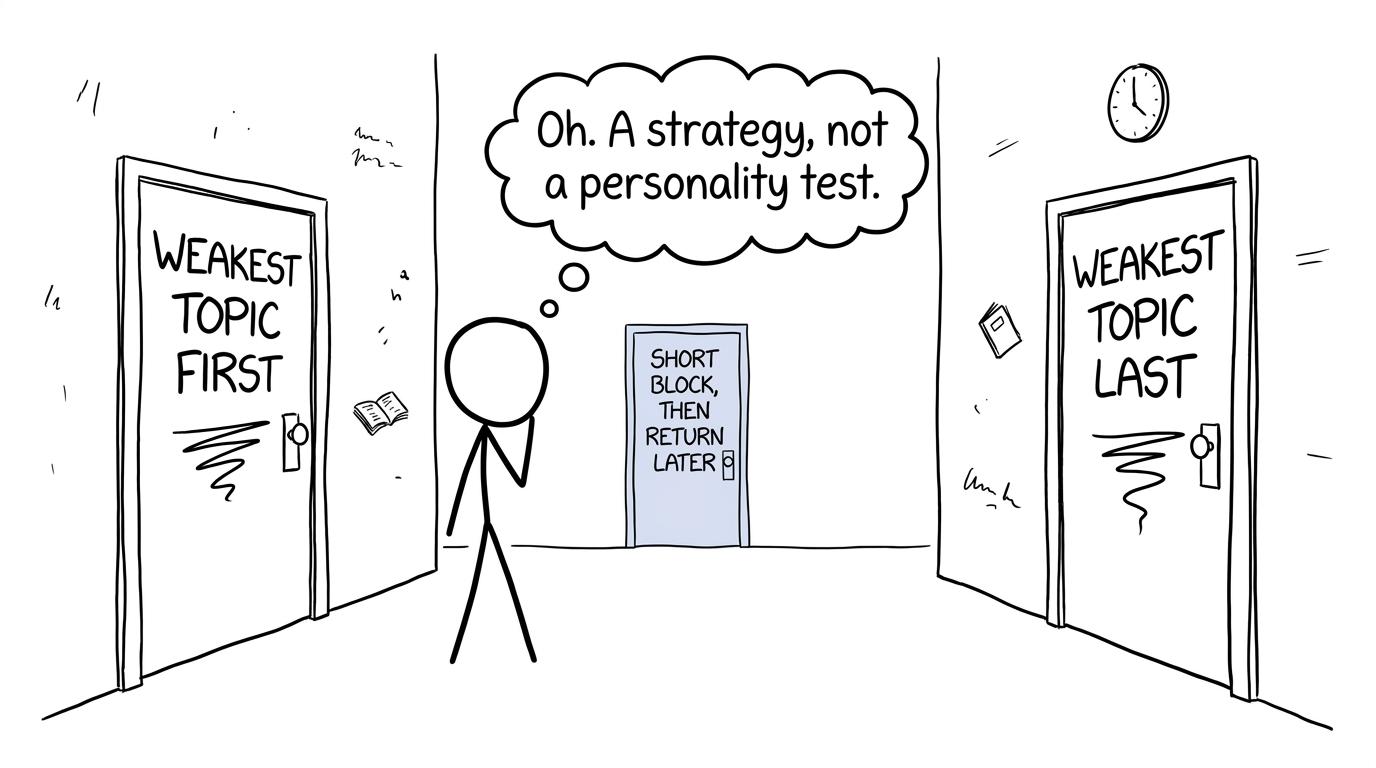 A student discovers that weakest-first and weakest-last are not the only revision choices
Why revising your weakest topic first usually works
Weak topics require more than time. They require attention, honest checking and a willingness to discover that your first answer was incomplete.
At the start of a planned session, you are generally better placed to do that demanding work. If you leave business finance, operations or extended evaluation until the final few minutes, it becomes easy to reread a page and call the topic revised.
There is also a behavioural advantage. Starting early removes the daily negotiation with yourself. You no longer spend the session wondering whether you will eventually reach the difficult chapter.
Educational evidence supports the broader principles behind this approach. Reviews of retrieval practice suggest that actively recalling material is usually more effective than simply rereading it. Evidence for spacing also supports returning to learning across different days rather than concentrating everything into one sitting. Research bodies, including the Education Endowment Foundation, caution that implementation matters: no revision technique works automatically unless the task is appropriately challenging and followed by feedback.
In practical terms, do not merely read your weakest Business topic first. Close the book and attempt to retrieve definitions, explain cause-and-effect chains, interpret data or plan an exam response. Then check what you produced.
When revising the weakest topic last can make sense
“First” is a useful default, not an inflexible law. There are situations where putting the weakest area later is sensible.
You need a brief confidence-building start
If exam anxiety makes it difficult to begin, completing a small familiar task can create momentum. Keep this warm-up deliberately short. It should be a runway, not a hiding place.
You are testing recall rather than learning from scratch
A short end-of-session quiz can reveal whether the earlier work has stayed in memory. This makes “last” valuable as a check, even when the main learning happened first.
Your weak topic depends on another topic
Suppose interpreting profit figures is difficult because percentage change is insecure. The prerequisite may need attention before the broader Business topic becomes manageable. For the numerical foundation, MathsGenie's GCSE maths revision hub offers free lessons, questions and paper practice across the main exam boards.
The same principle applies elsewhere. A student struggling with cash flow may need confidence with negative numbers; break-even work may expose weaknesses in graphs; and market-share calculations may depend on percentages. Repair the smallest missing skill first, then return to the Business context.
The session is only a diagnostic
If you are completing a mixed paper to find weaknesses, do the paper in its intended order. Diagnose first, then schedule focused repair. The MathsGenie guide to finding your weakest GCSE topics explains how lost marks can become a practical revision list rather than a vague feeling.
Define “weakest” using evidence
Students often identify a weak topic by asking, “Which chapter feels frightening?” That feeling is relevant, but it is not enough.
A topic may feel difficult because it is unfamiliar, while another feels comfortable because you recognise the notes. Recognition is not the same as being able to produce an answer under exam conditions.
Use three sources of evidence:
- marked mock or past-paper answers;
- timed questions completed without notes;
- specific feedback from your teacher or a mark scheme.
For each lost mark, record whether the problem involved:
- knowledge of a term or concept;
- application to the business in the case study;
- analysis of consequences;
- evaluation and a supported judgement;
- quantitative skills;
- timing or misreading the command word.
This distinction matters because “marketing is weak” is too broad to guide a session. “I describe market segmentation but do not apply it to the case study” is actionable.
GCSE Business specifications assess more than factual recall. Across major boards such as AQA, Edexcel and OCR, the assessment objectives cover knowledge and understanding, application, and analysis or evaluation. Their overall weightings are commonly AO1 at 35%35\%35%, AO2 at 35%35\%35% and AO3 at 30%30\%30%, although you should always use the current specification for your board. A student can therefore know a topic but still lose marks because the context is ignored or the judgement is unsupported.
Use a split-session strategy
The most effective answer to “first or last?” is often “both”. Meet the weakness early, then return to it briefly at the end.
Begin with a narrow target
Do not write “revise finance”. Choose something observable, such as:
- distinguish cash from profit;
- interpret a cash-flow forecast;
- explain how changing price may affect revenue;
- apply break-even information to a decision;
- evaluate a suitable source of finance.
A narrow target reduces overload and makes progress visible.
Retrieve before reviewing
Before opening your notes, write down what you can remember. Attempt a question or create a response plan. This produces useful evidence about what is genuinely available in memory.
Then review the lesson material. The order matters: if you read first, the page can make everything look familiar.
Check against the expected answer
Feedback prevents an incomplete explanation from becoming habitual. Look for missing context, unclear chains of reasoning and conclusions that simply repeat the question.
This is equally important in maths. A wrong answer may come from the final calculation, an earlier method or a misunderstood instruction. MathsGenie's efficient Edexcel GCSE revision strategy uses the same learn, practise, mark and retest cycle.
Return after a gap
At the end of the session, spend a few minutes recalling the important ideas again. Revisit them on a later day through a different question. The GCSE one-month revision plan offers a useful model for combining daily retrieval, focused topic work and regular paper practice.
 A highlighter discovers that the mark scheme expects active practice
Do not let Business calculations become hidden maths weaknesses
Quantitative skills form a meaningful part of GCSE Business assessment. Official specifications include calculations and interpretation involving areas such as revenue, costs, profit, percentages, averages, cash flow and break-even.
If the business idea makes sense but the calculation does not, isolate the underlying maths skill. You may need to practise:
- fractions, decimals and percentages;
- percentage change;
- averages;
- ratio;
- reading tables and graphs;
- substituting values into a formula;
- rearranging straightforward formulae.
This is where maths revision can directly support Business marks. Use the GCSE maths topics by exam board and tier to locate the underlying skill, while remembering that GCSE Business itself is not divided into foundation and higher tiers.
Do not spend an entire evening on advanced maths that your Business question does not require. Repair the precise numerical obstacle, practise it independently, and then place it back into a Business context.
Balance weak-topic work with whole-course coverage
A weakness deserves priority, but not permanent ownership of your timetable.
If every session goes to finance, knowledge of marketing, operations, human resources and external influences may fade. A balanced week might include:
- two focused sessions on the weakest area;
- one mixed retrieval session across older topics;
- one timed section or extended response;
- one review session driven by marking and feedback.
As the examination approaches, increase mixed and timed practice. Topic work builds individual pieces; papers test whether you can select and connect them under pressure.
This resembles effective GCSE maths preparation. There is a sensible order for building prerequisite knowledge, but the final goal is mixed exam performance. MathsGenie's guide to the best order for learning GCSE maths topics explains why “hardest first” is not always the same as “best next step”.
Common mistakes when prioritising weak topics
Saving the hardest area for a tired final block
This often turns planned practice into passive reading. Put demanding work earlier, even if you begin with a short warm-up.
Choosing topics by emotion alone
Use marked evidence. Your least favourite topic and your largest source of lost marks may not be the same.
Revising a whole unit instead of one weakness
A broad label creates broad activity. Identify the exact knowledge, application, evaluation or calculation problem.
Spending too long making notes
Notes can organise knowledge, but they do not prove that you can retrieve or apply it. Follow review with questions completed without support.
Never returning to the topic
One successful session creates confidence, not permanent mastery. Space further retrieval across later days.
Ignoring stronger topics
Revision should reduce your largest risks without creating new ones. Keep mixed practice in the plan.
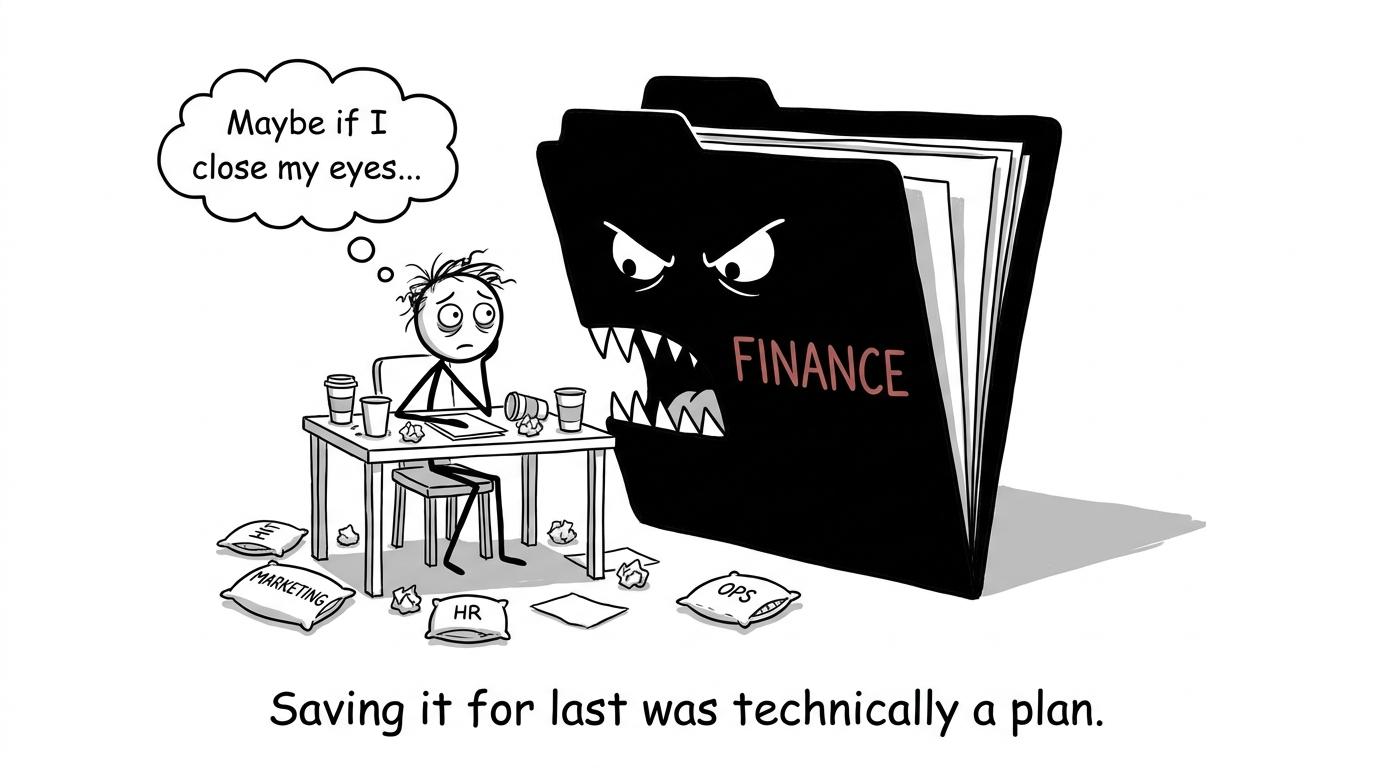 A student discovers the consequence of saving finance until the end
Make the first block count
Your weakest GCSE Business topic should usually receive your best attention near the start of a session. But the winning method is not simply “hardest first”. It is a cycle: diagnose precisely, retrieve, review, practise, check and return later.
That approach also protects the maths marks hidden inside Business questions. When percentages, graphs, averages or formulae are the real obstacle, MathsGenie gives you a free route from uncertainty to evidence: revision lessons to rebuild the skill, practice questions to strengthen it, mark schemes and video solutions to explain errors, and mini tests to check whether it has stuck.
Start with the MathsGenie GCSE revision area, then use past papers and predicted papers to make your next weakness visible. Do not wait to feel ready. Give the difficult topic a short, focused beginning, and a planned return.