Revise GCSE Sociology: No Quiet Space at Home
Revise GCSE sociology with no quiet space using short active sessions, portable resources, realistic routines and quieter places beyond your home.
A noisy home can make revision feel like a test before the real test begins. Conversations drift through walls. The television is on. Someone needs the table. Just as you begin an essay plan, another interruption arrives.
If you searched revise GCSE sociology no quiet space, the practical answer is this: stop waiting for perfect silence. Build short, active revision sessions that can survive ordinary noise, move demanding tasks to quieter times or places, and keep a portable revision kit ready.
You are not failing because your home is busy. You simply need a revision system designed for the home you actually have.
Your quiet-space revision checklist
Start with these actions:
- divide revision into short tasks with one clear outcome
- use active recall instead of repeatedly reading notes
- match each task to the noise level around you
- identify quieter times, not only quieter rooms
- ask your school about supervised study spaces
- prepare a portable revision kit
- practise exam questions and mark them carefully
- protect sleep rather than revising late simply because it is quieter
The principle is simple: control the parts of the environment you can control, then make each available minute more useful.
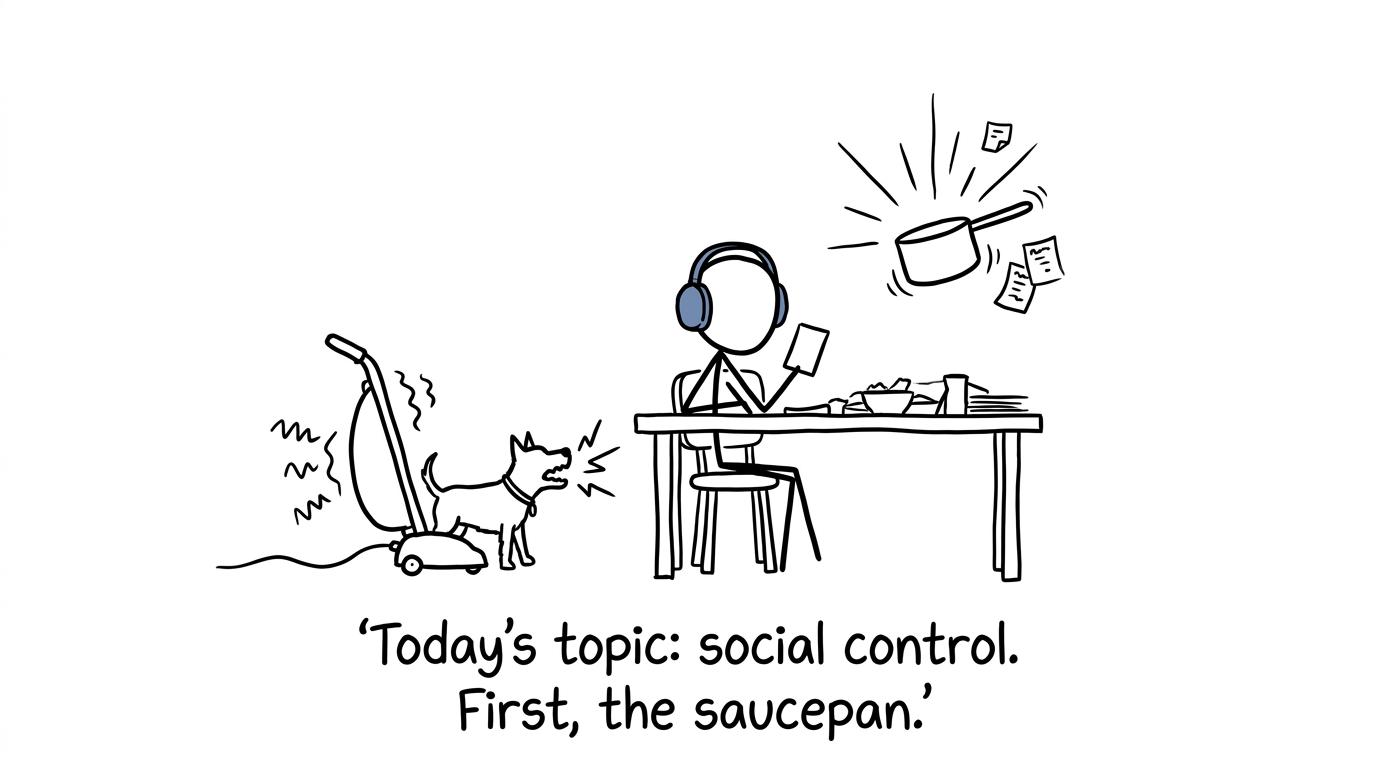 A student revising sociology during a noisy home orchestra
Stop treating silence as the starting condition
There is an understandable trap here. You tell yourself you will begin when the house settles down. But the house may not settle down until late, and by then you are tired.
A better question is not, “When will it be silent?” It is, “What useful task can I complete at this noise level?”
GCSE Sociology revision contains different kinds of work. Some demand sustained concentration; others can be completed in imperfect conditions.
Tasks that can survive moderate noise
Use busier periods for contained activities such as:
- recalling definitions from flashcards
- matching sociologists to theories or evidence
- sorting ideas into functionalist, Marxist, feminist or interactionist perspectives
- creating brief mind maps
- testing key terms aloud or on paper
- marking an answer completed earlier
- correcting one paragraph using a mark scheme
- organising notes by specification topic
Tasks that need your quietest available period
Reserve calmer periods for:
- learning unfamiliar theories
- planning extended answers
- writing timed responses
- comparing competing perspectives
- evaluating research methods
- completing a full paper or substantial paper section
This is energy and environment management, not an excuse to avoid difficult work. You are placing each task where it has the best chance of succeeding.
Build revision around short, complete cycles
A long session is fragile. One interruption can make the whole evening feel lost. A short cycle is easier to restart.
Try a session of roughly 202020 to 252525 minutes:
- Settle: choose one precise target and remove unnecessary tabs.
- Retrieve: write what you remember without looking at your notes.
- Check: compare your recall with your specification, textbook or class materials.
- Apply: answer one relevant question or produce one paragraph plan.
- Record: note one gap to revisit.
The key word is complete. “Revise education” is too large. “Recall three explanations for differences in educational achievement and identify one criticism of each” has an observable finish line.
Students balancing sociology with maths can apply the same structure through MathsGenie’s GCSE twenty-minute maths revision routine. Keeping a similar rhythm across subjects reduces the number of decisions you must make each evening.
Use active recall when concentration is limited
Rereading can feel reassuring because the page looks familiar. Yet familiarity is not the same as being able to produce an answer in an exam.
Close the book and try to retrieve:
- the meaning of a sociological concept
- the main argument of a perspective
- evidence that supports or challenges that argument
- one strength and one limitation of a research method
- the structure you would use for an extended response
Then check what you missed. The gap between your attempted recall and the accurate version is your next revision target.
This approach suits a noisy home because retrieval can be brief and sharply defined. A five-minute recall grid still creates useful evidence. Ten distracted minutes of highlighting may not.
Forgetting is also normal. Return to a topic after a gap rather than expecting one session to make it permanent. Maths students can see how retrieval and spaced practice fit together in MathsGenie’s guide to remembering GCSE content more securely.
Revise for what GCSE Sociology actually assesses
Your revision should reflect your exam board’s current specification and assessment materials. Check the board named on your school documents or mock paper rather than assuming that a friend’s topic list applies to you.
Across regulated GCSE Sociology qualifications, assessment covers three broad demands:
- AO1: knowledge and understanding of sociological theories, concepts, evidence and methods
- AO2: applying that knowledge to issues and contexts
- AO3: analysing and evaluating ideas to form arguments, judgements and conclusions
This means memorising definitions is necessary, but not sufficient. Your quiet-space plan must eventually include application and evaluation.
A useful topic card therefore has four prompts:
- What is the concept or argument?
- Which perspective, sociologist or evidence is connected to it?
- How could it apply to the question?
- What limitation, alternative view or judgement could be added?
Research methods also deserve regular attention. Do not leave them until the end because they appear less memorable than families, education, crime and deviance, or social stratification. Practise choosing and evaluating methods in context, not merely listing generic advantages and disadvantages.
Create a portable focus kit
If you do not control a room, make your revision setup movable. Keep a small bag or folder containing:
- specification or topic checklist
- flashcards
- lined paper or a compact notebook
- pens and highlighters
- printed exam questions
- earplugs or headphones, if safe and suitable
- a simple timer
- a written list of short tasks
The task list matters. Without one, the first part of every session disappears into deciding what to do.
If you use headphones, avoid playing audio so loudly that it becomes another distraction or blocks important household communication. Instrumental audio or steady background sound may feel less intrusive than music with lyrics, but personal responses vary. Test it using the same recall task on different days and compare what you can actually remember.
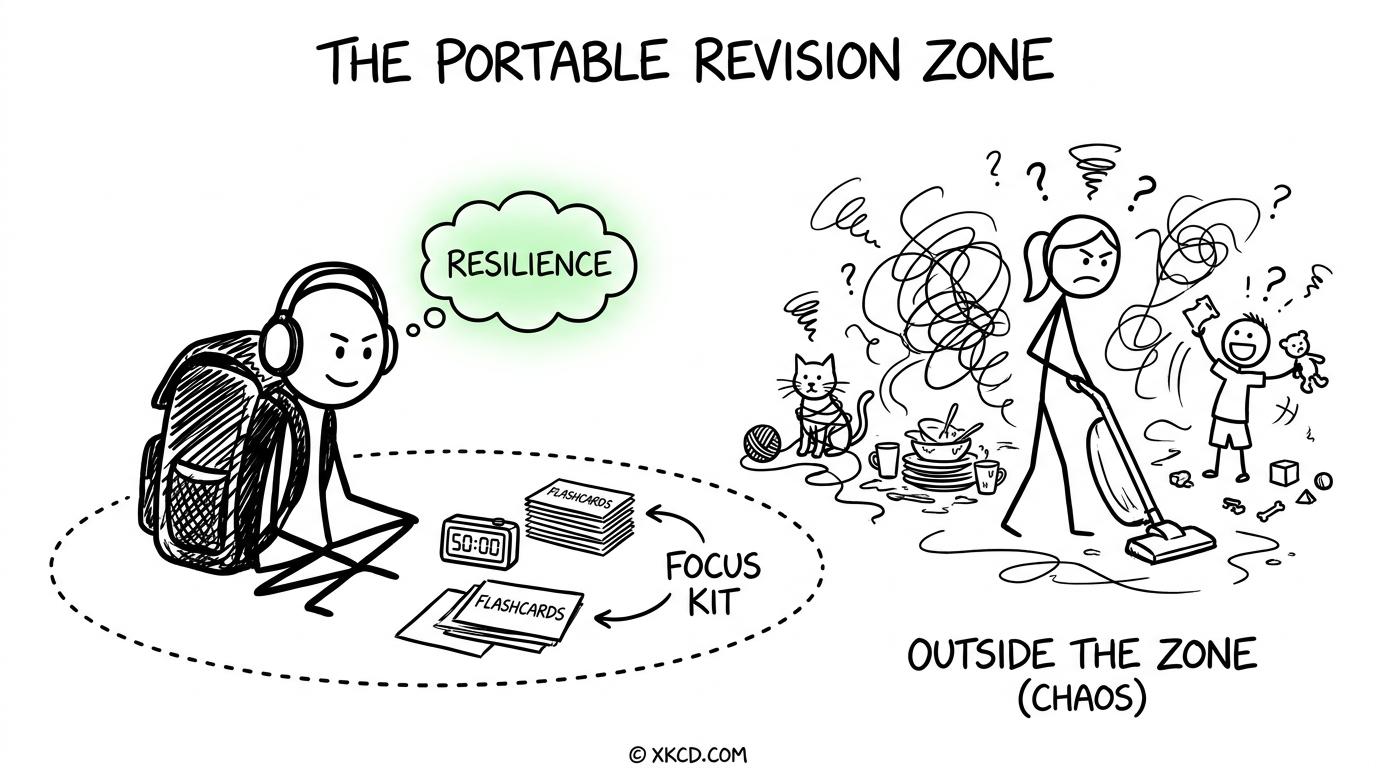 A portable focus kit creating a tiny revision zone
Find quiet time and quiet places beyond your bedroom
A quiet revision space does not have to be a permanent private room. It might be a reliable window of time or a supervised place outside home.
Ask your school directly
Schools may have a library, homework club, intervention session, study room or classroom available before school, at lunchtime or after lessons. Ask a teacher, form tutor, librarian or pastoral member of staff what is available and whether booking is required.
Be specific: “I do not have a quiet place to complete timed practice at home. Is there somewhere I can work after school on Tuesdays?” A precise request is easier to answer than a general statement that revision is difficult.
Consider suitable public spaces
A local library may offer desks, quieter areas and longer opening periods during exam season. Check current opening times, access requirements and rules with the library itself. A trusted relative’s home may also work if travel and safeguarding arrangements are sensible.
Use time as a space
Notice when your home is relatively calm. It might be shortly after school, during a regular activity elsewhere in the household or on a weekend morning.
Use the best window for your hardest work. Do not spend it copying headings. Complete an essay plan, a timed response or a difficult research-methods question.
Practise exam answers without demanding perfect conditions
Most learning can be adapted to background noise. Full exam rehearsal is different. You should complete some timed work in the calmest realistic conditions available so that you can measure pacing and sustain an argument.
Use your exam board’s official past papers and mark schemes. After each response:
- identify which assessment demand you met
- underline where you applied knowledge to the question
- mark where evaluation became specific rather than generic
- compare your answer with the level descriptors or indicative content
- rewrite the weakest paragraph
Do not merely record a mark. Record the reason marks were lost.
MathsGenie recommends the same evidence-led loop for maths: attempt, mark, diagnose, repair and retest. Its guide to using GCSE past papers properly explains why the learning often happens after the paper. When revising maths alongside sociology, use the GCSE Maths revision hub and select the correct exam board and tier.
Make a weekly plan that can bend
A rigid timetable often collapses after one disrupted evening. Use a weekly menu instead.
Include:
- several short recall sessions
- one application or paragraph-planning session
- one research-methods session
- one longer timed task in your quietest available place
- one review session for previous mistakes
- catch-up space
Assign tasks to categories such as “busy-home task”, “moderate-focus task” and “quiet-place task”. Then choose from the right category when you know what the environment is like.
For maths, the free MathsGenie revision planner can help organise the learning journey, while the one-month GCSE maths revision plan shows how to combine retrieval, topic practice and papers without turning every evening into a marathon.
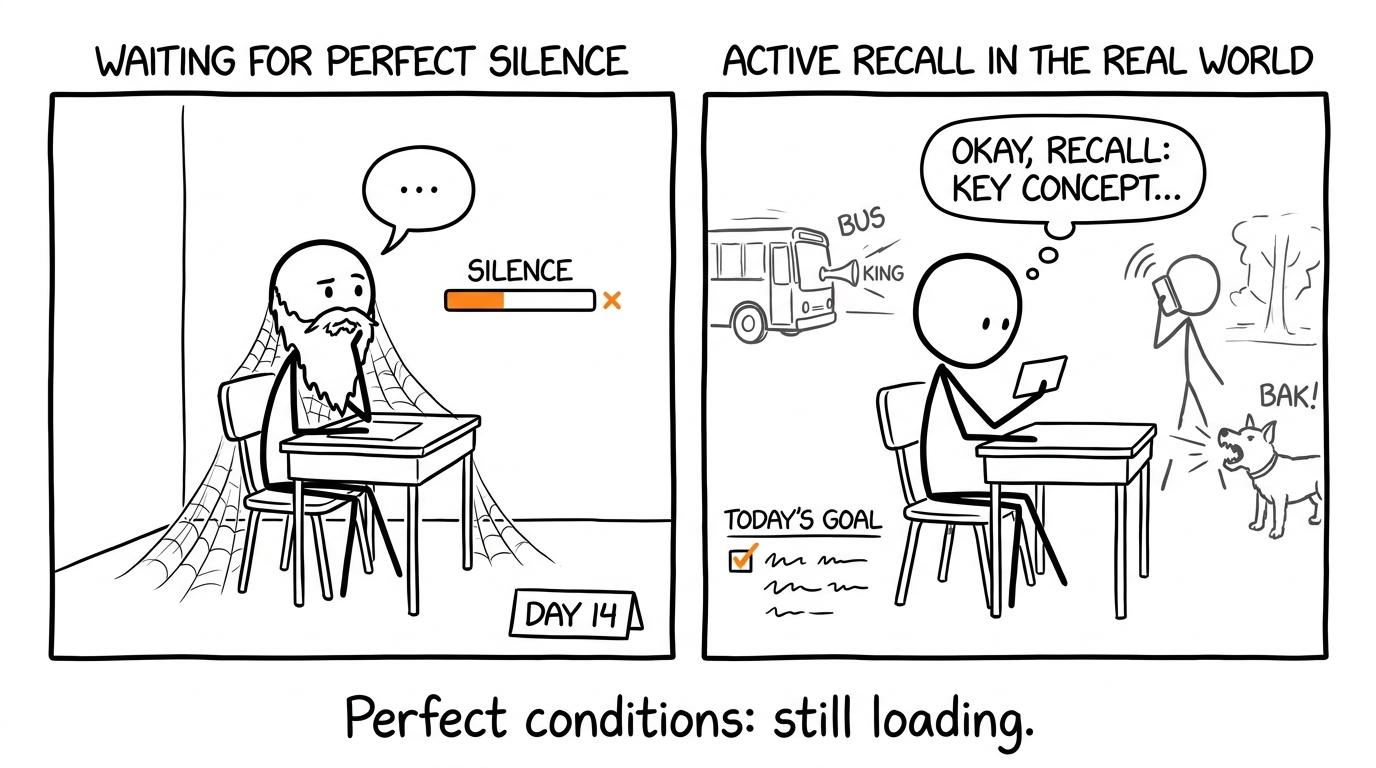 A student stops waiting for perfect revision conditions
Common mistakes when revising in a noisy home
Waiting for perfect silence
This gives the environment control over whether revision happens. Keep a list of tasks that remain possible during ordinary household noise.
Doing only easy flashcards
Flashcards help with AO1 knowledge, but exams also require application, analysis and evaluation. Include paragraph plans and exam questions every week.
Revising late into the night
Late hours may be quieter, but exhaustion can reduce the quality of your work and affect the next school day. Protect a realistic stopping time and seek an alternative study location for demanding tasks.
Trying to block every sound
The struggle to monitor and eliminate noise can itself become distracting. Reduce preventable interruptions, then focus on a small outcome rather than continually checking whether the room is quiet enough.
Making the plan too ambitious
If every session requires a clear desk, a silent hour and high motivation, the plan is unlikely to survive. Build a minimum session you can complete on a difficult day.
Ignoring other GCSE subjects
Sociology is one part of your timetable. Use separate evidence for each subject. In maths, for example, mini tests for targeted GCSE practice can reveal a specific weakness without requiring a full paper. When you have a genuinely quiet period, move towards the appropriate GCSE maths past papers, official mark schemes and timed practice.
Make progress in the space you have
A quiet room would make revision easier. Not having one is a genuine obstacle, and pretending otherwise is not helpful. But it does not have to decide the quality of every session.
Build a portable kit. Separate noisy-time tasks from quiet-time tasks. Ask your school for space. Retrieve before rereading. Practise application and evaluation, not only definitions. Most importantly, measure completed work rather than hours spent waiting for ideal conditions.
Then carry the same calm system into maths. Start with MathsGenie’s free revision lessons and practice questions, identify weaknesses through mini tests, and build towards past papers and predicted papers with mark schemes and video solutions. Open the MathsGenie GCSE revision area, choose your board and tier, and make the next session small enough to begin today.