

Revise GCSE ICT Alone or With Others? A Smart Guide
Revise GCSE ICT alone or with others using a topic-by-topic plan. Learn when solo focus, peer quizzes and hybrid revision sessions work best.

The difficult part of revision is not always understanding the subject. Sometimes it is deciding how to work. You sit down alone and wonder whether a group would make the material easier. Then you join friends and wonder whether anyone is actually learning.
If you are trying to decide whether to revise GCSE ICT alone or with others, the best answer is usually both. Revise alone when you need concentration, honest self-testing or sustained practical work. Revise with others when explanation, questioning and comparison can reveal gaps in your understanding. The right choice depends on the topic and the task, not simply on whether you enjoy company.
One important qualification note: GCSE ICT has been discontinued in England, where many students now take GCSE Computer Science or vocational digital and information technology qualifications instead. ICT qualifications and course names can differ elsewhere in the UK. Check the exact title, specification and assessment arrangements given by your school before choosing resources. The revision principles below apply across ICT, digital technology and much of GCSE Computer Science.
The short answer: choose the method by task
Use this checklist before each session:
- Revise alone for learning definitions, completing practical tasks, answering exam questions and identifying your genuine weaknesses.
- Revise with others for quizzes, verbal explanations, evaluating technology and comparing extended responses.
- Return to solo work when you need to prove that you can answer without prompts.
- Keep groups small, structured and focused on a shared outcome.
- Match every session to your qualification's current specification and assessment format.
- Finish by recording what you still cannot recall, explain or apply.
Educational research summarised by the Education Endowment Foundation suggests that collaborative learning can improve attainment, but the detail matters. Productive collaboration involves clear tasks, participation and accountability. It is not the same as several people sitting together while independently checking their phones. The same research also supports metacognitive habits such as planning, monitoring and evaluating your learning, habits that matter whether you work alone or with classmates.
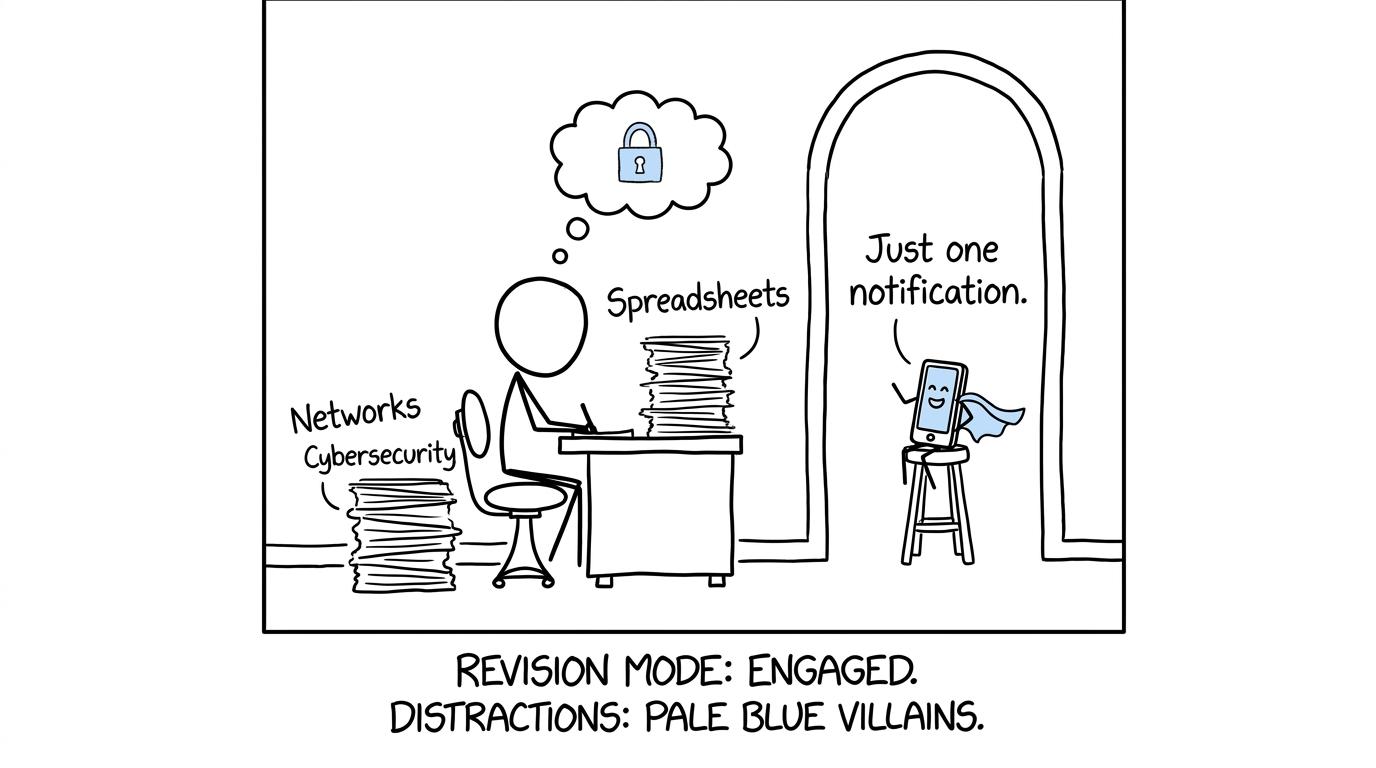 A solo reviser defends a desk from one tempting notification
When revising GCSE ICT alone works best
Solo revision gives you something a group cannot guarantee: an accurate picture of what happens when nobody helps. That matters because the final assessment is completed using your own knowledge and judgement.
Learning precise terminology
Topics such as networks, cybersecurity, data protection, hardware, software and database concepts often involve vocabulary that must be understood precisely. Working alone allows you to use retrieval practice without hearing somebody else's answer first.
Close your notes and recall a definition, process or list of advantages and disadvantages. Then check it against your course materials. Highlighting a page may feel fluent because the words look familiar; recalling the idea without help provides stronger evidence that you know it.
Completing sustained practical work
Database queries, spreadsheet modelling, interface design and other practical tasks usually benefit from uninterrupted attention. Solo work lets you make decisions, encounter errors and diagnose them yourself.
The key is not to copy a sequence of clicks. Ask what each operation accomplishes and why it is suitable. Software versions and interfaces may change, but the underlying purpose of sorting, validating, calculating, searching or presenting data remains important.
Attempting exam questions under realistic conditions
Independent question practice is the clearest test of whether your knowledge is usable. Remove your notes, set a time limit and answer using the command words in the question. Mark the work afterwards using the official mark scheme or guidance supplied for your qualification.
This is also a useful habit for GCSE maths. MathsGenie's guide to using GCSE past papers properly follows the same cycle: attempt, mark, diagnose, fix and retest. The subject changes, but honest feedback remains the engine of improvement.
Protecting your personal pace
A group naturally moves at an average pace. Your gaps are not average. You may already understand computer hardware but need longer on networks, algorithms or database relationships. Independent revision lets you allocate time according to evidence rather than the group's preferences.
If you are unsure where your weaknesses lie, adapt MathsGenie's method for finding weak GCSE topics: attempt questions, log lost marks by topic and practise the most costly gaps first.
When revising ICT with others is more effective
Group revision is most valuable when interaction changes the thinking. If everyone could complete exactly the same activity alone, the group may be adding company rather than learning.
Explaining systems and processes aloud
Try explaining how data travels through a network, how authentication protects access or why validation does not guarantee that data is correct. A classmate can stop you when a step is vague or challenge a hidden assumption.
Explanation exposes the difference between recognising an idea and understanding it. If you cannot express a process clearly, you may not yet be ready to apply it to an unfamiliar scenario.
Comparing evaluative answers
Questions about technology's effects, security choices, storage methods or system design rarely improve through memorised slogans. A useful answer normally connects a point to the scenario and considers relevant consequences.
In a group, compare the reasoning behind your responses. One person might notice cost, another accessibility and another privacy. The aim is not to create one enormous answer. It is to recognise which factors are relevant and support a justified conclusion.
Running fast recall quizzes
Peer quizzes work well for terminology, hardware functions, network types, security threats and legislation listed in your specification. Give one student the role of questioner, one the role of respondent and another the role of checker. Rotate roles so that nobody becomes a spectator.
Questions should require recall rather than simple recognition. Asking someone to describe phishing is more revealing than offering four options and letting them guess.
Finding misconceptions early
A confident mistake can survive for weeks in private notes. Discussion gives it a chance to be challenged. However, classmates can also spread incorrect information, so settle disagreements using your teacher's materials, the specification or an official mark scheme rather than a vote.
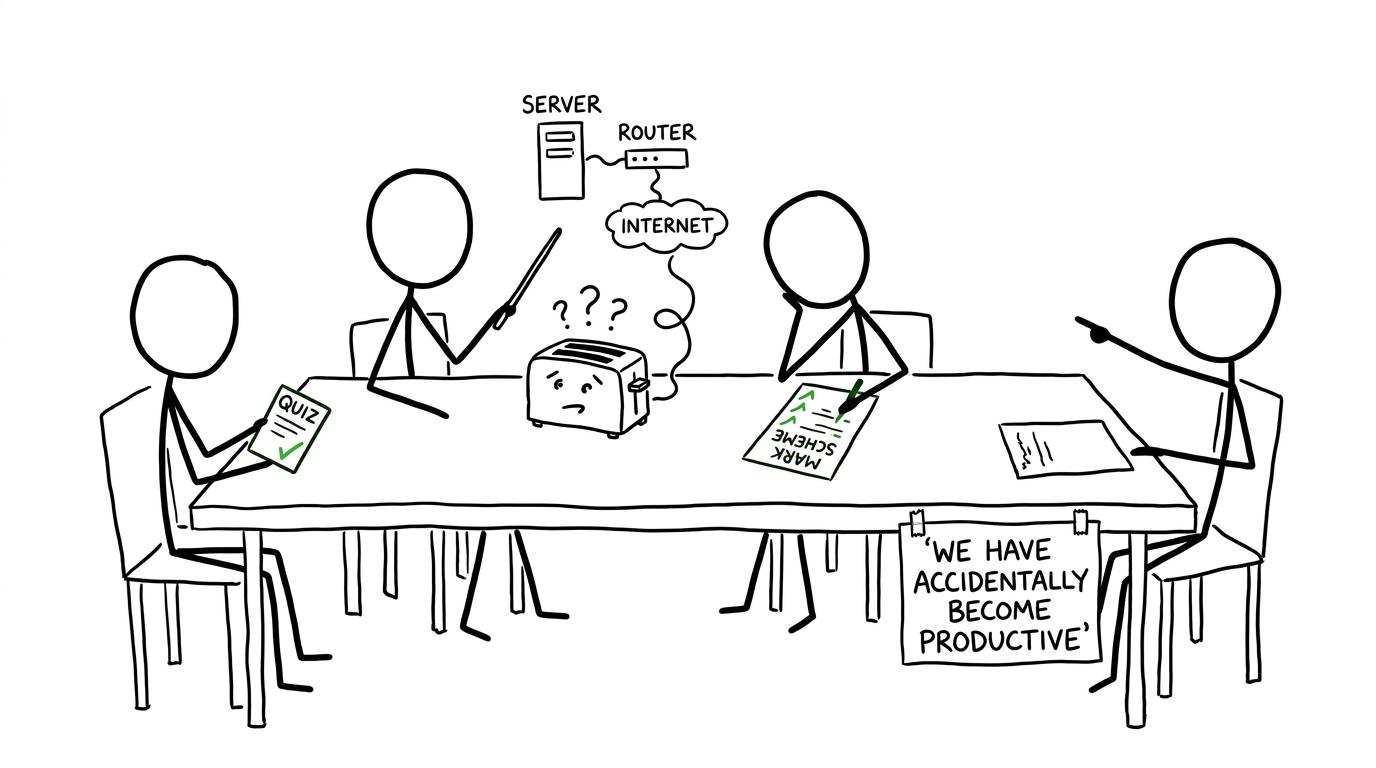 A structured revision group accidentally becomes productive
Which ICT topics suit each revision style?
Topics that usually suit solo revision
Independent work is often best for:
- memorising precise definitions and technical vocabulary;
- practising database, spreadsheet or presentation skills;
- tracing algorithms or reviewing programming constructs where these appear in your course;
- completing timed questions without hints;
- learning the specific requirements of your exam board or awarding organisation;
- correcting personal errors from marked work.
These activities require concentration and reveal individual competence. The principle is similar in maths: you can discuss algebra with friends, but eventually you must solve the question yourself. The GCSE Maths revision hub offers topic resources and exam practice that make independent testing straightforward.
Topics that usually suit group revision
Structured collaboration is often useful for:
- comparing the advantages and disadvantages of technologies;
- discussing ethical, environmental, legal and social effects;
- explaining networks, cybersecurity measures and data flows;
- testing each other on terminology;
- reviewing the quality of extended answers;
- planning how to approach unfamiliar scenarios.
Group work is particularly valuable when several defensible ideas exist but each must be connected carefully to the context.
Topics that need a hybrid approach
Many areas need both methods. Learn cybersecurity threats alone, explain suitable countermeasures to a partner, then answer an unseen scenario independently. Review database concepts together, but build and test a database on your own. Discuss an extended-response question, then write a fresh answer without copying the group's wording.
This hybrid pattern prevents two common illusions: feeling that you know something because a friend explained it, and believing that solitary struggle is always productive.
A practical hybrid revision routine
A reliable session can move through three stages.
Prepare alone
Choose one narrow topic from your specification. Attempt a short set of questions or write down everything you can recall. Record the uncertainties you want the group to resolve.
A revision plan should be specific enough to act on. MathsGenie's GCSE revision timetable guide shows how to organise revision around topics, timed practice and review rather than vague blocks labelled only with a subject name.
Collaborate with a purpose
Set one outcome before the group begins, such as checking definitions, comparing responses or quizzing one another. Keep the group small enough for everybody to participate, assign roles and agree an end time.
Do not divide the syllabus so completely that each person learns only one section. Everyone ultimately needs the knowledge required by their own assessment.
Prove it alone
After the discussion, close the shared document and answer a different question independently. Mark it, note any remaining weakness and decide the next action. Discussion creates possibilities; independent performance shows what has actually stayed with you.
For maths revision alongside ICT, short tests are useful at this stage because they provide rapid feedback. The MathsGenie GCSE revision resources include mini tests, practice papers and topic-focused materials, while Edexcel GCSE Maths predicted papers can help you practise under more realistic conditions near the exams.
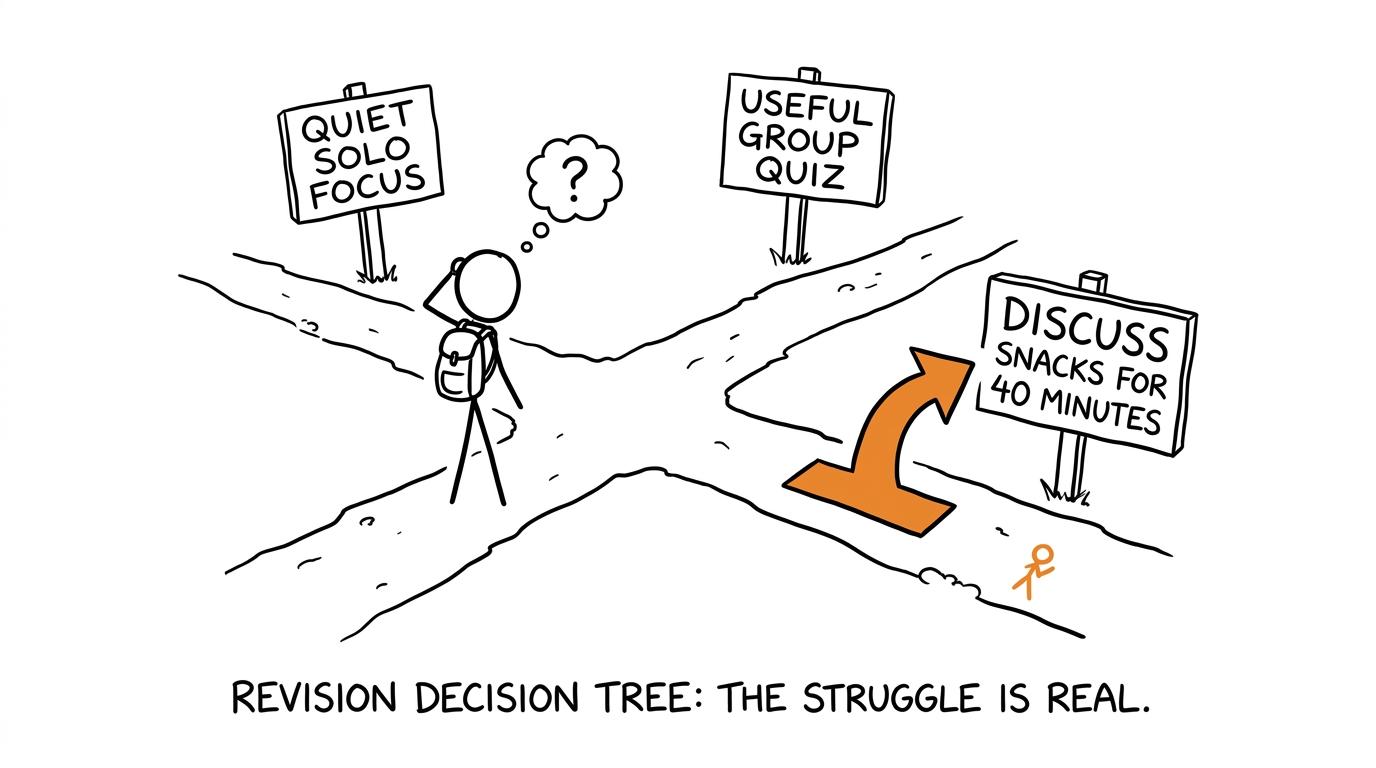 A student chooses between useful solo work, a focused group and discussing snacks
Common mistakes when choosing how to revise
Treating group revision as automatically effective
Conversation is not evidence of learning. Without questions, roles or an outcome, a group can spend most of its time deciding what to revise. Begin with a written agenda and end with an individual check.
Revising only in your preferred way
Quiet students may avoid valuable discussion; sociable students may avoid the discomfort of independent testing. Preference matters, but the assessment's demands matter more. Use the method that fits the task.
Letting the strongest student do all the explaining
If one person supplies every answer, the rest may experience familiarity without retrieval. Rotate the roles of questioner, explainer and checker. Everyone should produce an answer before hearing the group's version.
Using resources for the wrong qualification
GCSE ICT, Computer Science and vocational digital qualifications are not interchangeable. Content, command words and assessment arrangements can differ between AQA, Pearson Edexcel, OCR, Eduqas, WJEC and CCEA qualifications. Confirm your exact course and use its current specification.
Marking without taking action
A score describes what happened; it does not repair the gap. For every lost mark, identify whether the cause was missing knowledge, weak application, imprecise wording, poor timing or a misread question. Then choose a targeted correction.
MathsGenie's article on when to start GCSE past papers reinforces the same idea: paper practice is useful when there is still time to learn from what it reveals.
The best choice is a deliberate one
There is no permanent winner between solo and group revision. Solitary work is better for concentration, practical independence and honest testing. Structured collaboration is better for explanation, questioning and seeing an issue from several angles. Most students need both.
Before every session, ask one useful question: what must I be able to do by the end? If the answer requires quiet production, work alone. If it requires challenge and comparison, involve others. Then test yourself independently before considering the topic secure.
Apply the same discipline to your maths preparation. Start with MathsGenie's free GCSE Maths revision resources, use revision lessons and practice questions to repair gaps, then move into mini tests, past papers, predicted papers, mark schemes and video solutions. Choose the setting with care, but measure success by what you can explain and complete when the room finally goes quiet.











