

Revise GCSE Economics Alone or With Others?
Revise GCSE economics alone or with others? Compare both methods, match them to each topic and build a focused revision routine for stronger exam skills.
The quietest revision mistake is assuming that the place you feel most comfortable is automatically the place where you learn best. Working alone can feel productive because nobody interrupts you. Revising with friends can feel productive because the conversation stays lively. Neither feeling guarantees progress.
So, should you revise GCSE economics alone or with others? The best answer is to combine both. Revise alone when you need concentration, honest self-testing and independent calculation practice. Work with a small, focused group when you need to explain economic chains, compare judgements or expose misconceptions. The topic and task should decide the method.
The quick decision checklist
Choose solo revision when you need to:
- retrieve definitions without prompts;
- learn or repair a weak topic;
- practise calculations accurately;
- complete timed questions independently;
- mark your work and record personal mistakes.
Choose revision with others when you need to:
- explain why an economic effect may occur;
- debate the advantages and disadvantages of a policy;
- compare answers using a mark scheme;
- test one another on terminology;
- challenge assumptions in an extended response.
The strongest routine is usually: learn alone, discuss together, then test alone again. That final independent check matters because the examination is not a group activity.
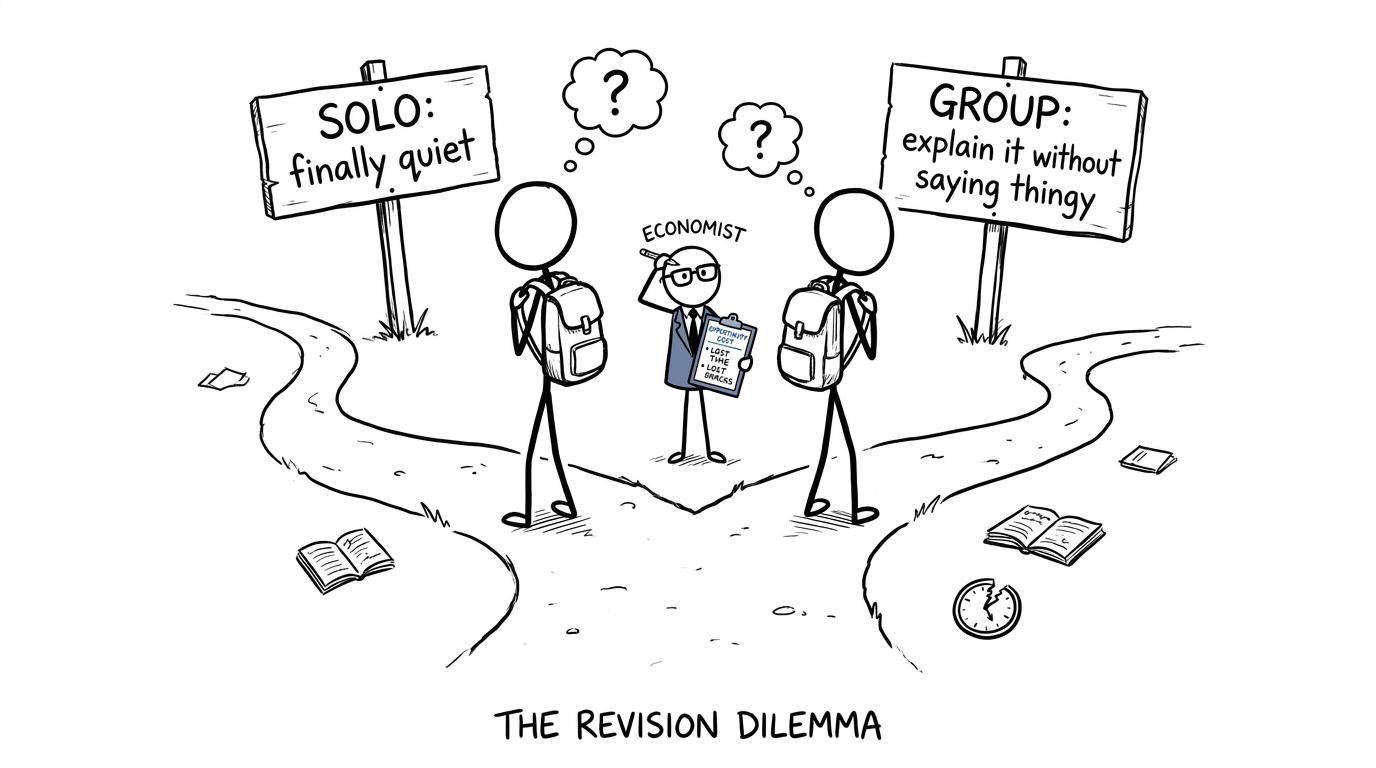 Students choosing between solo and group revision while an economist considers the opportunity cost
Why GCSE Economics needs both approaches
GCSE Economics does not assess memory alone. Ofqual's assessment framework requires students to demonstrate knowledge and understanding, apply concepts to different contexts, and analyse and evaluate economic evidence and issues. Quantitative skills must also account for at least 10%10\%10% of the total marks and must be assessed within an economic context.
That creates several different revision jobs. Remembering the definition of opportunity cost is not the same as applying it to a government decision. Drawing a supply curve is not the same as explaining why it shifts. Calculating percentage change is not the same as using the result to support a judgement.
AQA and OCR specifications both include calculations involving percentages, averages, revenue, costs, profit and income, alongside the construction and interpretation of graphs. MathsGenie's quantitative skills in economics revision guide brings these connected skills together.
In other words, Economics asks you to switch between precision and argument. Solo revision is often better for precision. A well-run group can be better for testing an argument.
When revising GCSE Economics alone works best
Learning definitions and core knowledge
Solo retrieval is useful for scarcity, opportunity cost, factors of production, market failure, inflation, unemployment and other foundational ideas. Close your notes and write what you can remember before checking them. The effort to retrieve the idea is more valuable than repeatedly reading a highlighted page.
Keep the task demanding but manageable. A definition should be accurate, but it should also make sense to you. If you can only repeat the textbook wording and cannot use the term in a new context, the knowledge is still fragile.
Practising quantitative skills
Calculations are personal. A friend can explain a method, but only you can prove that you can carry it out without help.
Relevant GCSE Economics relationships include:
Percentage change=new value−original valueoriginal value×100%\text{Percentage change}=\frac{\text{new value}-\text{original value}}{\text{original value}}\times 100\%Percentage change=original valuenew value−original value×100% Total revenue=price×quantity sold\text{Total revenue}=\text{price}\times\text{quantity sold}Total revenue=price×quantity sold Profit=total revenue−total cost\text{Profit}=\text{total revenue}-\text{total cost}Profit=total revenue−total costThese skills overlap with GCSE Maths, so students preparing for maths exams can strengthen both subjects at once. If percentage change is causing errors in economic data questions, use the percentage change revision guide before returning to the economic context.
Solo practice also reveals small errors that conversation can hide: dividing by the new value instead of the original value, omitting units, copying data incorrectly or failing to state whether a result is an increase or decrease.
Completing timed exam questions
You need periods of silence in which nobody supplies the missing word or rescues an unfinished explanation. Timed practice reveals whether your knowledge remains accessible under pressure.
Afterwards, use the mark scheme actively. Record whether each lost mark came from missing knowledge, weak application, an incomplete chain of reasoning, inaccurate calculation or poor judgement. MathsGenie's guide to using GCSE past papers properly explains the same diagnose-and-repair principle for maths revision.
Protecting focus
Working alone makes it easier to match the session to your own gaps. Your friends may want to discuss monetary policy while your real weakness is interpreting graphs. A personal plan prevents somebody else's priorities from quietly becoming yours.
Use the free MathsGenie revision planner to schedule specific tasks rather than vague instructions such as “revise economics”. A useful entry names the topic, activity and intended check.
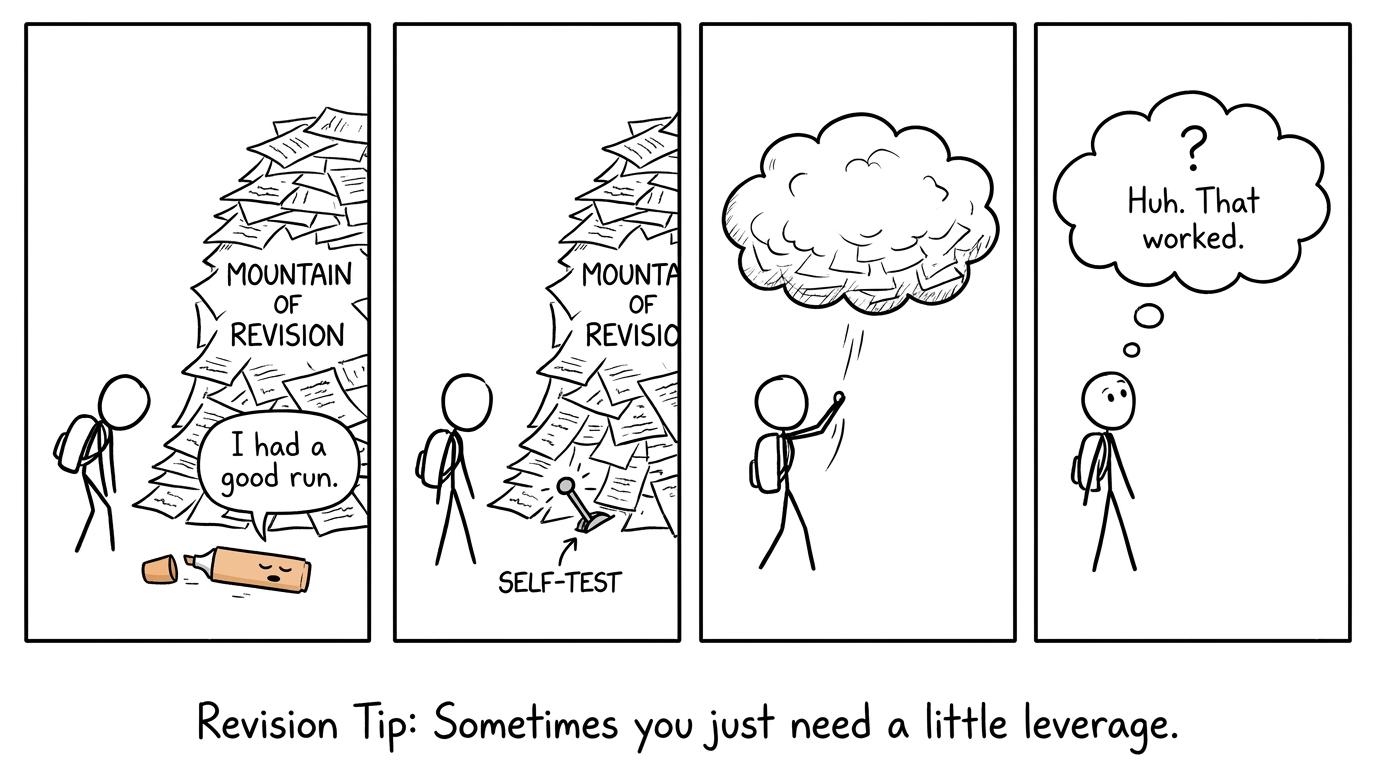 A student using self-testing to lift a mountain of notes while a retired highlighter watches
When revising with others is more effective
Explaining chains of economic reasoning
Economic analysis often follows a chain: an initial change affects incentives or costs, which changes behaviour, which creates a further consequence. Explaining that chain aloud can expose gaps that silent reading misses.
Ask one student to explain an effect while another listens for unsupported jumps. The listener should ask questions such as “Why would that happen?”, “Who is affected?” and “Does this depend on the size of the change?” The purpose is not to win a debate. It is to make every link defensible.
Evaluating policies and decisions
Topics such as taxation, subsidies, minimum wages, interest rates and government spending contain competing perspectives. Group discussion can help you consider consumers, producers, workers, the government and the wider economy rather than repeating one memorised argument.
A useful group structure is:
- one person states a possible benefit;
- another develops the economic reasoning;
- a third identifies a limitation or condition;
- everyone writes an individual conclusion afterwards.
The writing must remain individual. Discussion creates possibilities; independent writing shows whether you can select and organise them.
Checking diagrams and data interpretation
Pairs or small groups can compare supply and demand diagrams, axis labels, curve shifts and written interpretations. Students often notice one another's missing labels more quickly than their own.
However, do not simply agree with the most confident speaker. Check explanations against your specification, teacher materials and reliable revision resources. Confidence is not evidence.
Using peer quizzing properly
Peer quizzing works when everyone must retrieve an answer before receiving feedback. It becomes much weaker when one person reads notes aloud while everyone else listens passively.
Keep questions precise. Mix definitions with prompts requiring application or analysis. After each answer, confirm the correction immediately so that an inaccurate explanation does not circulate around the group.
Research reviews of collaborative learning generally find that it can support attainment, but they also stress that productive collaboration does not happen automatically. Small groups need a shared goal, clear roles and participation from everyone.
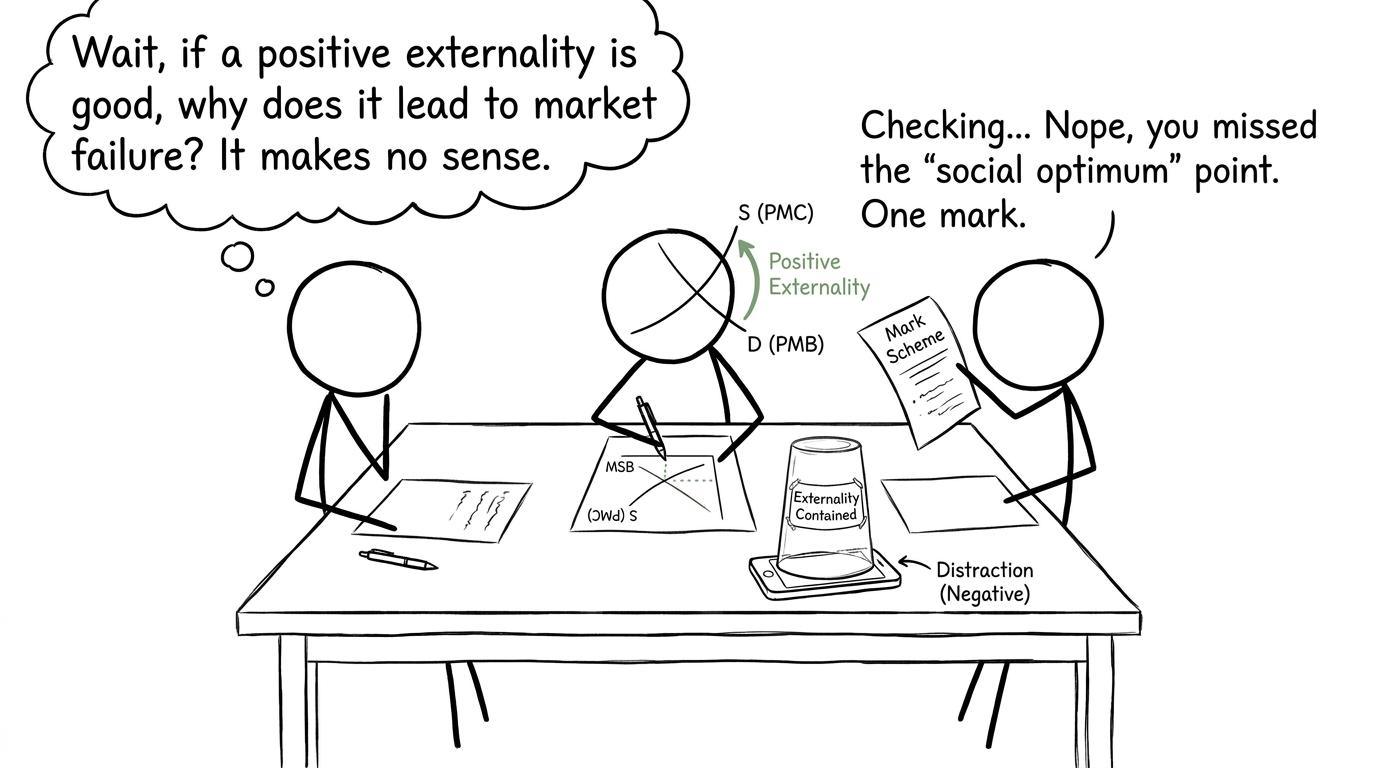 A focused revision group containing the externality caused by a distracting phone
Which method suits each Economics topic?
| GCSE Economics topic or task | Best starting method | Why it fits |
|---|---|---|
| Definitions and key terminology | Alone | Retrieval shows what you personally remember. |
| Percentages, costs, revenue and profit | Alone | Accuracy and independent method matter. |
| Supply and demand diagrams | Alone, then with a partner | Draw independently before checking labels and shifts. |
| Interpreting charts and economic data | Alone, then together | Form your own conclusion before comparing interpretations. |
| Chains of analysis | With others | Questions expose missing causal links. |
| Policy advantages and disadvantages | With others, then alone | Discussion broadens perspectives; solo writing builds exam readiness. |
| Timed extended responses | Alone | You must manage planning, writing and time independently. |
| Mark-scheme review | Alone or in a pair | Individual diagnosis matters, but comparison can clarify what earns marks. |
The same principle helps with maths. Learn methods and complete questions independently, then use another person or a video solution to challenge your reasoning. The Edexcel GCSE Maths revision hub offers lessons, question practice and papers for this cycle. Students following AQA, OCR or Eduqas should use resources matched to their own board and tier.
A practical hybrid revision routine
A productive session does not need to choose one method forever. It can change mode as the task changes.
Before meeting the group
Revise the agreed topic independently. Retrieve key terms, complete one short calculation set or plan an answer without notes. Write down two uncertainties. This prevents the meeting from becoming the first time anyone has looked at the material.
During the group session
Keep the group small enough for everyone to participate. Agree one outcome, such as comparing conclusions for a policy question or checking supply and demand diagrams. Give each person a role and keep phones away unless they are genuinely needed.
Spend more time answering and explaining than making notes. If the group cannot identify what it has produced by the end, the session probably drifted.
After the session
Complete a fresh question alone. This is the test that matters. If you still need prompts, the topic is not secure yet.
Then schedule a later revisit rather than assuming one successful session has finished the job. MathsGenie's article on the best order for learning GCSE Maths topics shows how revisiting skills can form part of a wider learning journey.
Common mistakes when choosing how to revise
Treating a social meeting as revision
Conversation can feel busy without producing learning. Set a topic, task, time limit and final individual check before the session begins.
Revising only in the preferred way
Students who enjoy solitude may avoid explaining ideas. Sociable students may avoid the uncomfortable silence of independent recall. Your preferred method can become a hiding place from the skill you most need to improve.
Letting one person dominate
If one student answers every question, the others are observing rather than retrieving. Rotate roles and require everyone to write an answer before discussion begins.
Comparing confidence instead of checking accuracy
The loudest explanation is not necessarily the best one. Use mark schemes, specifications and trusted resources to settle disagreements.
Ignoring the maths inside Economics
Economic understanding does not excuse inaccurate arithmetic. Practise percentages, averages and graphs directly, then apply them to economic evidence. MathsGenie's guide to GCSE Maths topics by exam board and tier can help identify connected maths skills.
Finishing without independent testing
A group explanation may make perfect sense while somebody else is speaking. You only know it has transferred when you can reproduce and apply the idea alone.
Build a revision system that changes with the task
The real choice is not between being a solo learner and a group learner. It is between choosing revision by habit and choosing it deliberately.
Work alone to retrieve knowledge, practise calculations and face timed questions honestly. Work with others to test explanations, broaden evaluation and uncover assumptions. Then return to independent practice. That final step converts a useful conversation into examination readiness.
MathsGenie can support the quantitative side of that routine with free revision lessons, practice questions, mini tests, mark schemes and video solutions. Use GCSE Maths predicted papers and past-paper practice to strengthen the percentages, averages, graphs and data skills that Economics also demands. Start with one weak skill, test it, correct it and revisit it. Progress often looks less dramatic than a long group session, but it is far more dependable.











