Revise GCSE Classical Civilisation: Screen vs Paper
Revise GCSE Classical Civilisation screen vs paper with a practical hybrid plan for stronger recall, source analysis, essay practice and confidence today.
Revision can look productive long before it becomes useful. A neatly highlighted digital textbook, twelve open tabs and a folder full of attractive notes may create the feeling of progress. But the exam asks a harder question: what can you remember, analyse and write without those supports?
If you are deciding how to revise GCSE Classical Civilisation screen vs paper, the best answer is not to choose one medium for everything. Use screens to organise material, view sources and run quick retrieval activities. Use paper for close reading, memory work, essay planning and timed exam practice. Research generally finds a small comprehension advantage for print when reading longer informational texts, although results vary by task and learner. What you do with the material matters more than the device alone.
That distinction matters for students balancing Classical Civilisation with maths. Both subjects reward active practice rather than comfortable rereading, even though the knowledge and exam skills are very different.
The screen vs paper revision checklist
A balanced routine should include:
- screen-based access to notes, prescribed sources and digital flashcards;
- paper-based recall completed without looking at notes;
- regular comparison of Greek and Roman material where your component requires it;
- handwritten plans and extended responses;
- marking against an official mark scheme or teacher guidance;
- an error log showing missing knowledge and weak analysis;
- spaced returns to the same material over several days;
- timed practice in the format of the real examination.
The principle is simple: use each medium for the job it does best.
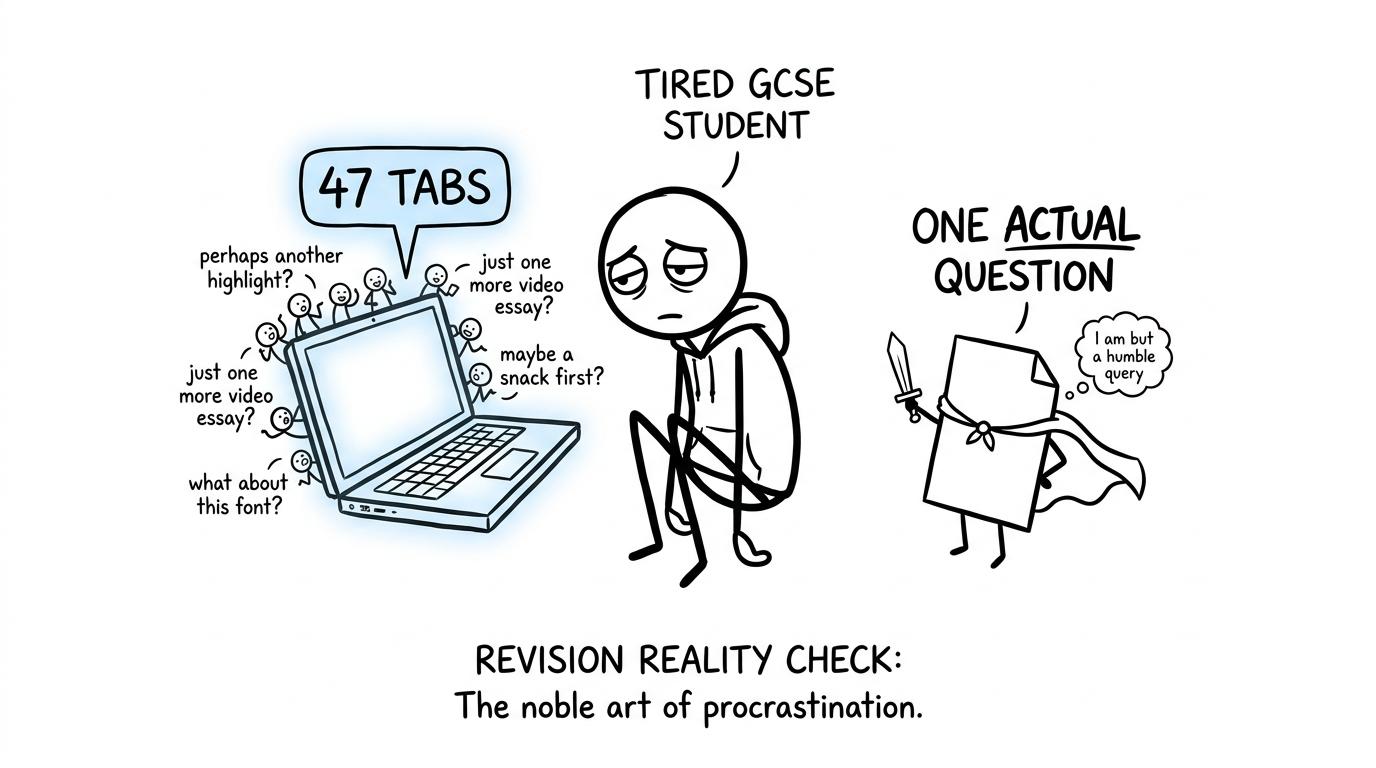 A student choosing between a laptop with too many tabs and one useful sheet of paper
What the GCSE Classical Civilisation exam demands
OCR GCSE Classical Civilisation, specification J199, is assessed through two written components. Students take one Thematic Study and one Literature and Culture component. Each examination lasts 111 hour 303030 minutes, carries 909090 marks and contributes 50%50\%50% of the qualification.
The Thematic Study options are Myth and Religion or Women in the Ancient World. The Literature and Culture options are The Homeric World, Roman City Life or War and Warfare. Questions include shorter responses, source work and extended writing. The assessment tests both knowledge and understanding and the ability to analyse and evaluate ancient evidence.
This immediately tells you something about revision media. Digital access can help you gather and sort a large body of material, but the final performance is handwritten. You need to retrieve precise knowledge, interpret literary and visual evidence, compare material where required and sustain an argument on paper.
Your school should confirm your exact components and provide the current OCR specification, prescribed material and assessment guidance. Do not revise every available option simply because an online folder contains them.
Does digital Classical Civilisation revision actually stick?
Yes, it can. A screen is not automatically a shallow learning tool. It becomes shallow when it encourages passive behaviour: scrolling, copying, highlighting and switching between distractions.
Digital revision is strongest when it makes you produce an answer. Useful activities include hiding notes before recalling a myth, sorting evidence by theme, labelling a visual source from memory, answering a flashcard before revealing it and drafting questions from a passage.
Technology is also useful for repeated practice. Digital flashcards can schedule forgotten material, while searchable notes help you locate related sources quickly. For example, you might collect evidence concerning duty, power or gender across several texts before closing the screen and reconstructing the links from memory.
That final step matters. Recognition is not recall. Seeing the name of a figure and thinking, “I know that,” is easier than explaining the figure's relevance in a source-based answer.
The same danger appears in maths. Watching a solution can feel clear while it is playing, yet the real test is whether you can complete a fresh question alone. MathsGenie's guide to turning notes into active recall explains a transferable cycle: convert material into questions, answer from memory, check, correct and revisit.
Why paper still deserves a central role
Research comparing screens with print is more nuanced than slogans such as “paper always wins”. Systematic reviews report mixed findings, but several have identified a small average advantage for paper when people read informational or explanatory texts. The difference can become more relevant with longer passages, close comprehension or time pressure.
Classical Civilisation contains exactly these demanding situations. You may need to notice a detail in a literary passage, connect an object to its cultural context or evaluate how far a source supports an interpretation. Printing selected material can make slow annotation and cross-referencing more deliberate.
Paper also removes some friction. There are no notifications, accidental tab changes or tempting searches. More importantly, handwriting resembles the physical act required in the examination. It lets you practise writing at a sustainable pace, structuring paragraphs and leaving enough time to complete the paper.
Do not turn this into a rule that every note must be handwritten. Copying pages from a textbook is still copying. Paper works when it supports thinking: closed-book recall, concise annotations, comparison grids, essay plans and timed answers.
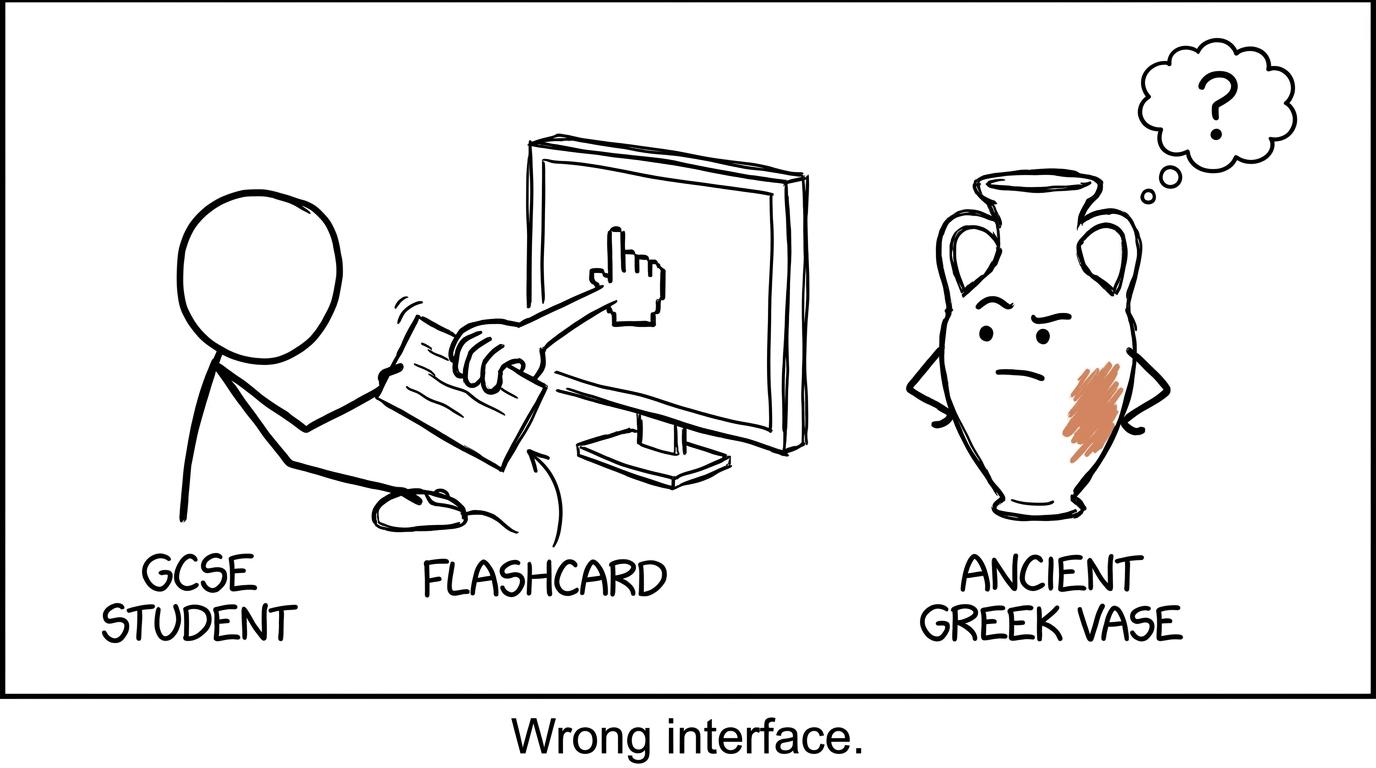 A student attempting to drag a paper flashcard with a computer mouse
Match the medium to the Classical Civilisation task
Learn and organise content on screen
Use your device to check the specification, view prescribed visual and material culture, organise class resources and create searchable topic lists. Keep one folder for each component and separate factual knowledge from possible interpretations.
A screen is particularly helpful when visual sources need careful enlargement. Look closely at composition, clothing, gestures, objects and inscriptions. Then close or cover the description and record what you can identify without assistance.
Retrieve knowledge away from the screen
Take a blank sheet and write everything you can remember about one narrow prompt. A prompt might concern the features of a religious practice, the presentation of a character or the social significance of an artefact.
Check your recall only after you have finished. Add missing material in another colour, then turn each gap into a question for a later session. Retrieval should reveal weakness rather than disguise it.
This approach resembles the diagnostic role of GCSE maths mini tests: the purpose is not merely to receive a score, but to discover what needs repairing.
Plan analysis by hand
For an extended response, a list of facts is not enough. Practise building a chain from evidence to interpretation and then to judgement. On paper, create brief plans containing:
- the claim you intend to make;
- the specific ancient evidence supporting it;
- an explanation of what that evidence suggests;
- an alternative interpretation or limitation;
- a judgement answering the precise question.
Keep plans short. Their purpose is to rehearse decisions, not become essays in miniature.
Complete final practice on paper
OCR Classical Civilisation is a written examination, so at least some practice should reproduce that experience. Use the correct time limit, write without notes and complete responses in full rather than mentally sketching them.
Afterwards, use the relevant official mark scheme, examiner material or teacher feedback. Record whether marks were lost through missing knowledge, vague source use, limited analysis, weak comparison, poor judgement or timing.
This paper, mark, repair and retest cycle also underpins MathsGenie's guidance on using GCSE past papers properly. The subject changes; the feedback loop does not.
A practical hybrid revision session
A focused session can move deliberately between media:
- Screen: choose one specification point and review the relevant source material.
- Paper: close everything and retrieve the key facts, names and source details.
- Screen: check accuracy and identify omissions.
- Paper: plan or write an exam-style response without support.
- Screen or paper: compare the response with the mark scheme or teacher guidance.
- Planner: schedule the weakest material for another day.
This is more demanding than rereading because it keeps removing support. That difficulty is useful. Revision should expose what cannot yet be produced independently.
If several GCSE subjects are competing for time, build these sessions into a realistic schedule. MathsGenie's GCSE revision timetable guide shows how to prioritise genuine weaknesses and revisit them rather than assigning equal time to everything. The one-month GCSE revision plan offers another model for combining retrieval, focused practice and feedback.
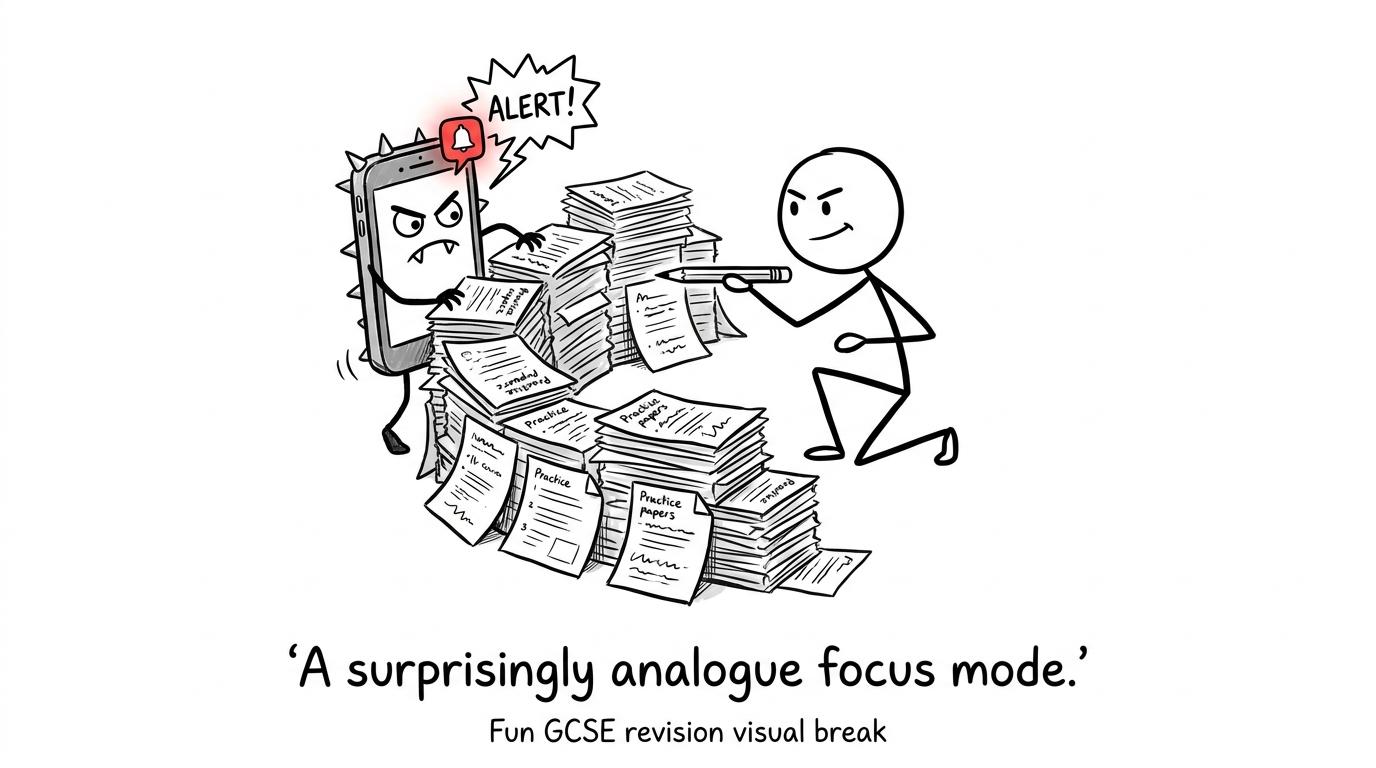 Printed practice papers forming a fortress against phone notifications
How to tell whether your revision is working
Do not judge a method by how polished the notes look. Test its output.
At the end of a week, ask whether you can:
- recall key material without opening your notes;
- identify prescribed sources accurately;
- explain why evidence matters rather than merely naming it;
- compare Greek and Roman material where required;
- produce a focused judgement;
- write clearly for the required length under time pressure;
- correct previous weaknesses when they reappear.
Keep a small error log. One column can state the problem; another can state the next action. “Weak on Roman religion” is too broad. “Cannot explain the purpose and significance of this prescribed ritual” gives you something precise to revise.
A similar diagnostic mindset helps in maths, where every lost mark should direct the next practice session. The free GCSE maths revision hub brings together revision lessons, exam questions, worksheets and board-specific resources for Edexcel, AQA, OCR and Eduqas.
Common screen and paper revision mistakes
Assuming digital automatically means active
Typing is not retrieval if you are copying from another window. Close the source before answering and reveal it only when you are ready to check.
Highlighting almost everything
Highlighting may guide a later task, but it does not prove that you can recall or analyse the material. Turn each important passage into a question, source prompt or argument.
Making beautiful notes instead of exam responses
Presentation can become a safe substitute for uncertainty. Once you understand a topic, move into closed-book recall and exam-style writing.
Avoiding handwriting until the final weeks
Knowledge alone does not build writing stamina. Include short handwritten plans early, followed by paragraphs and complete timed responses.
Using a generic mark scheme
Classical Civilisation components assess particular content and question types. Use the correct OCR material for your component and examination series, alongside guidance from your teacher.
Revising preferred topics repeatedly
Familiar material feels fluent, which makes it attractive. Begin with a diagnostic task and let errors choose the next topic. Maths students can apply the same idea through GCSE predicted papers, practice questions and mini tests, while remembering that predicted papers complement rather than replace full specification coverage.
Choose the tool, then do the thinking
The screen versus paper debate is tempting because it offers a simple answer to a complicated problem. But memory does not improve because a page glows or because it does not. It improves when you retrieve knowledge, receive accurate feedback, revisit gaps and practise the performance the exam requires.
For GCSE Classical Civilisation, that usually means a hybrid method: screens for access, organisation and efficient self-testing; paper for deep reading, recall, argument and timed writing. Keep the official OCR specification and your teacher's guidance at the centre of the plan.
Then protect time for your other subjects. For maths, make MathsGenie your free revision base: begin with focused revision lessons and practice questions, test yourself with mini tests, and build towards past papers, mark schemes, video solutions and predicted papers. A medium is only a tool. The progress comes from what you repeatedly ask your brain to do.