

GCSE Active Recall: Turn Chemistry Notes Into Results
GCSE active recall made simple: turn Chemistry notes into self-testing prompts, then mirror the method for maths with YesGenie past papers and mark schemes.
GCSE revision often starts with good intentions: you rewrite Chemistry notes neatly, colour-code headings, and promise yourself you’ll “go over it later”. Then later arrives as a foggy evening before a mock, and the notes feel familiar but strangely unusable. Familiarity is not the same as recall. The skill you need for GCSE exams isn’t recognising a page you’ve seen before; it’s pulling an idea out of your head under time pressure.
That’s where active recall comes in. This guide shows you how to turn GCSE Chemistry notes into active recall prompts, and then (because you’re a maths student too) how to carry the same system into GCSE maths using YesGenie lessons, practice questions, mini tests and past papers.
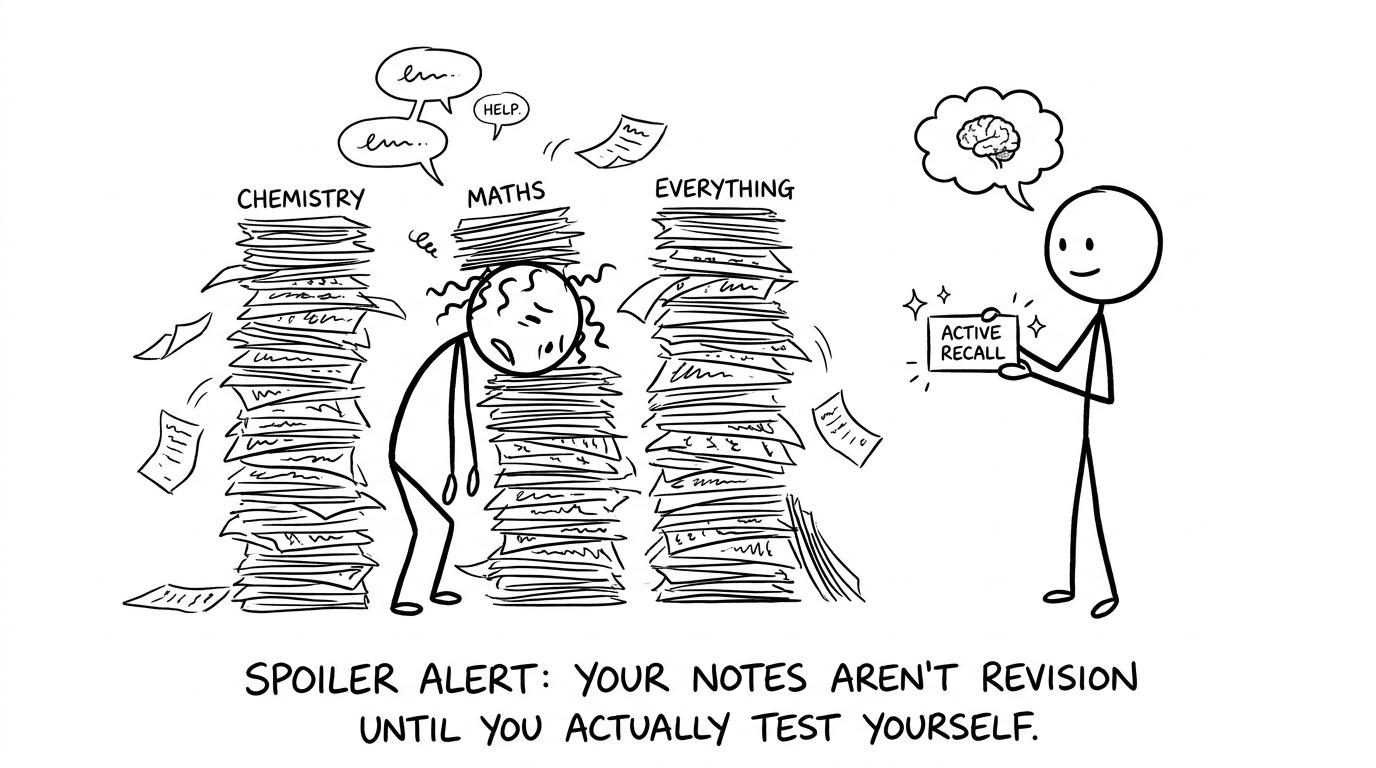 A stressed student meets active recall
The active recall checklist (keep it boring, keep it effective)
If you want your GCSE notes to turn into marks, you need a repeatable process. Here’s the quick checklist:
- Reduce notes into questions (not summaries).
- Answer from memory first, then check.
- Mark with a checklist (like a mini mark scheme).
- Fix the exact gap (one sentence, one calculation, one definition).
- Space the same questions over days and weeks.
- Interleave topics (mix them) so recall becomes flexible.
This is the same logic that makes maths past papers so powerful: you’re practising retrieval, not re-reading.
Why GCSE notes feel “productive” but don’t move your grade
Your brain is economical. If a page looks tidy and you’ve read it twice, your brain labels it “known” and moves on. In GCSE Chemistry, that’s dangerous because many marks come from precise language: definitions, required practicals, and explaining trends. In GCSE maths, it’s dangerous because many marks come from method: the working, not the vibe.
Active recall forces the opposite behaviour: you try to retrieve the idea with no help, you fail in specific places, and then you repair the exact weakness.
That repair step is where grades move.
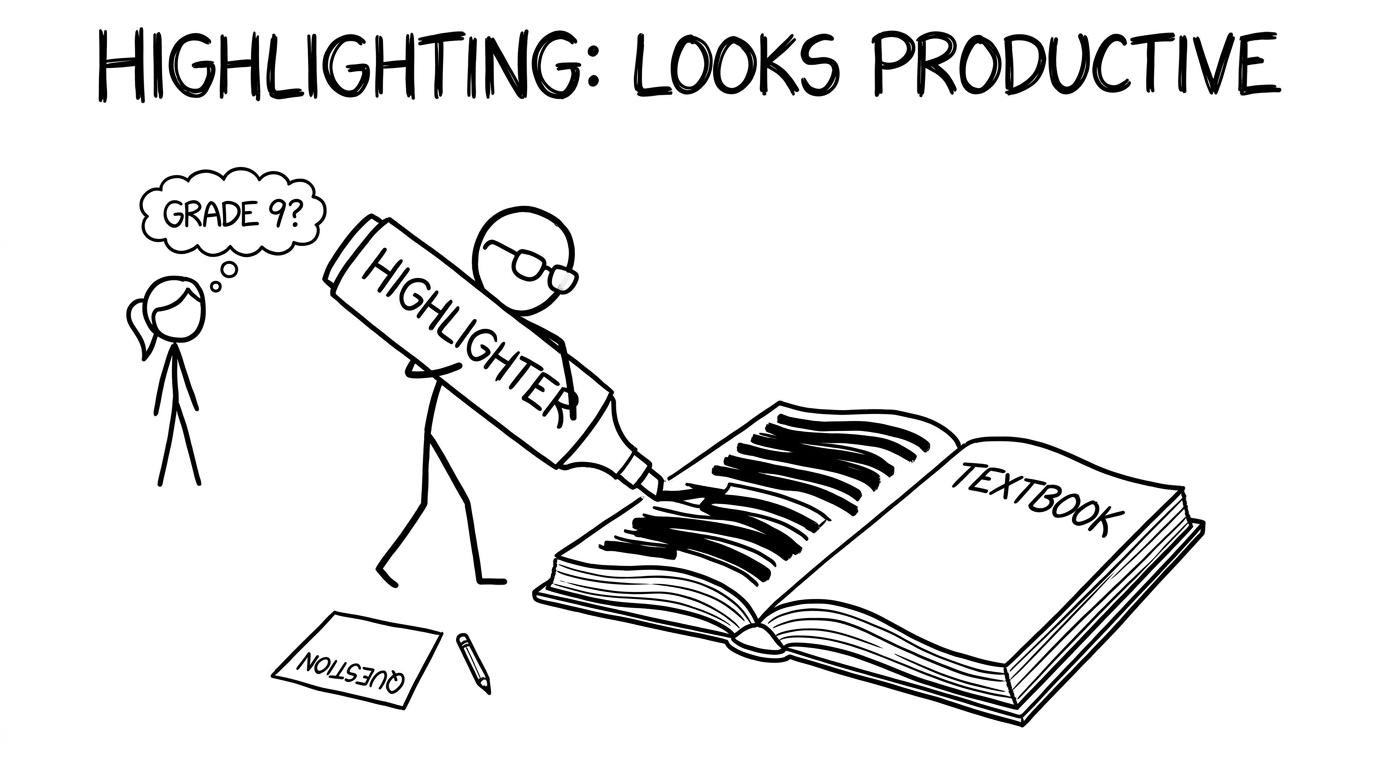 Highlighting looks productive
How to turn GCSE Chemistry notes into active recall prompts
Step one: turn every heading into a question
Take a typical GCSE Chemistry page:
- “Electrolysis of molten ionic compounds”
- “Half equations at the cathode/anode”
- “Why aluminium extraction is expensive”
Rewrite those as questions:
- “What is electrolysis?”
- “What happens at the cathode in electrolysis of a molten ionic compound?”
- “Write the half equation for oxide ions at the anode.”
- “Why is aluminium extraction expensive? Give two reasons.”
Your notes now have a job: generate retrieval.
Step two: convert facts into ‘minimum-answer’ cards
A strong GCSE active recall prompt has a small answer you can mark quickly.
Bad prompt: “Explain everything about acids.”
Better prompts:
- “State the pH range for acids.”
- “Name the ion produced in aqueous acids.”
- “Write the general equation: acid + metal →\to→ ?”
Keep the answers short, because short answers scale. You can do 30 short recalls in 20 minutes. You can’t do 3 essays in 20 minutes.
Step three: add mark-scheme language
In Chemistry, marks often depend on key words like “increase”, “decrease”, “random motion”, “net movement”, “electrons transferred”. Add these to your model answer.
A useful trick is to include one forbidden vague word at the bottom of your prompt, like: “things”, “stuff”, “goes up”. If your answer contains it, you must rewrite the sentence more precisely.
This is the same habit you need in GCSE maths: “I timesed it” doesn’t get marks. A method does.
Step four: use exam-style stems, not textbook phrasing
Chemistry exams repeat patterns:
- “Describe and explain…”
- “Give two reasons…”
- “Suggest why…”
- “Calculate…”
So build prompts using those stems. Your brain becomes familiar with the shape of questions, not just the content.
Borrow the maths approach: active recall is just “past-paper thinking”
Maths students often assume active recall is for essay subjects. But the best GCSE maths revision is active recall disguised as practice: you attempt, you check, you correct, you repeat.
On YesGenie, you can make this automatic:
- Use lessons to learn the method once: Edexcel GCSE Maths Lessons or Eduqas GCSE Maths Lessons.
- Then switch fast into exam-style retrieval using Edexcel GCSE Maths Mini Tests.
- Finally, prove it under pressure with GCSE Past papers and mark schemes.
Your Chemistry active recall cards are doing the same job as a mini test: forcing the idea out of your head.
A worked method example: turn a Chemistry calculation into an active recall routine
Chemistry has calculations where the method matters (moles, concentration, gas volumes). The active recall version is: store the method as a short checklist and practise retrieving it.
Example prompt you create from your notes:
“Concentration: what are the steps to find concentration in g/dm3\text{g}/\text{dm}^3g/dm3 from mass and volume?”
Model answer (your checklist):
- Convert volume to dm3\text{dm}^3dm3 if needed
- Use concentration=massvolume\text{concentration} = \dfrac{\text{mass}}{\text{volume}}concentration=volumemass
Now mirror the same approach in GCSE maths, where students often lose marks because they don’t have a reliable checklist.
Maths worked example: unit cost (links directly to real exam marks)
This looks like “shopping maths”, but it’s really method and clarity.
Question: A 750 ml bottle costs £2.70. A 1.5 L bottle costs £4.80. Which is better value?
Convert to the same unit. Use litres.
- 750 ml=0.75 L750\text{ ml} = 0.75\text{ L}750 ml=0.75 L
- Unit cost for 0.75 L bottle: 2.700.75=3.60\dfrac{2.70}{0.75} = 3.600.752.70=3.60 (£ per L)
- Unit cost for 1.5 L bottle: 4.801.5=3.20\dfrac{4.80}{1.5} = 3.201.54.80=3.20 (£ per L)
So the 1.5 L bottle is better value because £3.203.203.20 per L is lower.
Your active recall prompt for maths becomes:
- “Best buy questions: what are the steps?”
And you practise it using: Best Buy Questions (practice).
That’s the same transformation you’re making in GCSE Chemistry: notes →\to→ method →\to→ recall →\to→ marks.
A Level students: why this matters even more
If you’re revising for A Level maths alongside GCSE content (or helping a younger sibling), active recall becomes less optional. A Level topics punish “I kind of remember it”. The jump is not just harder content; it’s stricter chaining of ideas.
That’s why A Level revision tends to revolve around papers and marking. You can use YesGenie for that too: Edexcel A Level Maths Past Papers.
The story is the same at every level: retrieval first, comfort second.
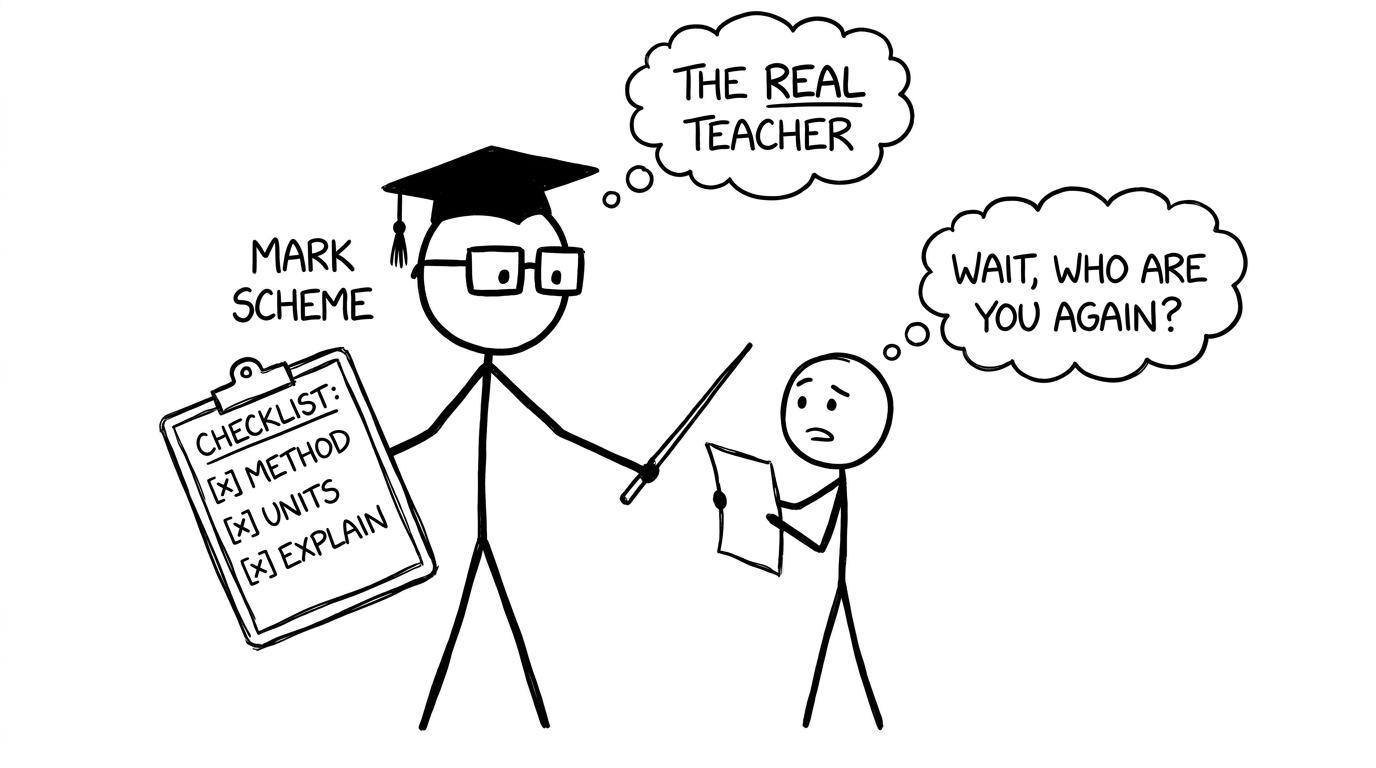 The mark scheme as a character
How to schedule active recall (so it survives a real week)
GCSE students rarely fail because they don’t care. They fail because their system requires a perfect day. Active recall needs to fit into imperfect days.
A simple spacing plan:
- Day 0: make prompts from today’s Chemistry notes (10-20 minutes)
- Day 1: recall session (10 minutes)
- Day 3: recall session (10 minutes)
- Day 7: recall session (10 minutes)
- Day 14: mixed recall (Chemistry + maths)
In maths, you can use short, focused sets as your “recall sessions”, like mini tests: Edexcel GCSE Maths Mini Tests.
When exam season arrives, bring in predicted papers to simulate the real thing: Edexcel GCSE Maths Predicted Papers.
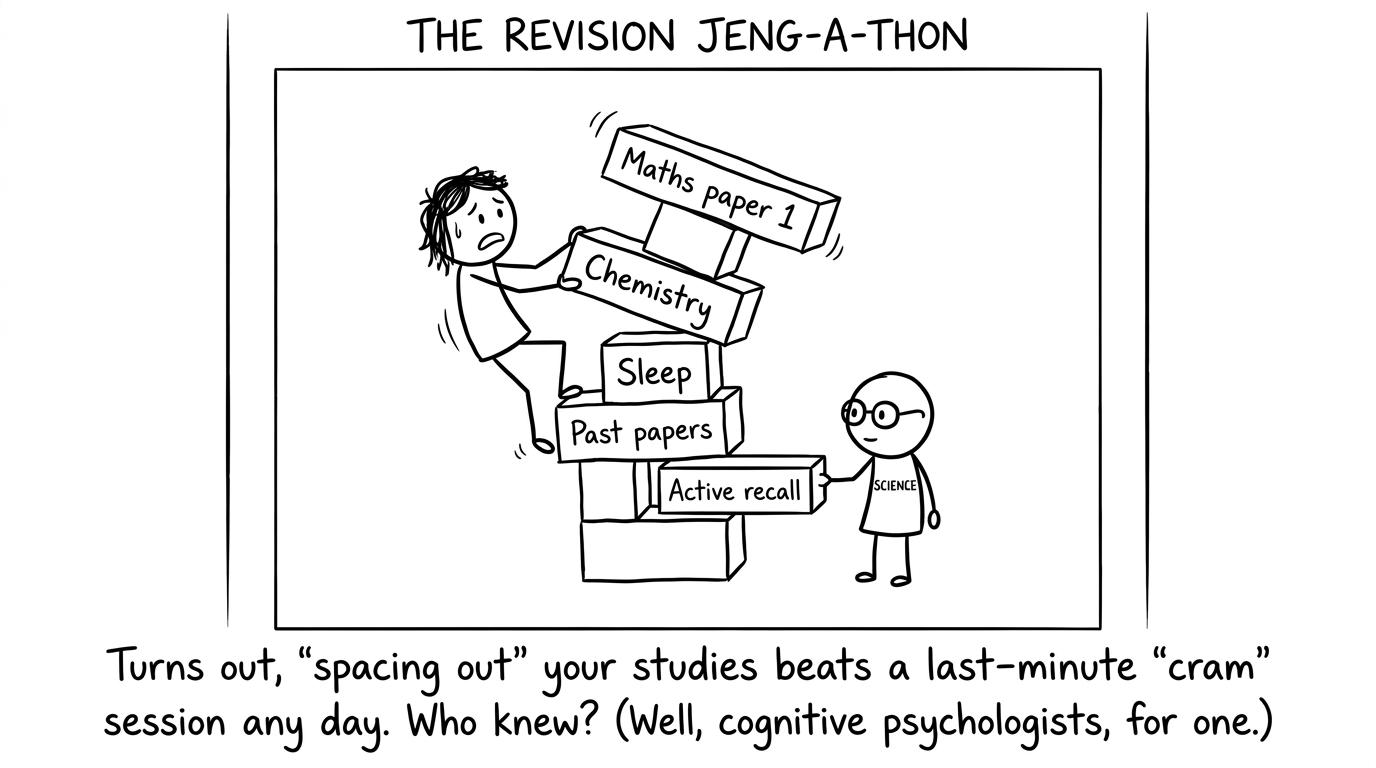 Revision schedule Jenga
Common mistakes (and quick fixes)
Making “pretty prompts” instead of testable prompts
If the prompt can’t be answered in 10-30 seconds, it’s probably a mini-essay. Split it into smaller questions. GCSE Chemistry rewards precision, not poetry.
Checking the answer too soon
If you look at your notes after two seconds, you are practising recognition again. Set a rule: you must attempt an answer, even if it’s wrong. Wrong attempts create strong memory hooks.
Forgetting to mark your own answers
Active recall without feedback becomes confident repetition of mistakes. In maths, always compare with worked solutions and method. Use YesGenie video solutions on papers when you’re stuck, such as: GCSE Maths Paper Video Solutions.
Only recalling what you already like
Students tend to repeat easy topics because it feels good. Your revision plan should include your weak areas first. On YesGenie, the topic-by-topic layout makes this honest and manageable, for example: Simplifying Algebra (practice).
Not switching from prompts to exam questions
Prompts build the memory. Exam questions build the performance. In GCSE maths, the final step has to include timed practice with mark schemes: GCSE Past papers.
Closing: make GCSE notes earn their keep
Your GCSE Chemistry notes don’t need to be longer. They need to be interrogated. Turn headings into questions, shrink answers into mark-scheme phrases, and practise retrieval until it feels normal to not look.
Then copy the same system into maths, where the fastest grade gains usually come from doing more real retrieval: topic practice, mini tests, and past papers. YesGenie is built for that kind of revision: free lessons, practice questions, mini tests, predicted papers, past papers, mark schemes and video solutions. Start with your weakest topic, do one short retrieval session today, and let consistency do what motivation can’t.
Useful starting points on YesGenie:










