Revise GCSE Biology With a Sibling: Does It Help?
Revise GCSE Biology with a sibling effectively by using active recall, checking the current specification and avoiding outdated notes and exam advice.

The offer sounds ideal: your sibling has already sat the exam, kept a folder of notes and remembers which topics felt difficult. But should you revise GCSE Biology with a sibling, or could their old advice send you in the wrong direction?
The short answer is yes, it can help, provided your sibling acts as a questioner, explainer and source of perspective rather than your unofficial exam board. Their experience can make revision more active and less lonely. Their notes, remembered question predictions and knowledge of the current specification must still be checked.
That distinction matters. A sibling can help you learn. Only your present specification, teacher guidance and current exam materials can tell you exactly what you need to learn.
A quick sibling revision checklist
Before beginning, agree on a few rules:
- Confirm your qualification: separate GCSE Biology or Combined Science.
- Check your exam board: AQA, Edexcel, OCR or Eduqas.
- Use the current specification as the master checklist.
- Ask your sibling to quiz you before showing you their answer.
- Check scientific wording against a current mark scheme.
- Include calculations, graphs and practical-method questions.
- Record weak areas and return to them after a gap.
- Stop the session if it becomes a lecture, argument or tour of old exam stories.
The sibling is the training partner. The specification is the map.
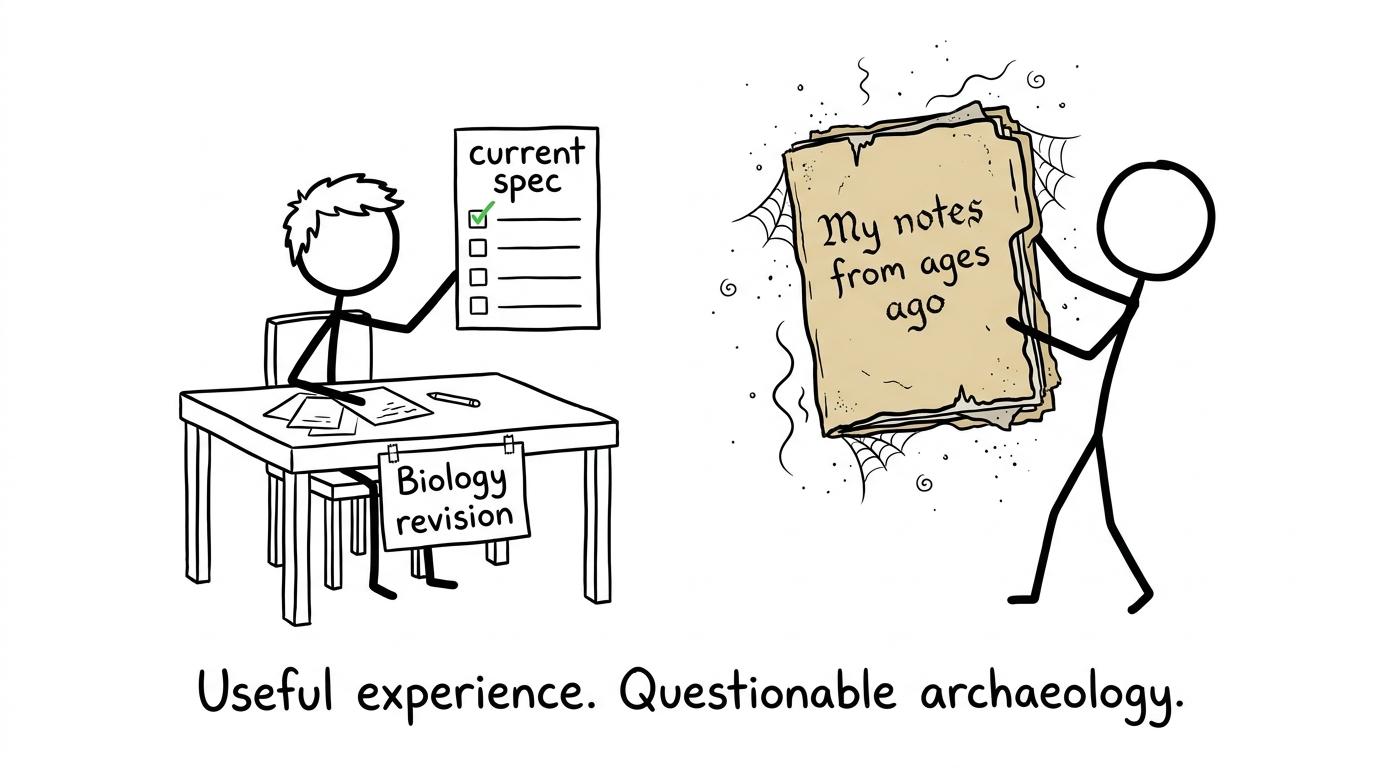 An older sibling offers ancient biology notes while a student checks the current specification
What an older sibling can genuinely help with
Turning revision into active recall
One of the most useful things a sibling can do is take your notes away.
That may sound unhelpful, but it changes the mental task. Looking over a page can produce familiarity without secure recall. Being asked to explain osmosis, describe the role of enzymes or identify variables in an investigation forces you to retrieve knowledge.
Research summarised by the Education Endowment Foundation supports retrieval practice as a useful learning approach. It also stresses the importance of suitable challenge, repeated retrieval after a delay and corrective feedback. In other words, a quiz helps most when you genuinely try to remember, receive an accurate correction and meet the idea again later.
Ask your sibling to:
- read a question without displaying the answer;
- wait while you form a complete response;
- request precise biological vocabulary;
- reveal one hint only after a genuine attempt;
- check the answer against current material;
- save missed questions for another day.
This principle works in maths too. The MathsGenie guide to stopping GCSE content from being forgotten explains how active recall, spaced practice and exam-style questions can form one repeatable revision cycle.
Making you explain ideas clearly
Understanding often becomes visible when you have to put an idea into words. Your sibling can ask follow-up questions such as:
- What causes that change?
- Which variable would you control?
- How does the evidence support the conclusion?
- What is the difference between describing and explaining?
- Could you sketch the process from memory?
They do not need to remember every detail themselves. Their job is to notice where your explanation becomes vague. If you can name a process but cannot connect its stages, you have found a revision gap.
This is especially valuable for extended responses. A sibling can check whether your answer follows a logical chain, while the official mark scheme or teacher resources confirm whether the science is correct.
Providing low-pressure exam practice
Some students find it easier to make mistakes in front of a sibling than in a classroom. Used well, that safety makes practice more honest. You can say, “I do not know,” identify the missing knowledge and repair it before the exam.
Your sibling can also act as a timer, remove distractions and mark which questions required hints. Keep the atmosphere calm. The aim is not to recreate an interrogation across the kitchen table. It is to make an unsupported attempt feel normal.
A short structure often works better than an open-ended evening:
- recall key knowledge without notes;
- answer a small set of exam questions;
- check against reliable answers;
- write down the exact gaps;
- choose when to revisit them.
Students balancing Biology with maths can use a similar framework through the MathsGenie GCSE maths revision hub, where revision lessons, question banks, flashcards, mini tests and papers are organised by board and topic.
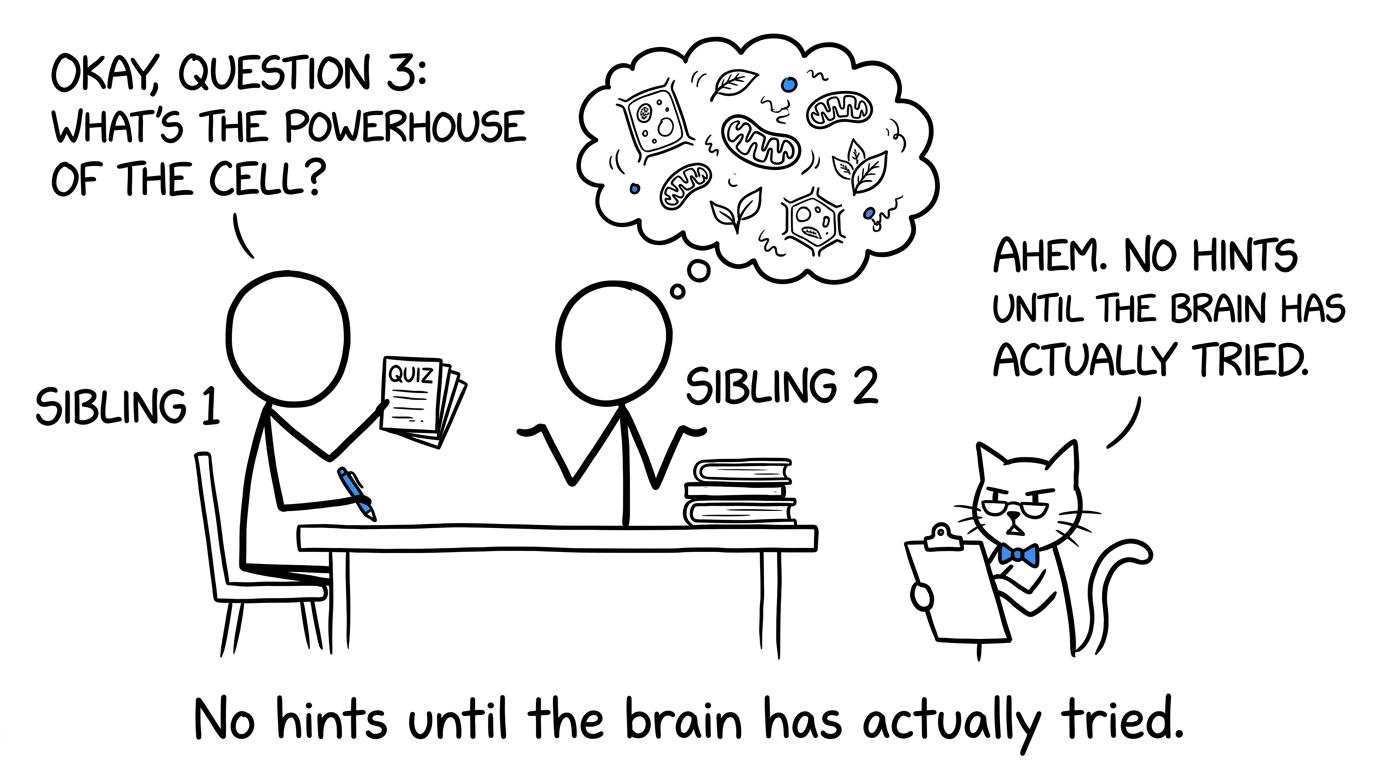 Two siblings run a biology quiz while a cat behaves like an examiner
What may be outdated after your sibling's GCSE
Experience ages slowly. Exam details can age quickly.
Their topic list may not match your course
“GCSE Biology” does not describe one identical paper. AQA, Pearson Edexcel, OCR and Eduqas organise content and practical work differently. Separate Biology and Combined Science also have different content boundaries.
For example, current AQA GCSE Biology identifies required practical activities within its specification. Pearson Edexcel uses mandatory core practicals, while OCR specifications organise practical requirements through Practical Activity Groups. The important lesson is not to memorise those labels. It is to use the label and requirements belonging to your own board.
Your sibling's folder may therefore contain:
- material from a different exam board;
- separate-science content that is not on your Combined Science route;
- missing higher-tier material;
- a practical method taught under an older course;
- terminology that no longer matches current mark schemes.
Do not throw the folder away. Filter it. Check every topic against the current specification supplied by your school or exam board.
Remembered exam questions are not predictions
A sibling may vividly remember a question about ecology or the heart. That tells you what appeared on their paper, not what will appear on yours.
Past questions are useful for understanding command words, application and mark-scheme precision. They are not permission to ignore the rest of the specification. This is the same principle MathsGenie recommends in its guide to using GCSE past papers properly: the value comes from sitting, marking, diagnosing and repairing, not trying to forecast one future paper from one old paper.
Use any predicted material as additional practice, never as a replacement for full specification coverage. Maths students can apply that rule directly when using Edexcel GCSE maths predicted papers.
Temporary exam arrangements can change
Students sometimes remember special arrangements from their own exam year and assume they remain permanent. That is risky.
For the 202620262026 exam series, formula and equation sheet arrangements apply to subjects including GCSE Maths and the physics components of relevant science qualifications. They do not create a general Biology fact sheet. Always check current information through your school and exam board rather than relying on what happened when your sibling sat the exam.
Their mark-scheme language may be approximate
A sibling may understand the biology perfectly but describe it conversationally. GCSE mark schemes can require distinctions between terms such as correlation and causation, accuracy and precision, or pathogen and disease.
Treat your sibling's explanation as a route towards understanding. Treat current mark schemes and teacher feedback as the test of wording.
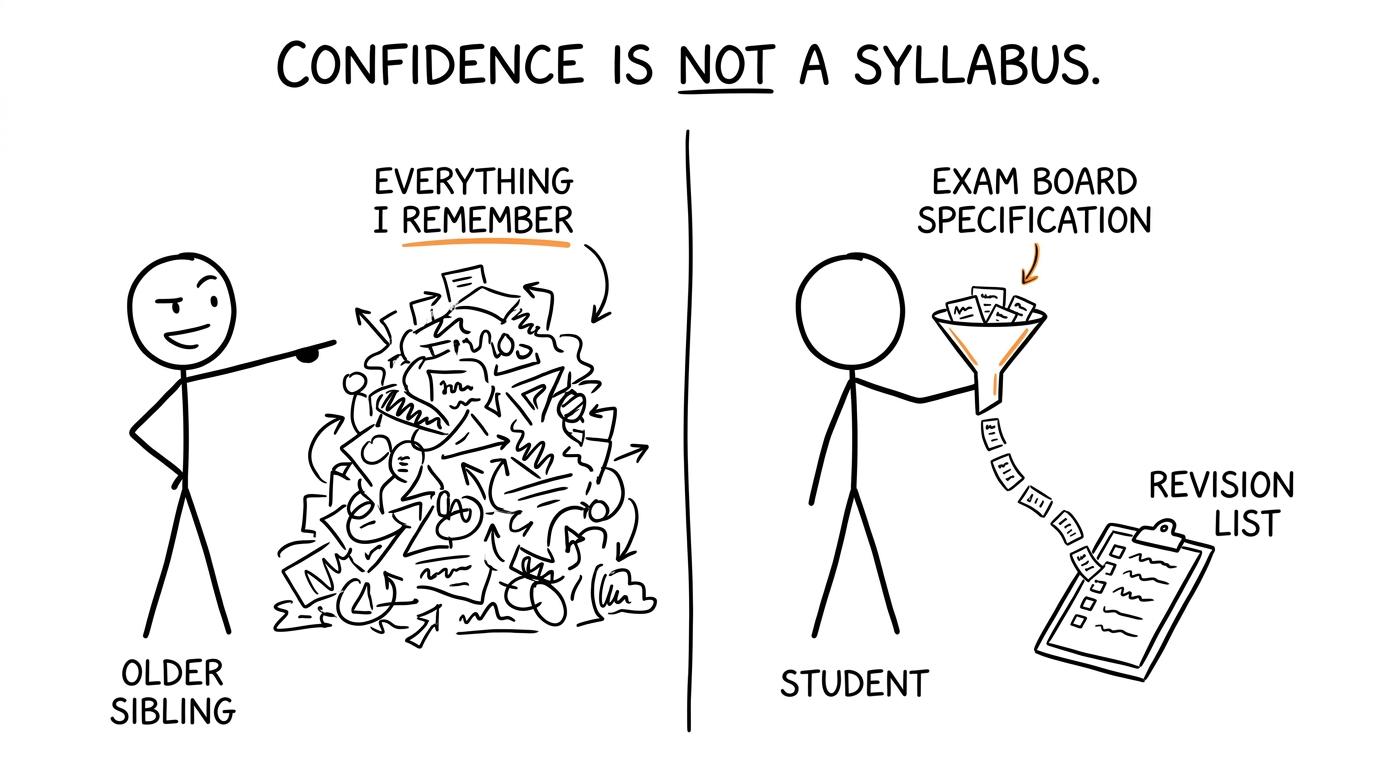 A student's exam-board specification filters a sibling's enormous pile of remembered advice
How to run a useful sibling revision session
Begin with evidence, not confidence
Choose one current exam-style question set and answer it without help. Mark it, then classify each lost mark:
- missing biological knowledge;
- weak application to an unfamiliar context;
- imprecise vocabulary;
- practical-method error;
- graph or calculation error;
- misreading the command word.
This prevents the session being driven by whichever topic your sibling happens to remember. The MathsGenie weakest-topics method uses the same evidence-led idea: mark first, label the loss and practise the smallest skill that fixes it.
Give each person a clear role
You should do the difficult thinking. Your sibling should manage the questions, hints and checks.
A productive rule is:
- Student: recalls, writes, explains and corrects.
- Sibling: asks, listens, times and checks.
- Specification or mark scheme: settles disagreements.
If your sibling supplies every answer, they are revising Biology while you watch.
Include Biology's mathematical demands
Biology papers do not assess facts alone. Depending on the specification and question, you may need to interpret graphs, handle ratios, calculate percentage change, use standard form, substitute into equations or comment on data.
An older sibling can check whether you:
- show working clearly;
- include units where required;
- read graph scales carefully;
- distinguish an anomalous result from a general trend;
- avoid claiming that correlation proves causation;
- round only when the question requires it.
If these skills are costing marks, move from Biology revision to targeted maths practice. The GCSE maths topics by board and tier guide can help you identify the relevant number, ratio, algebra or statistics skill. For fuller exam practice, use Edexcel GCSE maths past papers with mark schemes or choose your board from the main revision hub.
Finish with a retest date
A corrected answer can feel secure because it is still in working memory. The better test comes later.
End by selecting a few missed questions for another session after a gap. Your sibling can shuffle them among questions from other topics so that you must recognise the method rather than repeat a memorised sequence.
If schoolwork is busy, use the pattern in the MathsGenie 202020-minute revision routine: recall, practise, mark and choose the next small target.
Common mistakes when revising with a sibling
Treating old notes as the specification
Old notes can explain a stable scientific idea, but they cannot confirm current content boundaries or assessment rules. Check first.
Letting hints arrive too quickly
A hint given immediately removes the retrieval attempt. Agree that your sibling will wait before helping.
Revising only what they remember from their paper
Memorable questions are not a balanced revision plan. Cover the full current specification and use exam evidence to prioritise weak areas.
Arguing from memory
If your answers differ, do not let confidence decide. Consult a current mark scheme, specification or your teacher.
Ignoring practical and data questions
Knowing definitions is not enough. Include methods, variables, risk, data interpretation, conclusions and evaluation.
Turning every session into a marathon
Long sessions can become passive or irritable. Short, planned meetings with a clear endpoint are usually easier to repeat.
Make sibling help one part of a wider revision system
Revising with an older sibling can be genuinely useful. They can make recall harder, explanations clearer and practice less isolating. What they cannot do is freeze the exam system at the year they took it.
Keep the human advantage and remove the risk: let your sibling quiz, listen and encourage, while current specifications and mark schemes govern the content. Then take the same disciplined approach into your maths preparation.
Start at the MathsGenie GCSE maths revision hub. Use free revision lessons and practice questions to repair individual topics, mini tests to check recall, and past papers to build exam stamina. As the exams approach, add predicted papers, strict marking and video solutions. A sibling can keep you accountable, but a clear revision system is what keeps your progress moving.