Retake GCSE English Literature After Sixth Form
Retake GCSE English Literature after sixth form: understand college and private centre entries, summer exams, fees and revision arrangements.
The difficult part of leaving sixth form is that familiar systems disappear. There is no form tutor reminding you about deadlines and no exams officer automatically making your entry. Yet the qualification itself remains within reach.
Yes, you can retake GCSE English Literature after sixth form. If you are no longer enrolled at a school or college, you will normally enter through an approved exam centre as a private candidate. A former school, further education college or adult learning provider may also be willing to arrange the resit, but it is not required to accept you.
The important distinction is timing: GCSE English Literature is generally available in the summer examination series, unlike GCSE English Language and Maths, which also have November opportunities for eligible post-161616 candidates. That makes early planning essential.
Your English Literature retake checklist
Before revising every poem and reopening every novel, settle the practical details:
- Decide why you want to improve the qualification.
- Check your original exam board and specification.
- Ask your former school or college whether it accepts returning candidates.
- If necessary, find an approved centre accepting private candidates.
- Confirm that the centre offers your exact English Literature specification.
- Request the total fee and the centre's internal entry deadline.
- Discuss access arrangements immediately if you need them.
- Check your statement of entry, texts, papers and examination dates.
- Build a revision plan around your other GCSE, A Level or work commitments.
Administration feels less exciting than revision. But until an approved centre has entered you, there is no examination to revise for.
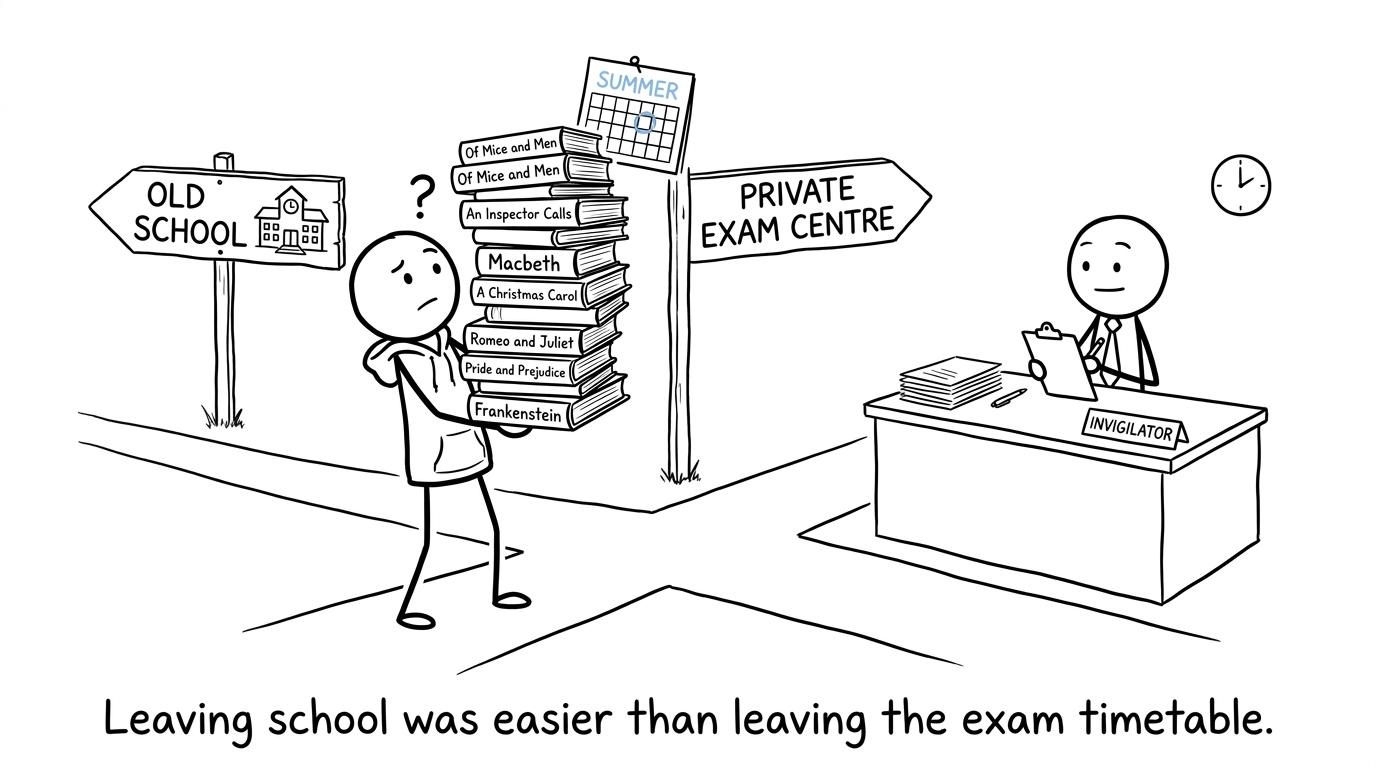 A former student choosing a route to a private exam centre
How resitting works after leaving school
Once you have left education, you are usually classed as a private candidate. This means you sit the qualification at an approved school, college or examination centre without being enrolled there as a student.
Exam boards do not normally accept an entry directly from an individual. The approved centre makes the entry on your behalf, checks your identity, conducts the examinations and handles your result. You are responsible for finding the centre, supplying its requested information and paying its fees.
The process usually follows this order:
- Choose the qualification, board and specification.
- Contact centres before their entry deadlines.
- Complete the chosen centre's registration process.
- Supply identification and previous candidate information where requested.
- Pay the examination and administration charges.
- Receive and inspect your statement of entry.
- Attend every required paper at the stated place and time.
Keep your previous results documents if possible. Your Unique Candidate Identifier may help a centre connect your new entry with your examination record, although the exams officer can explain exactly what information is required.
Can your old sixth form or a college enter you?
Your former school or sixth form is a sensible first call. It already knows your previous entry and may offer resits to former students. However, centres choose whether to accept private candidates, so an earlier connection does not guarantee a place.
A local further education college or adult learning provider may offer teaching alongside the examination entry. Others may accept examination-only candidates. Ask whether you must enrol on a course, whether lessons are included and whether the college teaches the same texts and specification you previously studied.
If you are currently enrolled at another college or training provider, begin with its exams office. It may be able to make the entry internally or explain which local centre it uses.
Ask every potential centre the same questions:
- Do you accept private GCSE English Literature candidates?
- Which boards and specification codes do you offer?
- Can I retain my original selection of set texts?
- What is your internal deadline?
- What is the complete fee, including administration?
- How will I receive my timetable and result?
- Can you support my existing access arrangements?
Written confirmation matters. A telephone conversation is useful, but an email leaves you with a record of the board, specification, fee and deadline agreed.
Using a private exam centre
A private exam centre can be the most direct route when a former school or college cannot help. The Joint Council for Qualifications maintains a search service for centres that have indicated they accept private candidates. Local centres not shown there may also accept entries, so contacting nearby schools and colleges can still be worthwhile.
Availability varies. A centre might offer AQA and Pearson Edexcel but not OCR or Eduqas. It might also accept one GCSE subject but not another. Confirm the exact qualification before paying for tuition or buying new materials.
Fees are not nationally fixed. They can include the awarding body's entry charge, the centre's administration costs and charges associated with late entry or additional services. Request a complete quotation rather than assuming the exam board's entry fee is the final price.
Start looking well before the national entry deadline. Centres often impose earlier internal deadlines, and places can fill. Late entries may cost more or be refused altogether.
English Literature is not English Language
The names are similar, but they are separate GCSE qualifications.
English Language assesses reading and writing skills across fiction and non-fiction. English Literature assesses your response to prescribed plays, novels and poetry. Improving one result does not automatically change the other.
This distinction matters because many university courses, apprenticeships and employers specify GCSE English Language at grade 444 or above rather than English Literature. Others may accept either qualification or set higher entry requirements. Check the exact wording of the requirement you are trying to meet before booking a Literature retake.
For England's current 161616 to 191919 funding rules, a grade 444 or above in either GCSE English Language or English Literature can satisfy the English condition of funding. That policy does not mean every employer or course must treat the qualifications as interchangeable.
If your goal is admission to a particular course, ask its admissions team which qualification it requires. A clear answer now can prevent months of preparation for the wrong resit.
When can you resit GCSE English Literature?
GCSE English Literature is normally examined in the May and June summer series. The November GCSE series is principally an additional opportunity for Mathematics and English Language, subject to its age and entry rules. You should not assume that Literature can be taken in November.
Exact dates, deadlines and availability depend on the year, exam board, specification and UK nation. Your entering centre should confirm these details using the current awarding-body timetable.
English Literature qualifications are generally linear. Expect to sit all compulsory papers needed for certification rather than carrying forward the mark from one written paper. Check this directly against your board's current resit rules before making your entry.
The content also differs between AQA, Pearson Edexcel, OCR and Eduqas. Shakespeare may appear on different papers, anthology choices vary, and question structures are not identical. Revising familiar texts using resources for the wrong board is an easy way to work hard without preparing accurately.
Access arrangements after sixth form
Previous support such as extra time, a reader, a scribe or modified papers does not transfer automatically simply because you received it at school. Tell the new centre when you first enquire.
The centre must review your evidence, establish what arrangements apply and submit any required applications by the relevant deadlines. Some deadlines arrive earlier than ordinary entry deadlines, particularly for modified papers. A private centre may need information from your former school about your normal way of working.
Do not wait until the examination timetable arrives. Access arrangements are part of choosing a suitable centre, not an issue to raise a few days before the paper.
Balancing Literature with GCSE Maths revision
For a student already preparing for Maths, a Literature retake creates a second kind of workload. Maths improves through repeated problem-solving; Literature also needs retrieval, planning and timed writing. Both suffer when revision becomes passive.
Use one calendar for every subject. The GCSE maths revision timetable explains how to prioritise weaknesses and build repeatable weekly sessions. Keep Literature blocks separate from Maths blocks so that each has a clear outcome.
A practical rhythm could include text recall and essay planning for Literature, alongside revision lessons and question practice through the MathsGenie GCSE maths hub. If Maths is also a resit, use the GCSE Maths resit revision plan to turn lost marks into specific topics.
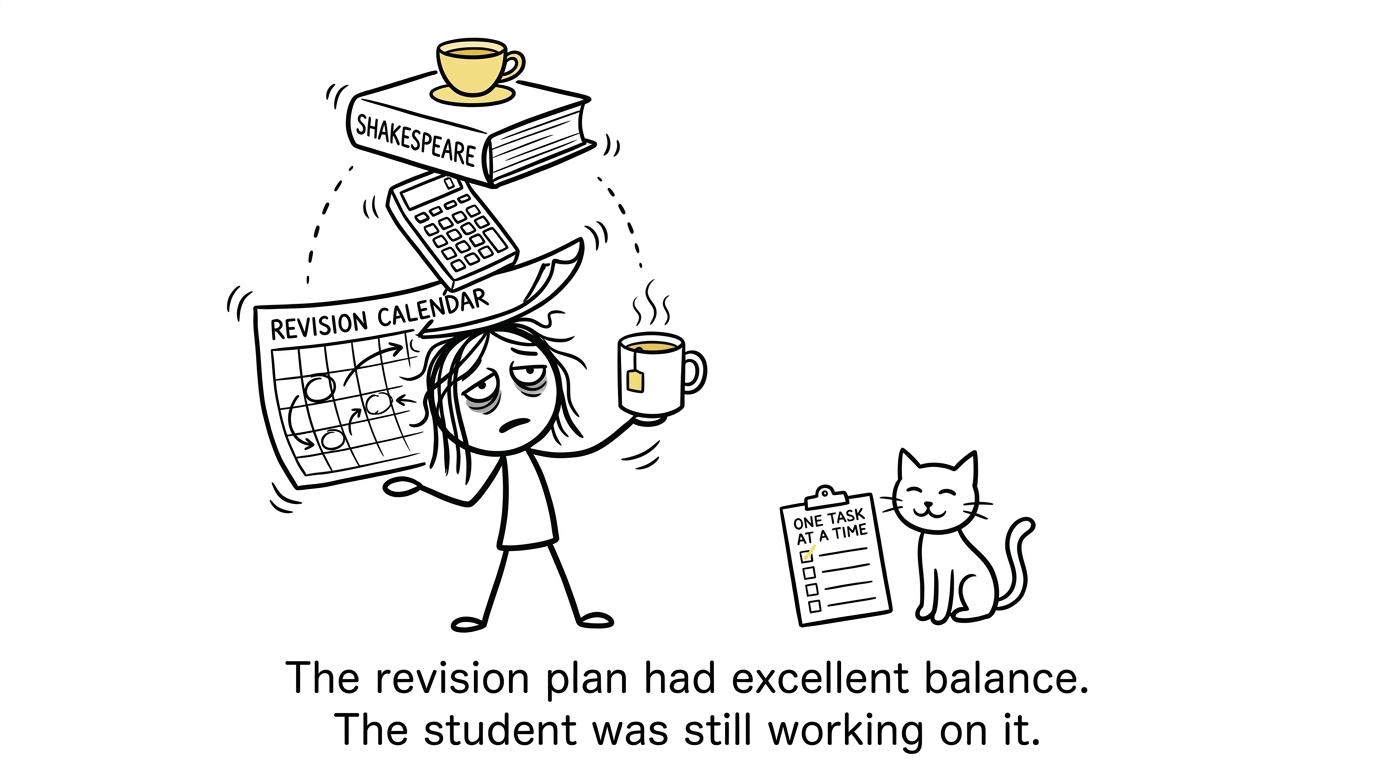 A student balancing English Literature and Maths revision
As examinations approach, move from learning to performance. The guide to starting GCSE past papers shows why timed work is most useful when there is still time to repair what it reveals.
For Maths, choose the correct board and tier. Edexcel students can use GCSE Maths past papers with mark schemes, followed by Edexcel predicted papers for additional practice. Predicted papers should complement official past papers rather than replace them.
Common mistakes when arranging an English Literature resit
Assuming the old school must accept you
A former school may help, but it can decide whether to take private entries. Contact several possible centres rather than relying on one conversation.
Confusing Language with Literature
Check the precise GCSE required by the university, apprenticeship or employer. A Literature result may not satisfy a requirement specifically naming English Language.
Waiting for a national deadline
Your centre can set an earlier internal deadline. Make arrangements early and ask when payment and documents must be received.
Registering for the wrong specification
Do not identify the board from memory alone. Check your result documents, specification code and set texts before confirming the entry.
Forgetting access arrangements
Raise them during your first enquiry. Evidence, applications and modified-paper requests take time.
Revising before securing an entry
Revision is valuable, but an informal plan is not an examination booking. Obtain confirmation and inspect your statement of entry for errors.
Trying to revise every weakness at once
A long list can feel organised while producing little change. For Maths, follow a focused one-month GCSE revision plan: diagnose, practise, mark, correct and retest.
Your next step
Leaving sixth form changes who organises the examination, not whether you are allowed to improve your qualification. Begin with the practical question: will your former centre enter you? If not, find an approved private centre, confirm the board and specification, understand the full fee and secure the summer entry.
Then make revision measurable. For English Literature, work from the correct texts, assessment objectives and paper format. For Maths, make MathsGenie your free revision base. Use revision lessons and practice questions to rebuild individual skills, mini tests to check them, and past papers, predicted papers, mark schemes and video solutions to prepare for examination conditions.
One confirmed entry and one focused revision session are modest steps. Together, they turn an old result from something fixed into something you can act upon.