Retake GCSE Chemistry After Sixth Form: Your Options
Retake GCSE Chemistry after sixth form with confidence. Learn how colleges, private exam centres, practicals, tiers, fees and entries work in the UK.
Leaving sixth form can make an exam result feel strangely permanent. The timetable has ended, teachers have moved on and the familiar exams office is no longer down the corridor. But the result itself is not fixed forever.
You can retake GCSE Chemistry after sixth form. You will normally enter through a school, college or approved private exam centre, either as an enrolled student or a private candidate. You must choose the correct qualification, arrange any required practical work and sit all the written papers for the new result. For GCSE Chemistry, that will usually mean waiting for the summer exam series rather than taking an autumn resit.
The difficult part is rarely deciding whether you are allowed to try again. It is organising the details early enough that the attempt has a fair chance.
GCSE Chemistry retake checklist
Before beginning revision, confirm these essentials:
- Check whether your original qualification was separate GCSE Chemistry or Combined Science.
- Identify the original exam board and specification code.
- Ask your former school whether it accepts past students for resits.
- Contact local further education colleges and approved private exam centres.
- Confirm whether the centre offers AQA, Pearson Edexcel, OCR or Eduqas Chemistry.
- Ask how required practical activities will be handled.
- Choose foundation or higher tier with the centre.
- Request the full cost and the centre's internal entry deadline in writing.
- Discuss access arrangements as early as possible if you need them.
- Check your statement of entry when it arrives.
Do not wait until revision is nearly complete before finding a centre. An exam grade begins with preparation, but an exam entry begins with paperwork.
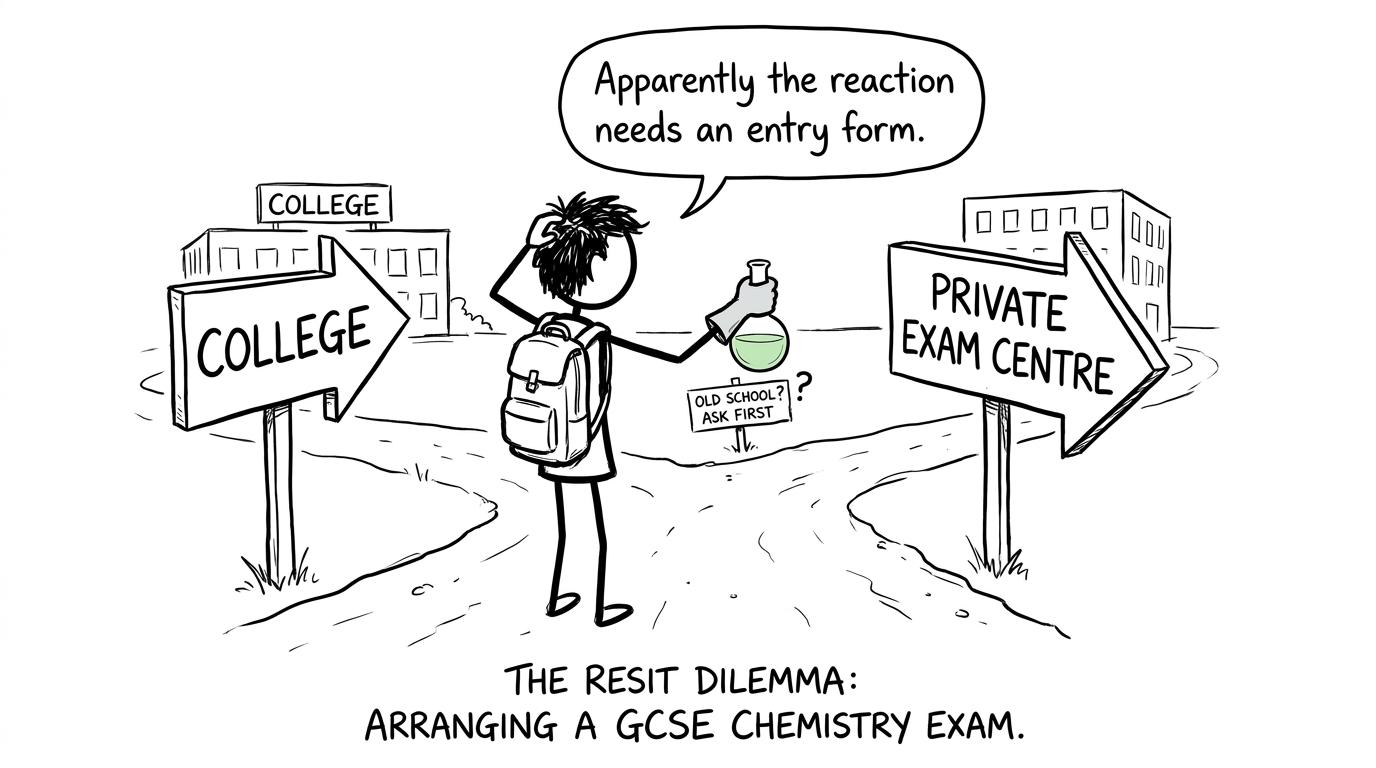 A student choosing between a college and private exam centre for a Chemistry resit
How resitting GCSE Chemistry works after leaving school
Once you are no longer enrolled at a school or college, you can sit the qualification as a private candidate. This means an approved centre enters you for the examinations even though it may not teach you.
The centre deals with the exam board, provides the examination room, checks your identity, submits your entry and issues your statement of entry. You remain responsible for finding the centre, meeting its deadline, paying its fees and preparing for the papers.
Current JCQ and Ofqual guidance confirms that private candidates must enter through an approved school, college or other examination centre. You cannot make a GCSE entry directly with the exam board or sit an official GCSE examination at home.
Asking your former school
Your former school is often the simplest first contact because it may already offer your original specification. However, schools are not required to accept former students or private candidates. Laboratory capacity, safeguarding, staffing and practical requirements can all affect the decision.
Contact the exams officer rather than relying on an informal conversation with a former teacher. Ask whether the school can enter you for the complete qualification and whether it can meet the science practical requirements.
Taking the resit through a college
A further education or adult learning college may offer GCSE courses, but availability varies. Some colleges provide teaching and make the exam entry as part of the course. Others accept external candidates for examinations without offering lessons.
Ask whether you must enrol on a full course, which board the college uses and whether attendance at practical sessions is compulsory. A course can provide useful structure, particularly if you have been away from Chemistry for some time, but it may be less flexible than independent preparation.
Using a private exam centre
An independent exam centre can be practical if local schools and colleges do not accept external candidates. The centre should be approved for the relevant awarding organisation and willing to enter private candidates for your exact qualification.
Centres set their own administrative fees and internal deadlines. Chemistry may cost more to arrange than a wholly written subject because laboratory work, supervision and specialist equipment can be involved. Request an itemised quotation rather than assuming the exam board entry fee is the total price.
Check what qualification you actually took
This small check prevents a large mistake.
If your certificate says GCSE Chemistry, you can retake that separate science qualification. If it shows Combined Science, your Chemistry content formed part of a double-award qualification. Retaking only a Chemistry paper will not improve an existing Combined Science grade.
To replace a Combined Science result, you would normally need to enter and retake the complete Combined Science qualification. Alternatively, you may be able to take separate GCSE Chemistry as a new qualification, provided a centre accepts the entry and satisfies the relevant specification requirements. That is not quite the same as resitting your original certificate.
Also check the exam board. AQA, Pearson Edexcel, OCR and Eduqas organise their content and papers differently. Changing boards is possible in principle, but it can create extra revision because the specification order, required practicals and question style may change. Staying with your previous board is often simpler, provided a suitable centre offers it.
When can you retake GCSE Chemistry?
GCSE Chemistry is normally available in the summer examination series. The November GCSE series is principally associated with GCSE English Language and GCSE Maths for eligible candidates, not Chemistry.
Because centres impose internal deadlines before the awarding organisations' final deadlines, contact them well in advance. A centre may stop accepting candidates when its available places or practical sessions are full. Late entries can also involve additional charges.
Once entered, check every detail on your statement of entry:
- your legal name;
- your date of birth;
- the awarding organisation;
- the qualification and specification code;
- foundation or higher tier;
- every required paper;
- the examination venue.
If something looks wrong, tell the exams officer immediately.
Do you have to retake every Chemistry paper?
Current GCSE Chemistry qualifications are linear. To receive a new grade, you retake all externally assessed papers required by the specification in the same examination series. You cannot normally keep the stronger paper from your previous attempt and replace only the weaker one.
For example, Pearson Edexcel GCSE Chemistry has two written papers, while the detailed paper structure differs between specifications. The rule to remember is broader: the entry is for the whole qualification, not a single topic or isolated paper.
Your new result is based on the assessments in that entry. Ask the centre or awarding organisation how previous and new results will appear in any specific application context, particularly if a university, apprenticeship or employer has set an entry requirement.
Foundation or higher tier?
GCSE Chemistry uses tiered papers. In the standard grades 999-111 structure used in England, foundation tier targets grades 111 to 555, while higher tier targets grades 444 to 999. A grade 333 may be awarded on higher tier to candidates who narrowly miss grade 444, subject to the awarding rules.
The centre makes the formal entry, so discuss the tier rather than assuming it will match your previous attempt. Higher tier is not automatically the better choice. It gives access to the highest grades, but it also contains more demanding content and questions.
Base the decision on:
- the grade you need;
- your current performance on full papers;
- the content required by your chosen course or career;
- advice from a teacher or tutor who understands the specification.
The same principle applies in maths. The GCSE Maths topics by board and tier guide explains why tier choice should follow evidence rather than pride.
How required practicals affect private candidates
GCSE Chemistry does not have the separate Practical Endorsement used for A Level sciences. However, practical work remains an essential part of the GCSE specification, and practical knowledge is tested in the written examinations.
Requirements vary by awarding organisation. AQA GCSE Chemistry specifies 888 required practical activities and states that a centre accepting a private candidate must make provision for them. Pearson Edexcel also includes 888 mandatory core practicals. OCR requires centres to address its practical activity requirements and assess practical knowledge through the written papers.
This is why a centre that accepts private candidates for GCSE Maths may not necessarily accept them for Chemistry. A desk and an invigilator are not enough; science can require laboratory access, equipment, trained staff and records.
Ask each prospective centre:
- Must I complete every practical activity with you?
- Can you recognise practical work completed at my former school?
- What documentary evidence would you require?
- Are practical sessions included in the quoted fee?
- When will the sessions take place?
- What happens if I miss one?
Do not assume old practical experience transfers automatically. Get the centre's decision in writing before paying or building your revision plan around it.
Planning revision when you study independently
Independent revision works best when the course stops feeling like one enormous object. Download the current specification for your chosen board and turn every section into one of three categories: secure, uncertain or not yet covered.
Then use a repeating cycle:
- learn one small section;
- answer exam-style questions without notes;
- mark them against the official mark scheme;
- record the exact reason for each lost mark;
- revisit the weakest skill after a short gap;
- introduce complete timed papers later.
The logic is the same as the approach in MathsGenie's guide to self-studying GCSE Maths. Independence does not mean improvising every day. It means creating a system strong enough to replace the school timetable.
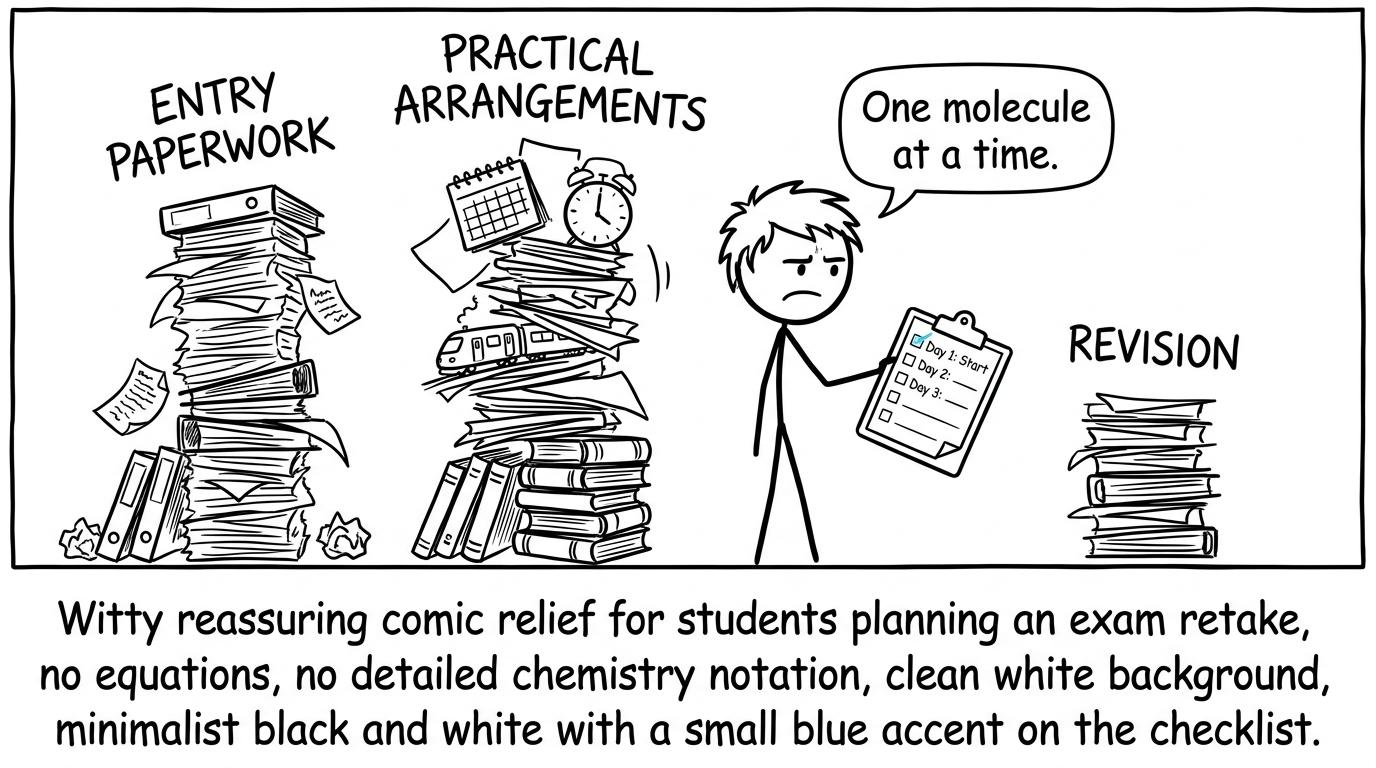 A student turning Chemistry resit paperwork and revision into a manageable checklist
Strengthen the maths used in GCSE Chemistry
Chemistry papers contain calculations as well as scientific explanations. Depending on your specification and tier, you may need confidence with ratios, percentages, unit conversions, graphs, formula substitution and standard form.
MathsGenie is a free maths revision resource rather than a Chemistry course, but it can repair the mathematical skills that often sit underneath Chemistry questions. Useful starting points include:
- the complete GCSE Maths revision hub;
- standard form revision;
- ratio revision;
- the best order for learning GCSE Maths topics.
A useful revision habit is to separate scientific misunderstandings from mathematical errors. If you know the Chemistry but mishandle a ratio, that calls for maths practice. If the arithmetic is correct but you chose the wrong chemical relationship, return to the Chemistry specification.
Use the free revision lessons and practice questions first, then test your progress with MathsGenie's GCSE predicted papers. Predicted papers should supplement official past papers, not replace them.
Access arrangements after leaving sixth form
If you previously received extra time, supervised rest breaks, a reader, a scribe, modified papers or use of a word processor, tell the new centre when you first enquire.
Previous arrangements do not simply follow you automatically. The new centre is responsible for checking the evidence, establishing your normal way of working where required and submitting applications by the relevant deadline. Starting early matters because assessment and documentary evidence may take time.
Do not wait until the examination timetable arrives. By then, some deadlines may already have passed.
Common mistakes when arranging a Chemistry resit
Revising before securing an exam centre
Knowledge alone cannot create an entry. Confirm that a centre accepts your board, specification, tier and practical arrangements first.
Confusing Combined Science with separate Chemistry
Read the qualification title on your certificate or results statement. The route for improving a Combined Science grade is different from taking a new separate Chemistry GCSE.
Assuming Chemistry has a November resit
Plan around the summer series unless your centre and awarding organisation explicitly confirm otherwise.
Booking the cheapest written-exam entry
A low advertised fee may exclude practical sessions, late charges or administration. Ask for the complete cost.
Ignoring the tier until the last moment
Foundation and higher papers assess different grade ranges. Your revision materials and examination entry must match.
Treating practicals as optional revision
Even though practical skills are assessed through written questions, you need to understand methods, variables, hazards, observations, data and evaluation.
Completing papers without analysing mistakes
A total mark tells you where you are. It does not tell you what to do tomorrow. MathsGenie's guide to finding weak GCSE topics shows how to turn lost marks into precise next actions.
Your next step
A GCSE Chemistry result can matter for a science course, apprenticeship, career change or simply the wish to finish something properly. Whatever the reason, the route is manageable when taken in the right order: identify the qualification, find an approved centre, settle the practical arrangements, make the entry and then revise to the correct specification.
Start by contacting your former school, nearby colleges and private exam centres. While those arrangements are moving, strengthen the calculations that Chemistry expects through MathsGenie. Use free revision lessons, practice questions and mini tests to rebuild individual skills, then move to past papers, mark schemes, video solutions and predicted papers when you are ready for timed work.
A resit is not a return to the beginning. It is a second attempt with better information, and that can make all the difference.