How to Reset After a Bad Week of GCSE ICT Revision
Reset after bad week GCSE ICT with a calm seven-day plan that rebuilds momentum, protects maths revision and turns missed work into clear next steps.
A revision plan rarely collapses dramatically. More often, one difficult evening becomes three missed sessions. By Sunday, the untouched checklist feels less like a plan and more like evidence against you.
If you need to reset after bad week GCSE ICT revision, do not try to repay every missed hour. Instead, identify what matters next, complete one short active task today and build a realistic seven-day plan around your other GCSE subjects, especially maths. Your goal is not to recreate the week you lost. It is to make the next week work.
One note before you begin: students often use “GCSE ICT” as a general label, but your actual course might be GCSE Computer Science or another digital qualification. Content and assessment arrangements vary, so confirm the qualification, exam board and current specification with your school.
Your reset checklist
Use this before opening your notes:
- Check the exact qualification and exam board you are taking.
- List the ICT topics currently being taught or assessed.
- Circle no more than three genuine priorities.
- Complete one short task without notes.
- Check it and record what you could not recall.
- Plan several manageable sessions rather than one rescue marathon.
- Protect your maths revision instead of allowing ICT to consume the week.
- Arrange help from your teacher if missing work or unclear content caused the problem.
The important shift is from guilt to evidence. “I had a bad week” is a feeling. “I cannot yet explain network security clearly” is a useful next action.
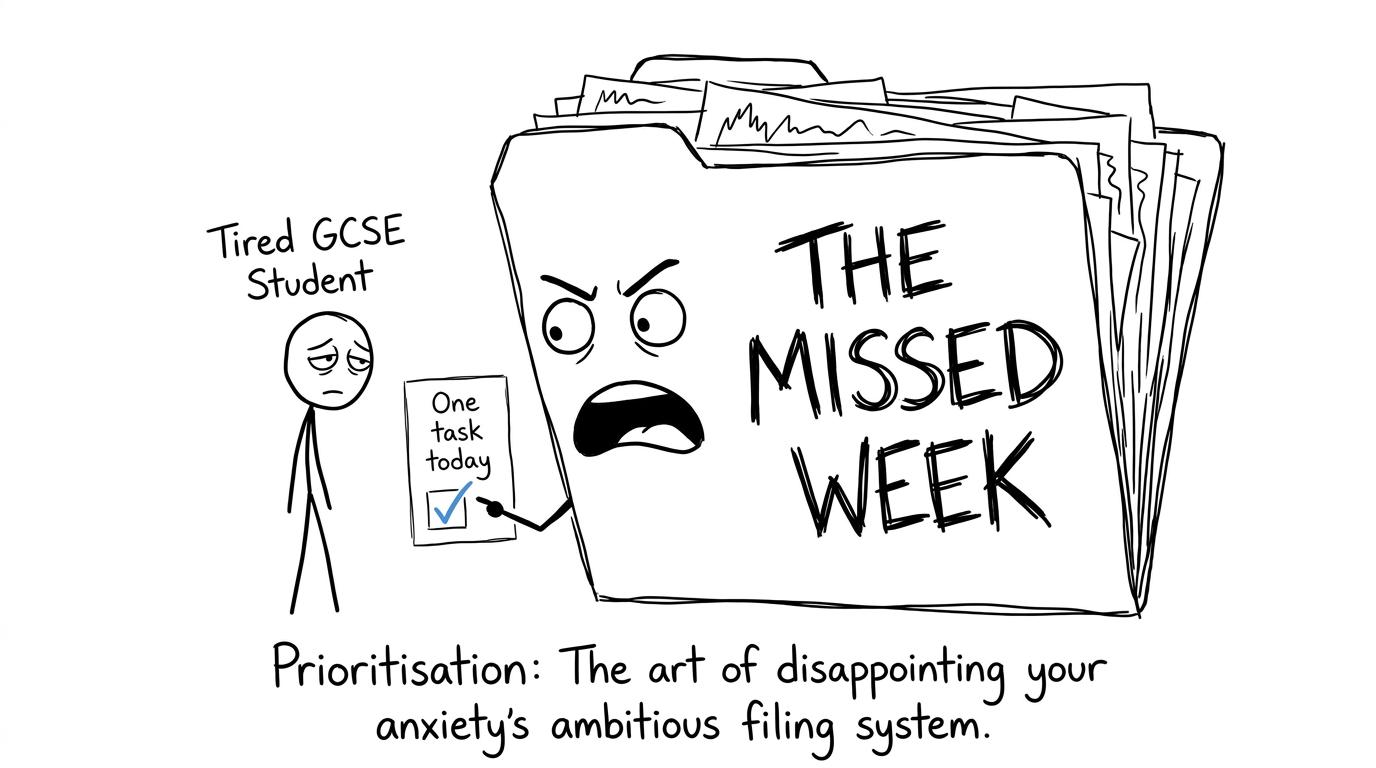 A student chooses one small task instead of confronting an enormous missed week
Stop trying to catch up with the calendar
A missed plan creates an imaginary debt. If you intended to revise for five hours, it can feel as though those five hours must be squeezed into Monday and Tuesday before normal life resumes.
That approach usually produces another overloaded plan.
Start with the specification or topic list instead. Divide the relevant content into three groups:
- Secure: you can explain it accurately and answer questions without support.
- Uncertain: you recognise it but struggle to retrieve details or apply them.
- Not ready: you cannot yet explain the idea or begin a question confidently.
Prioritise material that is both uncertain and likely to matter soon, such as content needed for an upcoming assessment. Do not spend the reset making attractive notes about a topic you already understand.
Use the same evidence-led approach for maths. The GCSE Maths topics by exam board and tier guide can help you distinguish the full course from the smaller set of topics that currently need attention.
Complete a restart task today
The first session should be deliberately small. It exists to restore movement, not to prove how much work you can tolerate.
Choose one narrow ICT objective, such as recalling key terminology from a recent lesson, labelling a process, tracing a short algorithm or answering one exam-style question. Work from memory before checking your notes. Then compare your response with reliable class materials or the appropriate mark scheme.
This follows a useful revision cycle:
- retrieve;
- check;
- correct;
- revisit.
Current revision and exam-pressure guidance consistently recommends breaking revision into manageable topics, setting specific targets and testing what you have learnt. Active retrieval shows you what is actually available from memory; rereading alone can create familiarity without dependable recall.
Finish by writing one sentence beginning, “Next time I need to remember...” That sentence becomes the starting point for your next session.
Build a seven-day recovery plan
A good recovery week leaves space. If every evening is full, the smallest interruption will break the plan again.
Use minimum, target and extra tasks
Give each planned day three levels:
- Minimum: the smallest useful task you can complete on a difficult day.
- Target: the normal session you reasonably expect to finish.
- Extra: optional work for a day when time and concentration are good.
For example, the minimum might be a brief recall quiz. The target could add an exam question and marking. The extra might be correcting an older response. This avoids the all-or-nothing belief that a shorter session does not count.
If planning repeatedly becomes a problem, adapt the structure in the GCSE maths revision timetable guide. Its central principle applies across subjects: prioritise genuine weaknesses, revisit content and leave room for catching up.
Separate learning from checking
Each ICT session should have a clear purpose. A simple sequence is:
- Learn: clarify one small section of content.
- Retrieve: close the material and recall the important ideas.
- Apply: answer a relevant question or complete a practical task.
- Check: compare your work with feedback or a mark scheme.
- Schedule: decide when to retrieve it again.
Spacing revision across different days is more useful for long-term retention than concentrating all your contact with a topic into one exhausting sitting. Revisiting also exposes whether yesterday’s apparent understanding survived overnight.
Protect GCSE maths while ICT catches up
When one subject goes badly, it can absorb every available hour. That creates a second problem: maths practice disappears, fluency weakens and the next week begins with two neglected subjects.
Keep a small maths baseline during your ICT reset. The 20-minute GCSE maths revision routine offers a useful model: choose one precise skill, retrieve the method, practise questions, mark the work and decide the next step.
Start from the GCSE Maths revision hub, where you can select resources for boards including Edexcel, AQA, OCR and Eduqas. Make sure you also use the correct foundation or higher tier materials.
A balanced recovery week might contain:
- several short ICT retrieval and question sessions;
- two focused maths topic sessions;
- one brief maths mini test or paper section;
- one catch-up slot that remains empty unless needed;
- a proper evening away from revision.
The precise arrangement depends on your timetable and approaching assessments. The principle is stable: recover one subject without quietly abandoning another.
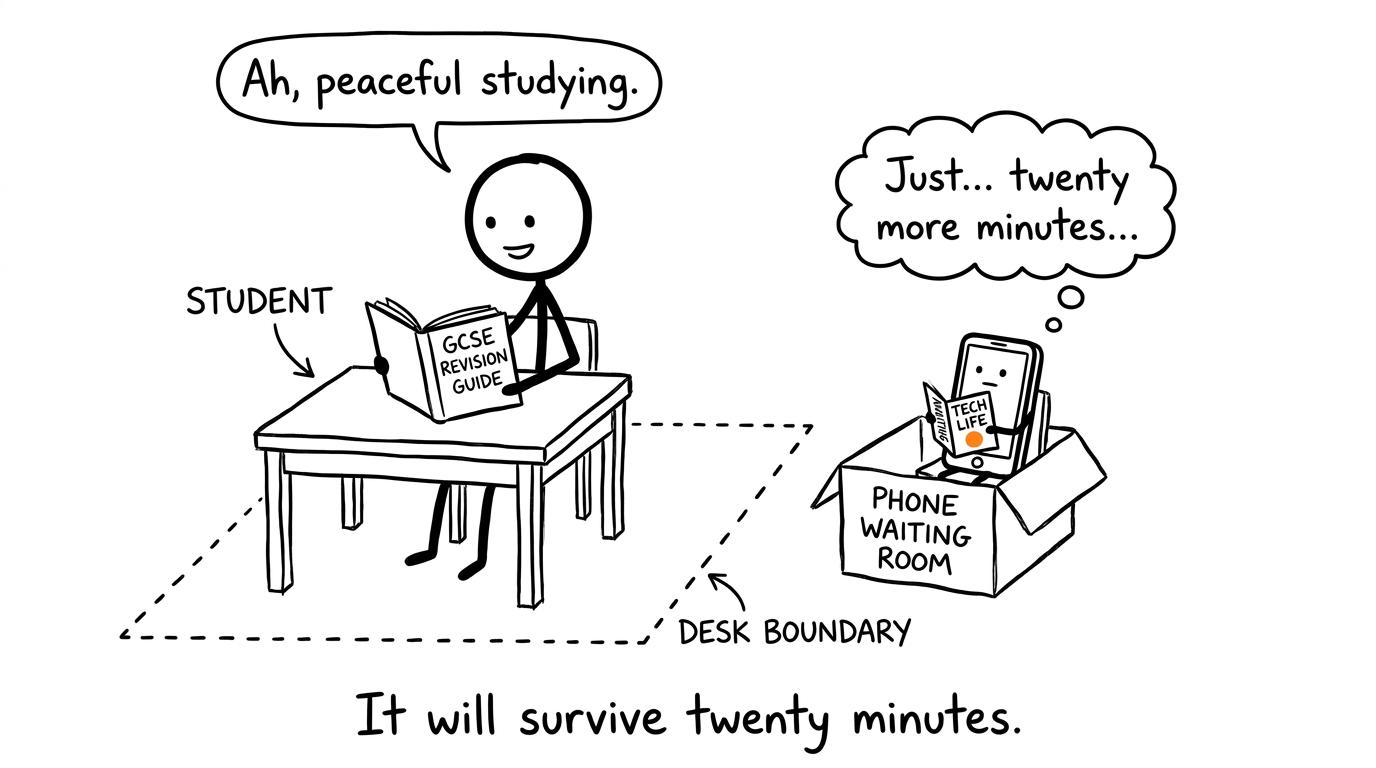 A student's phone waits outside while a short revision session continues
Remove the obstacle that caused the bad week
A new timetable cannot solve the wrong problem. Ask what actually disrupted the previous week.
If the plan was too ambitious
Reduce the number of sessions and define smaller outcomes. “Revise databases” is vague. “Recall the purposes of primary keys and answer one related question” is actionable.
If your phone kept interrupting
Put it in another room during the session. Do not rely on repeatedly choosing not to touch it. Change the environment so the choice disappears.
If you did not know how to begin
Prepare the first resource in advance. Leave the relevant question, worksheet or topic list ready. The start of a session should require almost no decision-making.
If you were exhausted or overwhelmed
Protect sleep and speak to someone. Government exam-pressure guidance advises making manageable plans, checking progress and seeking support when pressure becomes difficult to manage. A recovery plan should reduce strain, not hide it beneath a busier timetable.
If uncertainty about the course itself is blocking you, ask your teacher which specification sections, assessment components and command words matter for your qualification.
Turn mistakes into the next session
Marking is where revision becomes specific. After an ICT question, classify each problem:
- missing knowledge;
- confused terminology;
- weak application;
- misread command word;
- incomplete explanation;
- time pressure.
Then attach one action. Missing knowledge may require a short lesson review. Weak application needs another question. A misread command word requires deliberate practice interpreting what the question asks.
The same process is particularly valuable in maths. The guide to finding your weakest GCSE topics explains how lost marks can become targeted practice rather than a discouraging total.
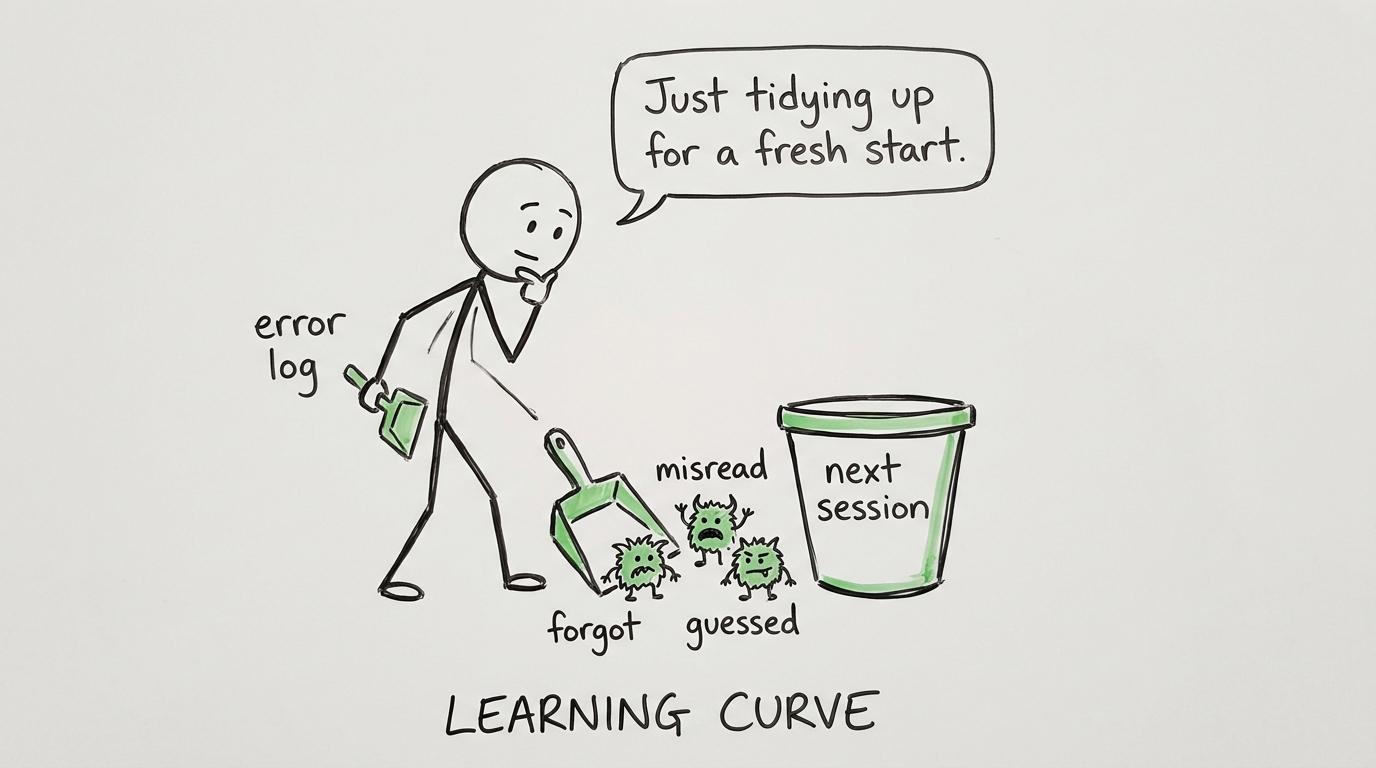 A student sweeps small mistake monsters into an error log for the next session
Know when to return to full papers
Do not use a full paper as punishment for missing a week. Begin with small, focused tasks if your knowledge or concentration is fragile. Move towards timed sections when you can recall the core content, then use complete papers to develop stamina and decision-making.
For maths, the guide to using GCSE past papers properly explains the full cycle: choose the correct paper, complete it under suitable conditions, mark it, identify the cause of lost marks, repair the topic and retest it.
MathsGenie provides board-specific collections including Edexcel GCSE Maths past papers, AQA GCSE Maths past papers and OCR GCSE Maths past papers. Shorter Edexcel GCSE Maths mini tests can be less intimidating during a recovery week.
For ICT or Computer Science, use papers and mark schemes that match your precise qualification and current specification. Do not assume that a resource labelled “ICT” matches the course your school has entered you for.
Common mistakes when resetting revision
Planning a perfect week
A plan that only works when energy, homework and family life cooperate perfectly is not realistic. Include spare time and a minimum task for difficult days.
Rewriting every missed note
Neat notes can support understanding, but copying is not automatically retrieval. Test yourself before deciding what needs to be rewritten.
Revising the broadest possible topic
Large labels create unclear sessions. Choose a question-sized objective that can be checked when the session ends.
Measuring recovery only in hours
Time at a desk does not prove learning. Track completed questions, corrected misconceptions and topics successfully recalled later.
Avoiding marking because it feels uncomfortable
Unmarked work cannot guide the next session. A low mark is information about what to do next, not a verdict on your eventual grade.
Sacrificing sleep to repay missed revision
Late-night catch-up can damage concentration the following day and continue the cycle. Set a stopping time and continue the plan after rest.
Start again without making it dramatic
A bad revision week does not need a heroic response. It needs a smaller plan, an honest first task and a method for turning errors into decisions.
Confirm your exact ICT or Computer Science course. Choose three priorities. Complete one active recall task today. Then build a recovery week that preserves maths practice, rest and room for ordinary life.
For your maths sessions, make MathsGenie’s free GCSE revision resources your starting point. Use revision lessons to rebuild a method, practice questions and mini tests to check it, then past papers and predicted papers to develop exam confidence. Mark everything with the available mark schemes and video solutions. You do not have to rescue the week that disappeared; you only have to make the next useful choice.