

Reset After a Bad Week of GCSE History: A Plan
Reset after bad week GCSE History with a calm, practical plan to rebuild recall, exam technique and a balanced GCSE revision routine without panic.
A bad revision week rarely looks dramatic. It is usually a series of small slips: one tired evening, an unfinished plan, another subject taking longer than expected, then a weekend spent worrying about everything you did not do.
If you searched reset after bad week GCSE history, the immediate answer is this: do not try to recover every missed hour. Choose one manageable History topic, complete a short recall task, check it, and schedule your next two sessions. Your goal is to restart the routine, not punish yourself for losing it.
This matters particularly when History is competing with GCSE maths, English and science. A useful reset protects all your subjects. It replaces the impossible catch-up plan with a smaller system you can repeat.
Your GCSE History reset checklist
Use this as your way back in:
- Accept that the missed week has finished.
- Check which History topics and papers you actually study.
- Pick one weak area rather than revising an entire unit.
- Start with closed-book recall.
- Check your knowledge against reliable notes.
- Complete one short exam task.
- Record one factual gap and one technique gap.
- Plan two realistic follow-up sessions.
- Leave enough time for maths and your other GCSE subjects.
- Stop at a sensible time and protect your sleep.
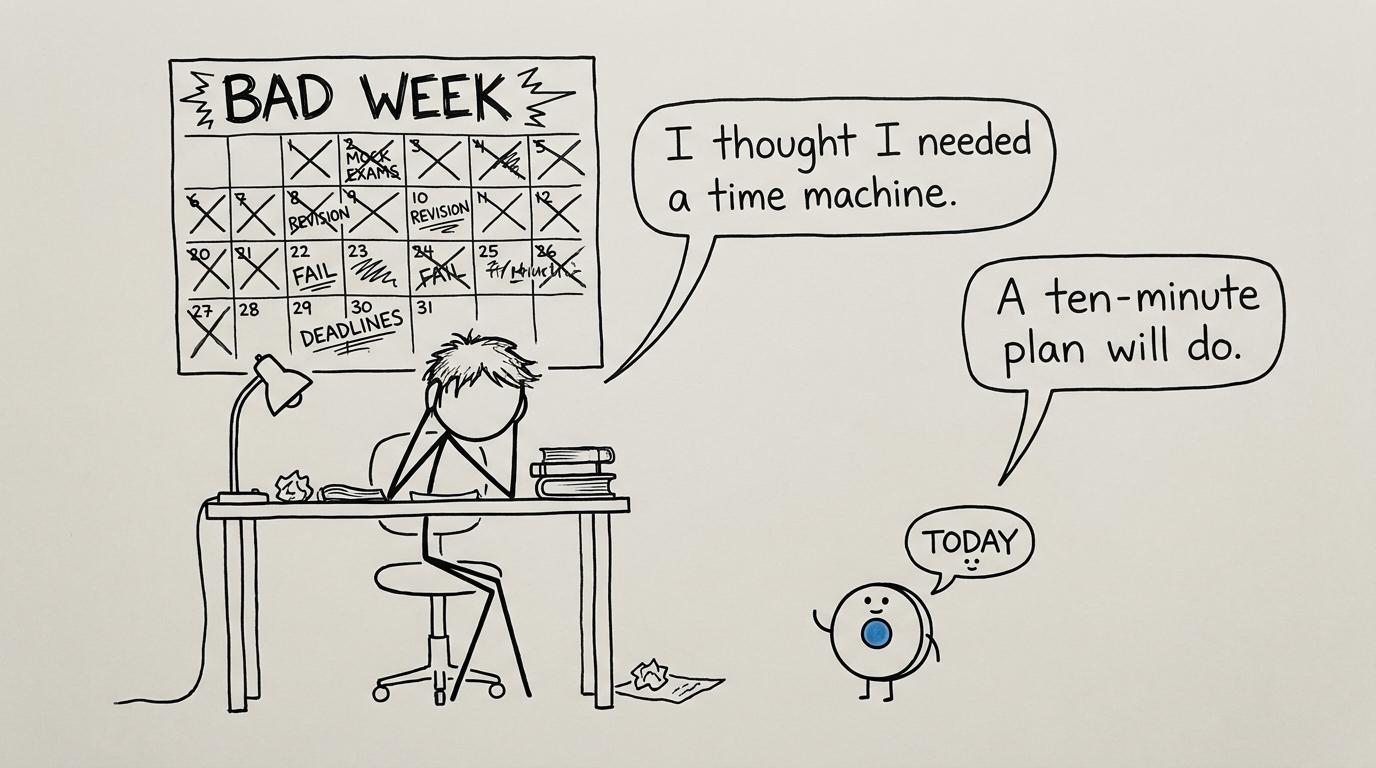 A student discovers that restarting revision needs a small plan rather than a time machine
Stop treating the missed week as revision debt
Revision plans often fail because students treat time like money. If five sessions were missed, it seems logical that five extra sessions must now be squeezed into the next week.
But learning does not work like clearing an unpaid bill. Doubling tomorrow's workload does not recreate yesterday's concentration. It usually produces a timetable that looks impressive and feels impossible.
Instead, separate the problem into three parts:
- Knowledge: Which facts, dates, individuals or developments can you not recall?
- Historical thinking: Are you struggling with cause, consequence, change, continuity, similarity, difference or significance?
- Exam technique: Do you understand the command word, expected judgement and structure of the question?
This turns a vague feeling, “I am behind in History”, into a specific action. The same principle works in maths. MathsGenie's guide to finding your weakest GCSE topics explains why diagnosis is more useful than revising comfortable material simply to feel busy.
Make the first session deliberately small
Your first session back should be easy to begin but active enough to reveal something useful. Aim for roughly 202020 to 303030 minutes.
Recall without notes
Choose one narrow area from your course. It might be the causes of an event, the impact of a policy, a sequence of developments or the role of an individual.
Put your notes away and write what you remember. You could use a timeline, a cause-and-consequence map, a list of key evidence or short answers to questions you create yourself.
The important part is attempting retrieval before checking. Educational guidance on retrieval practice stresses that the attempt to remember matters. Feedback matters too, because unchecked recall can leave misconceptions in place.
Check and correct
Open your class notes, textbook or teacher-approved materials. Add missing details in a different colour and correct anything inaccurate. Do not rewrite the whole page. Your corrections are the valuable part because they show what the next session needs to revisit.
Finish with one exam action
Plan a response, annotate a source or interpretation, or write one analytical paragraph. Check the question style for your own exam board, whether that is Edexcel, AQA, OCR or Eduqas. Paper structures and mark tariffs differ, so a memorised paragraph formula should never replace the wording of the actual question.
A short session with recall, checking and application is more useful than an hour of copying notes.
Rebuild around what GCSE History assesses
For GCSE History qualifications regulated in England, the assessment objectives give you a useful map. Knowledge and understanding under mathrmAO1mathrm{AO1}mathrmAO1 account for 35%35\%35%, while explanation and analysis using second-order concepts under mathrmAO2mathrm{AO2}mathrmAO2 also account for 35%35\%35%. Source work under mathrmAO3mathrm{AO3}mathrmAO3 and interpretations under mathrmAO4mathrm{AO4}mathrmAO4 each account for 15%15\%15%.
That does not mean dividing every revision session mechanically by those percentages. It means recognising that factual recall alone is not the whole exam.
A balanced History reset should therefore include:
- accurate knowledge placed in the correct context;
- explanation using concepts such as causation or change;
- analysis of contemporary sources where your paper requires it;
- evaluation of later interpretations where relevant;
- substantiated judgements supported by selected evidence.
Check your specification, school course outline and teacher guidance before choosing questions. Two students may both take GCSE History but study entirely different periods and paper combinations.
Use a three-session recovery rhythm
One productive evening can restore hope. A repeatable rhythm restores revision.
Session one: diagnose
Spend 202020 to 303030 minutes recalling and checking one topic. End by writing two needs:
- one knowledge need;
- one exam-skill need.
For example, the knowledge need might concern chronology, while the skill need might concern reaching a supported judgement. These are categories, not a worked answer to any specific paper.
Session two: repair
Return to the same area on another day. Test the missing knowledge again, then complete a short question or plan focused on the skill you identified. Compare your work with a teacher-provided model or official mark scheme where available.
Session three: apply
Later in the week, use an unfamiliar question from the same part of your course. Work without notes for at least part of the task. This shows whether the improvement survives when the wording changes.
Spacing the work across several days is more sustainable than compressing it into one late-night catch-up session. Planning, monitoring and evaluating your learning are also central to effective self-regulated revision.
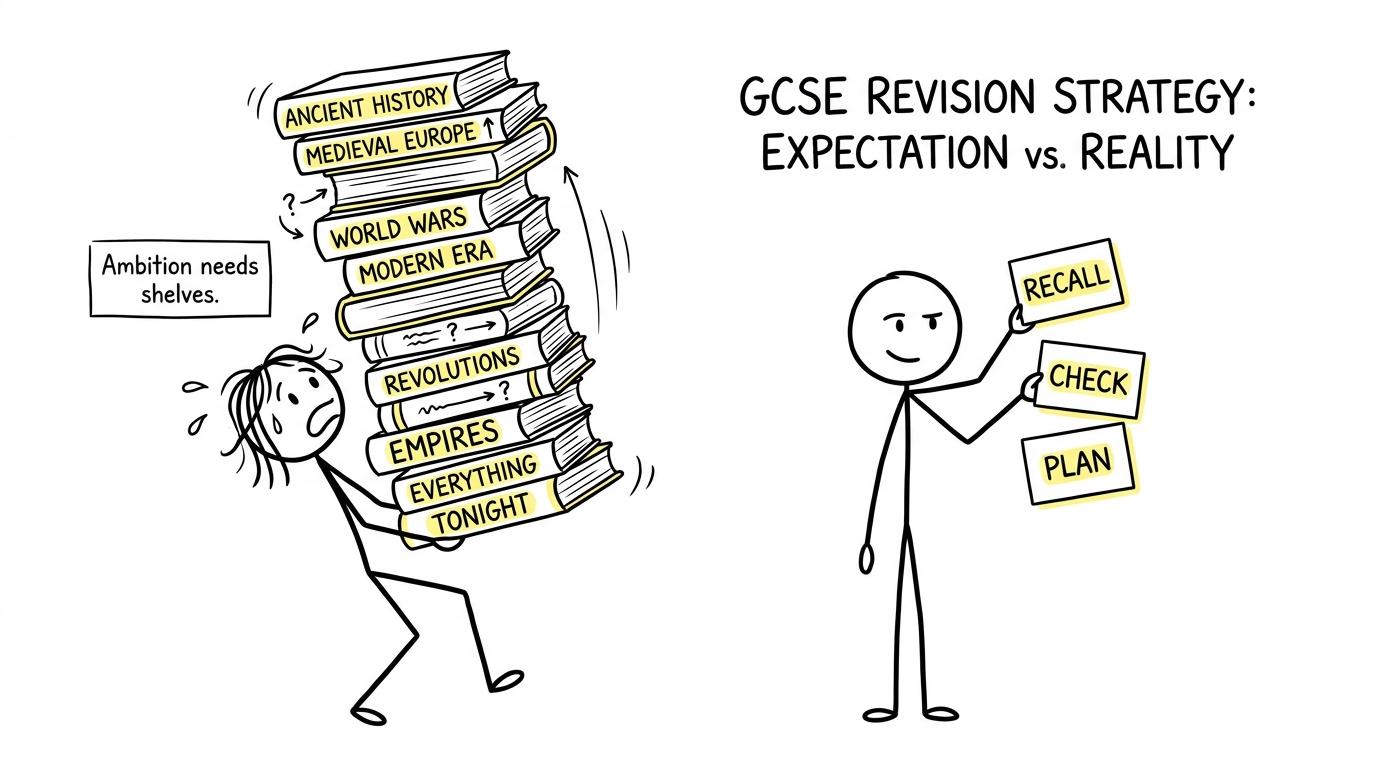 One student carries every textbook while another uses three small revision cards
Keep History and maths revision in balance
If you are also preparing for GCSE maths, the solution is not to let History consume the entire week. Give each subject a defined next action.
A practical evening might contain one short History recall-and-plan session followed by targeted maths practice on another day. For maths, the GCSE maths revision hub brings together board-specific resources, revision lessons, questions, papers and solutions. That reduces the time lost deciding what to open.
When energy is limited, MathsGenie's twenty-minute GCSE maths routine offers a compact structure. If your wider timetable has also fallen apart, use the GCSE maths revision timetable guide to rebuild around weak areas, regular practice and room for rest.
The principle is the same in both subjects: identify a gap, practise actively, check the result and return to it later. In History, that might mean retrieving evidence and improving analysis. In maths, it means doing questions, checking the mark scheme and correcting the exact step that lost marks.
Plan the next week, not the perfect month
After a disrupted week, a month-long colour-coded schedule can become another form of avoidance. Plan only the next seven days.
Choose:
- two short History sessions;
- one longer History question or paper section;
- specific maths sessions based on weak topics;
- fixed stopping times;
- at least one spare slot for work that moves.
Write the task, not merely the subject. “History” creates another decision. “Recall the causes from Topic B, check notes, then plan one causation question” tells you how to start.
Do the same for maths. “Maths revision” is vague; “complete one algebra mini test and mark it” is actionable. Edexcel GCSE Maths mini tests are useful for shorter practice if that is your board. Students following other boards should begin from the main GCSE hub and select resources aligned with their specification and tier.
Protect sleep instead of extending the panic
Trying to repair a poor week by revising deep into the night is usually a bad trade. NHS guidance says most teenagers need around `888 to 101010 hours of sleep and advises realistic schedules, manageable chunks and regular short breaks. It also warns against all-night cramming.
Choose a finish time before you begin. If a task remains unfinished, write the next step and return to it later. This keeps one difficult evening from damaging the following school day.
If exam pressure feels overwhelming rather than temporary, speak to a parent, carer, teacher, pastoral lead or another trusted adult. A revision plan can organise work, but it is not a substitute for support.
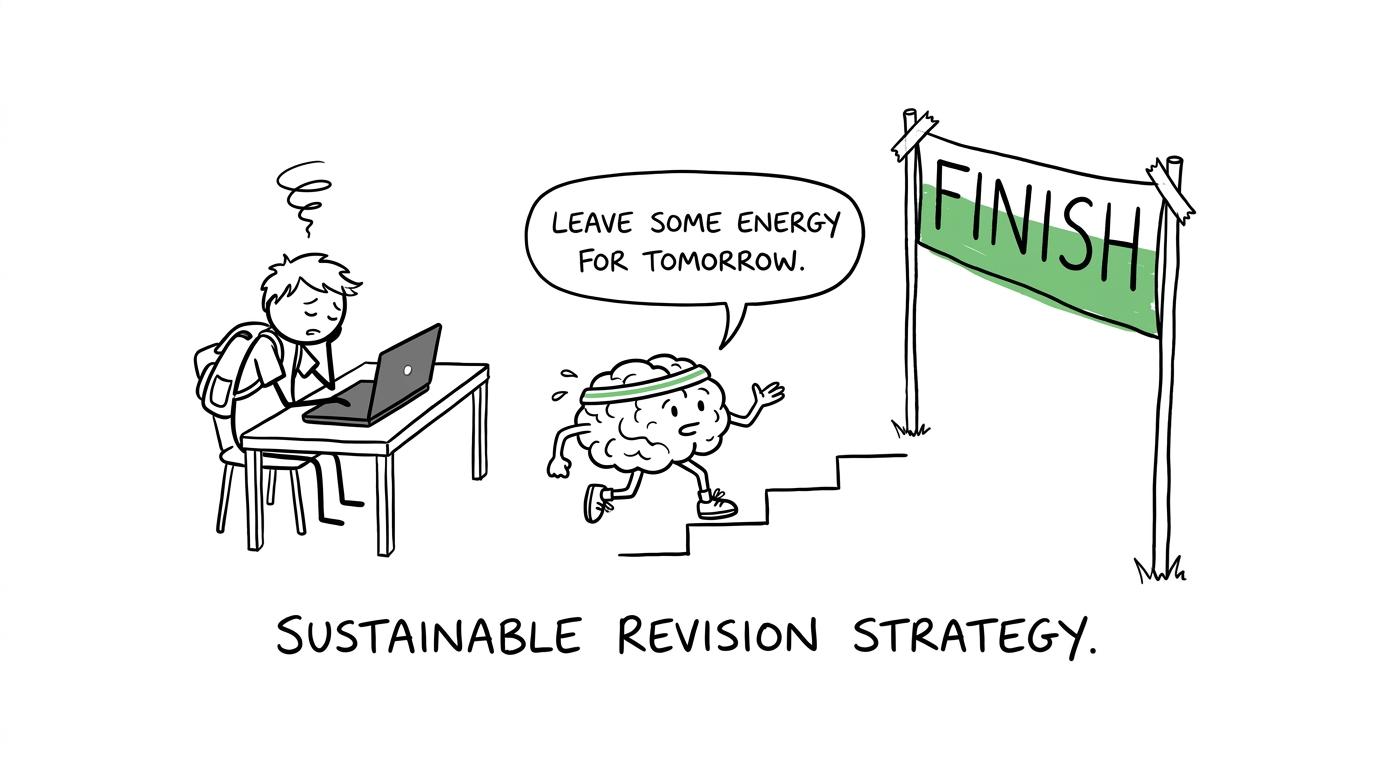 A cartoon brain reminds a student to save some energy for tomorrow
Common mistakes when restarting revision
Trying to complete every missed task
This creates an overloaded week before the new week has started. Keep only tasks that address current knowledge or exam gaps.
Beginning with the largest topic
A huge unit creates friction. Begin with one event, concept, source skill or question type. A small completed loop is more valuable than a grand unfinished plan.
Re-reading without testing memory
Familiar pages can create the feeling of progress without showing what you can recall. Close the book first, retrieve, then check.
Writing essays before rebuilding knowledge
Exam practice matters, but unsupported argument cannot replace accurate evidence. Repair the specific factual gap, then apply it to a question.
Ignoring the mark scheme and command word
A response can contain good History yet fail to answer the task set. Use questions from your own board and learn what words such as “explain”, “how useful” or “how far” require in that paper.
Letting History replace every other subject
A bad History week does not need to become a bad maths week. Keep maths active with short topic practice, then build towards GCSE past papers and GCSE predicted papers when appropriate.
Restart with evidence, not guilt
A bad week is information. Perhaps the plan was too crowded, the tasks were too vague, or your energy was lower than expected. Use that information to make the next week more realistic.
Today, choose one History topic. Recall it without notes, check your gaps, complete one exam action and schedule the return. Then give maths the same clarity: one lesson, one set of practice questions, one honest check.
MathsGenie can make that half of your GCSE workload simpler. Use the free revision lessons to rebuild a method, practise with topic questions and mini tests, then move towards past papers and predicted papers. Mark with the available mark schemes and use video solutions to understand errors rather than merely counting them.
You do not need to win back the lost week. You need to make the next useful session happen.











