Regret Picking GCSE English Literature? Read This
Regret picking GCSE English Literature? Explore common concerns, course demands and what to check before choosing while protecting maths revision time.
There is a particular kind of regret that arrives halfway through Year 10. The option form has disappeared, the timetable is fixed, and a subject that looked interesting on paper now feels much larger in real life.
Students who regret picking GCSE English Literature usually do not suddenly dislike every book or poem. More often, they discover a mismatch between what they expected and what the qualification demands: substantial whole texts, analytical essays, unseen material, closed-text examinations and revision that competes with maths, science and other subjects.
That does not make English Literature a bad choice. It means the best choice depends on how you like to learn, what your school requires and whether you understand the workload before committing.
The quick checklist before choosing
Before treating English Literature as either an obvious choice or an automatic mistake, check:
- whether it is genuinely optional at your school
- which exam board you will follow: AQA, Edexcel, OCR or Eduqas
- the exact plays, novels and poetry collection your school teaches
- whether the examinations are closed text
- how many papers you will sit and how long they last
- whether you enjoy explaining how writers create meaning
- how confidently you write extended answers under time pressure
- how the workload will fit beside your GCSE maths revision
- what support, feedback and practice papers your department provides
The crucial question is not simply, “Do I enjoy reading?” It is, “Am I willing to read these particular texts closely and write analytical responses about them under examination conditions?”
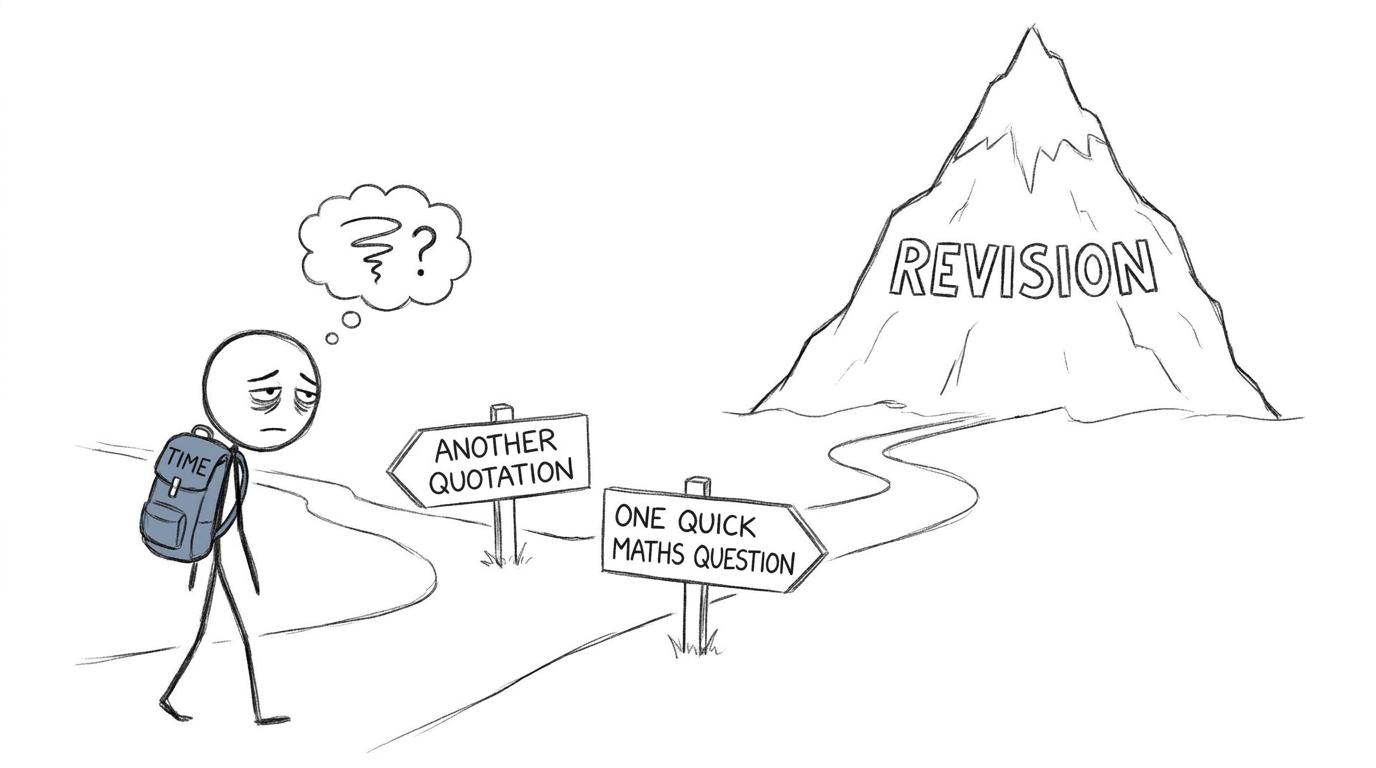 A GCSE student choosing between another quotation and a quick maths question, with both paths leading towards the revision mountain
Why some students regret picking GCSE English Literature
There is no reliable national ranking of students’ reasons for regretting the subject, so it would be misleading to attach percentages to them. These are better understood as recurring concerns created by the structure of the course.
They expected reading, not sustained literary analysis
Enjoying a story and analysing it are different activities. GCSE English Literature asks students to move beyond plot and character description. You may need to explore language, form and structure, develop an interpretation, select textual references and explain relevant context.
The official subject content includes Shakespeare, a nineteenth-century novel, poetry, modern British fiction or drama and unseen texts. The precise arrangement varies by exam board, but the central task remains similar: construct an argument about how a writer creates meaning.
A student can enjoy Macbeth yet dislike writing timed essays about ambition, imagery and dramatic structure. That is not laziness. It is a clue about the kind of work they prefer.
The set texts may not be the texts they would choose
Students often hear that English Literature involves “reading books” and imagine choosing books they already enjoy. In reality, schools select from an exam board’s prescribed lists. Your class may study a Shakespeare play, a nineteenth-century novel, a modern play or novel, and a particular poetry cluster.
You usually cannot replace a set text simply because another one interests you more. Before choosing, ask your teacher for the exact list. Read a scene, chapter or poem from each. A course should be judged by its actual content, not by the most appealing title in the specification.
Closed-text examinations feel memory-heavy
Current specifications commonly use closed-text assessments. AQA states that all its GCSE English Literature assessments are closed book, while OCR describes both of its examined components as closed text. Eduqas also restricts access to set texts in its examinations. Some questions provide an extract or named poem, but students must still draw on knowledge of the wider work where required.
This does not mean every line must be memorised. It does mean you need a dependable core of short quotations, plot knowledge, themes, character development and methods. If memorising verbal material is difficult for you, the course may demand more deliberate retrieval practice than you expected.
Maths students often recognise the feeling. A formula is only useful if you know when to use it; a quotation is only useful if it supports the argument. The problem is not merely storage. It is selection under pressure.
Timed essays can feel less certain than maths answers
In maths, feedback can appear reassuringly definite. A method either works or needs correcting. English Literature rewards a reasoned interpretation supported by evidence, so two strong answers may take different routes.
That flexibility can be exciting, but some students experience it as uncertainty. They may understand the text yet struggle to convert that understanding into a focused thesis, analytical paragraphs and a conclusion within the available time.
The response is not to memorise entire model essays. It is to practise planning and writing, then compare the result with assessment objectives and examiner guidance. The GCSE English Literature exam-week checklist offers a manageable structure for quotations, paragraph plans and timed responses.
The workload collides with maths revision
Regret often emerges from the timetable rather than the subject itself. Literature revision can expand endlessly because there is always another quotation, interpretation or contextual point to review. Maths also needs regular practice, especially when forgotten methods begin to accumulate.
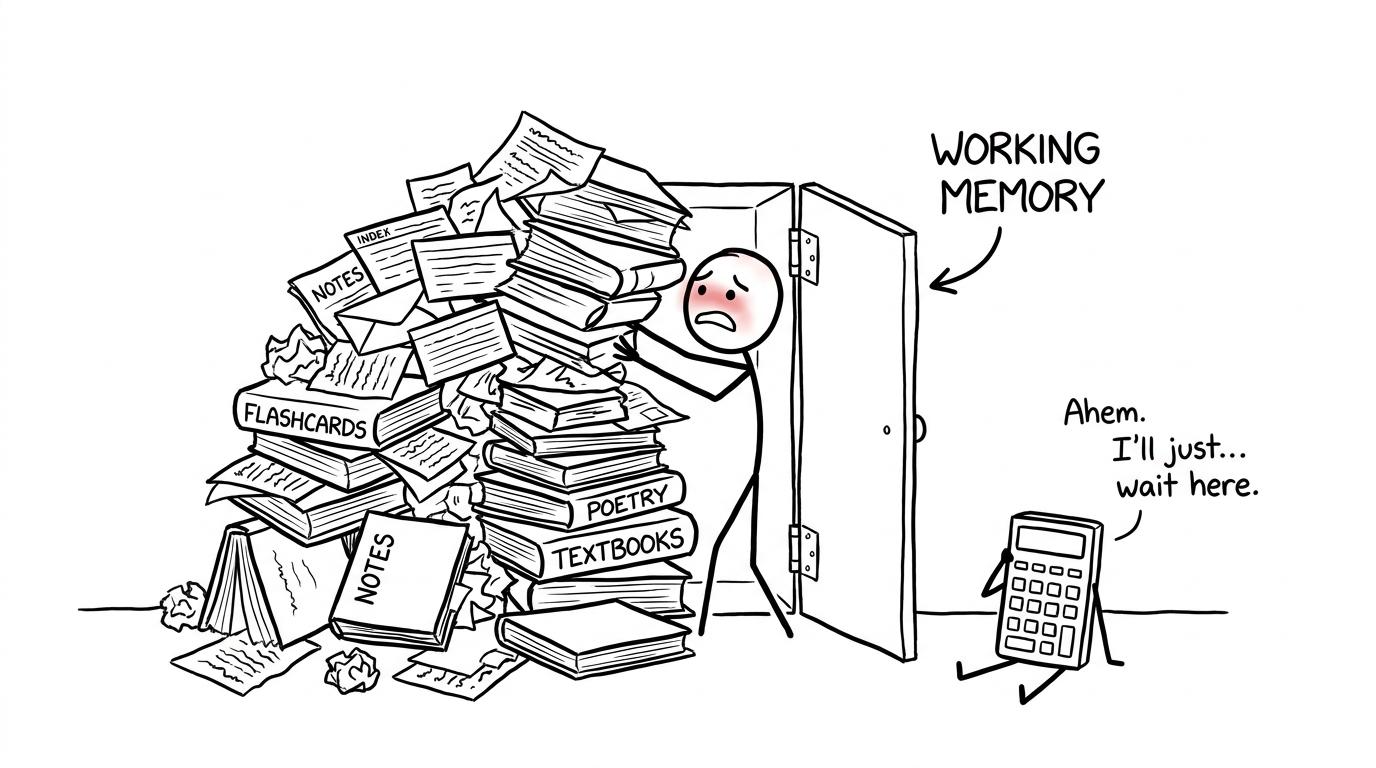 A student attempting to squeeze books and poetry notes into a cupboard labelled working memory
The solution is to give each subject a different revision shape. Literature benefits from short quotation retrieval, essay planning and timed paragraphs. Maths benefits from questions, marking, correction and retesting. The guide to revising English Literature without wasting time explains how to use this distinction while keeping maths moving.
For maths, start from the GCSE Maths revision hub, where topics, exam-board resources, short tests and papers are organised in one place. A small, repeatable routine is safer than allowing one subject to consume every evening.
English Literature may not be a normal option
The language of “picking” English Literature can be confusing. In England, English is part of the compulsory Key Stage 4 curriculum, and both English Language and English Literature are included in the English Baccalaureate combination. To count towards the English part of the EBacc, a pupil takes examinations in both.
However, entry policies and curriculum pathways differ between schools. English Literature may be compulsory for most pupils at one school, optional for a particular pathway at another, or presented separately from the main options process. Arrangements can also differ across the UK.
Ask your school directly:
- Can I choose not to take the qualification?
- Would that change my timetable or English Language teaching?
- Does it affect my school’s expected pathway for me?
- Who must approve a change?
- What is the deadline?
Do not rely on what happened at a friend’s school. The relevant rule is the one governing your own timetable and exam entry.
What to check about the assessment
Exam boards cover nationally required content but organise it differently. For example, AQA currently uses two compulsory papers. Its first paper covers Shakespeare and the nineteenth-century novel; its second covers a modern text, anthology poetry and unseen poetry. OCR also uses two examined components, each worth 50%50\%50% of the qualification, but groups the content differently.
Specifications and set-text lists can change, so confirm the version applying to your examination year. Write down:
- your specification code
- your set texts and poetry cluster
- each paper’s content and duration
- which extracts or poems are printed
- the assessment objectives used for each section
- where spelling, punctuation and grammar are assessed
Then inspect a real paper. MathsGenie’s Edexcel GCSE English Literature past papers can help Edexcel students see the actual question style rather than imagining what the course might involve.
How to decide whether the subject suits you
A useful decision is based on evidence rather than identity. “I am a maths person” does not automatically mean Literature is wrong for you. Both subjects reward precision, structure and justified reasoning. The material is different, but the habit of making a claim and supporting it is transferable.
Try a small, realistic test before committing:
- read part of one likely set text
- examine a current question for your board
- plan a response without writing a full essay
- ask to see an anonymised answer and its feedback
- estimate the weekly homework and independent revision expected
- compare that commitment with your other options
Pay attention to the work itself. Do not choose solely because friends are taking it, because one teacher makes it sound easy or because you earned a strong mark on a single reading test.
What to do if you have already chosen it
Regret can exaggerate permanence. If you have only recently selected your options, speak to your school quickly; changes may be possible before timetables and examination entries are fixed. If a change is not available, shift from judging the choice to managing it.
Build a compact system:
- create a small bank of versatile quotations for each text
- organise quotations by themes and characters
- practise plans more often than complete essays
- write one timed paragraph at a time
- use teacher feedback to identify one specific improvement
- revisit unseen poetry regularly rather than leaving it until the end
Keep maths equally visible. Use a weekly plan containing topic practice and one timed assessment. The GCSE one-month maths revision plan provides a useful model, while the guide to using GCSE past papers properly explains how to turn mistakes into future marks.
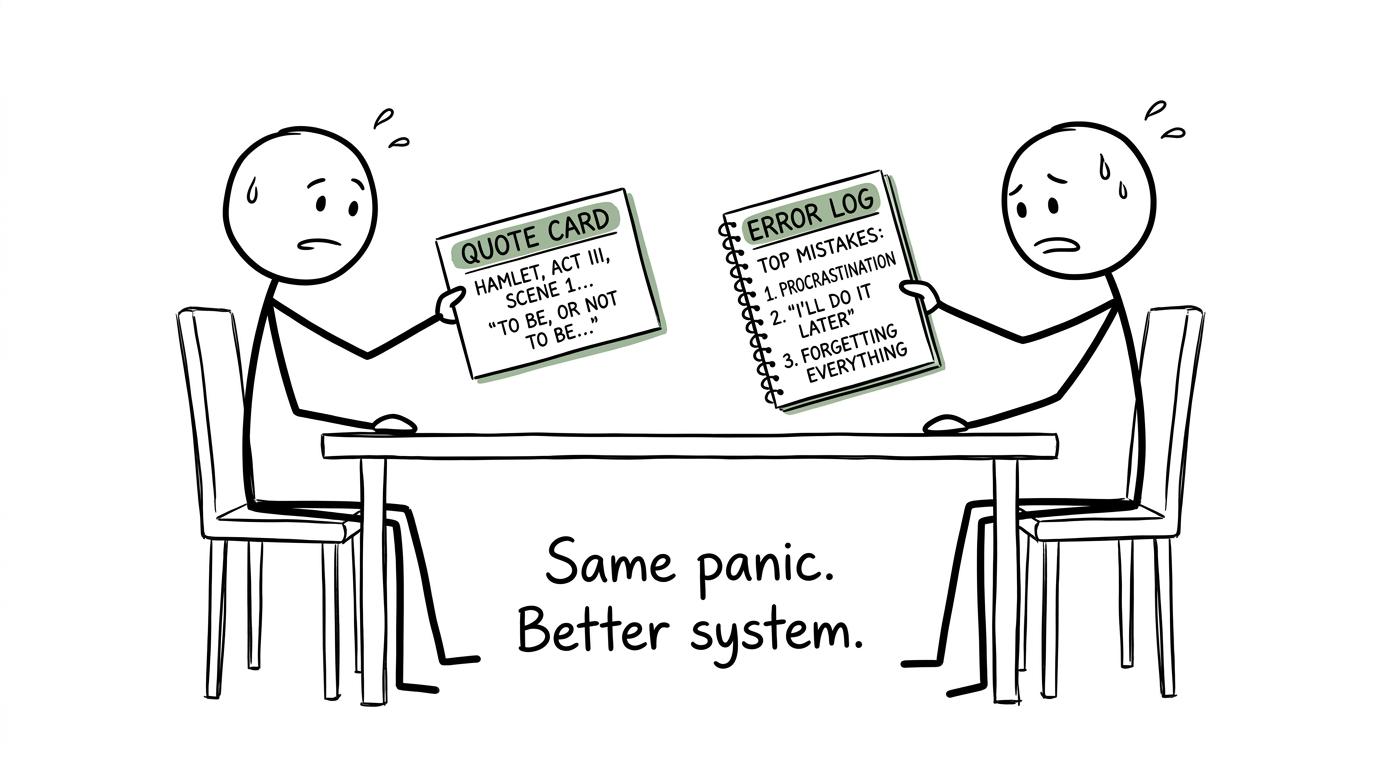 Two students exchanging a quotation card and an error log with the caption Same panic. Better system.
Common mistakes when making the decision
Assuming English Literature is an easy extra GCSE
The subject is accessible, but it is not passive. Whole-text knowledge, comparison, analysis and extended writing require consistent practice.
Confusing English Language with English Literature
The qualifications overlap in reading and writing skills, but their content and assessments are distinct. Check both specifications rather than treating Literature as more of the same.
Choosing around one favourite text
Your favourite play may represent only one part of the course. Consider every set text, including the poetry and unseen elements.
Ignoring the complete revision timetable
An option can be enjoyable in isolation and still create an unbalanced workload. Map it alongside maths, science and your other subjects.
Dropping maths practice during essay-heavy weeks
Maths fluency fades when practice stops. Even a short mini test or targeted question set can preserve momentum. Use the best order for learning GCSE Maths topics to decide what to prioritise, then build towards board-specific papers such as Edexcel GCSE Maths past papers or AQA GCSE Maths past papers.
Make the choice with open eyes
Students rarely regret a subject merely because it is difficult. Regret usually grows when the difficulty was hidden, misunderstood or allowed to crowd out everything else.
Before choosing GCSE English Literature, find out whether it is optional, identify the actual texts, inspect the assessment and test the kind of work you will be doing. If you have already chosen it, replace vague worry with a small system: retrieve, plan, write, receive feedback and repeat.
Then protect your maths revision with the same discipline. MathsGenie brings together free revision lessons, practice questions, mini tests, past papers, predicted papers, mark schemes and video solutions. Choose one weak maths topic today, practise it, mark it honestly and let the next step become clear.