

Redo GCSE Economics Mock Timed: Is It Worth It?
Redo GCSE economics mock timed or review it first? Learn when a full resit helps, when targeted correction wins, and how to plan your next session.
A mock can leave you with an uncomfortable choice. Do you sit through the whole paper again, hoping that repetition will make you faster, or spend that time examining what went wrong?
The question behind the search “redo GCSE economics mock timed” has a clear answer: review and correct your first attempt before resitting the entire paper. A full timed redo can be worthwhile later, particularly if timing, concentration or answer selection caused problems. But if missing knowledge or weak analysis cost the marks, immediate targeted revision will usually be a better use of time.
That principle matters beyond Economics. It is equally useful when preparing for GCSE Maths: a paper diagnoses your weaknesses, while the improvement happens when you mark, repair and retest them.
The quick decision checklist
Before booking another full mock into your evening, ask:
- Have I marked the original attempt carefully?
- Do I know why each mark was lost?
- Was timing genuinely a problem?
- Did I leave questions unfinished despite knowing the content?
- Have I corrected weak topics and answer structures?
- Would a fresh paper give me better evidence than repeating this one?
- Do I have enough uninterrupted time to recreate exam conditions properly?
If you have not analysed the first attempt, stop there. Review it first. MathsGenie’s guide to using GCSE past papers properly explains the same essential cycle: attempt, mark, fix and retest.
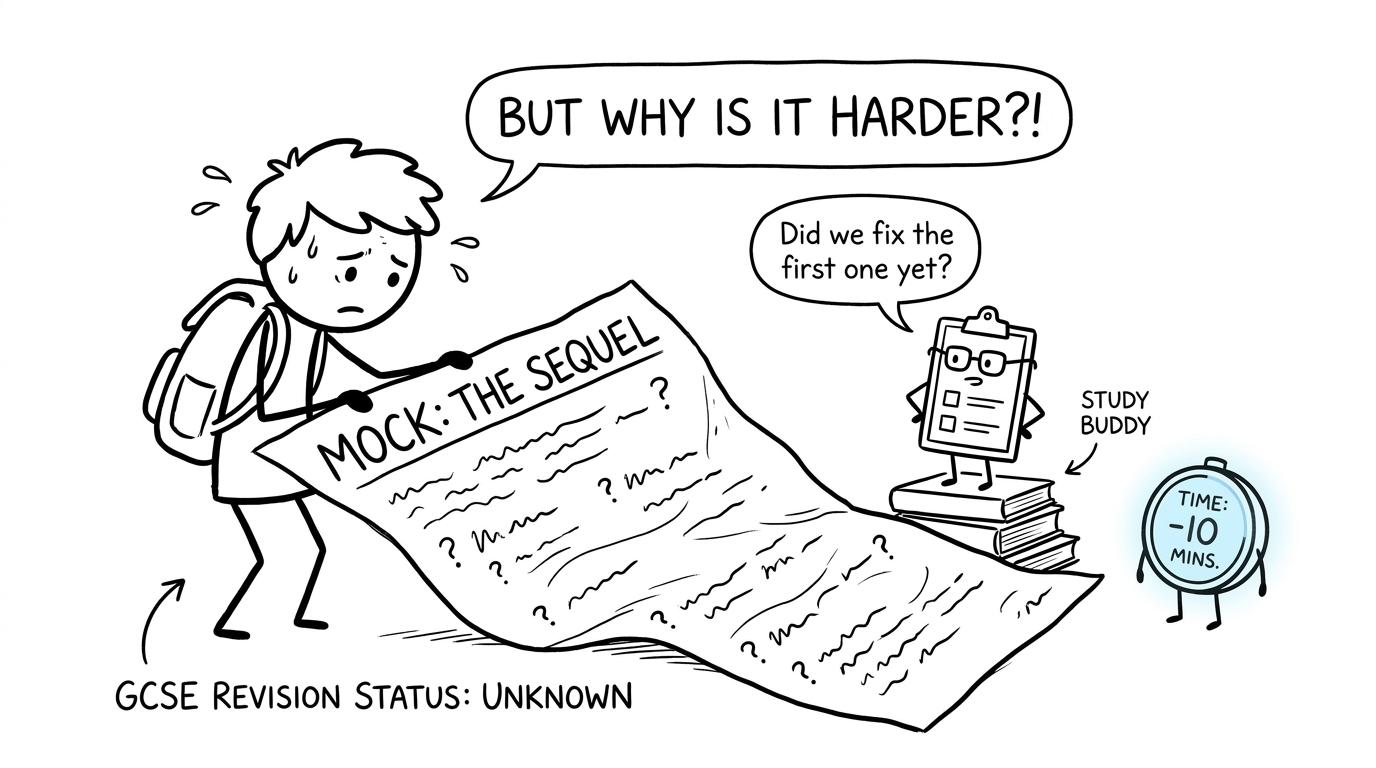 A student meets the unnecessarily dramatic sequel to a mock paper
Why reviewing the first attempt usually comes first
A mock produces two things: a mark and information. The mark feels important, but the information is more useful.
Suppose several marks disappeared because definitions were vague, chains of reasoning stopped too early or conclusions did not answer the question. Another timed attempt will expose those problems again, but exposure is not the same as repair. You need to identify the missing knowledge or decision, revise it and then test whether the correction survives without notes.
Research on retrieval practice broadly supports attempting questions rather than relying only on rereading. However, practice becomes much more useful when it informs the next stage of revision. That is why a marked mock should become an error log rather than being placed in a folder and forgotten.
For each lost mark, record:
- the topic;
- the question type;
- whether the problem was knowledge, application, analysis, evaluation or quantitative skill;
- whether time pressure contributed;
- the specific action needed before retesting.
This approach is also central to finding your weakest GCSE topics. It replaces the vague feeling that a subject went badly with a short list of fixable problems.
When a full timed GCSE Economics resit is worthwhile
Redoing the whole mock makes sense when the paper revealed an exam-performance problem rather than only a content problem.
You ran out of time
A timed resit can show whether you now allocate time more sensibly. GCSE Economics paper formats differ between specifications, so use the exact duration, structure and instructions for your exam board. Current AQA and OCR GCSE Economics qualifications both use two written papers, but their timings and question structures are not identical.
A simple planning measure is:
minutes per mark=available working minutestotal marks\text{minutes per mark}=\frac{\text{available working minutes}}{\text{total marks}}minutes per mark=total marksavailable working minutesThis is a guide, not a command to spend precisely the same time on every mark. Reading case studies, checking calculations and planning extended responses also require time. The purpose is to notice when one difficult question is consuming a disproportionate share of the paper.
You knew the material but could not organise answers
Students sometimes understand a topic during revision but struggle to select relevant knowledge under pressure. A full resit makes you practise switching between multiple-choice, calculations, data interpretation and longer written responses without guidance.
That kind of switching is part of exam technique. It cannot be trained entirely by reading model answers.
Your concentration faded
Paper stamina is real. If your answers were careful at the beginning and rushed near the end, a full timed session may be appropriate. Build towards it if necessary: begin with one timed section, move to a half paper and then complete the full mock.
The same progression works in maths. MathsGenie’s GCSE Maths revision hub offers shorter topic practice alongside full exam papers, allowing students to develop accuracy before adding endurance.
You have already repaired the weaknesses
A resit should answer a new question: did the revision work? If nothing has changed between attempts, the second sitting mainly measures familiarity and persistence. If you have revised the weak content, improved answer planning and practised quantitative skills, it becomes a meaningful check.
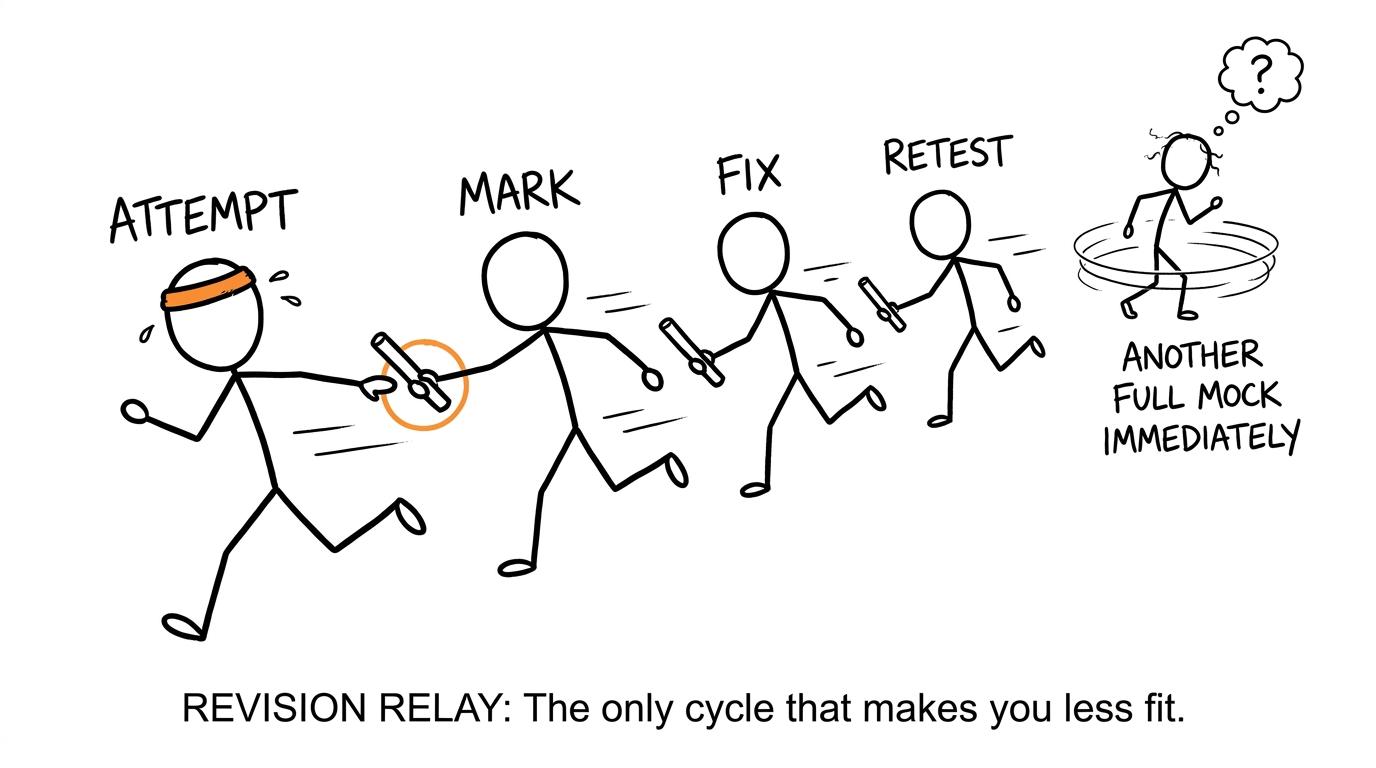 The useful revision relay of attempt, mark, fix and retest
When targeted review is the better use of time
Do not redo the entire paper merely because the first mark was disappointing. Choose targeted correction when:
- one or two topics caused most of the lost marks;
- you misunderstood key economic concepts;
- your calculations or graph interpretation were unreliable;
- you repeatedly misread command words;
- you have limited revision time;
- you have not yet used the mark scheme or teacher feedback.
The useful unit of revision is often smaller than a paper. You might need to practise conclusions, revisit market failure or strengthen percentage calculations. Repeating every question gives equal time to secure and insecure areas, even though those areas do not deserve equal attention.
You can quantify that imbalance with:
topic loss rate=marks lost on a topicmarks available on that topic\text{topic loss rate}=\frac{\text{marks lost on a topic}}{\text{marks available on that topic}}topic loss rate=marks available on that topicmarks lost on a topicA higher loss rate suggests a stronger priority. The calculation does not replace judgement, but it can prevent revision being guided only by whichever mistake feels most memorable.
Economics also includes quantitative skills. If percentages, averages, rates of change or data interpretation are holding you back, the topic-based lessons and practice questions in the GCSE Maths topics guide can support the underlying maths without requiring another complete Economics paper.
Should you repeat the same paper or use a fresh one?
The same paper and a fresh paper answer different questions.
Repeating the same mock checks whether you can now execute corrected methods and structures. It is useful for building fluency, but your score will be influenced by familiarity. You may remember a case study, a multiple-choice answer or the direction of a conclusion.
A fresh paper gives cleaner evidence of transfer. It asks whether you can apply what you learnt to unfamiliar material, which is closer to the real examination.
A sensible sequence is:
- mark and diagnose the original mock;
- correct specific questions without a timer;
- revise the weakest content;
- attempt selected questions under short time limits;
- redo difficult sections from the original paper;
- complete a fresh full paper under timed conditions.
For GCSE Maths, you can follow this sequence with free revision lessons, practice questions, mark schemes, video solutions and papers on MathsGenie. The advice in how to stop forgetting GCSE Maths content is particularly useful for spacing corrections and testing them again later.
How to run a useful timed resit
If a full resit is justified, make it realistic enough to teach you something.
Match the real paper
Confirm the exam board, paper and specification. Use the official time allowance and permitted equipment. Do not assume that AQA, OCR or an International GCSE Economics paper has the same structure simply because the subject title is similar.
Remove hidden help
Close notes, put away your phone and do not pause the timer. Reading the mark scheme shortly before starting also weakens the value of the result. Leave enough time between review and resit for the task to require genuine retrieval.
Record timing evidence
Note when you begin and when you finish each major section. Also mark questions you leave and return to. This shows whether your problem is overall speed, slow reading, excessive planning or getting trapped by individual questions.
Mark for decisions, not just totals
Use the relevant mark scheme and teacher guidance. Then compare the two attempts by category:
- completion;
- accuracy;
- use of evidence;
- development of reasoning;
- evaluation;
- quantitative skills;
- time remaining for checking.
The total mark matters, but improvement in these behaviours is more likely to transfer to a new paper.
 A student discovers that timing can be trained calmly
A revision plan that balances correction and timing
A calm plan might spread the work across several sessions:
| Session | Main purpose |
|---|---|
| Review the mock | Mark it, classify errors and identify unfinished questions |
| Repair weak areas | Relearn content and practise focused questions |
| Short timed retest | Check the weakest question types without notes |
| Delayed section resit | Test whether corrections survived after a gap |
| Fresh full paper | Measure timing, stamina and transfer |
This is more efficient than repeatedly sitting full papers and hoping the mark rises. Maths students can organise the same sequence with the MathsGenie revision planner, mini tests and exam-board resources. The guide for GCSE students who struggle to begin revision also shows how to keep the learn, practise, mark and fix loop manageable.
Common mistakes when redoing a mock
Resitting before understanding the first result
A second attempt cannot repair an error you have not identified. Mark and classify the first paper before doing more assessment.
Treating a higher repeat score as a new predicted grade
Familiarity can raise performance. Improvement is encouraging, but a fresh paper is a fairer test of whether the skill transfers.
Timing everything too early
Time pressure is useful after you understand the content and answer process. If you cannot yet construct a sound response without a timer, speed is not the first problem to solve.
Reviewing only incorrect answers
Also inspect answers that earned marks slowly or uncertainly. A correct answer produced through guessing or excessive time may fail under different conditions.
Completing papers without a repair phase
Volume can create the feeling of serious revision while leaving the same gaps untouched. One carefully reviewed paper can be more valuable than several unmarked attempts.
Make the next paper produce better evidence
Redoing an entire GCSE Economics mock under timed conditions is worthwhile when you have already reviewed the first attempt and need to test timing, stamina or improved exam technique. It is not usually the best immediate response to weak knowledge or poorly developed answers. Correct those problems first, retest them in smaller pieces and then use a fresh full paper to see whether the improvement transfers.
The larger lesson applies directly to maths revision. Papers reveal where marks disappear; focused practice helps you recover them. Start with MathsGenie’s GCSE Maths revision resources, use revision lessons and practice questions to repair individual skills, then bring in past papers, predicted papers, mini tests, mark schemes and video solutions when you are ready to test them.
Do not sit another paper merely to feel busy. Sit it when it can answer a useful question about your progress.










