Can You Redo GCSE Chemistry Coursework?
Redo GCSE Chemistry coursework? Current GCSE practical work is assessed in written exams. Learn what may be repeated, reviewed or resat, and who to ask.
A practical goes badly. The colour change happens before you are ready, a measurement looks wrong, or your write-up feels weaker than everyone else’s. It is natural to wonder whether you can redo GCSE Chemistry coursework before that mistake becomes part of your final grade.
For current GCSE Chemistry qualifications in England, the reassuring answer is that there is normally no marked coursework to resubmit. Practical work is compulsory and important, but your understanding of it is assessed through written examination questions. Repeating an experiment may be possible for learning or completion, at your school’s discretion, but you are not replacing a coursework mark.
The qualification, country and exam board still matter. If you are unsure what you are taking, check the exact title and specification with your chemistry teacher or exams officer rather than relying on the word “coursework”.
The short answer
Here is the position for most students taking a current GCSE in England:
- GCSE Chemistry is assessed by written examinations rather than a marked coursework component.
- You must be given appropriate opportunities to complete the required or mandatory practical activities.
- Schools keep evidence that practical work has been completed, but your laboratory record is not normally awarded a separate mark contributing to your grade.
- Practical knowledge is tested in the written papers. Ofqual requires at least 15%15\%15% of the marks in GCSE science qualifications to relate to practical work.
- A teacher may allow or arrange another attempt at an activity if something prevented proper completion, but this is not a formal coursework resubmission.
- If you want to improve the final GCSE result after certification, you would normally resit the qualification’s written papers under your board’s rules.
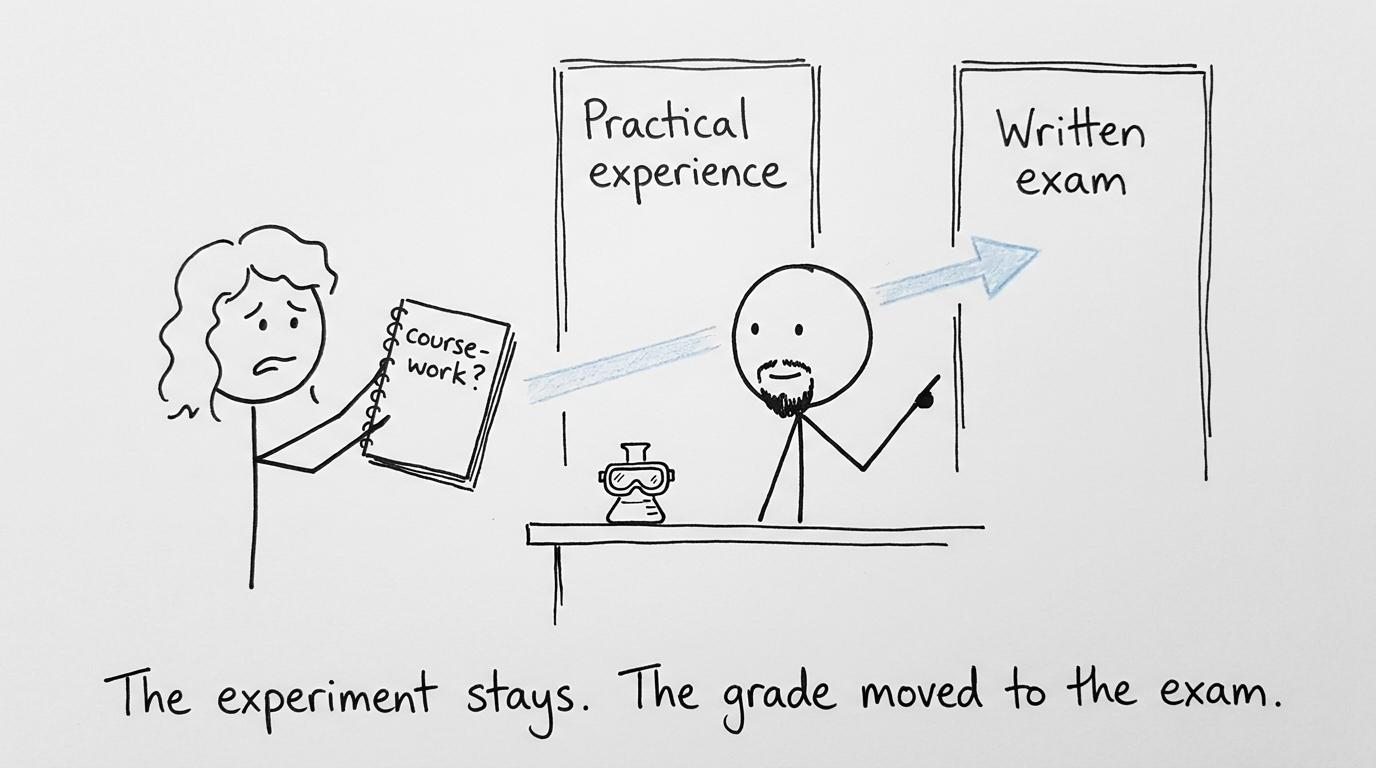 A student discovers that practical experience is assessed in the written exam
Why students still call practical work “coursework”
The word has survived longer than the assessment system it describes. Older science GCSEs included controlled assessment, and parents, older siblings and sometimes students continue to use “coursework” as a general name for practical notebooks and experiment write-ups.
Current reformed GCSE science qualifications work differently. AQA, Pearson Edexcel and OCR specifications require practical experience, while examination questions assess what you learned from it. Schools must also meet their board’s administrative requirements for confirming that students were given the required practical opportunities and kept suitable records.
The practical is therefore not optional, but neither is it a miniature examination carrying its own detachable mark. Its value appears later: when you interpret a graph, identify variables, evaluate a method, explain an anomaly or choose equipment with suitable precision.
This distinction changes the useful question. Instead of asking, “Can I submit a better write-up?”, ask, “Do I understand this investigation well enough to answer an unfamiliar exam question about it?”
What the major exam boards actually require
AQA GCSE Chemistry
AQA GCSE Chemistry includes eight required practical activities. Its specification says that written examinations draw on the knowledge and understanding gained through these activities, with practical-related questions accounting for at least 15%15\%15% of the qualification marks.
The school provides a practical science statement confirming that it has taken reasonable steps to ensure each student completed the required activities and made a contemporaneous record. “Contemporaneous” means a record made at the time of the work, not a polished reconstruction invented months later.
That record is not separately marked for your GCSE grade. If an activity was missed or could not be completed properly, speak to your teacher promptly so the school can decide what opportunity is appropriate.
Pearson Edexcel GCSE Chemistry
Pearson Edexcel GCSE Chemistry is assessed through two externally examined papers and includes eight mandatory core practicals. Students must carry out the practical work, but there is no separate coursework mark waiting to be improved.
The papers can test methods, apparatus, observations, calculations, data and evaluation. If you later resit the qualification, Pearson’s rules require the relevant examination papers to be taken together in the same examination series and at the same tier.
OCR GCSE Chemistry
OCR uses Practical Activity Groups in its GCSE science specifications. The organisation differs from AQA’s named required practicals, but the central principle is similar: practical experience develops the apparatus, investigative and analytical skills assessed in written examinations.
You cannot assume that a rule from an AQA classroom applies word for word to OCR. Ask for your precise specification, including whether you take Gateway Science or Twenty First Century Science.
Eduqas and qualifications in Wales
Be particularly careful here. “Eduqas”, “WJEC” and “GCSE Chemistry in Wales” are not interchangeable labels, and practical assessment arrangements can differ by qualification and country. Some Welsh qualifications may contain assessment structures that are not identical to GCSEs regulated in England.
Check the qualification title and code on your timetable, statement of entry or specification. Your school’s exams officer can then explain whether you have specified practical work, an internally assessed component or written papers only. Never base a resubmission decision on a generic online answer when the qualification code can settle it.
When might you be allowed to repeat practical work?
Although there is usually no GCSE Chemistry coursework mark to replace, repeating practical activity can still be sensible. Your school may arrange another opportunity if:
- you were absent for a required practical;
- equipment failed or the activity had to be stopped;
- safety or access arrangements prevented completion;
- the school needs evidence that a required activity was completed;
- your teacher believes another attempt would strengthen your understanding.
This is controlled by the school, timetable, safety requirements and specification. A student cannot demand unlimited attempts simply because the results were untidy. Real experimental data often contain variation, and learning to identify limitations is part of practical science.
Do not alter observations to make them look ideal. Keep the original evidence, label any later corrections clearly and follow your teacher’s instructions. A genuine anomalous result can teach more than a suspiciously perfect table.
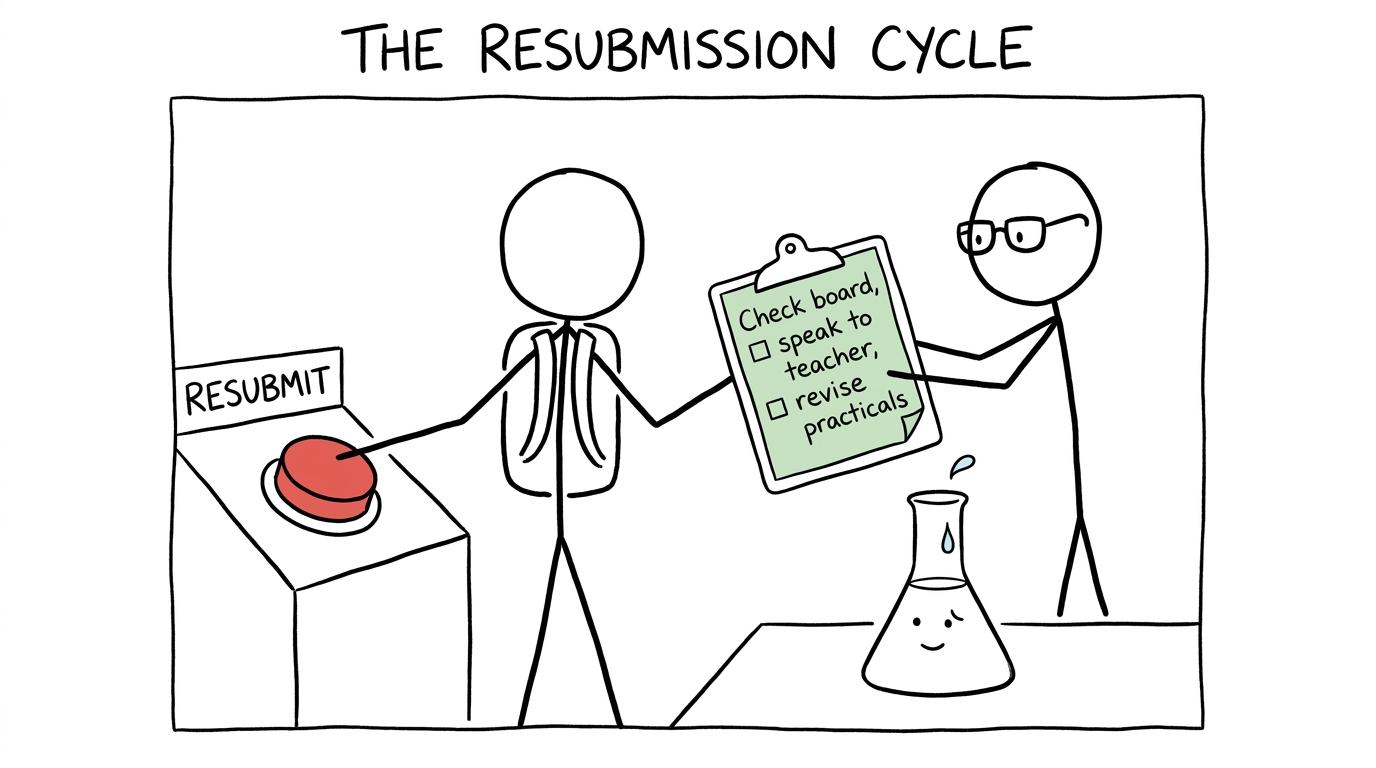 A resubmit button is replaced by a useful practical checklist
What to do if you are unhappy with your work
Confirm the exact assessment
Ask your teacher these direct questions:
- What is the full qualification title and exam board?
- Does this activity contribute a separately assessed mark?
- Is it a required or core practical record?
- Have I completed what the specification requires?
- Is another practical opportunity necessary or available?
This prevents a common misunderstanding: confusing feedback on a classroom write-up with a formal GCSE mark.
Explain the problem precisely
“I am not happy with it” is difficult to act on. Explain whether you missed the activity, recorded an incorrect unit, lost data, misunderstood the method or are worried that the record is incomplete. Your teacher can then distinguish a learning gap from an administrative issue.
Revise what the examination can test
For each practical, be able to identify:
- the independent, dependent and control variables;
- the equipment and why it is suitable;
- the main method and relevant safety precautions;
- how results should be recorded and displayed;
- sources of random and systematic error;
- ways to improve validity, accuracy, precision and reliability;
- any calculations required by your specification.
Chemistry practical questions often depend on the same numerical habits as GCSE maths: reading scales, converting units, using ratios, calculating means, interpreting gradients and judging whether a result is reasonable. MathsGenie’s GCSE maths revision hub helps you strengthen those transferable skills through lessons and exam-style questions.
If data handling is a weakness, use the GCSE maths topics by board and tier guide to identify the relevant graph, ratio and statistics topics rather than revising at random.
Can you challenge a result instead?
There is no coursework mark to appeal against if the qualification is assessed entirely by written examinations. After results day, any review of marking or other post-results service must normally be requested through your school or examination centre. It concerns the marked examination papers, not whether you would now produce a better practical notebook.
Speak to the exams officer before any deadline and ask about possible fees and risks. A reviewed mark can remain unchanged, rise or fall. The centre should explain the current procedure for your board before you consent.
If your concern is that you were not provided with the required practical opportunities, raise it with your teacher, head of science or exams officer while the course is still running. That is a centre-administration concern and should not be left until results day.
Resitting GCSE Chemistry is different from redoing coursework
A resit means taking the qualification again under the applicable exam-board rules. It does not mean submitting one improved experiment.
Because GCSE Chemistry is linear, students generally retake all required written papers in the same examination series. Availability, entry deadlines, practical requirements and private-candidate arrangements must be confirmed with the centre and exam board. AQA, for example, states that students can resit its GCSE Chemistry qualification within its shelf life, while private candidates must find a centre able to make appropriate provision for required practical work.
Before choosing a resit, compare the time required with your wider priorities. A structured revision cycle is more useful than repeatedly rereading a laboratory book. Maths students can apply the same principle using MathsGenie’s guide to starting past papers: diagnose, mark, repair the weakest skill and test it again.
Common mistakes to avoid
Assuming every practical write-up contributes to the grade
A teacher may mark a report to give feedback, set a target or check understanding. That does not automatically make it formal coursework.
Asking to redo it without checking the specification
The phrase “GCSE Chemistry” covers several boards and national arrangements. Find the qualification code first.
Rewriting results so they look perfect
Never replace genuine observations with expected values. Scientific evaluation requires honesty about anomalies, uncertainty and limitations.
Revising only the practical procedure
Examiners can change the context. Learn why each step is used, how variables are controlled and how evidence supports a conclusion.
Neglecting the mathematical skills
A correct method can still lead to lost marks through weak scale reading, premature rounding or poor graph interpretation. Use Edexcel GCSE Maths revision lessons if that is your maths board, or begin from the broader MathsGenie home page to find the right course.
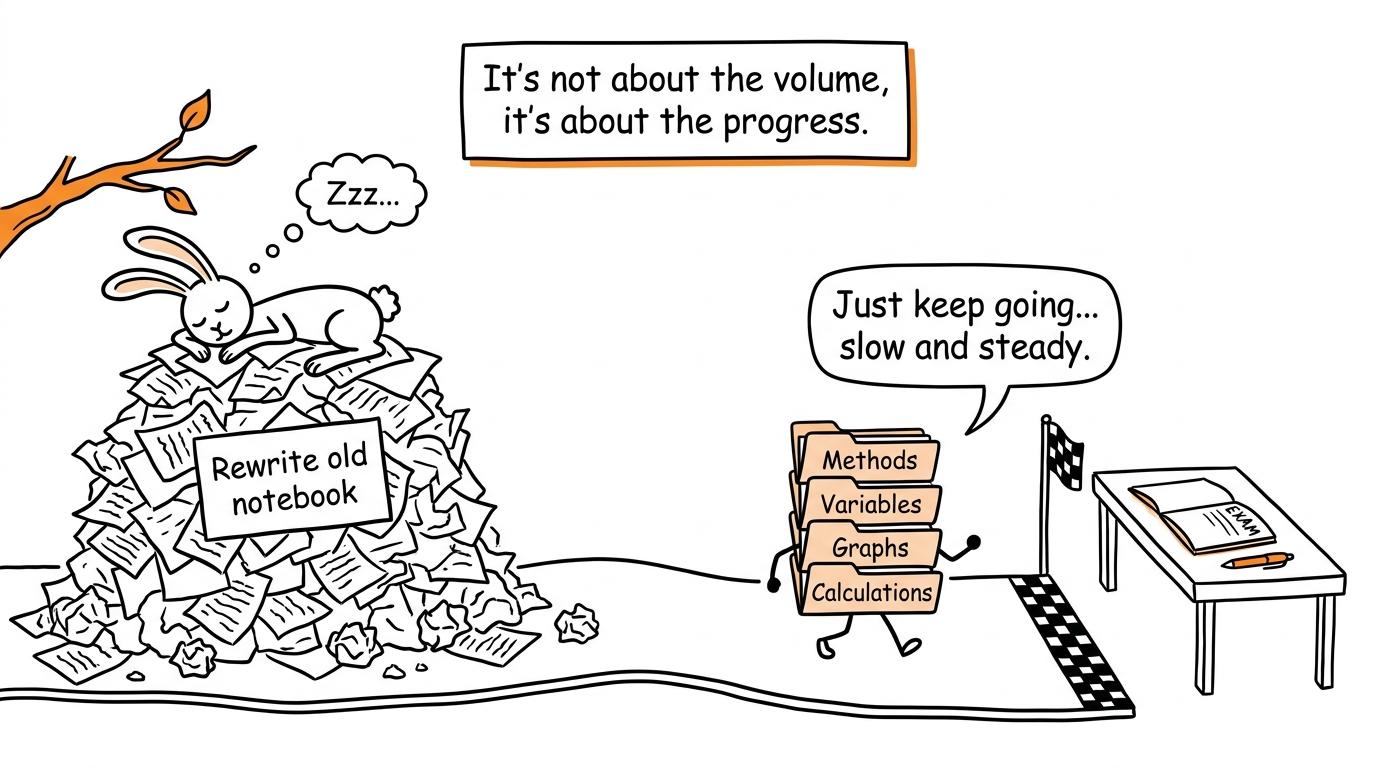 Organised practical revision quietly overtakes a giant notebook rewrite
Turn the worry into an exam plan
Not being happy with one experiment can feel final. Usually, it is not. In current GCSE Chemistry, the practical record supports participation and learning; your practical understanding earns marks when you meet it again in the written examination.
Confirm your qualification, tell your teacher exactly what went wrong and complete any required practical opportunity the school arranges. Then move your attention towards methods, variables, data, evaluation and calculations.
For the maths behind science questions, build a steady routine with MathsGenie. Start with the best order for learning GCSE maths topics, use revision lessons and practice questions to repair gaps, and then apply the past-paper review method. MathsGenie’s free past papers, predicted papers, mini tests, mark schemes and video solutions help turn uncertainty into a clear next step, one carefully reviewed question at a time.