Ready for GCSE Old Maths Early Sitting? A Guide
Ready for GCSE old maths early sitting? Use past-paper evidence, tier checks and exam habits to decide whether an early entry is genuinely wise.
Wanting to sit GCSE maths early can feel like proof that you are ready. Sometimes it is. Sometimes it only proves that you are keen.
If you are asking whether you are ready for GCSE old maths early sitting, the short answer is this: you need consistent evidence from complete, timed exam series at the correct tier, not one encouraging mock result. You should also have covered the full specification, understand your remaining weaknesses and have agreement from your teacher, school and exams officer.
The distinction matters because early entry is a real qualification entry. It is not simply an extra practice paper with a certificate attached.
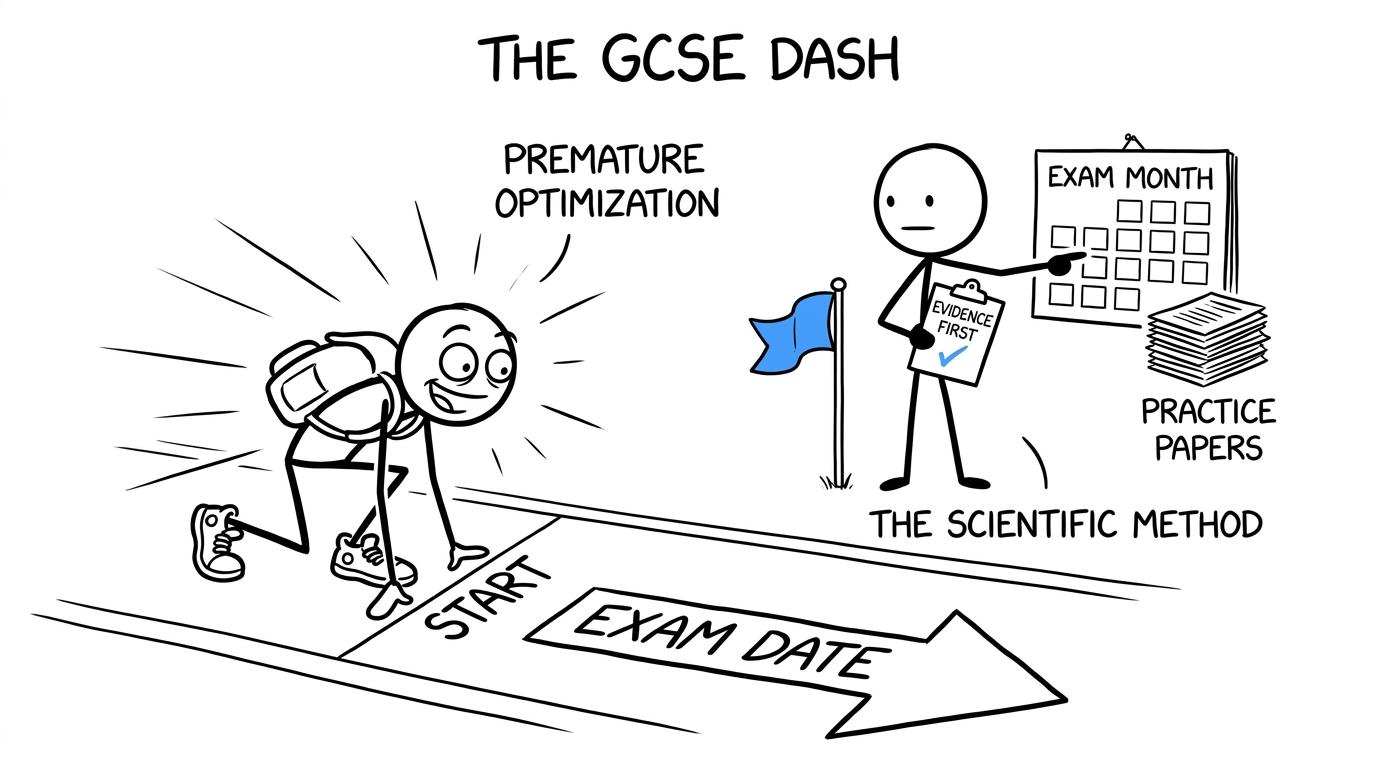 A keen student waiting at an early exam starting line while a teacher asks for evidence
The early-sitting readiness checklist
Before agreeing to an early entry, you should be able to answer yes to most of these statements:
- I know the exact qualification, exam board and specification being entered.
- I have completed the content required for my tier.
- My target grade is available on that tier.
- I have sat several complete exam series under proper timed conditions.
- My marks are consistently around or above my target, with some safety margin.
- My performance remains stable across number, algebra, geometry, ratio, probability and statistics.
- I can explain why I lose marks and how I am correcting those errors.
- I use the correct calculator and non-calculator techniques without prompting.
- Preparing early will not seriously damage my progress in other GCSE subjects.
- My teacher and exams officer believe the entry is educationally sensible and administratively possible.
A student who cannot yet tick these boxes is not failing. They have simply found the next stage of their preparation.
First, clarify what “GCSE Old Maths” means
The phrase “old maths” can cause confusion. It might refer to archived MathsGenie materials, older past papers or a previous GCSE specification. It should not be assumed to mean a currently available qualification.
Start by asking your school for:
- the exam board, such as Edexcel, AQA, OCR or Eduqas
- the qualification and specification code
- the intended exam series
- your foundation or higher tier entry
- the papers you will be required to sit
If you are using the archived MathsGenie website, check every resource against the specification named by your school. An older paper may still contain useful mathematics, but its structure, content or assessment style may not match your actual examination.
For current board-specific resources, begin with the GCSE Maths revision hub. That is a safer foundation for deciding whether your knowledge matches the qualification you will sit.
Entry rules also matter. In England, early-entry rules can affect which result contributes to a school’s performance measures. November GCSE maths entries are subject to age restrictions under exam-board arrangements; for example, AQA states that November entrants must be at least 161616 on 313131 August of that year. Availability and rules can vary by board, series and UK nation, so your exams officer must confirm the current position before any plan is made.
Genuine readiness is broad, not impressive
There is a particular kind of confidence that comes from solving a difficult quadratic or completing a trigonometry question before the rest of the class. It feels significant because it is visible.
Yet GCSE maths is broad. A high grade depends on collecting marks from across the specification, including ordinary-looking questions where accuracy matters more than flair.
Use the MathsGenie GCSE topic collection to audit the entire course. Your evidence should cover:
- number and calculation
- fractions, percentages and ratio
- algebra, graphs and sequences
- geometry and measures
- probability and statistics
- multi-step problem solving
A student who is excellent at algebra but repeatedly loses marks on bounds, transformations or statistical diagrams is not fully ready. Nor is a student who recognises methods during a revision video but cannot retrieve them independently in an unfamiliar question.
If your knowledge has gaps, follow the best order for learning GCSE maths topics. Completing the course in a sensible sequence is usually more valuable than rushing towards an entry date.
Your past-paper results should be stable
One strong paper can happen because the topics suited you. One weak paper can happen because you were tired. Readiness appears when results become stable across several papers and several days.
Complete at least three recent exam series from your board, using the correct tier and official time limits. A complete series matters because individual papers do not necessarily sample the specification in the same way. Follow the permitted calculator rules, do not pause the clock and do not look up a method midway through.
Record more than the total mark:
| Evidence to record | What it reveals |
|---|---|
| Mark on each paper | Whether performance changes by paper type |
| Total across the series | The best basis for comparing with published boundaries |
| Time remaining | Whether pace is sustainable |
| Unattempted questions | Gaps in knowledge or confidence |
| Method marks lost | Whether working is clear enough |
| Repeated topics | Weaknesses that may survive into the examination |
Grade boundaries change between series, so do not rely on a single fixed mark or percentage. Compare each completed series with the boundary published for that specific examination. Aim to perform above your desired boundary rather than repeatedly landing exactly on it.
MathsGenie’s guide to when to start GCSE past papers explains how to move from diagnostic questions to complete timed papers without using up all your best resources too soon.
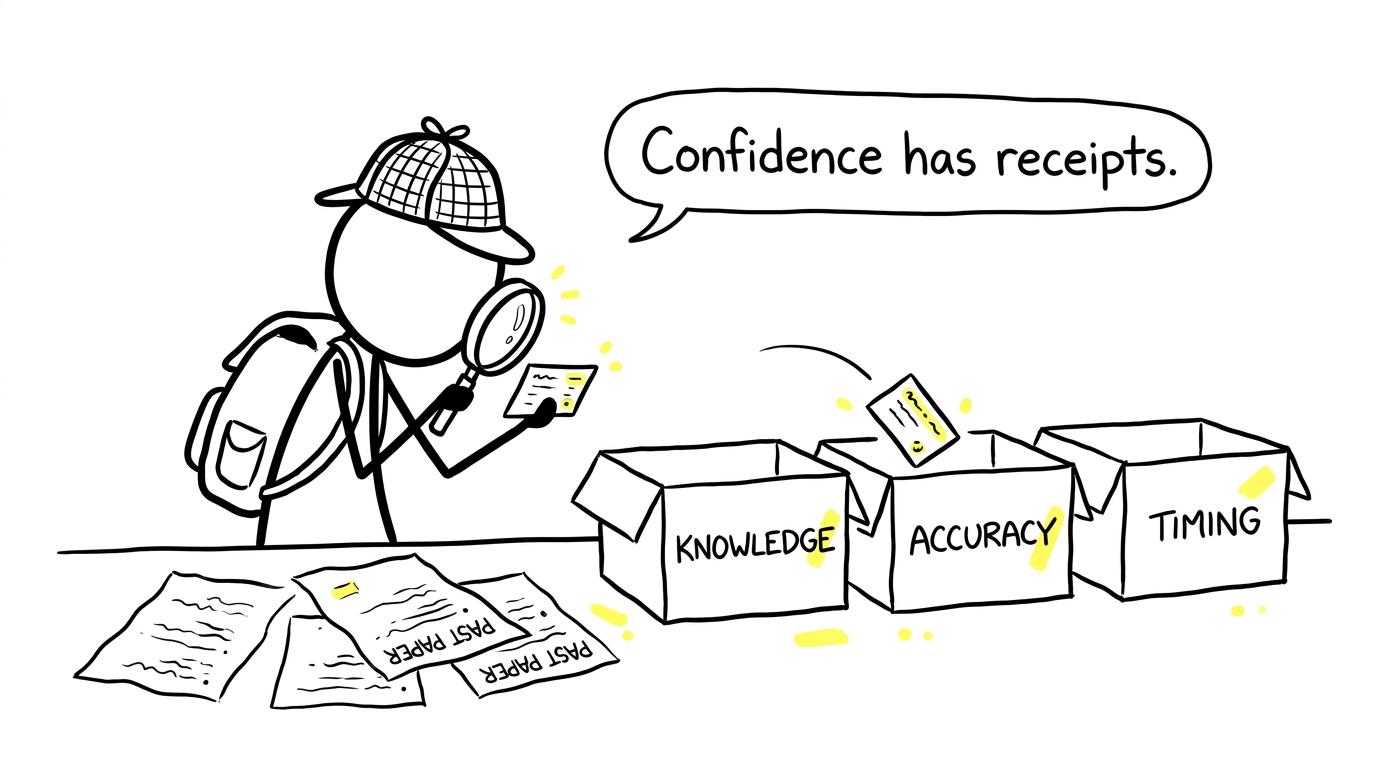 A student detective sorting past-paper errors into knowledge, accuracy and timing
You can diagnose your lost marks
Marks alone tell you what happened. Readiness requires understanding why.
Sort every lost mark into one of four categories:
- Knowledge: you did not know the required fact or method.
- Application: you knew the topic but could not adapt it to the question.
- Accuracy: your approach was suitable, but arithmetic, notation or rounding failed.
- Exam technique: you misread the question, showed insufficient working or managed time poorly.
Knowledge and application gaps usually require a revision lesson followed by targeted practice questions. Accuracy errors need slower checking and better-written working. Exam-technique problems need timed mini tests and full-paper experience.
A genuinely ready student does not need to make no mistakes. They need mistakes that are limited, understood and increasingly rare.
The correct tier supports your intended grade
Foundation and higher papers are not simply easier and harder versions of an identical test. They have different available grade ranges and different balances of content.
Your tier decision should be made with your teacher. It should reflect:
- the grade you need for your next step
- your performance across complete papers
- your confidence with tier-specific content
- the risk of losing accessible marks when questions become demanding
Do not choose higher tier merely because early entry sounds ambitious. Equally, do not choose foundation automatically if your evidence shows that a higher target is secure and appropriate.
The best tier is the one that gives you a realistic route to the grade you need. Prestige is not part of the mark scheme.
Readiness includes exam-day behaviour
Knowing the mathematics at home is not quite the same as producing it in an examination hall.
You are closer to being ready if you can:
- work without notes, hints or online searches
- remain focused for the full paper
- move on when a question becomes unproductive
- return to skipped questions methodically
- show enough working to earn method marks
- check units, rounding and calculator entries
- recover calmly after an unfamiliar question
These habits are best tested through mini tests and timed papers. A structured one-month GCSE maths revision plan can help you build this routine before a final entry decision is made.
Consider what early entry costs
Every decision has an opportunity cost. Time spent accelerating GCSE maths is time that cannot be spent on English, science, humanities or another subject.
Ask what early sitting achieves. A clear reason might be that you have completed the specification, are performing securely and have a planned next step such as further mathematics or suitable enrichment. “I want to get it out of the way” is less convincing if your results remain unstable.
Also consider what happens after the examination. Finishing early should not mean abandoning mathematics for a long period, particularly if you intend to take A Level Maths. Secure algebra, graphs, geometry and proportional reasoning need continued use.
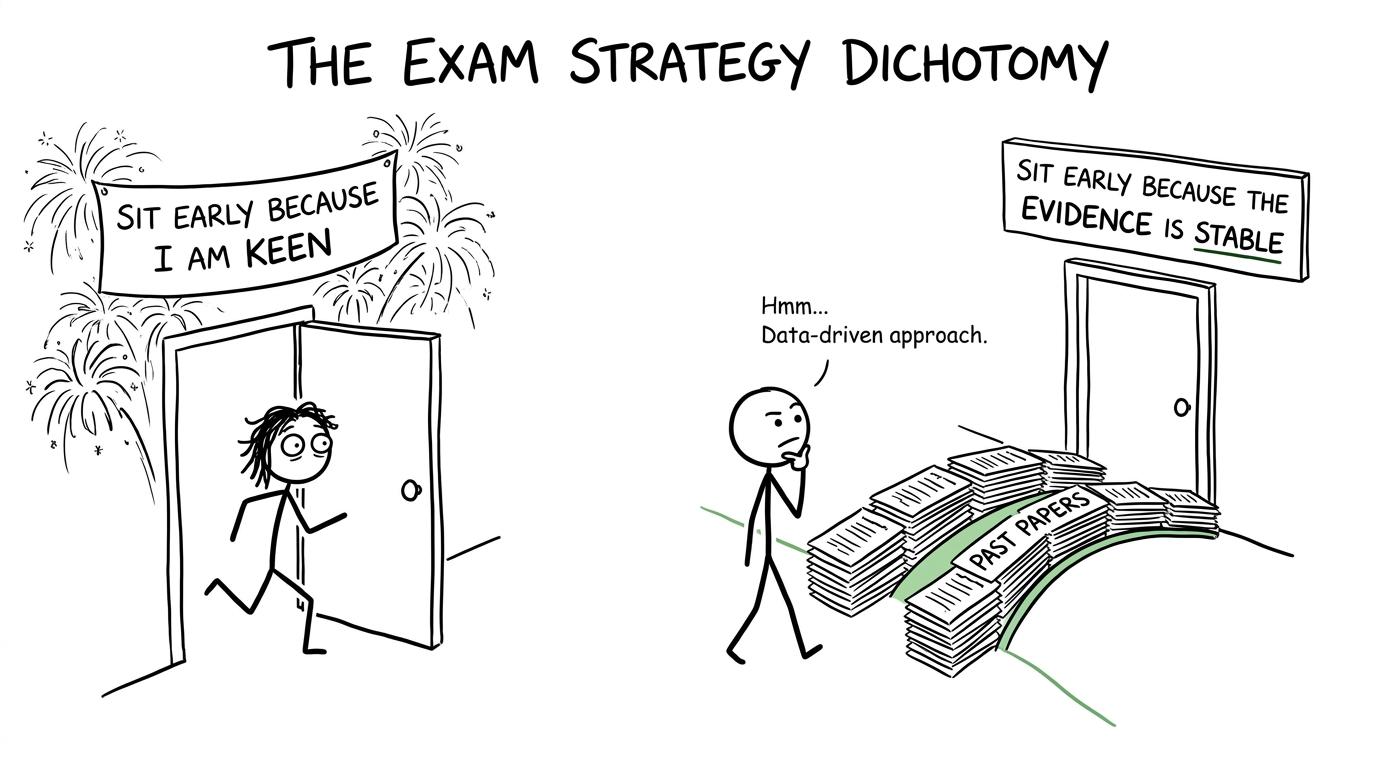 A student choosing a sturdy bridge made from evidence instead of a flashy early-entry door
Keen versus genuinely ready
Enthusiasm is valuable. It gets revision started. Evidence decides whether an examination entry should follow.
| A keen student may... | A ready student can... |
|---|---|
| Complete favourite topics quickly | Perform across the full specification |
| Quote one excellent mock result | Show stable results across several series |
| Feel confident after watching solutions | Solve unfamiliar questions independently |
| Focus only on reaching the target boundary | Maintain a margin above the target |
| Want to enter as soon as possible | Explain why the timing is beneficial |
| Avoid reviewing incorrect answers | Diagnose, correct and retest mistakes |
Predicted papers can provide useful unseen practice, but they should not replace official past-paper evidence. The Edexcel GCSE Maths predicted papers, for example, are most useful after you have identified and repaired specification gaps. You can also read how to use predicted GCSE topics without guessing.
Common mistakes when deciding to sit early
Treating one mock as proof
A mock is a snapshot. Different papers test different topic combinations, and marking may not reproduce the exact circumstances of a live series. Use several complete, independently marked papers.
Revising only difficult topics
Students sometimes chase grade 8 or 9 content while dropping routine marks through fractions, signs, units or calculator errors. Secure marks throughout the paper before making advanced questions the centre of your plan.
Using the wrong specification
An old paper may assess content differently from your current qualification. Confirm the specification code and use matching resources.
Marking generously
Award marks only where the mark scheme supports them. If you are unsure, ask a teacher. Optimistic marking produces optimistic readiness decisions.
Ignoring the wider timetable
Early entry is less useful if preparation weakens several other GCSE subjects. Review the whole revision calendar, not maths in isolation.
Assuming a resit removes all risk
A later attempt may be possible, but school performance-measure rules, entry availability, deadlines and centre policies still matter. Early entry should be chosen because the first sitting is appropriate, not because a resit feels guaranteed.
Make the decision from evidence
The calmest decisions usually have the least drama. Gather your recent paper results, error log and topic audit. Discuss them with your teacher and exams officer. Confirm the qualification, tier, series and current entry rules. Then ask one final question: does the evidence show secure readiness, or only strong enthusiasm?
MathsGenie gives you the tools to answer honestly. Use the free GCSE Maths revision resources for revision lessons, practice questions, past papers, mark schemes, video solutions, mini tests and predicted papers. Build a record of what you can do under pressure, repair what still costs marks and let consistent performance, not impatience, determine when you sit the exam.