Pomodoro Technique GCSE Engineering: Does It Work?
Pomodoro technique GCSE engineering: learn when 25-minute bursts help, when longer sessions work better, and how to revise actively for exams and NEA.

Revision can fail before the first question is attempted. The folder looks too large, the specification feels too broad, and deciding where to begin takes more energy than beginning. That is why the pomodoro technique GCSE engineering approach is appealing: choose one task, work for a fixed period, take a short break, then repeat.
Does it work? Yes, as a way to start, concentrate and control fatigue. But it is not automatically better than every longer revision session. Short timed blocks suit knowledge recall, focused calculations and question practice. Longer blocks are usually better for full papers, connected design thinking and practical work that cannot be stopped safely at an arbitrary moment.
The timer provides structure. What you do inside the time determines whether you learn.
The quick verdict
Use this checklist before starting:
- Choose one specific outcome, not simply “revise engineering”.
- Use a short block for recall, calculations or targeted exam questions.
- Use a longer block when a task needs sustained reasoning or practical continuity.
- Mark questions and correct errors within the session.
- Keep breaks genuinely short and preferably phone-free.
- Revisit difficult material on another day rather than relying on one long evening.
- Practise full papers without artificial breaks before the examination.
A sensible starting pattern is 252525 minutes of focused work followed by a 555-minute break. After several cycles, take a longer break. Treat those timings as a starting point, not a law.
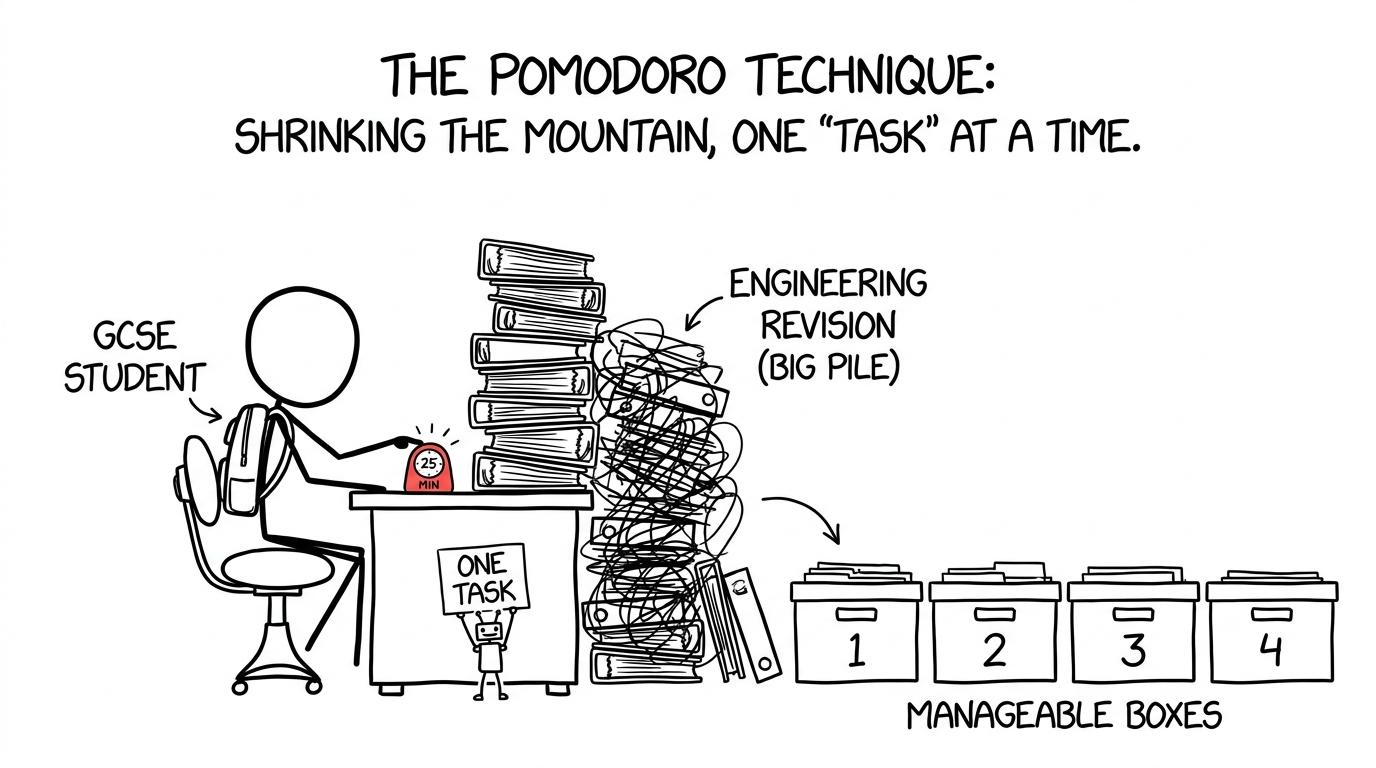 A student turns an intimidating engineering revision pile into manageable timed tasks
What the Pomodoro Technique actually does
The technique separates revision into defined periods of work and rest. Its immediate advantage is behavioural: “complete these questions for 252525 minutes” feels easier to begin than “revise everything about materials and manufacturing”.
A timer may help you:
- reduce the temptation to switch tasks;
- give an unappealing topic a clear finishing point;
- notice how long activities really take;
- include breaks before tiredness becomes an excuse to stop;
- build a repeatable revision routine.
However, the Pomodoro Technique does not explain, test or remember engineering content for you. Watching a timer while copying notes remains passive revision. A focused block should involve retrieval, application or feedback: recalling information without notes, answering questions, checking a mark scheme or correcting a previous mistake.
This distinction matters. Time management and learning are related, but they are not identical.
What does the research say?
The fairest answer is that research on timed systematic breaks is promising but mixed. It does not prove that one rigid schedule will raise GCSE Engineering grades.
A peer-reviewed study published in 202320232023 compared university students taking self-chosen breaks with students following predetermined schedules, including 242424 minutes of work followed by a 666-minute break. The structured-break groups reported less fatigue and distraction, while task completion did not differ significantly. The researchers suggested that systematic breaks may make revision feel more efficient, but they did not establish a universal learning advantage.
More recent studies comparing Pomodoro, self-regulated breaks and other arrangements have not found a consistent winner for productivity, task completion or learning performance. Some results favour the structure of predetermined breaks; others suggest that flexible breaks can support concentration and mood.
There are two important limits to remember:
- these studies mostly involved university students rather than GCSE pupils;
- they did not directly test GCSE Engineering revision over an examination season.
The responsible conclusion is therefore modest: timed blocks can be a useful concentration tool, particularly if you tend to procrastinate or work until you are exhausted, but the quality of the revision task matters more than owning the perfect timer.
Evidence for retrieval practice and spacing across several days is stronger than evidence for a particular within-session break schedule. In practical terms, answering questions from memory today and returning to the topic later is more valuable than repeatedly reading the same page during four beautifully timed sessions.
Why GCSE Engineering needs more than one session length
GCSE Engineering combines different kinds of thinking. The current AQA specification includes a written paper and non-exam assessment. The written paper contributes 60%60\%60% of the qualification, while the NEA contributes 40%40\%40% and involves an extended design-and-make activity completed under the required assessment conditions.
That mixture is exactly why one timer setting cannot suit everything. The AQA GCSE Engineering revision hub brings together relevant lessons, questions and paper resources, but you should choose the length of each session according to the task.
Tasks that fit short timed bursts
A block of roughly 202020 to 303030 minutes can work well for:
- recalling properties and uses of materials;
- reviewing manufacturing processes;
- labelling systems or engineering diagrams from memory;
- completing a small set of calculation questions;
- practising units, tolerances, ratios or scale;
- marking a short question set and recording errors;
- learning terminology through low-stakes self-testing.
Engineering calculations often draw on familiar GCSE maths. You can use a short session to strengthen ratio skills, review conversions and units, or practise the geometry behind volume of a prism.
These topics suit short blocks because the objective can be defined and checked. By the end, you should know whether you can perform the skill without prompts.
Tasks that need longer sessions
Use a block of 454545 to 909090 minutes, or the official examination duration where appropriate, for:
- a connected set of multi-stage engineering problems;
- analysing a design brief in depth;
- comparing several possible solutions;
- completing an extended response;
- sitting a substantial paper section;
- reviewing a whole paper and linking errors to topics;
- supervised NEA work where your school’s rules allow and require continuity.
A full written paper should eventually be practised under realistic conditions. Stopping every 252525 minutes can conceal whether you can maintain accuracy, judgement and concentration across the actual assessment.
For broader numerical preparation, the GCSE Maths revision hub lets you select the correct exam board, including Edexcel, AQA, OCR and Eduqas. This is particularly useful when weaknesses in algebra, measures or proportional reasoning are making engineering questions harder than they need to be.
Adapt the technique to the task
The original pattern is useful because it removes decisions. Adaptation becomes useful when you understand what the task demands.
Use a standard block when starting feels difficult
Set a target that can be observed, such as completing a question set and marking it. Work for 252525 minutes, rest for 555 minutes, then decide whether the next block should continue the topic or repair one specific weakness.
This is well suited to weekday revision when energy is limited. The MathsGenie revision planner can help turn separate sessions into a coherent plan rather than a collection of disconnected evenings.
Use an extended block for connected reasoning
If the alarm repeatedly interrupts calculations just as the structure becomes clear, try 404040 to 505050 minutes followed by a slightly longer break. The goal is not to prove that you can endure a long session. It is to preserve the chain of reasoning while still preventing fatigue.
For scale and modelling questions, for example, understanding how length, area and volume relate may require sustained attention. The similar shapes and volume revision guide can support that underlying maths.
Stop at a safe or logical boundary
In practical engineering work, safety and teacher instructions outrank the timer. Do not abandon machinery, tools, heating processes or partially secured materials because an alarm sounds. Finish the immediate safe step, make the workspace secure and follow your school’s procedures.
The same principle applies to written reasoning. If you are two lines from completing a calculation, finish it before taking the break. A timer should protect concentration, not disrupt it mechanically.
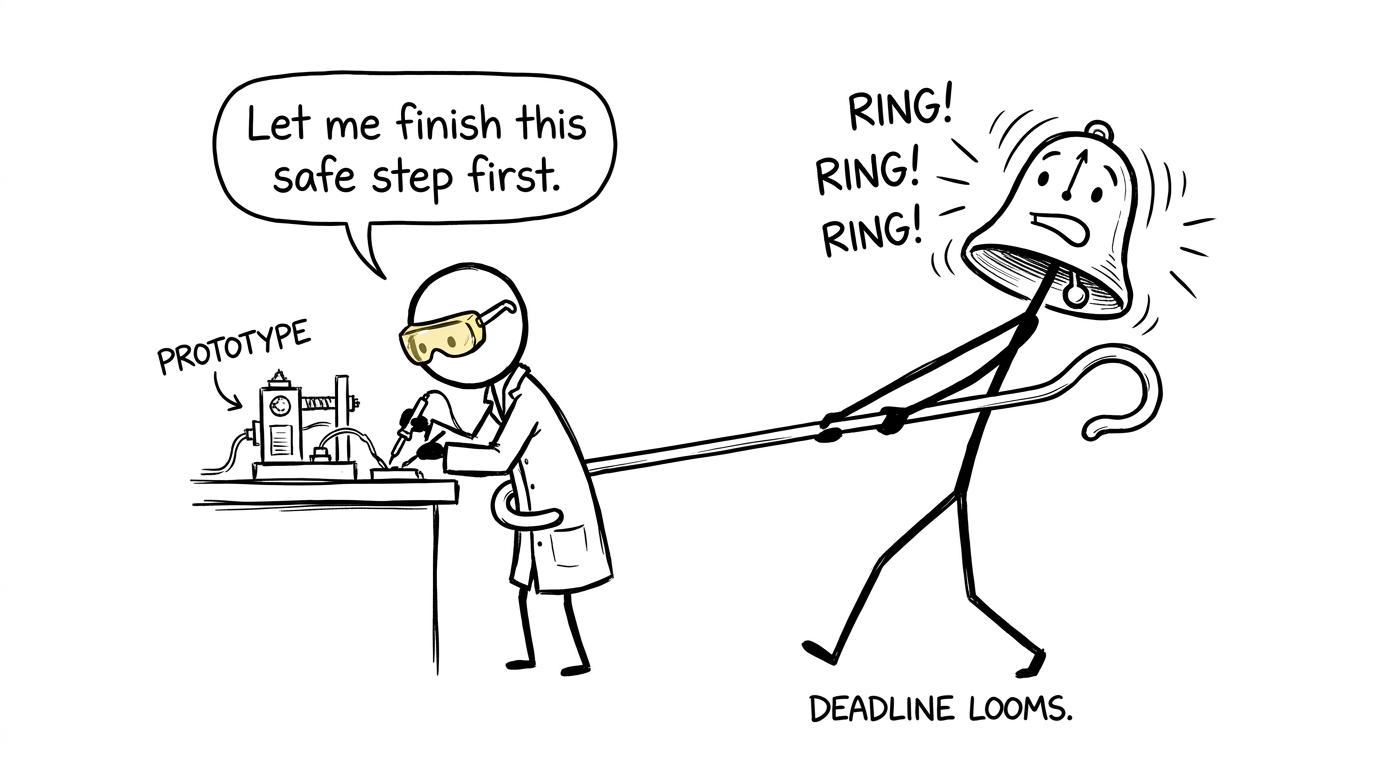 An enthusiastic timer learns that safe engineering steps cannot always stop instantly
What to do inside each focus block
A productive engineering revision cycle has four parts:
Retrieve
Begin without notes. Write down definitions, process stages, material properties or formulae that you can remember. This makes gaps visible immediately.
Apply
Answer questions that require you to select and use the knowledge. Avoid spending the full block making the page look tidy. Engineering rewards application, analysis and evaluation as well as recall.
Check
Use answers, mark schemes or video solutions. Identify whether the problem was missing knowledge, incorrect maths, weak explanation, poor units or misreading the command word.
Repair
Correct the response and record one precise next action. “Revise volume” is vague. “Practise choosing the correct cross-section before calculating prism volume” is actionable.
MathsGenie’s topic lessons, practice questions and mark schemes are designed around this learn, practise, check loop. When you are ready to test your mathematical stamina, guidance on when to start GCSE past papers can help you move from small timed sections towards complete papers.
Make the breaks work too
A 555-minute break can restore attention, but it can also become a 353535-minute disappearance. Avoid activities with no natural stopping point.
Better break choices include:
- standing up and moving away from the desk;
- getting water;
- looking away from the screen;
- preparing the next worksheet;
- briefly opening a window or walking around the room.
Keep the phone out of reach if notifications tend to capture your attention. The purpose of the break is to return with less mental noise, not more.
Common Pomodoro mistakes in engineering revision
Counting time instead of outcomes
Four completed timers do not necessarily represent useful revision. Record what you retrieved, answered, marked and repaired.
Choosing a task that is too broad
“Engineering revision” offers no clear first action. Choose one material category, process, calculation skill or paper section.
Breaking concentration at the wrong moment
Do not stop halfway through a safe practical procedure or a nearly completed line of reasoning. Pause at a logical boundary.
Using every break for scrolling
A short phone check can introduce messages, videos and decisions that follow you into the next block. Choose a low-stimulation break instead.
Never practising beyond 252525 minutes
Your examination will demand longer concentration. Gradually include extended questions and realistic paper sessions.
Reading without retrieving
Familiarity is not the same as recall. Close the notes, attempt questions and use feedback. Nearer the maths examinations, GCSE predicted papers can provide additional exam-style practice, but they should complement rather than replace past papers and topic repair.
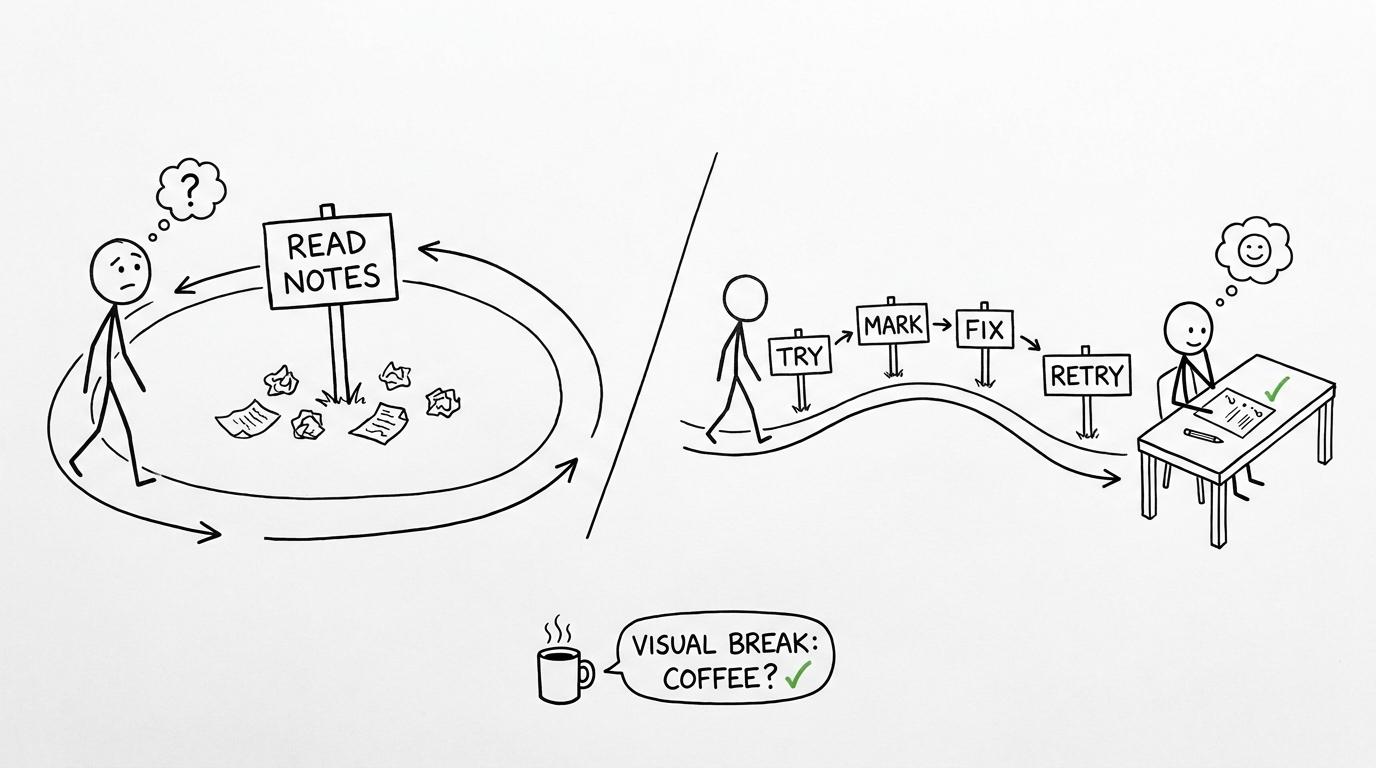 One revision path endlessly rereads notes while the useful path tries, marks, fixes and retries
A balanced weekly approach
Across a week, combine different session types:
- short retrieval blocks for terminology and earlier topics;
- focused calculation blocks for maths used in engineering contexts;
- medium sessions for exam questions and detailed marking;
- longer sessions for paper stamina or authorised project work;
- spaced returns to mistakes after at least one intervening day.
This is better than deciding that short sessions are always good or always bad. Revision length should follow the work. A timer is useful when it gives the session shape; it becomes unhelpful when obeying it matters more than learning.
Use the timer, but trust the task
The Pomodoro Technique can work for GCSE Engineering because it lowers the barrier to starting and makes breaks deliberate. Its strongest use is in compact, active tasks: retrieval, targeted calculations, short question sets and error correction.
Engineering also demands continuity. Full-paper practice, extended evaluation and safe practical processes need longer stretches of attention. Build those into your plan rather than trying to squeeze every activity into the same 252525-minute box.
Start with the free MathsGenie AQA GCSE Engineering resources, then use revision lessons and practice questions to repair individual gaps. Add mark schemes and video solutions for feedback, mini tests for regular checks, and past or predicted papers when you need realistic exam practice. Set one useful task, start the timer and make the minutes produce evidence of learning.