Revision notes for Edexcel GCSE Maths Volume of a Prism. Open the guide for explanations and worked examples. Written against the Edexcel GCSE Maths (1MA1) specification, so the content matches what's examinable rather than general Maths background.
Before volume, you need to be confident with area. Area measures flat space in a 2D shape, using square units like cm².
Volume measures 3D space, using cubic units like cm³.
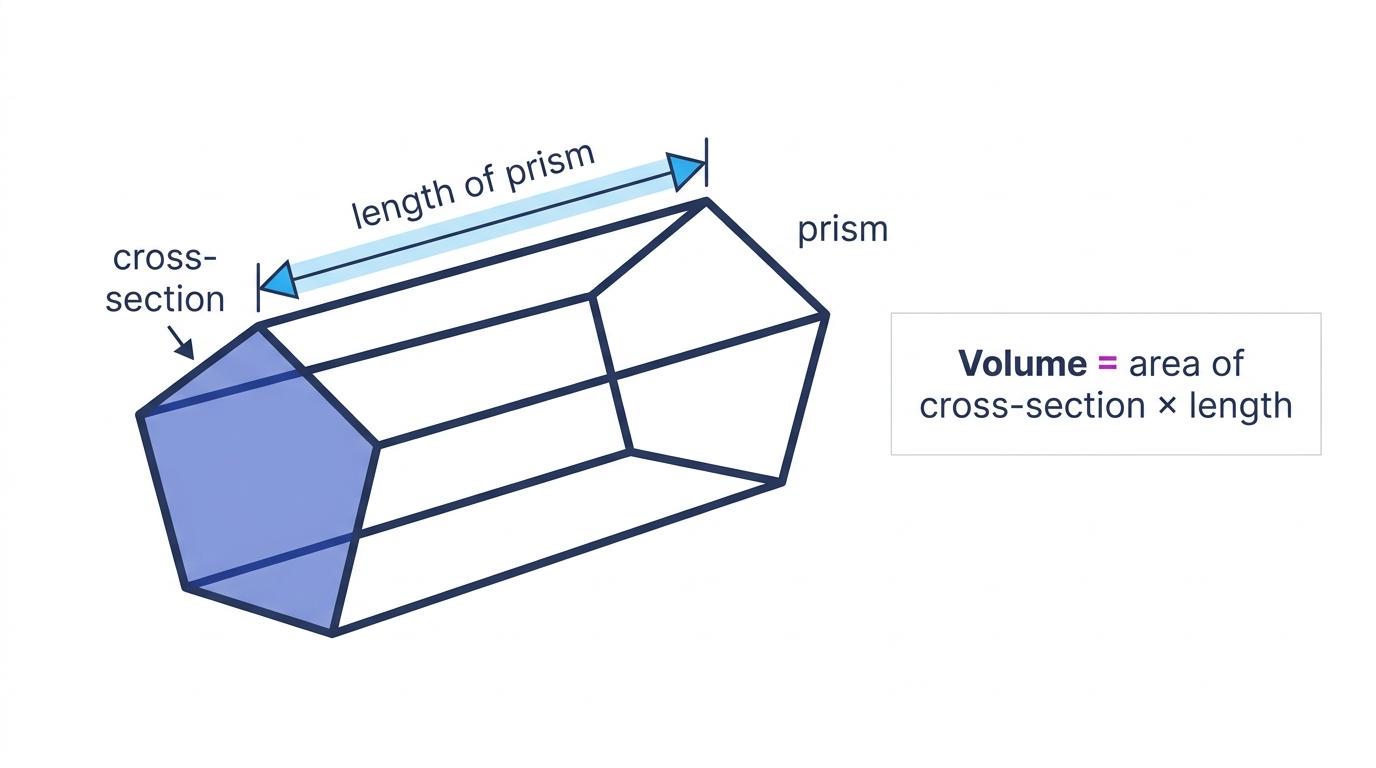
Volume, prism and cross-section
The length or depth of the prism is how far the cross-section has been stretched.

Main formula
For any prism, use V=A×LV = A \times LV=A×L, where AAA is the area of the cross-section and LLL is the length of the prism.
A rectangular prism
A prism has a rectangular cross-section measuring 6 cm by 5 cm. The prism is 8 cm long. Find its volume.

Find the area of the rectangular cross-section.
A=6×5=30 cm2A = 6 \times 5 = 30\text{ cm}^2A=6×5=30 cm2Multiply by the length of the prism.
V=30×8=240 cm3V = 30 \times 8 = 240\text{ cm}^3V=30×8=240 cm3The volume is 240 cm³.
A composite shape is made by joining simpler shapes together. For an L-shaped cross-section, split it into rectangles, find each area, then add them.
L-shaped prism
An L-shaped cross-section can be split into two non-overlapping rectangles: one is 5 cm by 2 cm, and the other is 3 cm by 4 cm. The prism is 10 cm deep. Work out the volume.

Find the area of the first rectangle.
A1=5×2=10 cm2A_1 = 5 \times 2 = 10\text{ cm}^2A1=5×2=10 cm2Find the area of the second rectangle.
A2=3×4=12 cm2A_2 = 3 \times 4 = 12\text{ cm}^2A2=3×4=12 cm2Add the areas to get the cross-section area.
A=10+12=22 cm2A = 10 + 12 = 22\text{ cm}^2A=10+12=22 cm2Multiply by the depth of the prism.
V=22×10=220 cm3V = 22 \times 10 = 220\text{ cm}^3V=22×10=220 cm3The volume is 220 cm³.
Adding the depth
Do not add the prism length to the cross-section area. Area is in cm² and length is in cm, so you multiply them to make cm³.
A triangular prism has a triangle as its cross-section. A right-angled triangle contains a 90° angle.
For a triangle:
A=12bhA = \frac{1}{2}bhA=21bhwhere bbb is the base and hhh is the perpendicular height.
Right-angled triangular prism
A triangular prism has a right-angled triangular cross-section with perpendicular sides 6 cm and 8 cm. The prism is 9 cm long. Find the volume.

Find the area of the triangular cross-section.
A=12×6×8=24 cm2A = \frac{1}{2} \times 6 \times 8 = 24\text{ cm}^2A=21×6×8=24 cm2Multiply by the length of the prism.
V=24×9=216 cm3V = 24 \times 9 = 216\text{ cm}^3V=24×9=216 cm3The volume is 216 cm³.
Using the hypotenuse
In a right-angled triangle, the hypotenuse is the longest side opposite the right angle. It is not needed for triangle area unless it is paired with a perpendicular height.

A trapezium is a four-sided shape with one pair of parallel sides. Parallel sides are always the same distance apart and never meet.
For a trapezium:
A=12(a+b)hA = \frac{1}{2}(a+b)hA=21(a+b)hwhere aaa and bbb are the parallel sides, and hhh is the perpendicular height between them.
Trapezium cross-section
A prism has a trapezium cross-section. The parallel sides are 6 cm and 10 cm, and the perpendicular height is 5 cm. The prism is 11 cm long. Find the volume.

Find the area of the trapezium.
A=12(6+10)×5=40 cm2A = \frac{1}{2}(6+10)\times 5 = 40\text{ cm}^2A=21(6+10)×5=40 cm2Multiply by the length of the prism.
V=40×11=440 cm3V = 40 \times 11 = 440\text{ cm}^3V=40×11=440 cm3The volume is 440 cm³.
Sometimes the question gives you the volume and asks for a missing length, often called xxx.
Use the volume formula, then solve the equation.
Finding a missing height
A triangular prism has a right-angled triangular cross-section with base 7 cm and height xxx cm. The prism is 12 cm long. Its volume is 252 cm³. Find xxx.

Write the volume equation.
12×7×x×12=252\frac{1}{2}\times 7 \times x \times 12 = 25221×7×x×12=252Simplify the numbers.
42x=25242x = 25242x=252Divide both sides by 42.
x=25242=6x = \frac{252}{42} = 6x=42252=6The missing height is 6 cm.
Keep the formula visible
When working backwards, write the full volume formula first. This helps you avoid forgetting the 12\frac{1}{2}21 in triangle questions.
For containers, volume often connects to capacity.
Filling a container with buckets
A rectangular container is 70 cm long, 50 cm wide and 40 cm high. Each bucket holds 12 litres. How many buckets are needed to fill the container?
Find the volume of the container.
V=70×50×40=140000 cm3V = 70 \times 50 \times 40 = 140000\text{ cm}^3V=70×50×40=140000 cm3Convert cm³ to litres.
140000 cm3=140 litres140000\text{ cm}^3 = 140\text{ litres}140000 cm3=140 litresDivide by the amount in one bucket.
140÷12=11.666…140 \div 12 = 11.666\ldots140÷12=11.666…You need 12 buckets, because 11 buckets would not completely fill the container.
Rounding in capacity questions
If you are filling a container, round up. If you are finding how many cups can be completely filled, round down.
For packing boxes into a van or container, check how many fit along each direction.
Packing boxes
A van space is 2.4 m long, 1.5 m wide and 1.2 m high. Each box is 60 cm long, 30 cm wide and 40 cm high. How many boxes fit?

Convert the van dimensions to centimetres: 2.4 m is 240 cm, 1.5 m is 150 cm, and 1.2 m is 120 cm.
Find how many boxes fit along the length.
240÷60=4240 \div 60 = 4240÷60=4Find how many fit along the width and height.
150÷30=5,120÷40=3150 \div 30 = 5,\qquad 120 \div 40 = 3150÷30=5,120÷40=3Multiply the three amounts.
4×5×3=604 \times 5 \times 3 = 604×5×3=60The van can fit 60 boxes.
A cube is a cuboid where every edge has the same length. The surface area is the total area of all the outside faces.
A cube has 6 identical square faces.
Volume from surface area
The total surface area of a cube is 294 cm². Find its volume.
Divide by 6 to find the area of one square face.
294÷6=49 cm2294 \div 6 = 49\text{ cm}^2294÷6=49 cm2Find the side length of the square face.
49=7\sqrt{49}=749=7Cube the side length to find the volume.
V=73=343 cm3V = 7^3 = 343\text{ cm}^3V=73=343 cm3The volume is 343 cm³.
In the exam
Check yourself
Test yourself with 5 quick questions on this guide. Answer them all correctly to complete it.
Test yourself on this topic, or move on to the next guide.
How was this guide?