

Pomodoro Technique for GCSE Economics: Does It Work?
Pomodoro technique GCSE Economics advice: learn when short revision bursts improve focus, when longer sessions work better, and how to combine both.
Revision can look productive long before it becomes useful. You sit down with a GCSE Economics textbook, read about market failure for an hour and finish with several highlighted pages. Yet when you close the book, the explanation has disappeared.
The Pomodoro technique for GCSE Economics can help with this problem, but it is not a guaranteed route to higher marks. Short, timed sessions can make revision easier to begin, reduce unplanned distractions and create regular opportunities for active recall. However, rigid 252525-minute blocks are often too short for extended responses, detailed evaluation and full exam practice.
The most effective approach is flexible: use short bursts for focused learning and retrieval, then use longer sessions when the task demands sustained thinking.
The short answer: does Pomodoro work?
The Pomodoro Technique traditionally involves:
- choosing one defined task;
- working for 252525 minutes;
- taking a break of about 555 minutes;
- repeating the cycle;
- taking a longer break after several cycles.
Research gives a measured answer rather than a dramatic one. Studies of university students suggest that predetermined breaks can sometimes reduce distraction and mental fatigue compared with completely self-regulated revision. More recent comparisons, however, have found no clear overall advantage for Pomodoro over flexible break-taking in productivity, task completion or objective learning performance.
There is also little direct research specifically involving GCSE Economics students. It would therefore be inaccurate to claim that Pomodoro automatically raises Economics grades.
Its real strength is simpler. A timer creates a boundary around a task. Instead of promising to revise “the whole economy”, you agree to retrieve definitions or plan one essay for a limited period. That can make starting less intimidating.
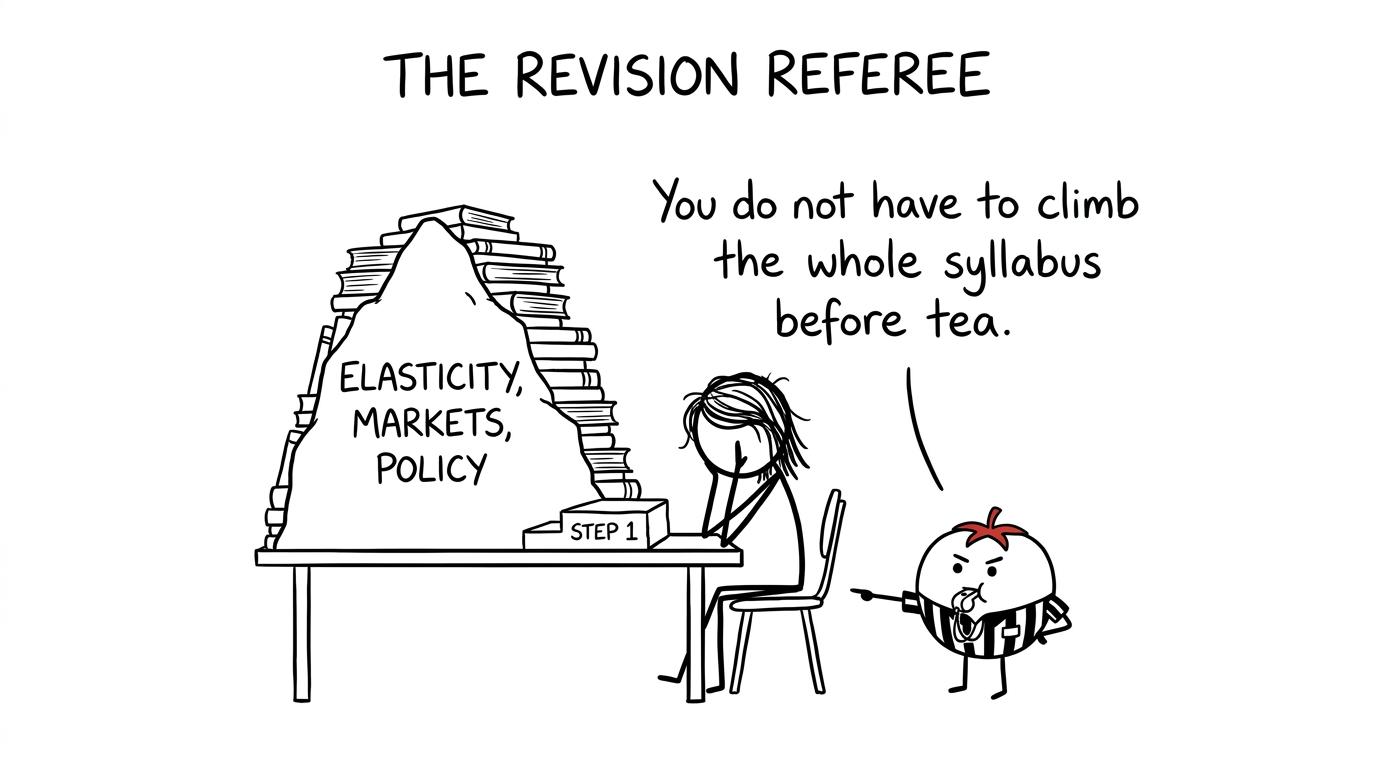 A tomato timer encourages a student facing a mountain of Economics revision
A quick Pomodoro revision checklist
Before starting, make each session specific enough to measure:
- Choose an outcome: recall six definitions, annotate a diagram or plan one evaluation.
- Match the timer to the task: do not assume every activity needs 252525 minutes.
- Work actively: retrieve, explain, calculate, plan or answer questions.
- Take a genuine break: stand up, move and leave your phone alone if it tends to capture your attention.
- Check the result: use notes, a mark scheme or your specification after attempting the task.
- Record the next step: schedule weak content for another day.
That final step matters. Research on learning provides stronger support for retrieval practice and distributed practice than for any particular timer. In other words, what you do and whether you revisit it matter more than the shape of the clock.
Why short bursts can suit GCSE Economics
They lower the cost of beginning
A vague instruction such as “revise macroeconomics” feels endless. A defined instruction such as “spend 202020 minutes recalling causes of inflation without notes” has a visible finish line.
This is particularly helpful when procrastination comes from the size of the task rather than its difficulty. The timer does not teach economics. It simply makes the first commitment smaller.
Maths revision works in much the same way. MathsGenie's guide to finding your weakest GCSE topics recommends using evidence from questions and lost marks rather than revising broad areas blindly. An Economics student can adapt that idea by logging whether marks were lost through missing knowledge, weak application, incomplete analysis, unsupported evaluation or quantitative errors.
They encourage active recall
A short session works well when it has one retrieval goal. Suitable Economics activities include:
- writing definitions from memory;
- recreating and labelling diagrams;
- recalling chains of cause and effect;
- listing arguments for and against a policy;
- answering short quantitative questions;
- planning the structure of an extended response.
These are more useful than fitting 252525 minutes of passive rereading between two alarms. Classroom research has repeatedly found benefits from retrieval practice across different subjects and age groups. Spacing revision across separate days can also improve retention compared with placing everything into one long block.
The approach in MathsGenie's guide to stopping forgotten GCSE content transfers well: attempt from memory, check the answer, record the error and revisit it later.
They make quantitative skills less avoidable
Economics includes numerical and graphical reasoning. Depending on your exam board's current specification, that can include interpreting data, calculating percentage changes, working with averages and applying ratios. Elasticity may involve a relationship such as:
Price elasticity of demand=percentage change in quantity demandedpercentage change in price\text{Price elasticity of demand} = \frac{\text{percentage change in quantity demanded}}{\text{percentage change in price}}Price elasticity of demand=percentage change in pricepercentage change in quantity demandedA student who is comfortable with economic ideas can still lose marks through inaccurate percentages, weak graph interpretation or premature rounding. A focused timer can isolate one of these weaknesses instead of allowing it to hide inside a broad revision session.
For supporting mathematical fluency, use the free GCSE Maths revision hub, which includes board-specific resources for Edexcel, AQA, OCR and Eduqas maths.
When GCSE Economics needs longer sessions
The danger of Pomodoro is confusing a convenient interval with a law of learning. Some Economics tasks should not be repeatedly interrupted.
Extended responses need continuity
Analysis is a chain. One change affects an incentive, behaviour changes, and that produces consequences for consumers, firms, workers or government. Evaluation then asks whether the outcome depends on assumptions, time periods, stakeholder differences or the scale of the change.
If an alarm rings while that chain is developing, stopping immediately may damage rather than protect concentration. For essay planning, writing and improvement, a block of roughly 404040 to 505050 minutes may be more practical. Finish the paragraph or chain of reasoning, note where you have reached, and then break.
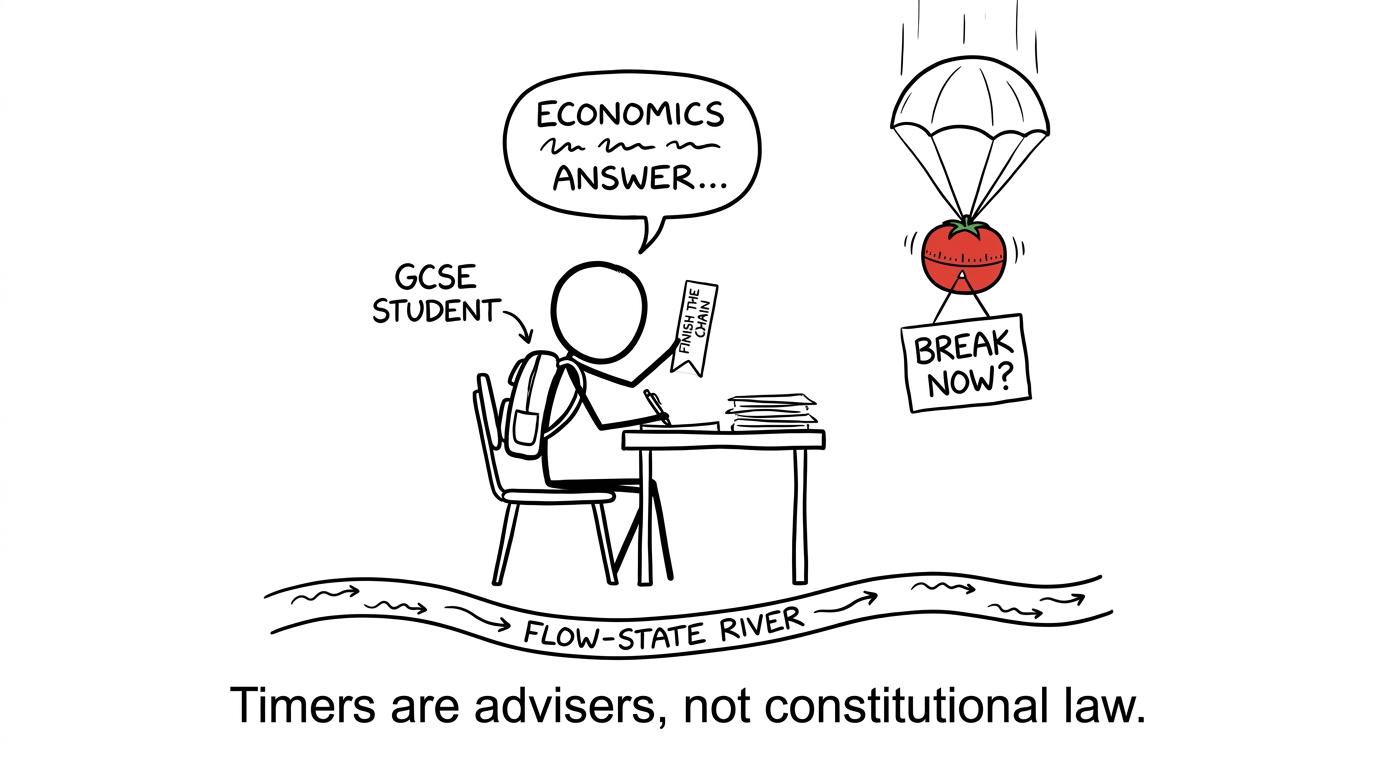 A timer discovers that an Economics argument cannot always stop on command
Timed papers require exam stamina
Your actual paper will not pause every 252525 minutes. As examinations approach, some revision must reproduce that sustained demand.
Use uninterrupted sessions for:
- full papers under timed conditions;
- substantial sections of a paper;
- data-response questions with several connected parts;
- extended answers completed to a realistic time limit;
- detailed marking and rewriting.
MathsGenie's article on when to start GCSE past papers explains the broader progression: begin with targeted practice, move into timed sections and eventually complete full papers. That principle applies equally well to Economics, using papers from your own exam board.
Pomodoro can still organise the review afterwards. You might use one block to mark, another to classify lost marks and a final block to repair the weakest area. But the paper itself should increasingly resemble the real examination.
Build a flexible Economics revision system
The best timer length follows the task, not the other way around.
| Revision task | Sensible starting block | What to produce |
|---|---|---|
| Definitions and key terms | 151515 to 252525 minutes | Written recall checked against notes |
| Diagrams and data skills | 202020 to 303030 minutes | Completed diagrams or calculations |
| Short exam questions | 252525 to 353535 minutes | Answers marked and corrected |
| Essay planning | 303030 to 404040 minutes | A clear argument and evaluation structure |
| Extended writing | 404040 to 505050 minutes | A complete timed response |
| Paper practice | The official paper time | A realistic exam attempt |
These are practical starting points, not scientifically perfect intervals. If concentration remains strong during a valuable task, finish a natural unit before stopping. If attention has genuinely collapsed after 181818 minutes, a planned reset may be more useful than staring at the page until the timer agrees.
Use a three-part cycle
A strong session can follow this pattern:
Retrieve: begin without notes and write what you know.
Apply: answer a question, interpret data or connect the idea to the context provided.
Review: check against reliable material or a mark scheme, then record exactly what needs correcting.
This is the difference between time spent and evidence produced. A completed question exposes understanding. A highlighted page mostly records that a highlighter was present.
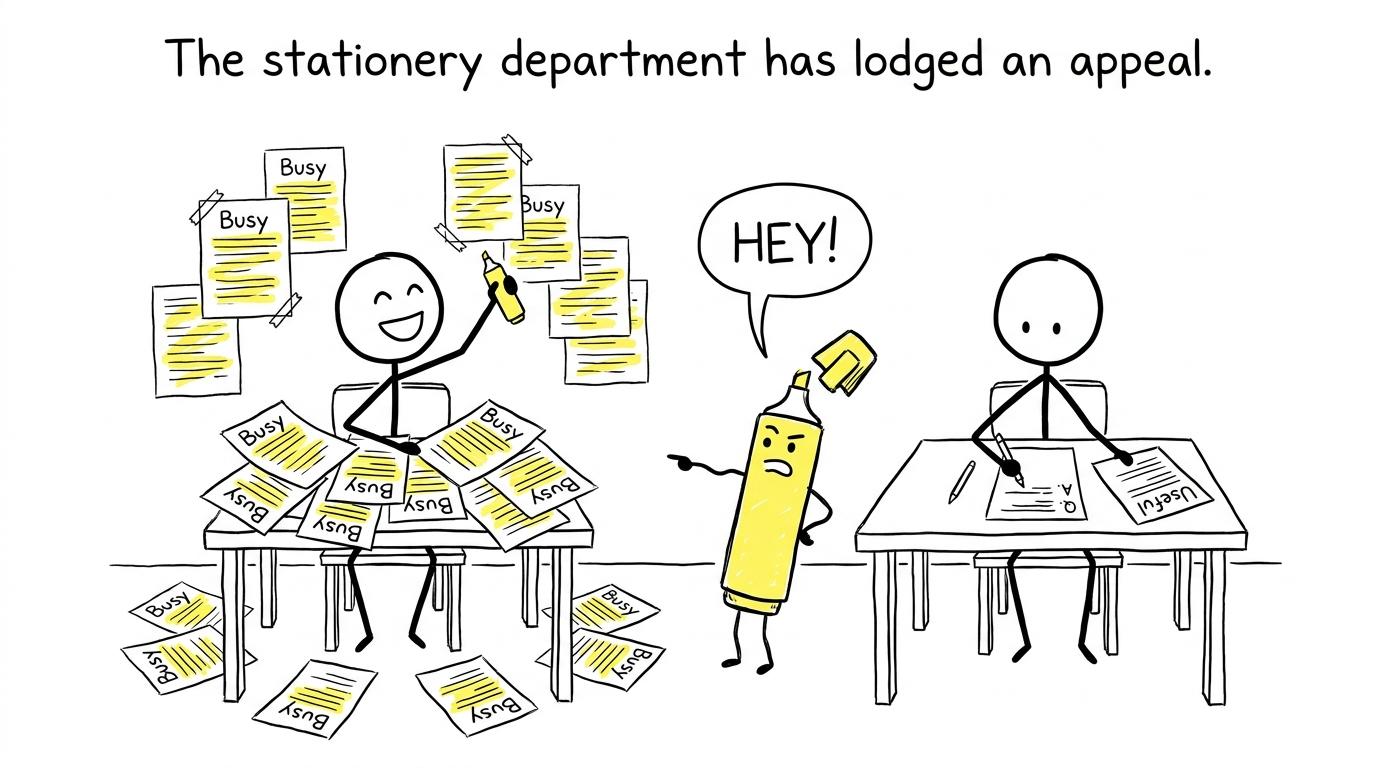 Active exam practice quietly defeats a pile of highlighted pages
For maths alongside Economics, MathsGenie's efficient Edexcel revision guide uses the same attempt, mark, fix and re-test loop. The GCSE night-before plan also shows why a short, purposeful set is usually better than unfocused last-minute cramming.
Adapt the method across the revision year
Early in revision, short sessions are useful for rebuilding coverage. Use the revision planner to spread topics across the week, then return to them rather than treating one completed timer as permanent mastery.
In the middle phase, combine focused recall with exam-style questions. Keep an error log and let it decide the next session. If most marks are being lost through evaluation, another definitions block is unlikely to solve the problem.
Near the exams, longer timed work should become more prominent. Short blocks remain useful for repairing specific gaps, but they should support paper practice rather than replace it. MathsGenie's advice on GCSE topics and three-pass revision provides a useful model: rebuild knowledge, practise by topic, then pressure-test it with papers.
Always use the specification and papers for your actual Economics qualification. GCSE Economics is commonly offered through boards including AQA and OCR, while qualification availability and assessment details differ between boards. Do not assume that an Edexcel, Eduqas or International GCSE resource matches your course merely because the topic name looks familiar.
Common Pomodoro mistakes
Measuring sessions instead of learning
Completing eight timers is not evidence that eight useful things happened. Set an output for each block and check it afterwards.
Using every break for social media
A planned 555-minute pause can easily become much longer. Choose a low-friction break such as stretching, walking or getting water.
Stopping in the middle of productive thought
A timer should prompt a decision, not issue an order. When you are constructing a strong analytical chain, finish the natural section and break afterwards.
Revising passively
Reading and highlighting can create familiarity without reliable recall. Put questions, diagrams, calculations and essay plans at the centre of the session.
Avoiding full papers
Short bursts cannot build all the stamina and judgement required for an examination. Practise sustained work regularly and review it carefully with a mark scheme.
Make the timer serve the task
The Pomodoro Technique can work for GCSE Economics, especially when the hardest part is beginning or when you need a boundary around a precise recall task. What the evidence does not justify is treating 252525 minutes as a magic learning interval.
Use short bursts for definitions, diagrams, calculations and targeted questions. Use longer blocks for analytical writing, evaluation and complete papers. Above all, retrieve information, apply it, check it and revisit it later.
For the mathematical skills that support Economics and your GCSE maths exams, make MathsGenie your free revision base. Use revision lessons to rebuild methods, practice questions and mini tests to expose gaps, mark schemes and video solutions to correct them, then past papers and predicted papers to develop exam confidence. Set the timer if it helps, but let the quality of your work decide whether the session succeeded.











