Pomodoro Technique GCSE Chinese: Does It Work?
Pomodoro technique GCSE Chinese guide: learn when 25-minute sessions help vocabulary and when longer practice works better for GCSE exam skills.

Revision can fail before it begins. You open a vocabulary list, notice how much there is to remember, and decide that reorganising your desk suddenly matters. The Pomodoro technique for GCSE Chinese can help with this problem because it makes the starting line smaller: work with full attention for 252525 minutes, take a 555-minute break, then repeat.
So, does it actually work? Yes, as a way to start, focus and schedule active practice. But it is not automatically better than longer sessions, and a rigid timer can interrupt speaking, writing and full-paper practice. The best approach is to match the session length to the task.
That distinction matters whether Chinese is your main concern or one subject competing with GCSE maths, science and English. A timer can organise revision. It cannot decide what good revision looks like.
The short answer
Use a standard Pomodoro for focused, self-contained tasks such as:
- retrieving vocabulary from memory;
- recognising and writing characters;
- practising tones and short spoken responses;
- completing a short listening extract;
- correcting mistakes from previous work.
Choose a longer block, usually around 404040 to 606060 minutes, for:
- extended writing;
- a full speaking sequence;
- longer reading or listening practice;
- timed sections of a past paper;
- reviewing and correcting a substantial piece of work.
The practical principle is simple: use short sessions to reduce friction, but do not let the timer cut through useful concentration.
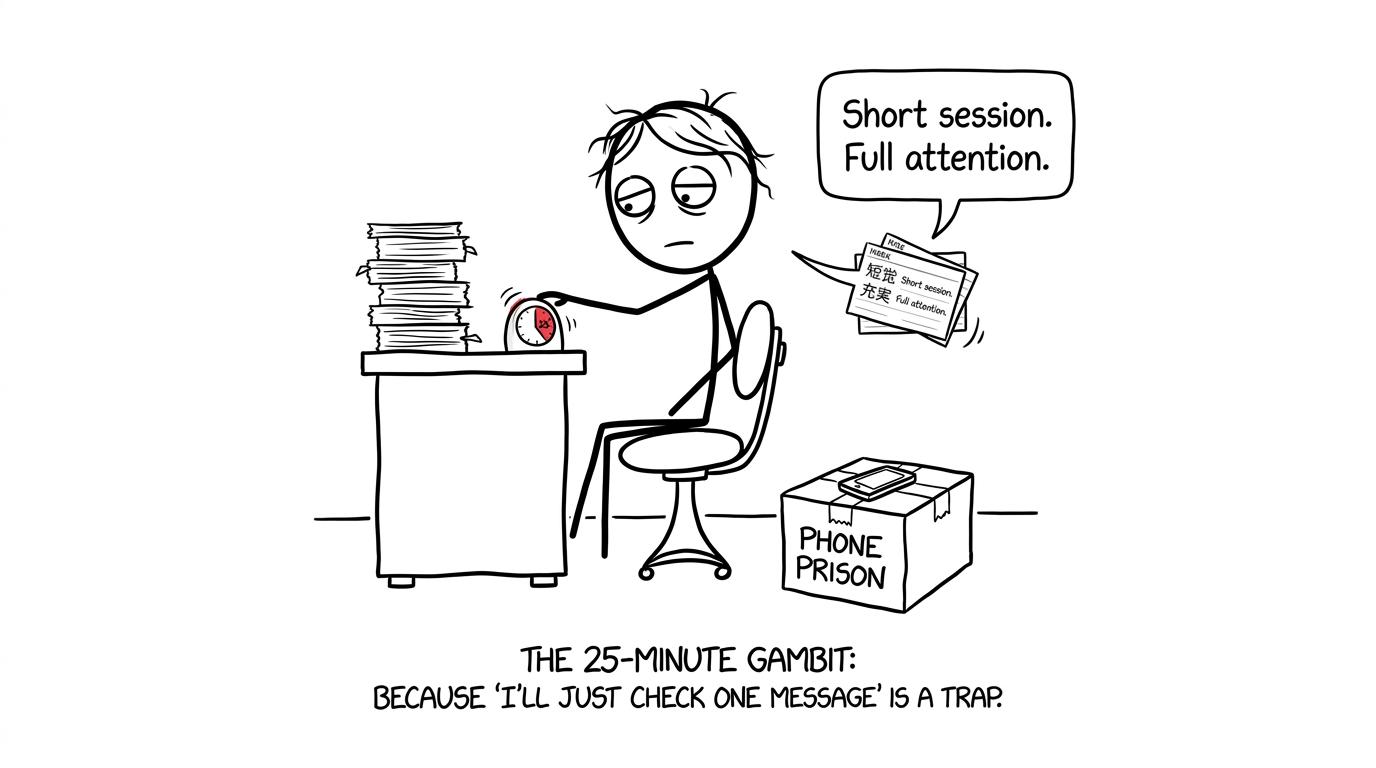 A GCSE student begins a focused revision session while flashcards encourage them and a phone waits in a tiny phone prison
What the Pomodoro Technique really does
The classic routine is 252525 minutes of focused work followed by a 555-minute break. After several cycles, you take a longer break. Its value is less mysterious than it sometimes sounds.
A short block creates a clear boundary. Instead of promising to “revise Chinese tonight”, you choose one visible action: recall twenty words, answer one reading section or record a speaking response. The timer also delays distractions. You are not giving up your evening; you are postponing your phone for 252525 minutes.
Research into structured study breaks is encouraging but mixed. A university study comparing predetermined breaks with self-regulated breaks found that structured groups reported less fatigue and distraction, although task completion did not differ. A later study found no overall advantage in productivity, task completion or flow for the fixed 252525/555 pattern, while motivation and fatigue sometimes changed less favourably than with self-regulated breaks.
This evidence mainly concerns university students rather than GCSE Chinese candidates. There is not strong direct evidence showing that a 252525-minute timer uniquely improves Chinese grades. The sensible conclusion is that structured breaks can support attention and effort regulation, but 252525 minutes is a useful default, not a scientific law.
Why short sessions suit parts of GCSE Chinese
GCSE Chinese is not one skill. In the AQA and Edexcel specifications, assessment covers listening, speaking, reading and writing. Each skill contributes a substantial part of the qualification, so revision must do more than build a large vocabulary list.
Vocabulary and character retrieval
Short blocks are particularly useful for retrieval practice. Look away from your notes and try to recall a meaning, pronunciation, character or phrase. Check the answer afterwards and separate secure items from weak ones.
This is more demanding than rereading, but that difficulty is useful. Research on learning consistently supports retrieval practice and spacing over passive review. The timer supplies the container; recalling the language supplies the learning.
Do not spend the full session copying characters mechanically. Include recognition, meaning, pronunciation and production. A character that looks familiar may still be difficult to produce without a prompt.
Listening practice
A 252525-minute block can hold one short cycle: listen without a transcript, answer questions, listen again, then identify what prevented understanding. The cause might be unknown vocabulary, a missed negative, unfamiliar speed or confusion between similar sounds.
However, stopping every 252525 minutes during a longer listening paper can weaken exam stamina. Once individual extracts feel manageable, use uninterrupted sections that resemble the demands of your exam board and tier.
Speaking practice
Short sessions make speaking easier to repeat frequently. You might rehearse a role play, respond to unpredictable questions or record yourself discussing one theme. Listening back creates feedback that silent revision cannot provide.
Do not stop halfway through a coherent speaking run simply because the timer rings. Finish the response or reach a natural boundary. Fluency depends partly on sustaining language, not merely producing isolated sentences.
Reading and writing
A focused block works well for a short reading passage, translation task or paragraph plan. Extended writing needs more flexibility. Planning, producing characters, checking accuracy and improving range may take longer than 252525 minutes.
The exam will not pause for a kitchen timer. As assessment approaches, some revision must therefore happen in uninterrupted, timed conditions.
A flexible Pomodoro plan for GCSE Chinese
A good revision block has a specific output. “Chinese vocabulary” is a category; “recall travel vocabulary and retest mistakes” is a task.
Try this decision process:
- Choose one skill. Decide whether the block is for listening, speaking, reading, writing or retrieval.
- Define the finish line. Name the extract, question set, vocabulary group or response you will complete.
- Select the interval. Start with 252525 minutes for a compact task and extend it when continuity matters.
- Remove interruptions. Put your phone out of reach and open the required materials before starting.
- Work actively. Recall, answer, translate, speak or write rather than merely highlighting notes.
- Check the result. Use the relevant answers, transcript, teacher feedback or mark scheme.
- Record one next step. Turn each mistake into a task for another day.
A conventional set of four work periods contains:
25×4=100 25 \times 4 = 100 25×4=100minutes of focused revision. That is a substantial workload. You do not need four cycles every evening, especially when Chinese sits beside other subjects. One properly used block is more valuable than several distracted ones.
For planning revision across a busy week, the same principles appear in MathsGenie's GCSE maths revision timetable guide and one-month GCSE revision plan: diagnose weaknesses, schedule realistic work and revisit material rather than relying on a final cram.
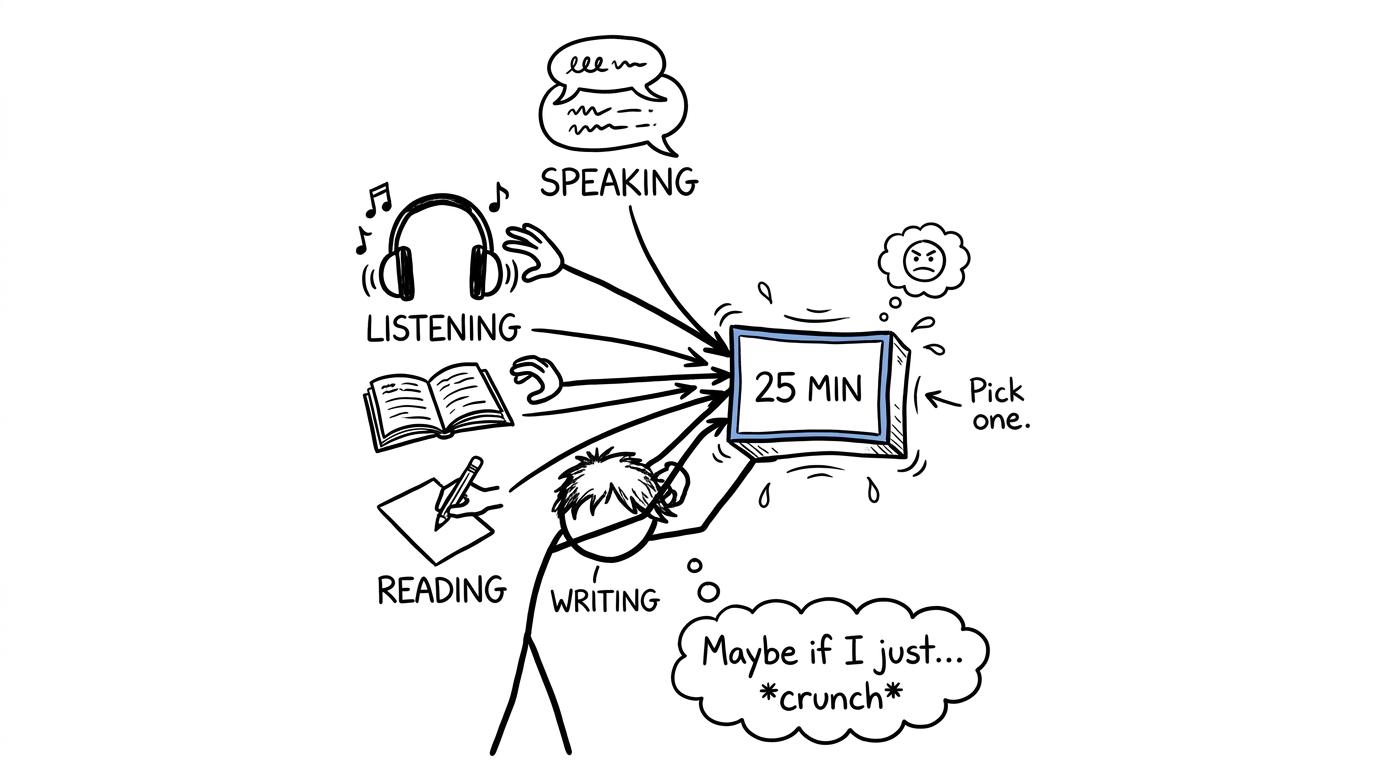 A tiny revision box protests as a student tries to squeeze listening, speaking, reading and writing into one session
When longer Chinese revision sessions are better
The Pomodoro technique becomes less helpful when the clock dictates the work rather than supporting it.
Building exam stamina
Foundation and higher tier papers require sustained attention. If all your practice is divided into short sections, the full assessment may feel unexpectedly tiring. Build gradually from individual questions to complete sections and then to whole papers under the correct conditions for your specification.
Maths revision follows the same progression. Topic practice builds accuracy, but GCSE maths past-paper practice tests whether that accuracy survives a longer exam. Edexcel students can use the organised collection of Edexcel GCSE maths past papers for this purpose.
Completing extended responses
Writing and speaking have internal momentum. Once you have recalled useful structures and begun connecting ideas, an alarm can create an unnecessary interruption. Use the timer as a check-in rather than a command: complete the paragraph, response or speaking sequence, then break.
Marking and repairing mistakes
Stopping immediately after completing questions misses the most valuable part. You need time to compare answers, classify errors and try difficult material again. MathsGenie's guide to turning mark-scheme feedback into marks explains a useful cross-subject habit: attempt first, mark honestly, identify the cause and retest later.
Combine Pomodoro with spacing and retrieval
The timer controls when you work. It does not guarantee that learning will last.
Spacing means revisiting material across different days. Retrieval means bringing it to mind without looking at the answer. Combined, they are more reliable learning strategies than repeatedly reading the same notes in one sitting.
After a Pomodoro, place weak vocabulary, characters or grammar into a future session rather than repeating everything immediately. Return after enough time for recall to require effort. Mix older content with newer content so that you must choose the right language rather than following a predictable sequence.
This is also why a revision planner matters. The MathsGenie GCSE revision hub provides a clear route through lessons, practice questions, papers and solutions for maths. You can borrow that structure for Chinese: learn, retrieve, practise, check, record the weakness and revisit it.
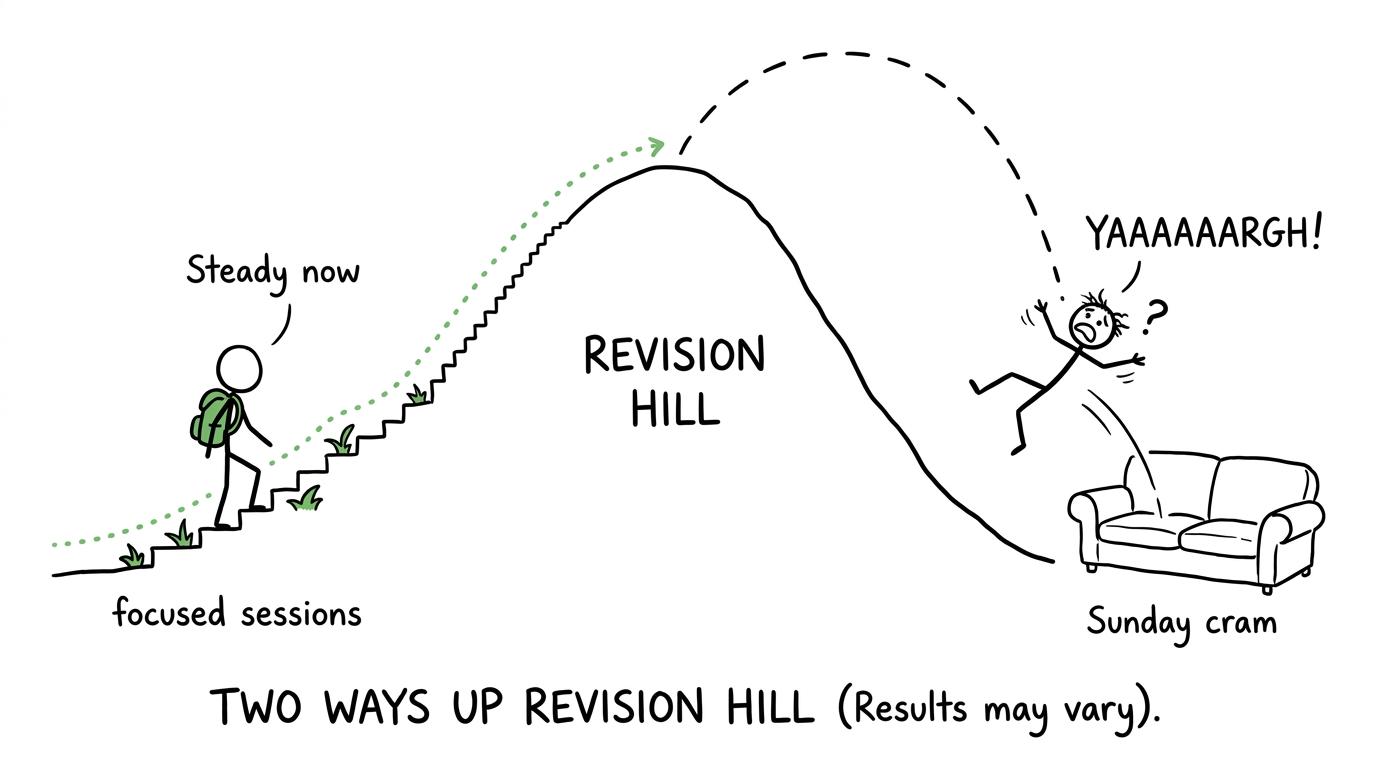 One student climbs a revision hill through steady focused sessions while another attempts a heroic leap from the Sunday cram sofa
Common mistakes with Pomodoro revision
Treating the timer as the revision method
Sitting beside a ticking timer while rereading notes is still passive revision. Every block needs an action and an observable result.
Cramming every language skill into one block
Switching repeatedly between listening, speaking, reading and writing creates shallow practice. Give one cycle a primary purpose. A later cycle can address another skill.
Taking breaks on a phone
A short break can quietly become a much longer one. Stand up, drink water or look away from the screen. Choose an activity with a clear ending.
Obeying the alarm in the middle of useful work
If you are completing an extended response or are deeply focused, reach a sensible stopping point. The method should reduce distraction, not manufacture it.
Never practising full exam conditions
Short sessions build habits, but they do not fully reproduce an exam. Schedule longer timed work as the assessment approaches. Maths students can use time-efficient OCR revision advice or the Edexcel revision workflow to see how focused topic blocks can lead into timed paper practice.
Make the timer serve the task
The Pomodoro Technique can work for GCSE Chinese, especially when the main barrier is beginning or maintaining attention. Its strongest uses are compact retrieval, character practice, short listening tasks and repeated speaking. Longer sessions are better when fluency, extended writing, marking or exam stamina matters.
Start with one 252525-minute block and judge it by what you can recall or produce afterwards, not by whether the timer reached zero. Then adapt. Good revision is structured, but it is not rigid.
For the maths part of your GCSE timetable, make MathsGenie your free revision base. Choose your exam board and tier, use revision lessons and practice questions to repair weak topics, then move into mini tests, past papers, predicted papers, mark schemes and video solutions. Set the timer, choose one useful task and begin.