Podcasts Audiobooks GCSE Further Maths: Do They Help?
Podcasts audiobooks GCSE Further Maths: discover when listening helps, where it falls short, and how to combine audio with questions and past papers.
There is a comforting kind of revision that happens through headphones. You press play, hear familiar terms and feel as though the subject is settling into place. But the real question behind podcasts audiobooks GCSE Further Maths searches is not whether listening feels productive. It is whether it helps you earn marks.
The short answer is yes, but mainly as a supplement. Audio can reinforce definitions, vocabulary, formula recall and the verbal sequence of a method. It cannot replace writing solutions, manipulating algebra, interpreting diagrams or completing exam questions under pressure. For Further Maths, the pencil still has to do most of the work.
The quick listening-based revision checklist
Use a podcast, audiobook or recorded explanation when you want to:
- review a topic you have already been taught;
- recall definitions, rules or method steps;
- fill otherwise unused time, such as a quiet journey;
- explain a method aloud after pausing the recording;
- identify topics that sound unfamiliar and need proper revision.
Do not use listening as a substitute for:
- handwritten algebra and clear mathematical working;
- topic-based practice questions;
- diagrams, graphs and matrix notation;
- checking answers with solutions or mark schemes;
- timed past-paper practice.
A sensible starting point is the AQA GCSE Further Maths revision hub, where lessons and questions turn what you have heard into something you can actually perform.
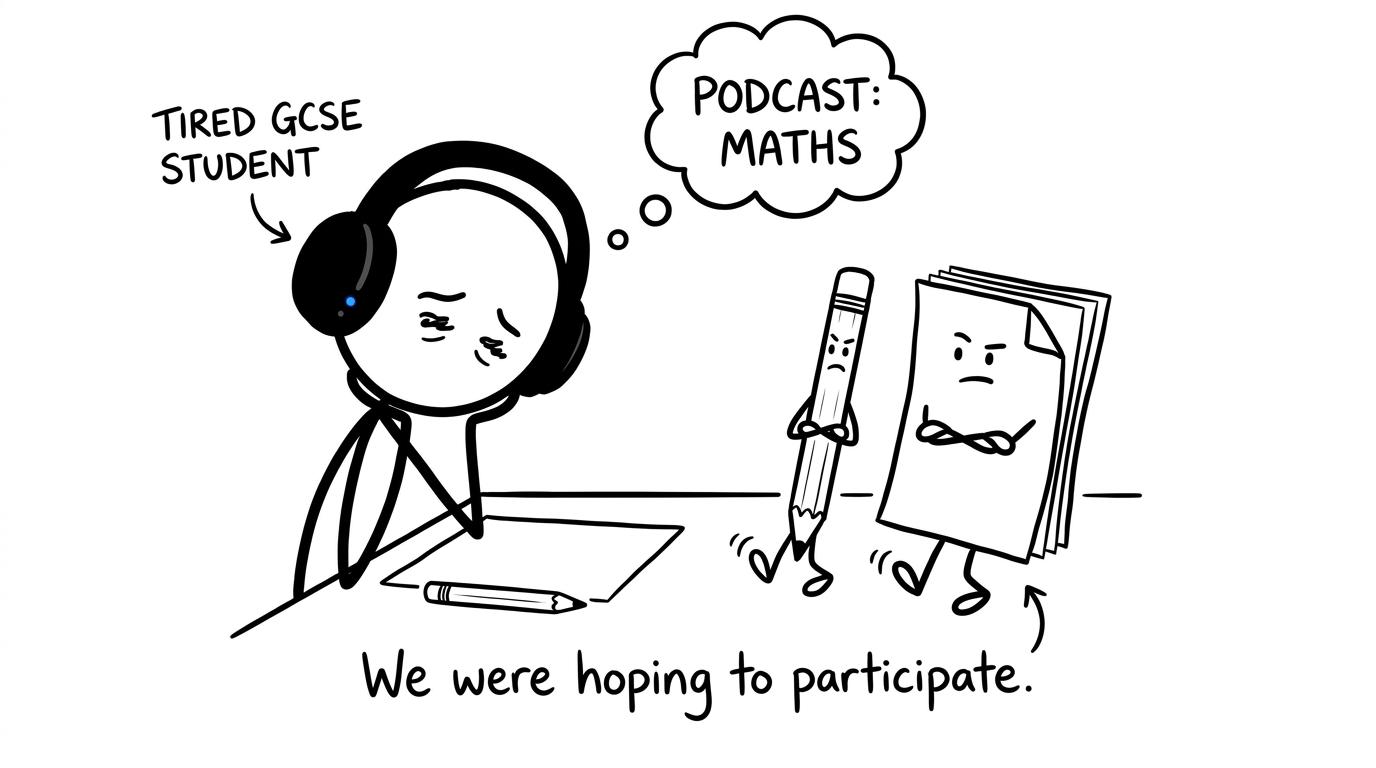 A GCSE student's untouched pencil and practice paper wait impatiently while the student listens to a maths podcast
Why listening can help with GCSE Further Maths
Audio is useful because not every part of learning mathematics is calculation. Further Maths has a language of its own: functions, domains, stationary points, transformations, identities, proofs and matrices. Hearing precise explanations can help those ideas become more familiar.
It can also provide structure. A good spoken explanation might describe a method as a sequence: identify the relevant information, choose the rule, carry out the process and check whether the result is sensible. That verbal framework can make it easier to begin a question later.
Listening may be particularly valuable when you are:
- returning to a topic after a gap;
- trying to distinguish similar terms;
- checking whether you can explain why a method works;
- too tired for a full session but still able to complete a short review;
- using audio alongside written notes, diagrams or a lesson page.
The important phrase is alongside written work. Familiarity is not the same as fluency. Recognising an explanation through headphones does not prove that you can reproduce the method independently.
What research suggests about passive and active revision
Research on learning generally distinguishes passive exposure from active retrieval. Listening again can refresh knowledge, but trying to recall an idea before hearing the answer usually demands more thought.
Classroom research has found broad benefits from retrieval practice, particularly when students must generate an answer rather than merely recognise it. However, mathematics-specific evidence is more cautious when the target is complex problem-solving. Remembering a definition and constructing a multi-stage solution are not identical learning tasks.
Research on mathematics gives stronger support to spaced practice than to doing all revision in one long block. This suggests a useful role for audio: listen briefly, retrieve what you remember, practise it on paper and return to it after a gap. The MathsGenie guide to stopping GCSE Maths content from being forgotten develops this active-recall and spacing approach.
The practical conclusion is simple. A podcast becomes more valuable when it causes you to pause, remember, write and check. Continuous background listening is less likely to develop exam-ready problem-solving.
Why audio cannot replace Further Maths practice
Further Maths is unusually demanding of the page. You need to see notation, follow transformations from one line to the next and notice small details such as signs, powers and brackets.
Audio alone struggles to teach:
- accurate algebraic manipulation;
- the shape and behaviour of graphs;
- geometrical proof and labelled diagrams;
- matrix calculations and transformations;
- differentiation written in correct notation;
- multi-stage reasoning where each line depends on the previous one.
There is also a difference between understanding someone else's solution and producing your own. In an examination, there is no narrator offering the next step. You must decide what to do, record sufficient working and recover when the obvious method does not immediately succeed.
That is why listening should lead into the GCSE Maths revision resources. Use the explanation to reopen an idea, then complete questions without the audio playing. Marks come from independent performance.
Check which Further Maths qualification you take
“GCSE Further Maths” is often used informally, but schools do not all enter students for the same qualification. A common option in England is the AQA Level 2 Certificate in Further Mathematics. AQA describes it as an additional, untiered qualification intended to extend students working towards high GCSE Maths grades; it is not a replacement for GCSE Mathematics.
Other schools may use qualifications such as Pearson Edexcel Extended Mathematics or OCR Additional Mathematics. Content and assessment arrangements differ. Your ordinary GCSE Maths board may not be the same as the board for your additional qualification.
Before choosing any audio resource, check:
- the qualification title;
- the exam board and specification code;
- whether the recording covers your exact content;
- whether your course includes the topic being discussed;
- whether the explanation uses notation consistent with your lessons.
A polished discussion of an interesting topic is not useful revision if that topic is absent from your specification. Ask your teacher or check the front of a practice paper if you are uncertain.
How to use podcasts and audiobooks effectively
Listen with a question in mind
Do not begin with “I will listen to Further Maths”. Choose something precise: recalling the meaning of a function, reviewing the stages of a proof or distinguishing a tangent from a normal.
A narrow target makes it easier to notice whether the audio has helped. If you cannot state the purpose of the session, it can quietly become entertainment rather than revision.
Pause and retrieve
Stop before the speaker gives a definition or next step. Say what you expect to hear. Better still, write it down.
This changes listening from simple exposure into active recall. The effort matters because it shows whether the knowledge is available without a prompt.
Explain the idea aloud
After a short section, explain the idea as though you were teaching someone who has not heard the recording. Keep the explanation precise. If you become vague, return to a MathsGenie revision lesson and question set rather than replaying an entire episode without a clear target.
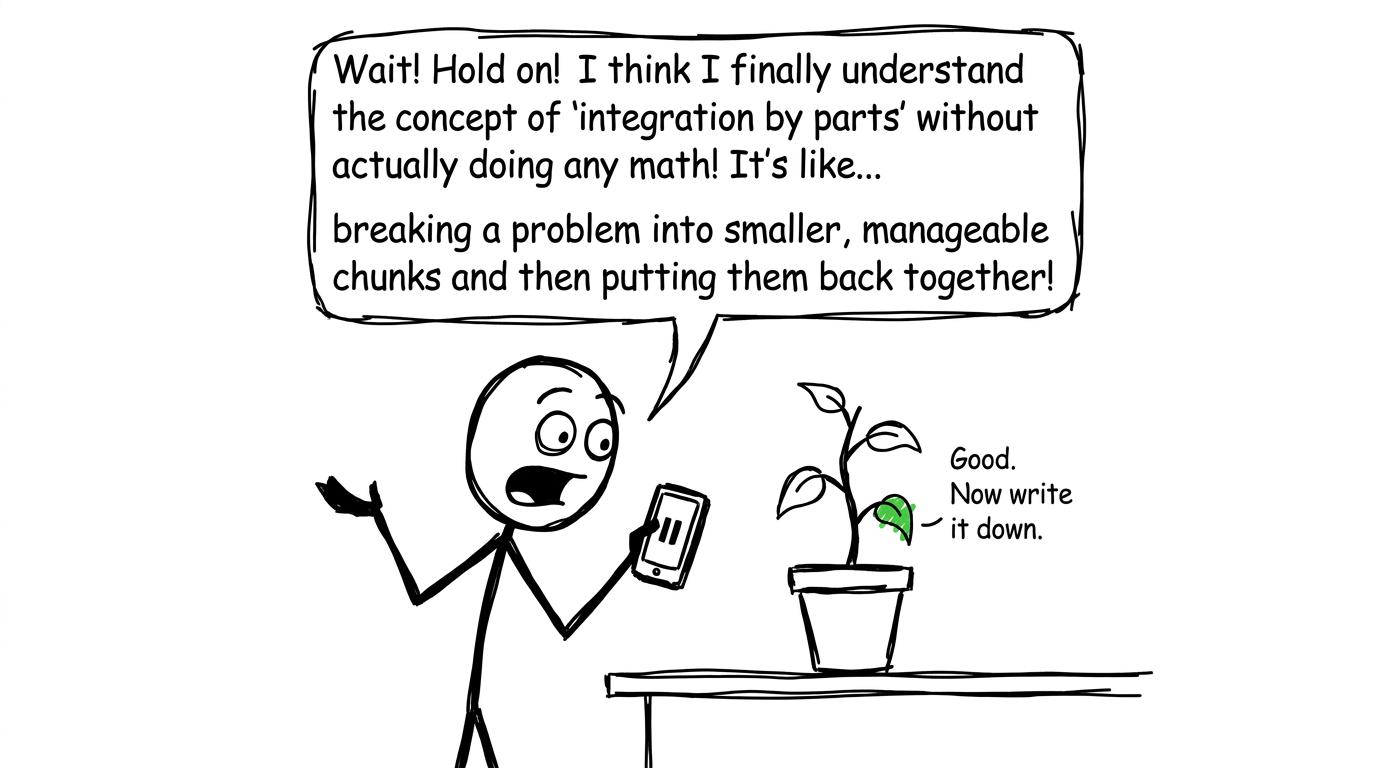 A student pauses an audiobook to explain a maths method to a houseplant, which asks them to write it down
Follow audio with written questions
Within the same session, complete a small set of questions without notes. Mark them immediately and record the exact reason for each lost mark.
Your error might be:
- a missing fact;
- an incorrect method choice;
- weak algebra;
- a notation error;
- an arithmetic slip;
- a misread instruction.
This diagnosis tells you whether more listening would help. A forgotten definition might benefit from another short audio review. Repeated algebra errors need written practice instead.
Revisit the topic after a gap
Return on another day and attempt fresh questions before replaying the explanation. Spacing reveals what has survived beyond the original session.
The twenty-minute GCSE Maths revision routine offers a practical structure for combining recall, exam questions and marking when time is limited.
A balanced revision session using audio
A productive session could look like this:
- Five minutes: recall the topic before pressing play.
- Ten minutes: listen actively, pausing to predict definitions or steps.
- Twenty minutes: complete written questions without help.
- Ten minutes: mark, correct and record errors.
- Five minutes: summarise the method aloud and schedule a retest.
The proportions matter more than the exact timings. Listening occupies the smaller part. Independent practice and feedback occupy the larger part.
On a walk or journey, you can still listen usefully. Make a mental list of the rules you remember, then complete written questions when you return. Avoid pretending that walking with headphones and sitting an exam are equivalent tasks.
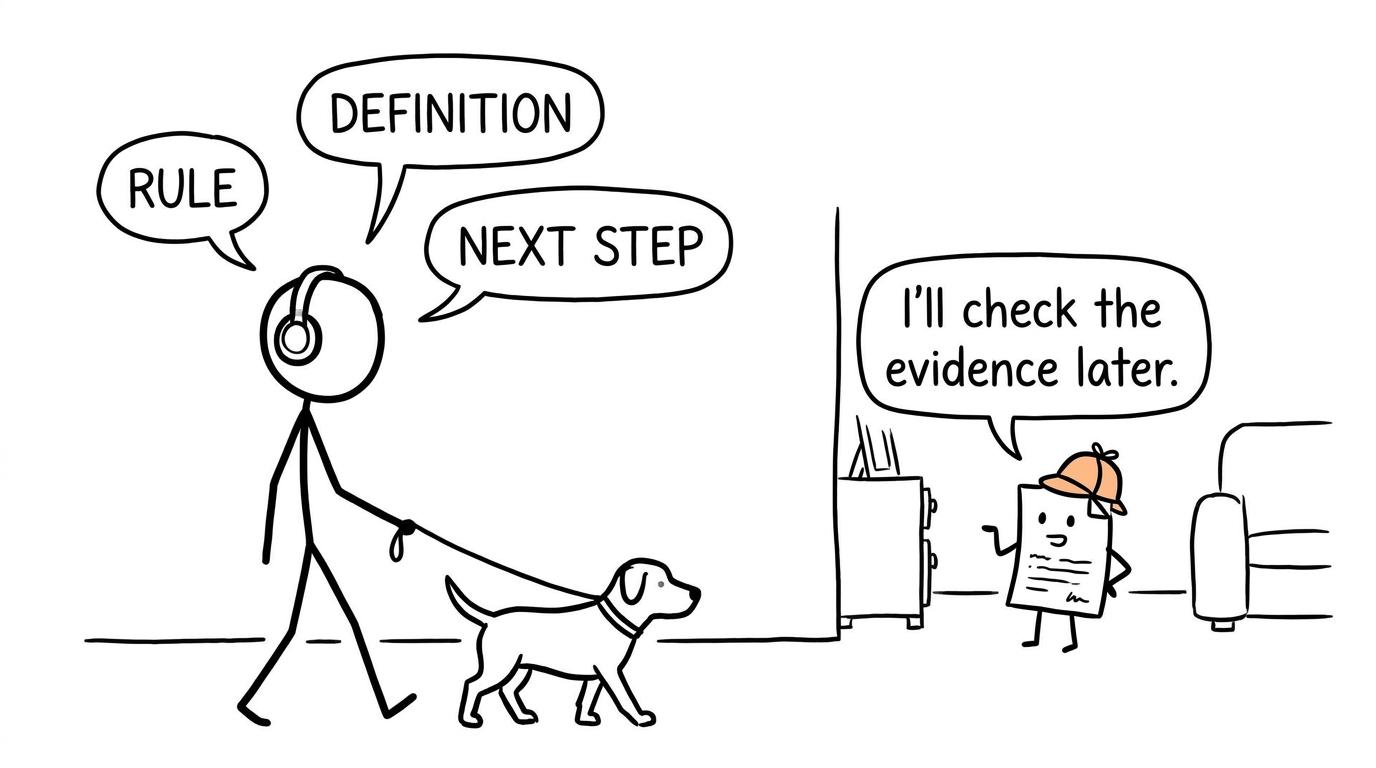 A student listens to maths while walking a dog as an exam paper waits at home to check the evidence
When listening is most and least useful
| Listening is more useful for | Written practice is essential for |
|---|---|
| Definitions and vocabulary | Algebraic manipulation |
| Recalling rules and method order | Graphs and diagrams |
| Reviewing a familiar topic | Matrix calculations |
| Self-explanation | Proof and multi-stage reasoning |
| Identifying knowledge gaps | Timing and exam technique |
Audio is also less effective when your attention is divided. Listening while scrolling, gaming or holding a conversation leaves little room for deliberate recall. A journey may be suitable if you can concentrate; a noisy, distracting activity may not be.
Common mistakes with audio revision
Counting listening time instead of checking performance
An hour completed is not evidence of an hour learnt. Measure progress through questions answered independently and mistakes corrected.
Listening only to comfortable topics
Familiar episodes feel smooth because recognition is easy. Use evidence from a mini test or paper to choose what needs attention. The guide to finding your weakest GCSE Maths topics explains how to turn lost marks into a focused revision list.
Never pausing the recording
Continuous listening removes the moment when your memory has to work. Pause before explanations, predict the next step and compare your response with what follows.
Replacing notation with verbal descriptions
You may understand “differentiate the function” when you hear it, yet still write the notation incorrectly. Always reconnect spoken explanations to written mathematical language.
Leaving past papers until the end
Past papers test topic selection, accuracy, timing and resilience. They should be part of the revision process, not a final ceremony. Follow the MathsGenie method for using past papers properly: attempt, mark, repair and retest.
The final verdict
Podcasts and audiobooks can help with GCSE Further Maths, but they work best in a supporting role. They can refresh terminology, organise methods and make short pockets of time useful. They cannot build reliable written technique on their own.
Treat audio as the doorway, not the destination. Listen briefly. Pause. Retrieve. Write. Mark. Return after a gap.
Then let MathsGenie provide the part headphones cannot: free revision lessons, specification-focused practice questions, mini tests, past papers, predicted papers, mark schemes and video solutions. Start with the AQA Further Maths revision area, choose one weak topic and prove your understanding on paper.