Podcasts and Audiobooks for GCSE Food Revision
Podcasts audiobooks GCSE Food and Nutrition: learn when listening helps, why active practice matters, and how to build an effective revision routine.
Revision can feel productive long before it becomes effective. You put on your headphones, hear a clear explanation of protein denaturation or food provenance, and finish the episode feeling as though the topic now belongs to you. Then someone asks you to explain it without help, and the details disappear.
So, do podcasts audiobooks GCSE Food and Nutrition resources genuinely help? Yes, but mainly as a supplement. Listening can introduce ideas, reinforce vocabulary and make otherwise unused time valuable. It cannot fully replace active recall, written exam questions, practical experience or careful work with your specification and mark schemes.
The best approach is simple: listen, pause, retrieve, check and apply.
The short answer: when listening-based revision works
Podcasts and audiobooks are most useful when you:
- choose content that matches your exam board specification;
- listen in short, focused sections rather than running hours of audio in the background;
- pause to recall facts without help;
- turn each section into questions, notes or spoken explanations;
- follow listening with written exam practice;
- revisit the same material after a gap;
- use audio alongside practical and visual learning.
They are less useful when listening becomes a comfortable substitute for testing yourself.
Research into educational podcasts suggests that audio can support knowledge acquisition and may perform comparably with traditional teaching in some settings. However, much of that evidence comes from higher education and professional education rather than GCSE Food Preparation and Nutrition. It would therefore be too strong to claim that podcasts alone improve GCSE grades.
What the evidence supports more confidently is structured use: audio works better when it is connected to learning objectives, followed by retrieval and integrated with other activities.
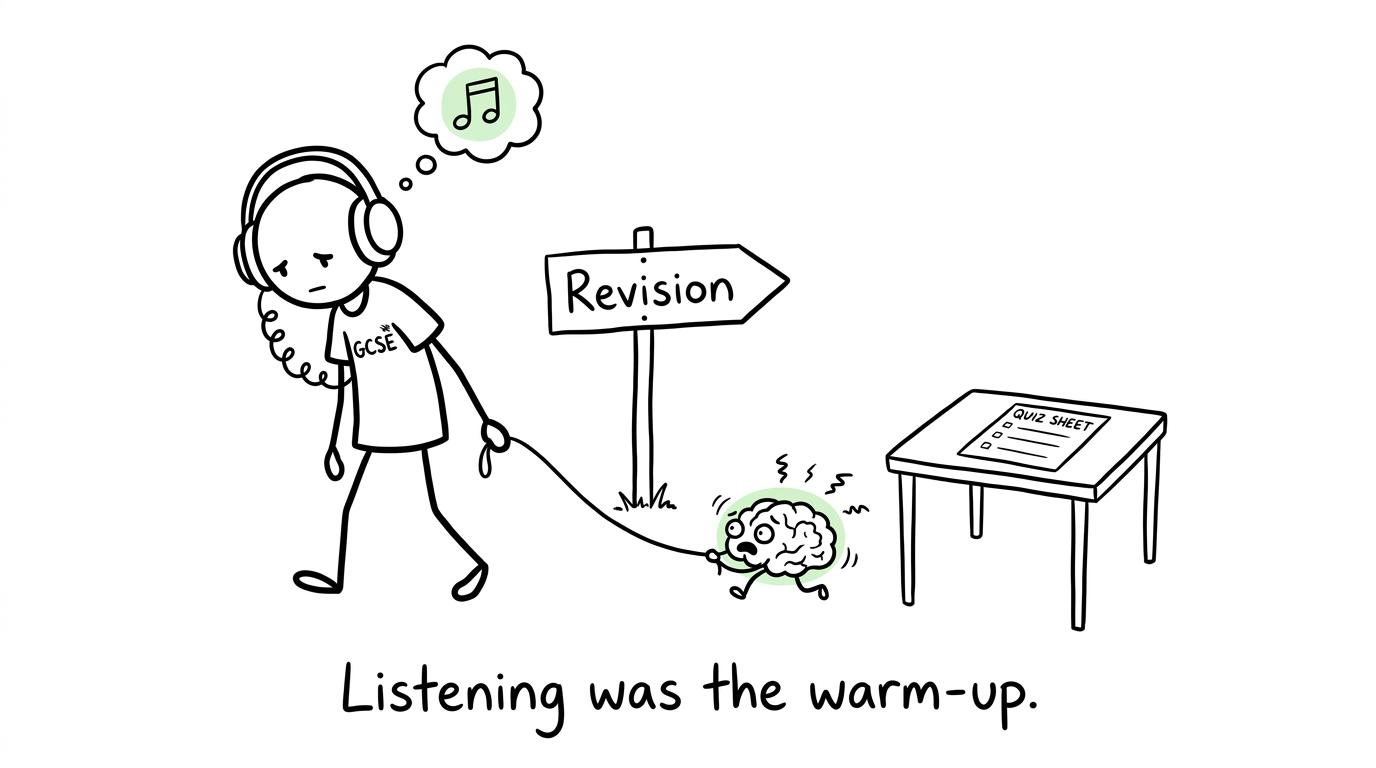 A GCSE student discovers that listening is the warm-up rather than the whole revision session
Why Food Preparation and Nutrition suits audio, up to a point
GCSE Food Preparation and Nutrition contains a substantial body of theory. Depending on your board, this may include nutrition and health, food science, food safety, food choice, provenance, commodities and cooking techniques.
Audio can be effective for content with a verbal structure. You might listen to explanations of:
- the functions and sources of nutrients;
- dietary requirements at different life stages;
- food poisoning and safe food handling;
- ethical, environmental and economic food choices;
- food provenance and production;
- scientific terminology connected with cooking;
- reasons for choosing particular ingredients or techniques.
Listening can also help you become familiar with precise subject vocabulary. Hearing terms used in a meaningful explanation is more valuable than memorising an isolated list.
But the qualification is not an audio-only subject. Current AQA, OCR and Eduqas specifications combine theoretical understanding with practical application and non-exam assessment. Their exact structures differ, so always check the specification used by your school. Across these qualifications, students must do more than recognise facts: they need to apply, analyse, evaluate, investigate and demonstrate practical skills.
A podcast cannot show whether you can organise a practical task safely. It cannot replace sensory evaluation, an investigation into ingredient properties or the experience of adapting a method when food behaves unexpectedly. It also gives limited support for diagrams, data tables, food labels and calculations.
That is why listening belongs beside practice, not in place of it.
Podcasts or audiobooks: which is better?
Neither format is automatically superior. The quality, relevance and way you use it matter more than the label.
Podcasts are useful for short, specific topics
A focused episode can fit neatly into a revision plan. Podcasts are often easier to pause, repeat and use during a walk or journey. They work particularly well for a single question, such as why microorganisms multiply under particular conditions or how heat changes an ingredient.
The risk is uneven coverage. An interesting episode may discuss nutrition without matching the depth or terminology required by your specification. Before listening, ask: Which specification statement will this help me revise?
Audiobooks are useful for connected explanations
A longer audiobook may provide a more coherent account of nutrition, food systems or cooking science. This can help you see relationships between topics rather than learning disconnected definitions.
However, a general book may include fascinating material that your exam will never assess. It may also use different terminology or assume knowledge beyond GCSE. Treat it as supporting context unless it is explicitly aligned with your course.
How to turn listening into active revision
The difference between entertainment and revision is what your brain has to do after the audio stops.
Preview the topic
Before pressing play, read the relevant specification section or your teacher's checklist. Write down three questions you expect the audio to answer. This gives your attention somewhere to go.
Listen in short sections
A long episode can create the illusion of progress while your attention wanders. Divide it into sections of roughly 101010 to 202020 minutes. Stop earlier if the material becomes dense.
Avoid combining listening with tasks that demand language or decision-making. Walking may be compatible with a familiar recap; completing written homework or scrolling through messages usually is not.
Retrieve before replaying
At the end of each section, remove the headphones and record what you remember. You could:
- write five key facts from memory;
- explain the idea aloud as though teaching it;
- sketch a process or sequence;
- create three questions and answer them;
- list anything you still cannot explain.
Only then should you replay or check your notes. The moment of effort matters because it reveals whether the information is available without the speaker's prompts.
This is the same principle behind the MathsGenie guide to making GCSE content stick: recall first, check afterwards and revisit later.
Apply it in the form the assessment requires
If the topic is assessed through writing, answer a written question. If it concerns practical work, connect it to an investigation, technique or observation you have completed in class. If it includes nutritional data, practise interpreting the data rather than merely listening to someone describe it.
Mark schemes matter because knowing a topic and expressing it for marks are different skills. The routine explained in how to use GCSE past papers properly transfers well to Food Preparation and Nutrition: attempt, mark, diagnose, repair and retest.
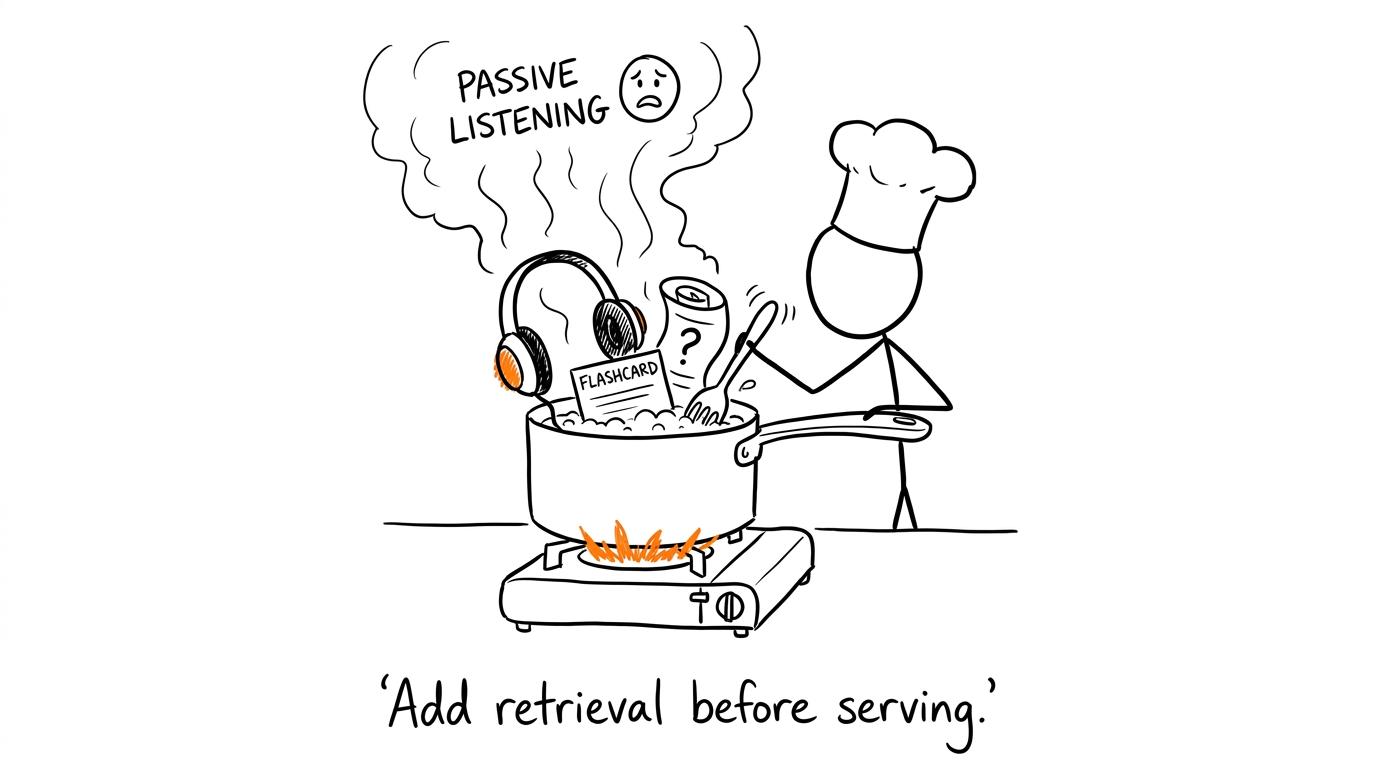 A revision recipe combines headphones, retrieval and an exam question
Do not overlook the maths inside food and nutrition
Students preparing for maths exams can use Food Preparation and Nutrition as meaningful numerical practice. Recipe scaling, ratios, proportions, percentages, costs, timings and nutritional data all require decisions with numbers.
Useful relationships include:
scale factor=required number of portionsoriginal number of portions\text{scale factor}=\frac{\text{required number of portions}}{\text{original number of portions}}scale factor=original number of portionsrequired number of portionsand
percentage of reference intake=amount consumedreference intake×100\text{percentage of reference intake}=\frac{\text{amount consumed}}{\text{reference intake}}\times 100percentage of reference intake=reference intakeamount consumed×100Audio may explain what these calculations mean, but you still need to write, calculate and check them yourself. A spoken description cannot build calculator accuracy or reveal that you have reversed a ratio.
For targeted support, use MathsGenie's free lessons and practice materials on GCSE proportion, GCSE ratio and percentages. These Edexcel maths pages develop skills that also appear in recipe and nutrition contexts, although you should use resources matched to your own maths board and tier for complete exam preparation.
A practical listening-based revision routine
A balanced 404040-minute session might look like this:
- 555 minutes: choose one specification point and write retrieval questions;
- 151515 minutes: listen actively, pausing only for brief keywords;
- 555 minutes: recall the content without notes;
- 101010 minutes: complete a written question, data task or planning activity;
- 555 minutes: check the answer and record one weakness to revisit.
The timings are flexible. The sequence is not. Listening comes before retrieval and application, not instead of them.
If busy school days make long sessions unrealistic, adapt the MathsGenie 202020-minute revision routine. One short cycle completed honestly is more useful than an hour of background audio.
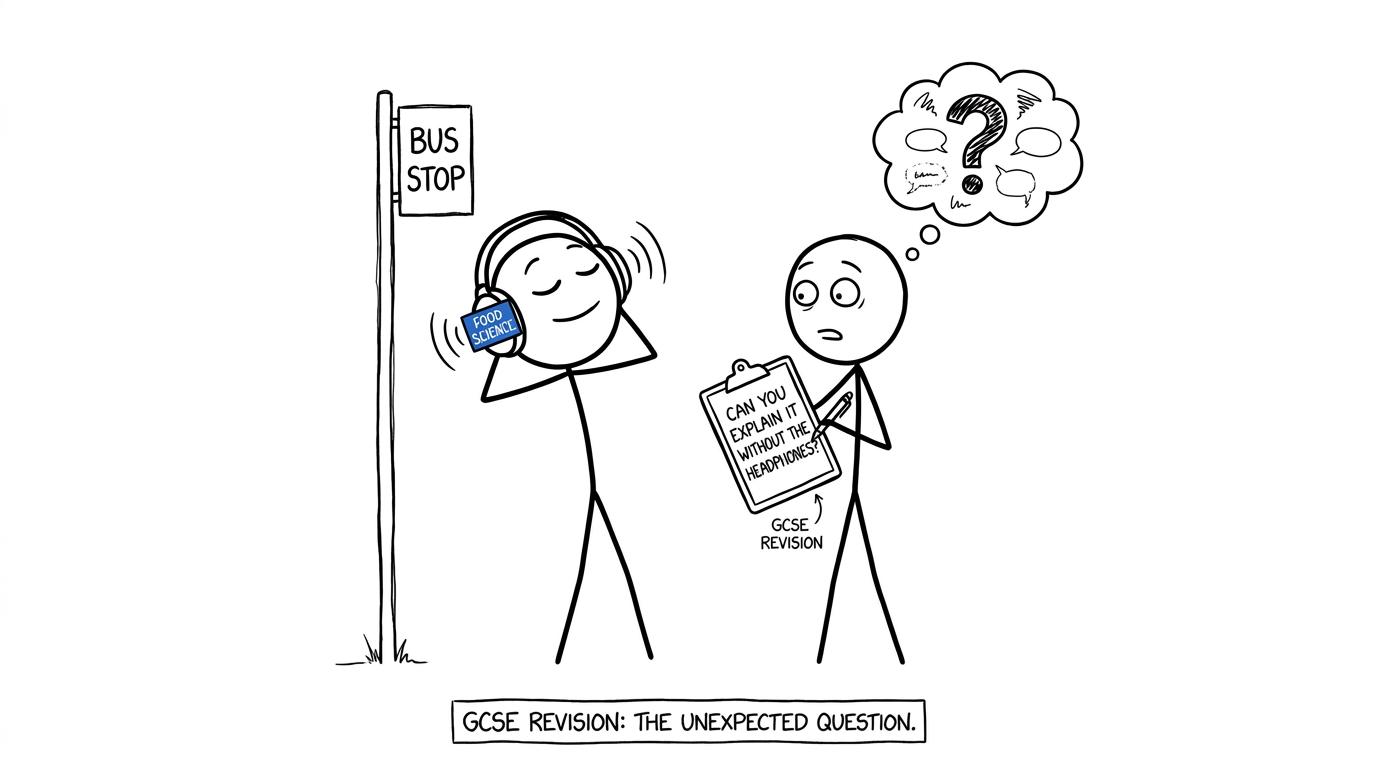 A listener is challenged to explain the topic after removing the headphones
Common mistakes with podcast and audiobook revision
Counting listening time instead of learning
Finishing three episodes measures exposure, not memory. Measure what you can recall, explain and apply afterwards.
Choosing entertaining but irrelevant content
A polished programme can still miss your specification. Check the episode against your board's content and your teacher's guidance before giving it revision time.
Multitasking too heavily
Audio feels portable, but divided attention can leave you remembering fragments. Use background listening for light recap, not for learning a difficult topic for the first time.
Taking continuous notes
Writing down nearly everything turns you into a transcription service. Capture a few prompts, then reconstruct the explanation from memory.
Replacing written and practical work
Food Preparation and Nutrition assesses application, analysis and practical understanding. Maths assesses written methods and accurate reasoning. Neither subject can be prepared for solely through headphones.
Never checking whether revision worked
Use a short quiz, teacher question, past-paper item or mini test. Maths students can use GCSE maths mini tests and the wider GCSE maths revision hub to turn perceived confidence into evidence.
The verdict: useful supplement, poor replacement
Podcasts and audiobooks can make GCSE Food Preparation and Nutrition revision more flexible. They are particularly helpful for recapping terminology, hearing connected explanations and using journeys or low-energy periods sensibly.
Their weakness is also simple: listening can feel fluent because the speaker is doing much of the thinking. Exams and non-exam assessment ask you to do that thinking yourself.
Use audio as the opening stage of a revision cycle. Then close the app, retrieve the content, answer a question and revisit the topic later. Keep practical experience, visual resources, specification coverage and written practice at the centre.
For maths preparation, make MathsGenie your free revision base. Start with revision lessons and practice questions, check understanding through mini tests, then move to GCSE past papers with mark schemes and solutions and Edexcel predicted papers where relevant. Use video solutions to repair methods and a revision planner to schedule the next attempt.
Headphones can help you begin. Active practice is what carries the learning into the exam.