Do Podcasts or Audiobooks Help GCSE Chinese?
Podcasts audiobooks GCSE Chinese revision can improve listening, vocabulary and pronunciation, but work best alongside active, exam-focused practice.
Revision can look productive without being productive. Headphones are on, Mandarin is playing and an hour passes. Yet when someone asks what the speaker actually said, the details disappear.
So, do podcasts audiobooks GCSE Chinese resources genuinely help? Yes, particularly with listening stamina, vocabulary recognition, pronunciation and familiarity with spoken Mandarin. But they work best as a supplement. Listening alone will not prepare you fully for the reading, writing, speaking and exam-question skills your GCSE assesses.
The useful distinction is not between listening and avoiding listening. It is between passive exposure and purposeful practice.
The short answer: use audio, but do something with it
A sensible GCSE Chinese audio routine should:
- match your current ability rather than overwhelm you;
- cover vocabulary and themes from your specification;
- include short, repeatable sections;
- provide a transcript where possible;
- make you recall, summarise or answer questions;
- sit alongside speaking, reading, character work and past-paper practice.
Podcasts are usually better for conversational speech, changes of speaker and everyday topics. Audiobooks are often better for sustained attention, clear narration and following a longer thread. Neither automatically teaches examination technique.
That matters because GCSE Chinese is not simply a test of whether Mandarin sounds familiar. For AQA and Pearson Edexcel, listening is one of four assessed skills alongside speaking, reading and writing. Under the specifications researched for this article, each skill contributes 25%25\%25% of the qualification. Your own exam board's current specification should always be the final reference.
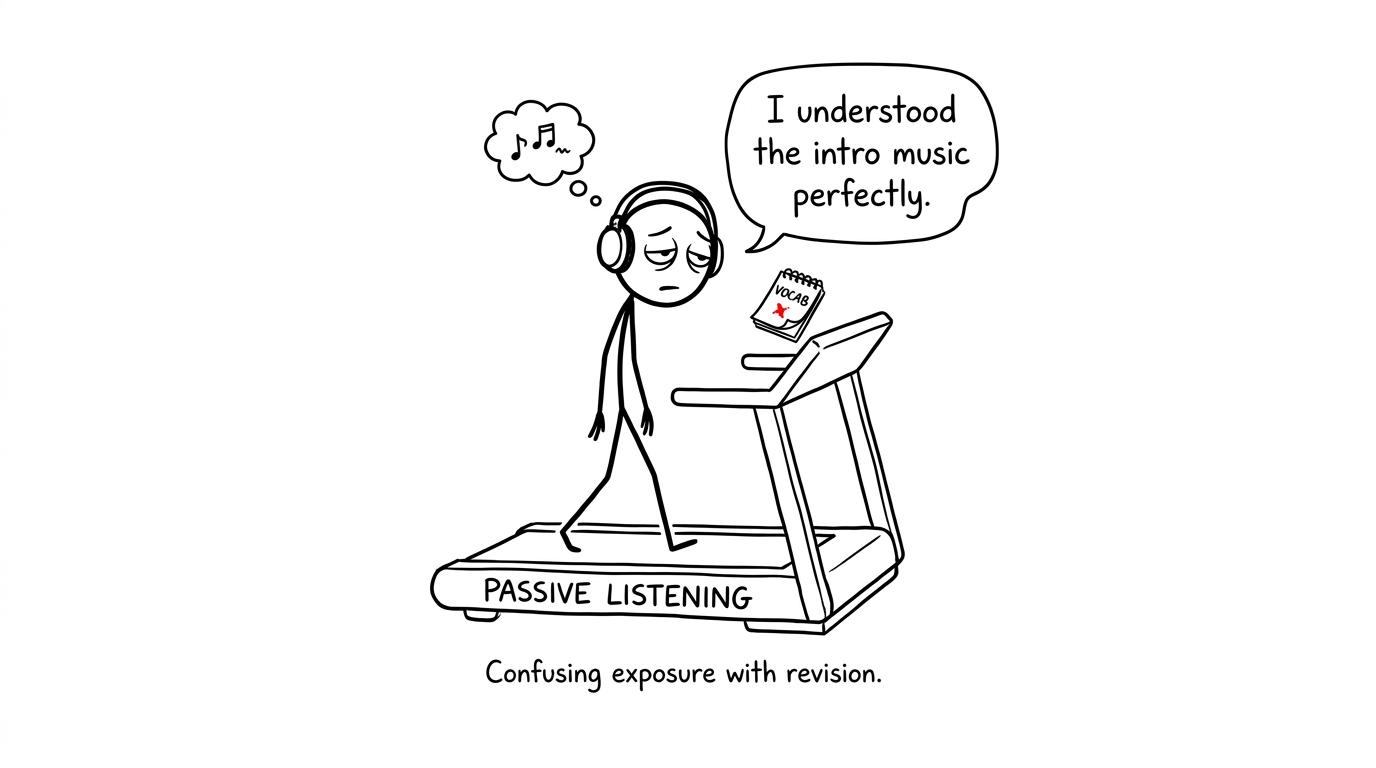 A student walking on a passive-listening treadmill while the vocabulary notebook remains out of reach
What listening-based revision can improve
Language is easier to recognise when you have met it in more than one form. A word seen only on a vocabulary list can feel unfamiliar when it arrives quickly inside a sentence. Regular listening helps connect vocabulary with sound, rhythm and context.
Research into second-language learning generally finds that extensive listening can support comprehension, vocabulary and engagement. Podcast research is especially encouraging when learners listen regularly and use suitable material. However, much of that evidence concerns English as an additional language or older learners, not GCSE Chinese students specifically. It supports a careful conclusion, not a miracle claim.
Listening comprehension and processing speed
In an exam, you cannot inspect a spoken sentence in the way you can reread a paragraph. You must hold information briefly, identify what matters and connect it to the question.
Podcasts can help you become more comfortable with:
- natural pauses and linking between words;
- different voices and speaking styles;
- dialogue rather than isolated vocabulary;
- extracting a main idea without understanding every word;
- listening for details such as time, opinion, reason or intention.
The improvement comes from repeated, comprehensible listening. Audio that is far beyond your level may become noise. Audio that is slightly challenging, supported by a transcript or familiar topic, gives you something you can gradually decode.
Vocabulary in context
A vocabulary list tells you what a word can mean. A well-chosen recording shows how it behaves.
You hear which words commonly appear together, where emphasis falls and how meaning changes across a full sentence. This can make vocabulary easier to retrieve later, particularly when the topic matches your course themes such as school, family, free time, technology, travel or future plans.
Audio should not replace deliberate vocabulary revision, though. After listening, select a small number of useful items and test yourself later. Recognition during playback is not the same as being able to recall a word independently.
Pronunciation and speaking awareness
Listening provides models of pronunciation, tones, pacing and intonation. Audiobooks can be especially helpful here because narration is often controlled and consistent. Podcasts may expose you to more conversational exchanges.
But hearing accurate speech does not guarantee that you can produce it. Pause occasionally and repeat a short phrase, then record yourself if appropriate. Compare carefully, paying attention to tones and rhythm rather than merely copying speed.
For speaking assessment, you must also form your own responses, ask or answer questions and communicate under pressure. That requires active speaking practice with a teacher, partner or structured prompt.
Podcasts or audiobooks: which is better?
The better resource is the one that develops the skill you currently need.
Choose podcasts for conversational listening
A short learner podcast can resemble the mental work required by dialogue-based listening tasks. Speakers may change, opinions may contrast and important information may be surrounded by less relevant detail.
Choose episodes with a clear subject, manageable length and transcript. GCSE revision is usually better served by five focused minutes that you revisit than by an advanced hour-long discussion you barely understand.
Podcasts are particularly useful when you want to practise:
- identifying who holds an opinion;
- following an exchange between speakers;
- noticing informal or everyday language;
- adjusting to different voices;
- extracting specific details from a conversation.
Choose audiobooks for sustained comprehension
Audiobooks generally offer a more continuous narrative. That can build concentration and encourage you to infer meaning from context rather than stopping at every unknown word.
Graded stories or familiar children's narratives are often more useful than an unabridged adult novel. If the language is accessible and the story is already partly known, you have more attention available for Mandarin itself.
Audiobooks can help with:
- following events over a longer passage;
- recognising repeated vocabulary;
- hearing clear, connected narration;
- developing patience when meaning is incomplete;
- enjoying the language beyond an exam task.
Their limitation is that literary narration may not resemble GCSE listening questions closely. Treat them as broad language development, not as a substitute for specification-matched recordings.
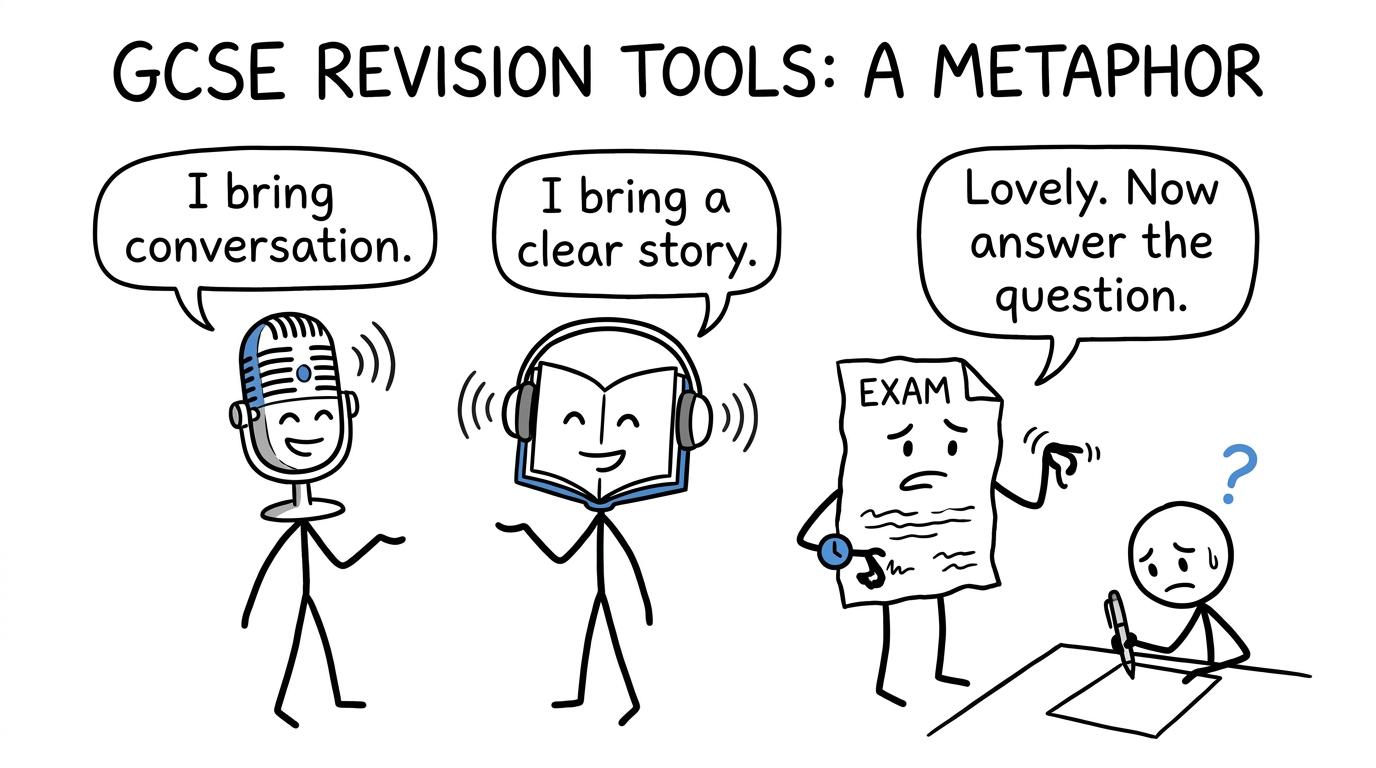 A podcast and audiobook meet an impatient exam paper
How to turn listening into effective revision
The most important step happens after you press pause. Retrieval practice, trying to recall information without looking back, has broad support in classroom research. It reveals what remained in memory and what only felt familiar.
Use this short cycle.
Preview the purpose
Before playing the audio, decide what you are listening for. It could be the main topic, three details, a speaker's opinion or examples of vocabulary from one specification theme.
A precise purpose stops your attention drifting.
Listen once without stopping
Treat the first play as a real listening attempt. Do not pause after every unfamiliar phrase. Write brief notes about the main idea and any details you catch.
Recall before checking
When the recording ends, explain what you understood without replaying it immediately. Write a short English summary, list key Mandarin words from memory or say the main points aloud.
This is where listening becomes revision rather than background sound.
Listen again with a transcript
Replay the section and use the transcript to investigate gaps. Mark whether each problem came from unknown vocabulary, a familiar word you failed to recognise, speed, tones or misunderstanding the whole sentence.
Those categories lead to different fixes. An unknown word needs vocabulary work. A known word missed at normal speed needs more listening exposure.
Produce something
Finish with one active response. You might answer a question, give a spoken summary, write several relevant sentences or create flashcards for a few high-value phrases.
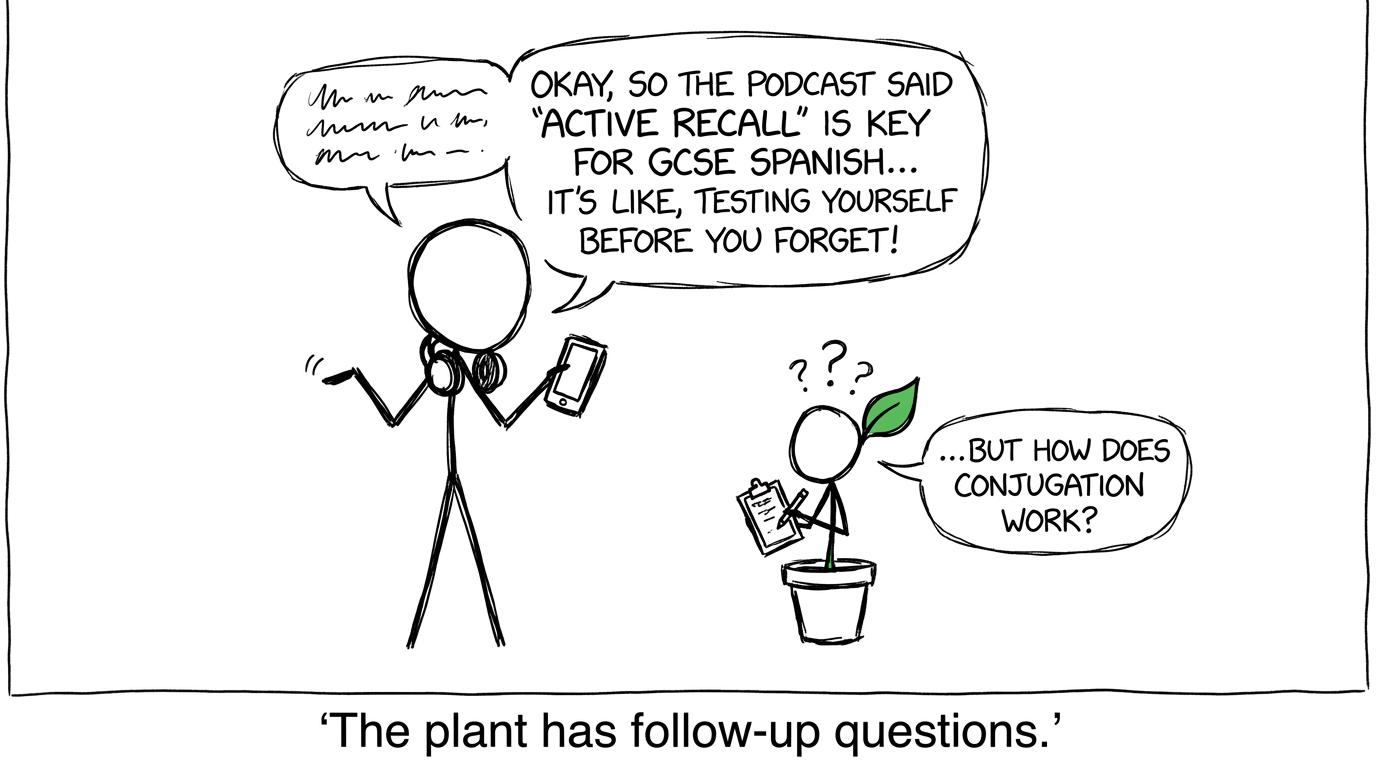 A student explains a paused podcast to a houseplant with an examiner clipboard
A realistic routine for students also revising maths
The target audience for this guide includes students preparing for GCSE maths alongside Chinese. The danger is not simply ineffective audio. It is allowing one comfortable activity to absorb time needed elsewhere.
Try a twenty-minute Chinese listening block:
- first five minutes: listen for the general meaning;
- next five minutes: replay and note details;
- next five minutes: check the transcript and correct gaps;
- final five minutes: recall vocabulary or record a response.
Then stop. A defined session protects time for other subjects and makes the task easier to repeat.
For maths, the same principle applies: input must lead to output. Watching a solution is useful, but answering a fresh question shows whether the method is yours. The MathsGenie GCSE maths revision hub brings together revision lessons, exam-style questions, worksheets and papers across the main UK exam boards.
If short sessions suit your timetable, use the twenty-minute GCSE maths revision routine. Students who need a wider schedule can follow the one-month GCSE maths revision plan and reserve specific blocks for Chinese listening.
Why audio should remain a supplement
A GCSE language qualification asks you to do more than understand speech. You must read accurately, communicate in writing and produce spoken language. Audio is therefore one part of a balanced plan.
Your weekly Chinese revision should also include:
- specification vocabulary and grammar;
- character recognition and writing;
- translation in the direction required by your board;
- prepared and spontaneous speaking;
- official past-paper questions;
- careful review of teacher feedback and mark schemes.
Use your board's own materials for exam-specific practice. A general podcast cannot reproduce the precise question wording, pauses, difficulty or response demands of your paper.
The comparison with maths is useful again. A student would not prepare for every maths paper by listening to someone discuss algebra. They would answer questions and correct errors. Start from the correct board pathway, such as AQA GCSE maths revision, then use timed papers when individual topics are secure. The same active principle should govern Chinese.
Common mistakes with podcasts and audiobooks
Playing audio in the background
Exposure has some value, but divided attention is weak exam preparation. If you are scrolling, travelling through a noisy place or completing unrelated homework, do not count every minute as focused revision.
Choosing content that is too difficult
Advanced native material may sound impressive while teaching very little. Choose audio where you can follow the broad meaning and recover more detail on a second listen.
Translating every word
Strong listeners tolerate small gaps. Focus first on the message, the speaker's attitude and the details demanded by your question. Investigate important unknown language afterwards.
Never checking understanding
Enjoyment is not proof of comprehension. Summarise, answer questions, use a transcript or explain the recording aloud. The guide to finding your weakest GCSE topics explains the same evidence-led principle for maths revision.
Replacing exam practice with comfortable listening
Audio feels less threatening than a timed task, which is exactly why it can become an escape. Build confidence with listening, then test it using official assessment materials. In maths, learn when to start GCSE past papers rather than waiting until every topic feels perfect.
Treating predicted material as certainty
Predicted resources are practice tools, not promises. MathsGenie's Edexcel GCSE maths predicted papers are designed for timed practice followed by marking and targeted repair. Apply that mindset across subjects: use fresh material to expose gaps, not to guess the exact exam.
Build a revision system, not a listening streak
Podcasts and audiobooks can make spoken Mandarin less intimidating. They can improve familiarity, support vocabulary and help you stay with a passage when every word is not immediately clear. Their value rises sharply when you pause, retrieve, check and respond.
But listening-based revision works best as a supplement only. Keep official exam practice, speaking, reading, writing and vocabulary retrieval at the centre of your GCSE Chinese plan.
Then give maths the same active attention. Open the MathsGenie GCSE maths revision area, choose your board and tier, and move from free revision lessons to practice questions, mini tests, past papers and predicted papers. Use mark schemes and video solutions to identify the next thing to fix.
Headphones can begin a good revision session. What you do after listening is what makes it count.