Physical Flashcards vs App for GCSE Religious Studies
Physical flashcards vs app GCSE Religious Studies: compare recall, focus, cost and spacing to choose a practical revision system with confidence.

Revision can become strangely productive-looking. You buy neat cards, choose five highlighter colours, download three apps and spend an evening designing a system. Yet the difficult question remains unanswered: can you recall the content without looking?
For physical flashcards vs app GCSE Religious Studies revision, neither format is automatically better. Paper cards offer focused, tactile revision without notifications. Apps make large decks easier to organise and can schedule repeated reviews. The best choice is the one that makes you retrieve accurate knowledge regularly, and still leaves time to practise complete exam answers.
That last point matters. GCSE Religious Studies is not simply a memory test. Across boards such as AQA, Edexcel, OCR and Eduqas, students need accurate knowledge alongside explanation, analysis and evaluation. Flashcards can build the knowledge beneath a strong answer, but they cannot replace writing one.
The quick decision checklist
Choose physical flashcards if you:
- focus better away from a screen;
- enjoy handwriting short summaries;
- have a manageable amount of content;
- will sort cards according to confidence;
- often get distracted by phone notifications.
Choose a flashcard app if you:
- need to manage several religions, themes or units;
- want automatic spaced-review reminders;
- revise during short gaps in the day;
- frequently lose paper resources;
- will create your own concise cards rather than collect huge shared decks.
Choose a hybrid system if you want the focus of handwriting and the scheduling convenience of an app. For many students, this is the most practical answer: make selected cards on paper, then use an app for the larger bank of definitions, teachings and comparisons.
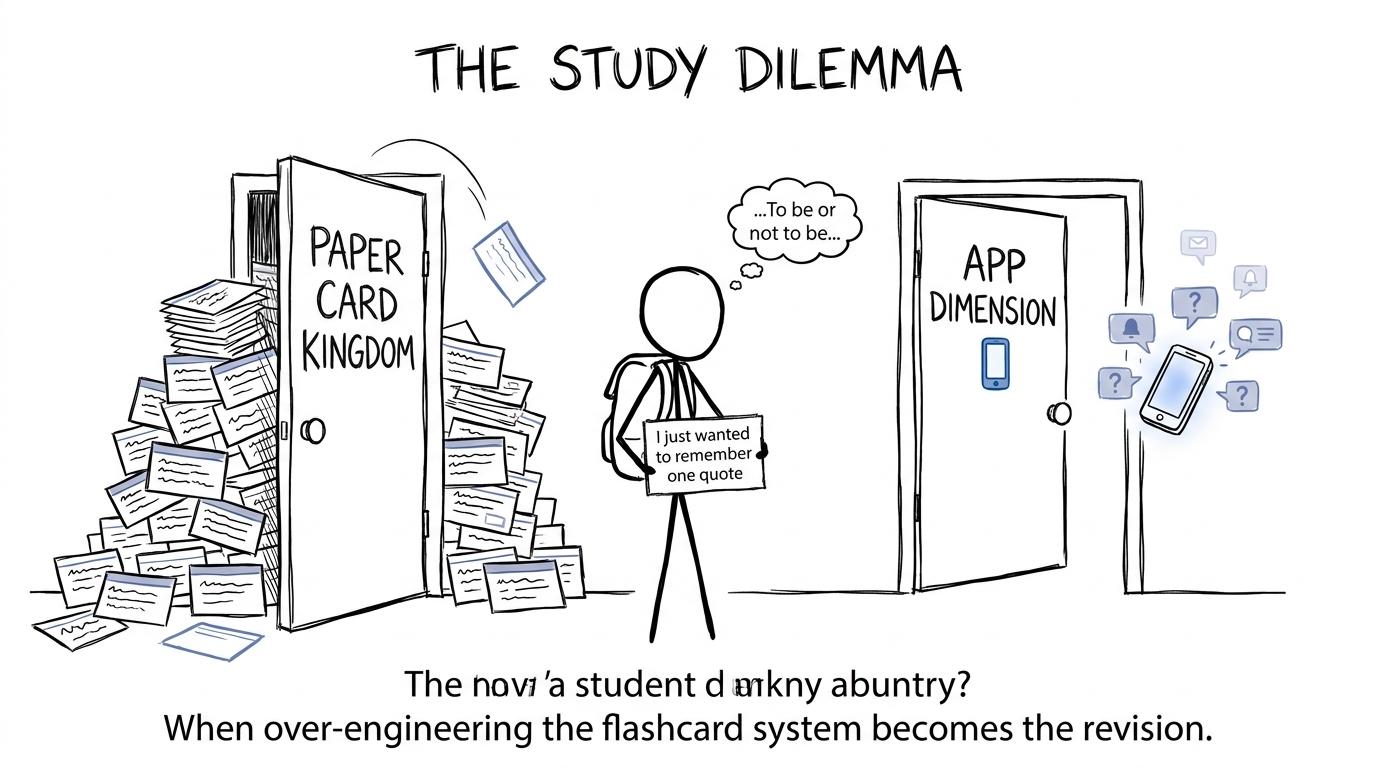 A student choosing between a kingdom of paper cards and an app dimension
What actually makes a flashcard effective?
The important distinction is not paper against screen. It is retrieval against recognition.
Recognition feels like this: you reveal the answer, read it and think, “Yes, I knew that.” Retrieval is less comfortable. You look only at the question, produce an answer from memory and then check it. That small struggle is the useful part.
Research on retrieval practice consistently supports attempting to recall information rather than repeatedly rereading it. Evidence comparing paper and digital flashcards is more mixed and often comes from vocabulary learning or older students, so it should not be treated as a guaranteed verdict for GCSE Religious Studies. The sensible conclusion is narrower: both formats can support learning when they require genuine retrieval and provide corrective feedback.
A good card should therefore:
- ask one clear question;
- have a short, checkable answer;
- use wording that you understand;
- test meaning, not merely visual familiarity;
- appear again after a delay;
- be answered before it is turned over or tapped.
This principle transfers directly to maths revision. Reading a formula is not the same as recalling when and how to use it. MathsGenie's GCSE Maths Revision hub combines active-recall flashcards with lessons, questions and papers because recall becomes valuable when it leads into application.
The real advantages of physical flashcards
Paper removes digital friction
A physical card cannot display a message, open a video feed or tempt you into checking something unrelated. If your phone regularly turns a planned revision session into twenty minutes elsewhere, paper has a serious advantage.
Physical cards also make progress visible. You can separate them into “secure”, “uncertain” and “not yet known” piles. That is a simple manual version of spaced repetition: weak cards return sooner, while secure cards wait longer.
Handwriting can encourage better selection
Writing is slower than copying and pasting. That inconvenience can be useful because it forces you to decide what belongs on the card. A concise question about the meaning of a belief is more useful than a paragraph copied from a textbook.
However, handwriting is not magic. A beautifully written card containing an entire essay plan may still be difficult to retrieve and mark. The benefit comes from thinking, selecting and reformulating, not from stationery itself.
Paper works well for small, deliberate sets
Physical cards are particularly effective for a carefully chosen collection of:
- key terms;
- brief teachings and their meanings;
- differences between religious viewpoints;
- links between beliefs and practices;
- common misconceptions;
- command-word reminders.
The weakness appears when the collection becomes unmanageable. A large box can make it difficult to know what is due, what has been mastered and what has quietly disappeared under your desk.
The real advantages of a flashcard app
Apps organise repeated review
Many apps can bring weaker cards back more frequently and delay cards you answer confidently. This removes some of the organisation required by a paper system. It is especially helpful when your course covers several themes and each theme contains definitions, teachings, arguments and contrasting perspectives.
Convenience also increases the number of opportunities to revise. A short review on the bus is unlikely to replace a focused desk session, but it can maintain knowledge between longer sessions.
Digital cards are easier to edit and search
If your teacher corrects the wording of a belief or explains that a quotation has been applied inaccurately, an app lets you change every relevant card quickly. Tags can group cards by religion, theme, paper or confidence level.
The danger is scale. Because digital cards are easy to create, students can produce hundreds without deciding whether each one deserves attention. A large deck is not evidence of learning. It may simply be a large future obligation.
Shared decks save time but require checking
Ready-made decks can provide a starting point, but they may follow another exam board, specification or taught religion. They can also contain oversimplified interpretations or quotations without sufficient context.
Check shared material against your specification, class resources and teacher guidance. Requirements vary, so do not assume that every quotation or response structure applies equally to AQA, Edexcel, OCR and Eduqas.
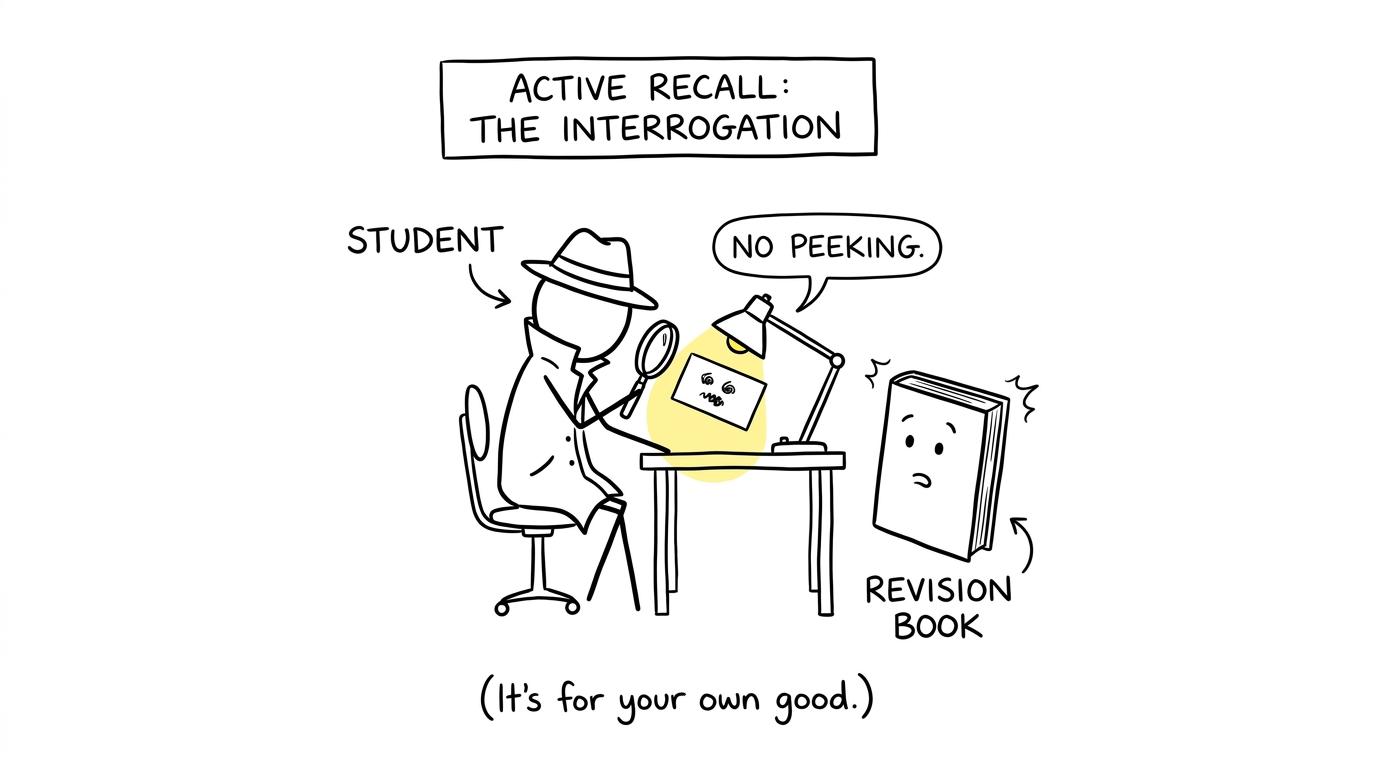 A flashcard detective insisting on no peeking during active recall
Why Religious Studies needs more than memory cards
Flashcards are strongest when an answer has a reasonably clear boundary. They can test what a term means, what a teaching communicates or how two viewpoints differ. Evaluation is less tidy.
A high-quality extended response needs you to select relevant knowledge, connect it to the question, consider arguments and reach a justified judgement. Memorising an entire model paragraph can become fragile if the wording of the question changes.
Use cards as the first stage of a three-part routine:
- Recall: retrieve key knowledge without notes.
- Connect: explain how the knowledge relates to a particular issue.
- Write: answer an exam-style question and review it against the relevant mark scheme or teacher feedback.
This resembles effective maths revision. A formula card may start the process, but marks come from applying the idea accurately. The 20-minute GCSE maths revision routine moves from recall into questions and feedback rather than stopping at memory.
Physical flashcards vs app: the honest comparison
| Consideration | Physical flashcards | Flashcard app |
|---|---|---|
| Focus | Usually distraction-free | Depends on notifications and device habits |
| Creating cards | Slower, which can encourage selection | Fast and easy to edit |
| Large collections | Harder to sort and transport | Easy to search, tag and organise |
| Spaced review | Requires a manual box or pile system | Often scheduled automatically |
| Availability | Only present when carried | Available across supported devices |
| Cost | Requires cards, paper or stationery | Free options may exist; features vary |
| Best use | Small, focused collections | Larger decks and regular review |
| Main risk | Spending too long making attractive cards | Copying, collecting or tapping without thinking |
The table suggests a practical rule: choose paper when focus is your main obstacle, and choose an app when organisation is your main obstacle.
If both are obstacles, use a hybrid. Handwrite only the concepts that require careful thought, then store shorter factual prompts digitally. There is no prize for loyalty to one medium.
A revision system that works alongside GCSE maths
Students rarely revise Religious Studies in isolation. English, science and maths are competing for the same evenings. The right system must therefore be sustainable, not merely impressive.
A balanced weekly pattern could include short flashcard reviews on several days and one longer Religious Studies session for exam responses. Protect separate time for mathematical practice using the GCSE maths revision efficiency guide, which follows a learn, practise, mark, fix and retest cycle.
When time is tight, use small tasks with a definite finish. MathsGenie's Edexcel GCSE Maths mini tests provide targeted timed practice, while a short Religious Studies flashcard deck can maintain recall. For longer-term organisation, the one-month GCSE maths revision plan shows how retrieval, topic work and papers can fit into a repeatable timetable.
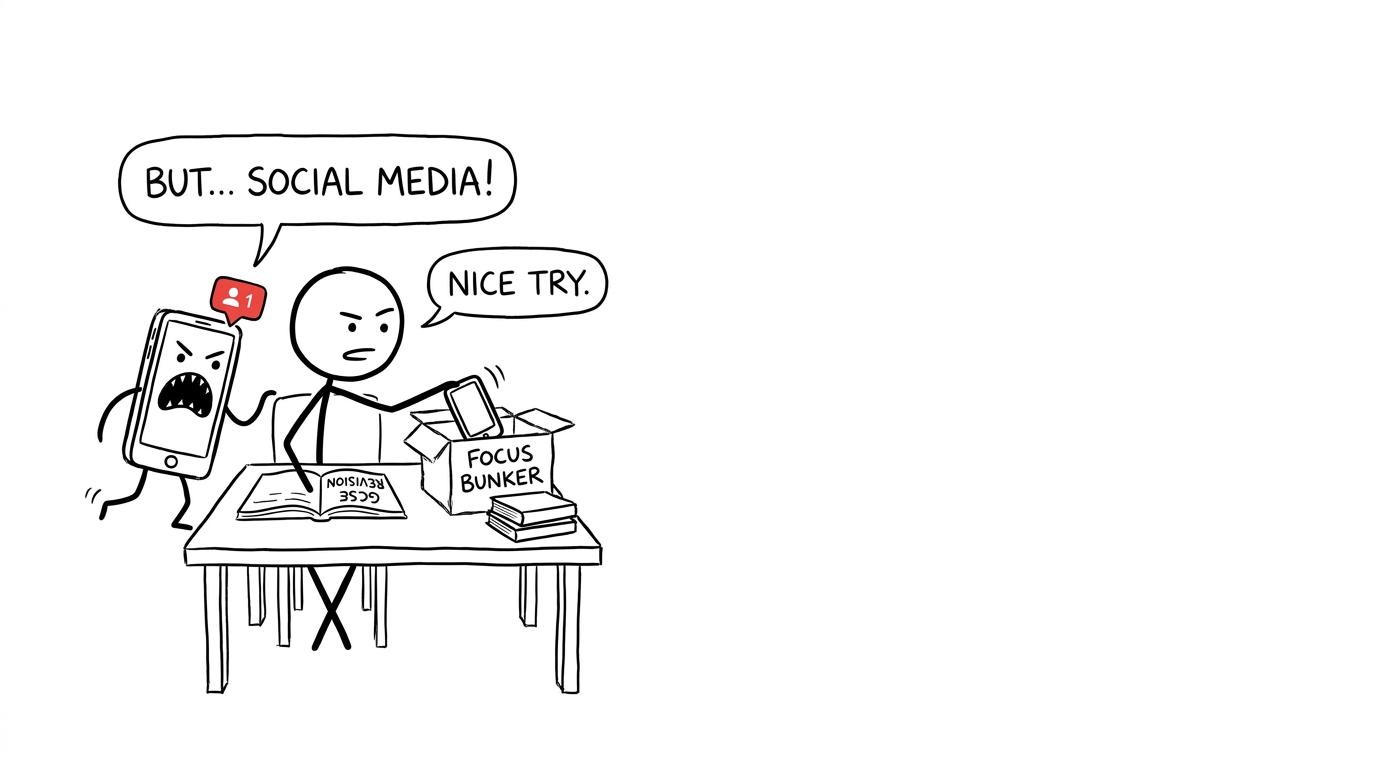 A student placing a distracting phone into a cardboard focus bunker
Common mistakes with GCSE Religious Studies flashcards
Putting too much on one card
If the back contains several paragraphs, you cannot judge your answer consistently. Split broad material into separate prompts testing definition, significance, application and comparison.
Revealing the answer too quickly
A flashcard only becomes retrieval practice when you make a genuine attempt. Say or write the answer before checking it.
Revising cards in the same order
A fixed sequence can create false confidence because one card hints at the next. Shuffle paper cards or use an app setting that varies the order.
Treating quotations as decorative extras
Knowing words without understanding their meaning or relevance is limited preparation. Pair each short teaching with prompts about what it supports, how it may be interpreted and where it would not answer the question.
Replacing exam practice with card making
Flashcards train components of an answer. They do not train timing, argument or sustained judgement. The same mistake appears in maths when students memorise methods but avoid unfamiliar questions. Learn how to turn feedback into action with MathsGenie's guide to using GCSE mark schemes to improve.
Revising the wrong specification
Check your board, course and taught religions before building or downloading a deck. A confident answer to content outside your specification is still misplaced revision.
The final verdict
Physical flashcards are worth making when handwriting helps you select ideas, paper protects your concentration and the deck remains manageable. An app is usually better when you need portability, searchable organisation and automatic scheduling across a large course.
But the medium is secondary. The winning system is the one in which you answer before looking, revisit weak knowledge over time and apply that knowledge in complete exam responses.
Use the same honest principle across your subjects. For maths, begin with the free MathsGenie GCSE revision resources, then move from revision lessons and flashcards into practice questions, mini tests, past papers and predicted papers. Mark your work carefully, use video solutions when a method is unclear and return to the weaknesses that cost marks.
Choose your tool, make the first small deck and start retrieving. Revision improves when the system stops being the project and becomes the habit.