GCSE Mark Schemes: How to Turn Them Into Marks
GCSE mark schemes can boost your grades fast. Learn how to read method marks, follow-through and units, with examples and a clear routine.

GCSE season has a specific kind of silence. You open a paper, you see a question you half recognise, and you can almost feel the marks slipping away, not because you know nothing, but because you’re unsure what the examiner wanted.
That’s why GCSE mark schemes matter. They aren’t just an answer key. A good GCSE mark scheme is a map of how marks are awarded: the method marks you can still earn, the accuracy marks you lose if you round too early, the units that quietly decide whether you get the final mark, and the follow-through that rescues you when one step goes wrong.
This post is about GCSE Chemistry mark schemes, but it’s written for GCSE and A Level maths students on YesGenie. Because the habits you build reading mark schemes in Chemistry translate perfectly to maths, and maths is where the fastest, most reliable mark gains usually happen.
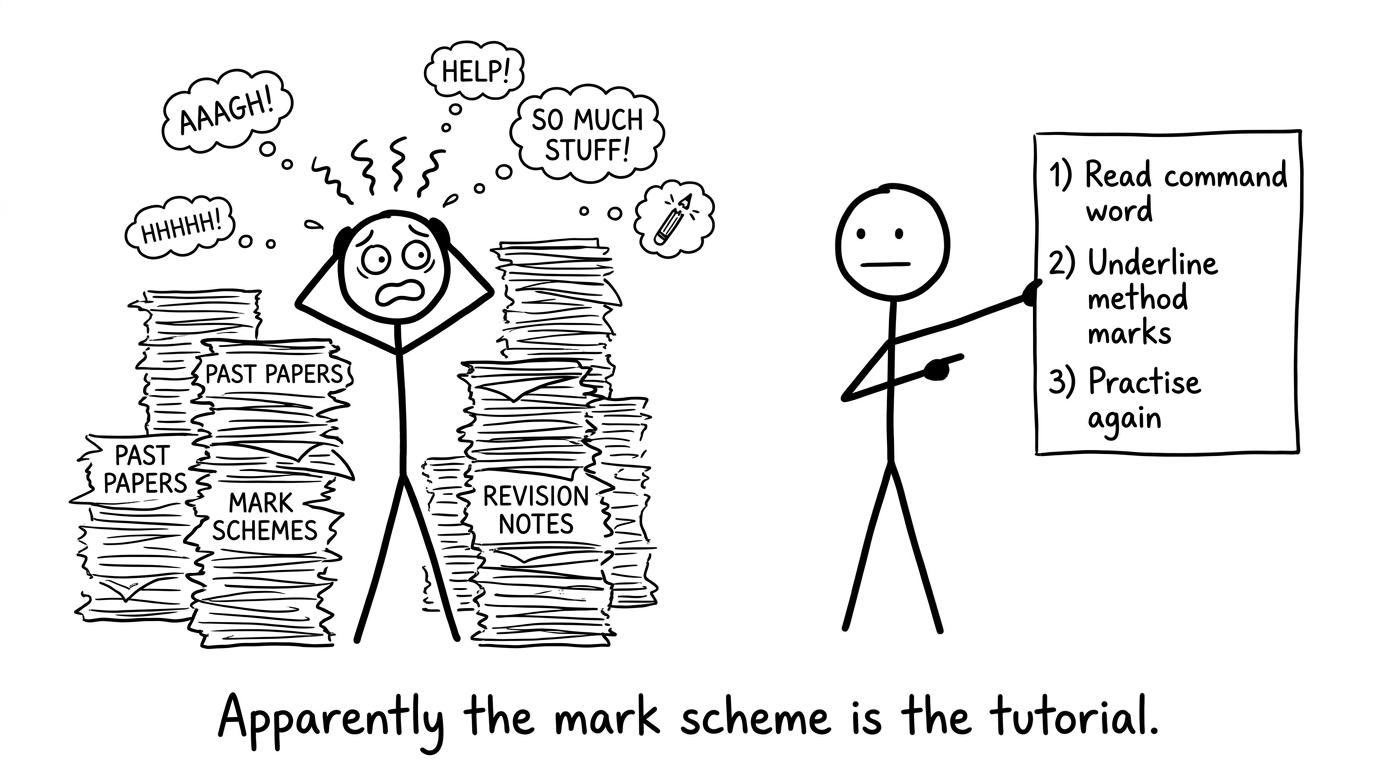 A stressed student discovers the mark scheme is a tutorial
The simple mark scheme routine (use this every time)
If you only take one thing from this, take this routine. It works for GCSE Chemistry calculations and GCSE maths.
- Attempt first, mark second: do the question properly before looking.
- Mark with a pen: write the mark scheme language next to your work (e.g. “method”, “units”, “sf”).
- Classify the loss: was it a missing step, a numerical slip, rounding, units, or wording?
- Rewrite the perfect solution: not just the final answer: the exact steps that earn marks.
- Repeat a near-twin question: immediately practise the same skill again.
To practise this on maths papers with real mark schemes, use GCSE Past Papers and then tighten the gap using GCSE Maths Mini Tests (Edexcel).
Why GCSE mark schemes feel harsh (and why that’s good)
A mark scheme is a contract. It says, “If you show this, you get that.” In GCSE Chemistry, that might be a structured method for calculating concentration or interpreting required practical data. In GCSE maths, it’s often a method mark for setting up the right equation even if the arithmetic later goes wrong.
Students often think the examiner is looking for brilliance. Usually, the examiner is looking for evidence.
The quiet advantage is that evidence is trainable. You can learn to write what earns marks.
On YesGenie you can see this clearly because many papers come with mark schemes and video walkthroughs. For example, you can attempt a paper and then compare your working to the Paper 1 Video Solutions (GCSE Maths Edexcel) style of presentation.
Translating GCSE Chemistry mark schemes into maths gains
Even if your immediate pain is Chemistry, here are the shared mark scheme ideas that will raise your maths score too.
Method marks are the real treasure
In GCSE Chemistry calculations, method marks often come from:
- writing the correct formula,
- rearranging it correctly,
- substituting values with units.
In GCSE maths, method marks come from setting up the right structure: the equation, the diagram, the rearrangement, the probability tree, the correct trig ratio.
Your mark scheme habit: circle the first line in the mark scheme that would have earned you a mark. Then ask: Did my script show that exact idea? If not, add the missing “evidence line” to your method.
Follow-through marks reward consistency
In Chemistry, if you mis-copy a value early but then do everything else correctly, examiners often allow follow-through.
Maths mark schemes do the same. A classic example is when you find a wrong gradient, but then correctly use your gradient in the line equation.
Your mark scheme habit: when you get a final answer wrong, scan the mark scheme for clues like “ft” or “follow-through” (phrasing varies by board). It teaches you that exams are not all-or-nothing.
Communication marks are really “clarity marks”
Chemistry gives marks for clear reasoning and correct scientific language. Maths gives marks for clear working, correct notation, and stating conclusions.
A mark scheme trains you to be readable under pressure.
If your algebra is messy, build one topic at a time using a structured page like Algebraic Fractions (GCSE Maths), where the presentation is consistent and the expectations are exam-style.
Worked example: using a mark scheme to rebuild your method (maths)
You don’t improve by staring at the “right answer”. You improve by rebuilding the sequence of marks.
Here’s a typical GCSE maths situation where mark schemes are powerful.
Example: rearranging and substituting (the “Chemistry-style” calculation)
A student is asked to rearrange and then substitute:
Rearrange A=3B−2CA = 3B - 2CA=3B−2C to make BBB the subject. Then find BBB when A=14A = 14A=14 and C=4C = 4C=4.
Step 1: Rearrangement
Start with:
A=3B−2C A = 3B - 2C A=3B−2CAdd 2C2C2C to both sides:
A+2C=3B A + 2C = 3B A+2C=3BDivide by 333:
B=A+2C3 B = \frac{A + 2C}{3} B=3A+2CStep 2: Substitute values
B=14+2×43=14+83=223 B = \frac{14 + 2\times 4}{3} = \frac{14 + 8}{3} = \frac{22}{3} B=314+2×4=314+8=322So B=223B = \frac{22}{3}B=322.
How the mark scheme mindset improves this
If you got the final value wrong, a mark scheme often awards marks for:
- correct rearrangement (B=A+2C3B = \frac{A + 2C}{3}B=3A+2C),
- correct substitution structure (14+2×43\frac{14 + 2\times 4}{3}314+2×4),
- accurate simplification.
That’s exactly how GCSE Chemistry mark schemes reward a correct formula and substitution even if the arithmetic is off. You’re training one skill across two subjects.
Using mark schemes the smart way (not the lazy way)
There are two types of mark scheme use.
The lazy way
- Look at the mark scheme quickly.
- Think “I get it”.
- Move on.
It feels efficient. It rarely changes your score.
The smart way
- Compare your line to their line.
- Identify the first mismatch.
- Add the missing line to your “personal method template”.
Over time you end up with a small set of reusable templates: for rearranging, for percentage change, for probability, for trig, for algebraic proof.
To make this systematic, build your practice around mark-scheme-backed resources like Resources (Predicted Papers, Mini Tests and more) and Edexcel GCSE Old Maths Revision when you want extra paper sets.
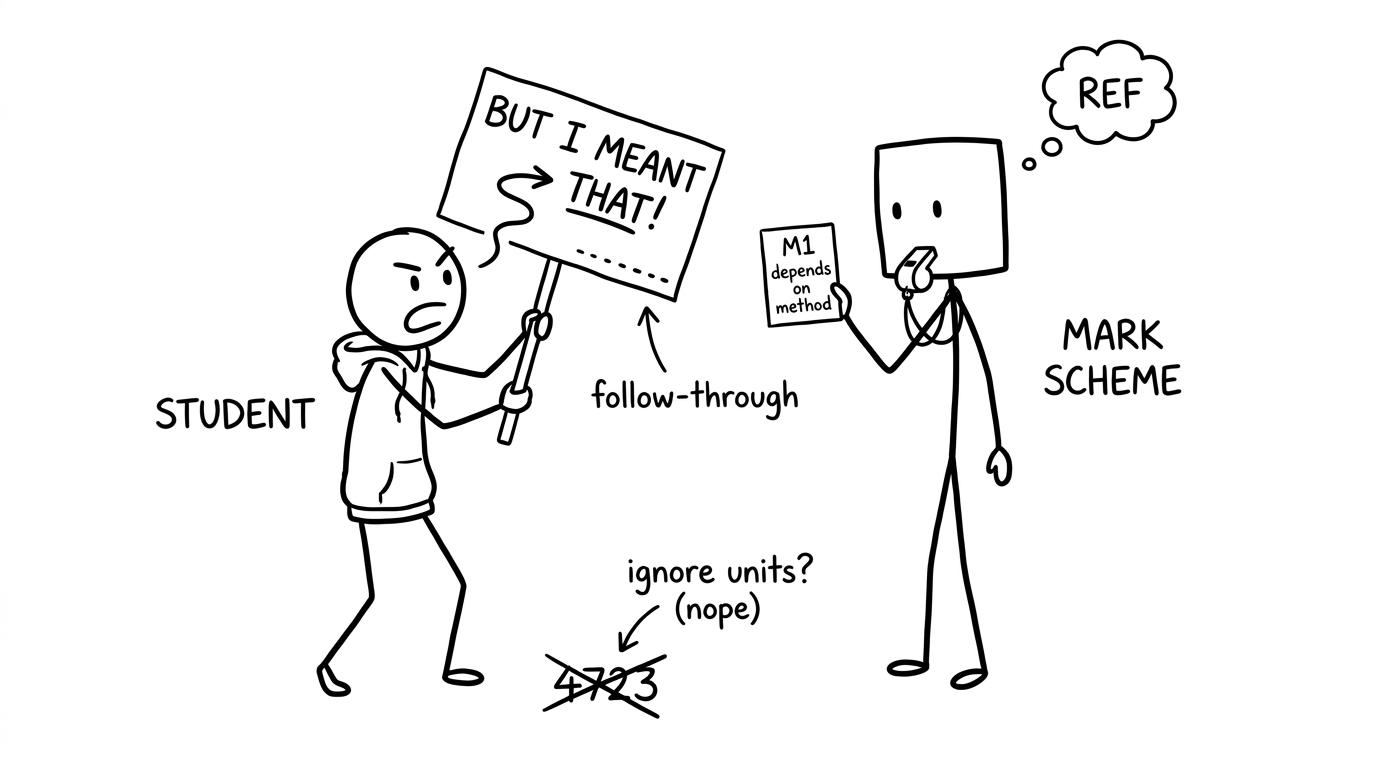 A student argues with the mark scheme like a referee
A quick “mark scheme translation” checklist for command words
Chemistry and maths share a frustrating truth: command words often decide how many marks are available.
- State / give: usually a short, precise answer (maths: value; chemistry: fact).
- Calculate: show your method. In maths, that means lines of working. In Chemistry, it often means formula, substitution, and units.
- Explain / justify: you need a reason, not just an answer.
- Show that: the examiner expects a trail that arrives at the given result.
If you want to see how mark schemes reward structured “show that” solutions in maths, choose a harder reasoning topic like Vectors Proof Questions (GCSE Revision Guide) and compare your work to the model structure.
Common mistakes when using mark schemes
These mistakes are common in GCSE Chemistry and GCSE maths, and they’re fixable.
Checking only the final answer
If you only look at the last line, you miss the method marks that were available. In GCSE exams, method marks are where grade jumps happen. Train your eyes to hunt for the first mark-awarding step.
Copying the mark scheme without understanding the mark allocation
A mark scheme is not a set of notes. It’s a marking recipe. If you don’t know which line earns which mark, you won’t know what to prioritise under time pressure.
Ignoring units, rounding, and significant figures
In Chemistry, this is obvious. In maths, it’s subtler: rounding too early can break accuracy marks. A good habit is to keep exact values (fractions or surds) until the end unless the question tells you otherwise.
Not learning the “standard sentence”
Chemistry has standard phrases. Maths does too: “Let”, “Therefore”, “Hence”, “So the value of xxx is…”. Mark schemes show you the expected phrasing and layout. Steal the structure.
Not doing a second attempt
The biggest waste is understanding the mark scheme and not immediately re-attempting a similar question. That second attempt converts insight into a habit.
 A revision planner where marks slowly come back
Bringing it back to YesGenie (and to your next paper)
The students who improve fastest aren’t always the ones who do the most revision. They’re the ones who turn every mistake into a repeatable method.
That’s what mark schemes are for. In GCSE Chemistry they teach you how marks are awarded for formulas, substitution, units and explanations. In GCSE maths they teach you how to harvest method marks, write clearer working, and stop losing easy accuracy marks.
Pick one paper today. Do it honestly. Then use the mark scheme like a coach: identify the first missing step, rewrite the perfect solution, and practise the same skill again. On YesGenie you can do that with GCSE Past Papers, targeted practice via Resources (Predicted Papers and Mini Tests), and topic support through revision guides such as Edexcel GCSE Maths Revision Guides.
If you want the simplest next action: choose your exam board (Edexcel, AQA, OCR, Eduqas), attempt one GCSE paper, and use the mark scheme to build your personal “methods that earn marks” list. Then let YesGenie’s lessons, practice questions, mark schemes, video solutions and predicted papers do what they’re designed to do: turn understanding into grades.