Perfectionism GCSE Spanish Revision: Break the Cycle
Perfectionism GCSE Spanish revision can turn care into avoidance. Spot hidden procrastination, practise imperfectly and protect your maths revision time.
Revision can look productive without producing much learning. A student might spend an evening redesigning Spanish flashcards, rewriting one paragraph until it sounds flawless or postponing speaking practice until they feel more confident. The desk is busy. The difficult work remains untouched.
That is the central problem with perfectionism GCSE Spanish revision: high standards quietly become avoidance. The answer is not to stop caring. It is to replace flawless preparation with small, imperfect attempts that generate useful feedback. This matters particularly when Spanish is competing with GCSE maths and other subjects for limited revision time.
Research does not suggest that every form of perfectionism is harmful. Ambition, organisation and realistic standards can support learning. The danger is self-critical perfectionism, fear of mistakes, rigid expectations and the feeling that work only counts when it is exceptional. Evidence about its precise relationship with procrastination is mixed, but research commonly distinguishes productive striving from perfectionistic concerns. NHS guidance also identifies excessive checking, indecision and procrastination as behaviours associated with unhealthy perfectionism.
A quick perfectionism checklist
Your Spanish revision may be getting trapped by perfectionism if you regularly:
- delay speaking because your accent is not ready;
- rewrite notes instead of testing your memory;
- spend too long making resources neat or complete;
- avoid listening tasks because missing words feels uncomfortable;
- check every sentence before finishing a timed writing task;
- restart revision plans after one disrupted day;
- revise familiar vocabulary while avoiding weak grammar;
- judge a useful session as a failure because it was not perfect.
One isolated habit proves nothing. A repeated pattern is more revealing: preparation expands while retrieval, correction and timed practice keep being postponed.
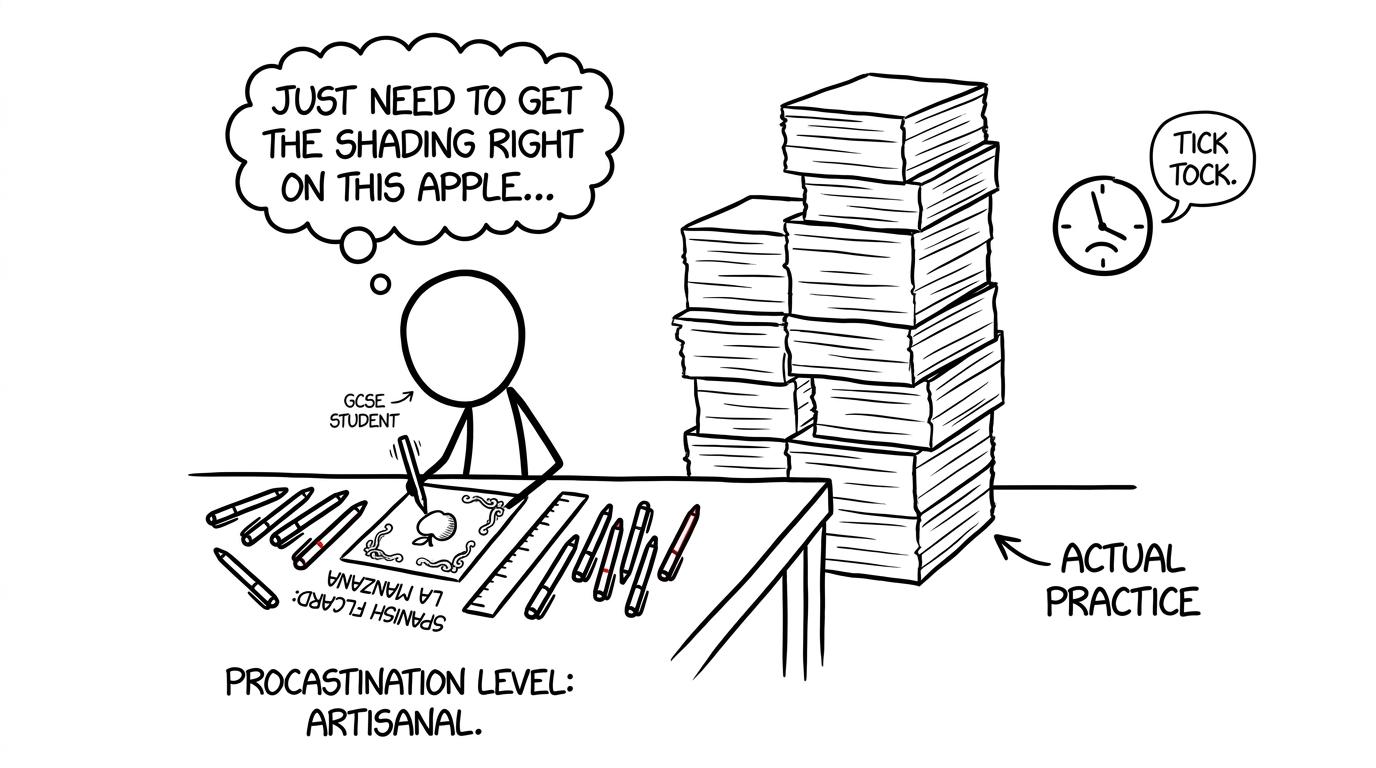 A student perfecting one flashcard while actual practice waits
How perfectionism appears in GCSE Spanish revision
Perfectionism rarely announces itself as avoidance. It usually sounds responsible: “I need better notes first” or “I will practise speaking when I know more vocabulary.” That is why it can be harder to notice than ordinary procrastination.
You prepare to revise instead of revising
Colour coding a vocabulary list or organising folders can be useful briefly. It becomes avoidance when the organisation repeatedly replaces recall. Recognition feels comfortable because the answer is visible. An examination asks you to retrieve, understand or produce language without the safety of a polished page.
A better test is simple: after making a resource, close it and use it. Recall the vocabulary, respond aloud, complete a listening task or write from memory. If the resource never leads to an attempt, its appearance has become more important than its function.
You treat speaking mistakes as evidence about your ability
Speaking exposes uncertainty immediately. You may hesitate, choose the wrong ending or forget a familiar word. A perfectionist can interpret that moment as proof that speaking practice should wait.
But waiting removes the exact experience needed to improve: forming language under pressure, noticing a gap and trying again. A rough spoken answer is not a final judgement. It is information about vocabulary, pronunciation, grammar and fluency.
You over-edit writing before completing it
Careful checking matters, but checking too early can break the flow of a response. Some students repeatedly repair the opening sentences while later bullet points remain unanswered. The work becomes locally polished but incomplete.
Separate production from correction. Finish a complete first attempt, then check it with a short sequence: task coverage, verbs, agreements, spelling and clarity. Your exam board’s current specification and sample materials should guide the precise demands of your writing paper.
You avoid listening because uncertainty feels like failure
Listening contains ambiguity. Speech continues even when one word is missed, and that can feel especially uncomfortable to a student who expects complete understanding.
The useful skill is not hearing every word. It is continuing to listen, identifying meaning from what you do understand and reviewing the transcript or answers afterwards. Avoiding difficult audio preserves confidence temporarily, but it also preserves the weakness.
You build an impossible timetable
A perfectionist revision plan often assumes ideal energy, uninterrupted evenings and no competing homework. When real life disrupts one session, the whole plan can feel ruined.
This all-or-nothing response matters to maths students because Spanish does not exist in isolation. An oversized language session can consume time intended for algebra, geometry or a past paper. A smaller plan that survives an ordinary school week is more valuable than an impressive plan abandoned after two days.
Why it can be worse than the procrastination it tries to prevent
Ordinary procrastination wastes time openly. Perfectionistic procrastination can waste time while creating the reassuring feeling that you are working.
It carries three costs.
First, it delays exposure to mistakes. If you keep polishing notes, you do not discover which vocabulary disappears under pressure or which grammar rules you cannot yet apply.
Second, it spends scarce time on low-value detail. Every extra half-hour making one resource flawless is time unavailable for another Spanish skill, a GCSE maths topic or proper rest.
Third, it adds self-criticism to delay. You have not only postponed the task; you may also decide that the delay reveals something negative about you. That judgement can make the next attempt feel even heavier.
This does not mean perfectionism inevitably causes procrastination. Studies have produced differing results, and much of the available academic research concerns university students rather than GCSE pupils. A more defensible conclusion is that fear of mistakes, anxiety and rigid standards can interact with avoidance. The practical response is to reduce the cost of starting.
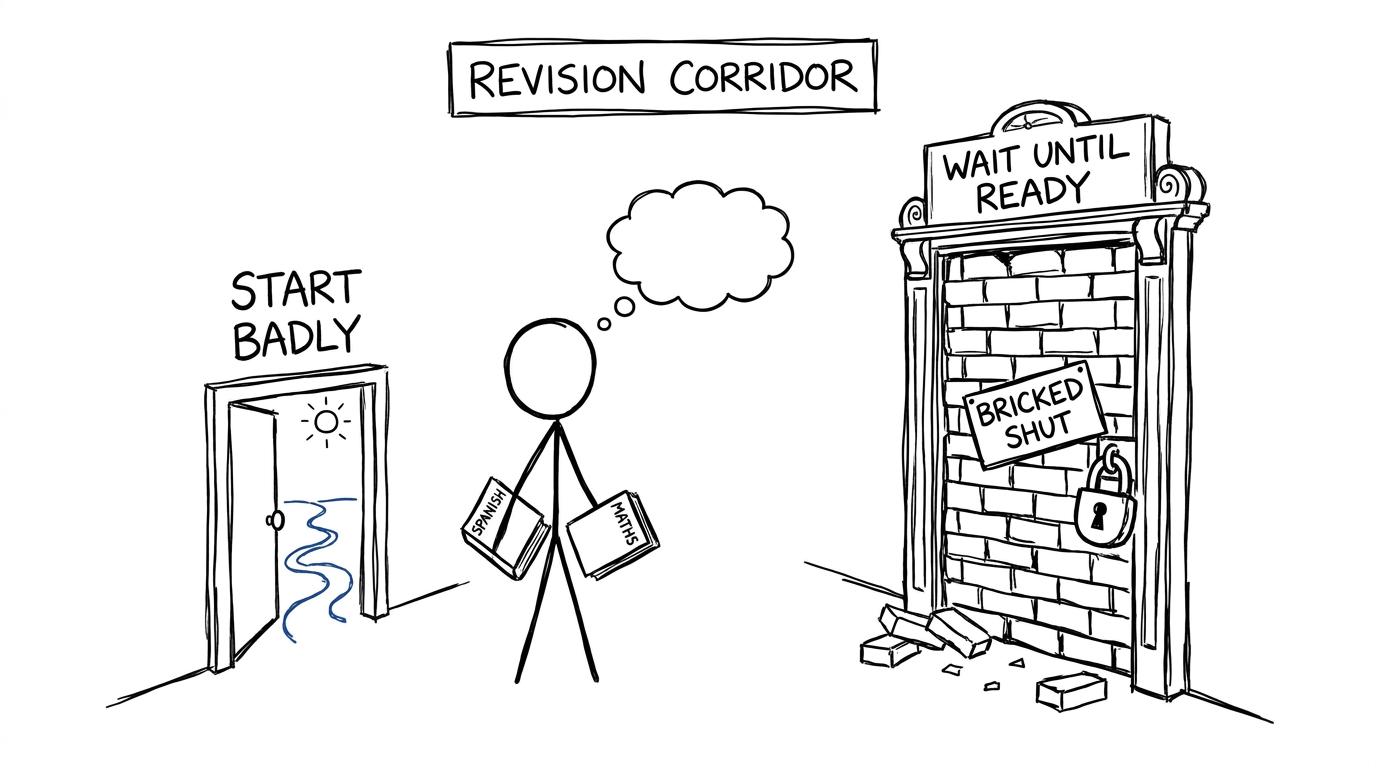 A small door marked start badly opens while waiting until ready leads nowhere
Replace perfect revision with feedback loops
The opposite of perfectionism is not carelessness. It is a shorter distance between attempt and feedback.
Define a minimum useful session
Choose an action small enough to begin on a difficult day. That might be recalling a short vocabulary set, recording one spoken response or completing part of a listening activity. Stop describing the goal as “revise Spanish”. Name the observable action.
The same principle works in maths. MathsGenie’s twenty-minute GCSE maths revision routine shows how a short session can move from recall to questions and marking without elaborate preparation.
Use a rough-first rule
Give yourself permission to produce an incomplete or uncertain first attempt. Speak before scripting every sentence. Write before checking every ending. Answer before opening the notes.
“Rough” does not mean random. It means the attempt is allowed to reveal what you cannot yet do. Feedback then gives the second attempt a clear purpose.
Limit checking
Decide what checking will involve before you begin. For Spanish writing, use a compact checklist rather than repeatedly rereading for a vague sense of certainty. For maths, compare your work with the mark scheme and identify the exact reason a mark was lost.
The MathsGenie GCSE maths revision hub brings together revision lessons, practice questions, mini tests, papers and solutions, making it easier to move from an attempt to a specific correction.
Keep an error log, not a shame log
Record errors neutrally:
- what the task tested;
- what went wrong;
- what you will do next;
- when you will test it again.
Avoid entries such as “careless” or “terrible”. They describe your frustration, not the correction. In maths, the same method turns a lost mark into a topic action. The guide to using Edexcel GCSE maths past papers properly explains this attempt, diagnose and reattempt cycle.
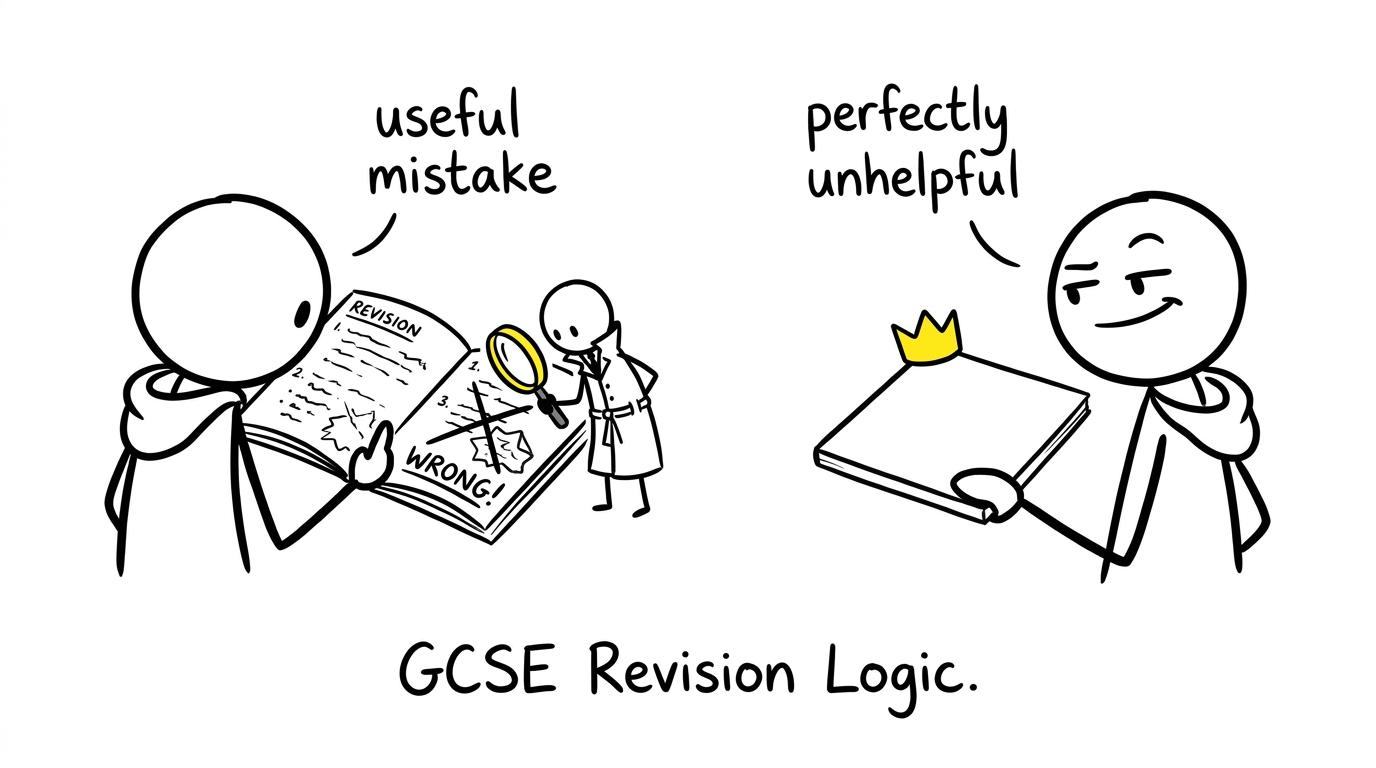 A useful crossed-out answer investigates while a perfect blank page offers no clues
Protect your GCSE maths revision as well
Perfectionism in one subject can distort the whole revision week. If Spanish expands until every flashcard, paragraph and pronunciation feels complete, maths receives whatever energy remains.
Use a shared revision structure instead:
- allocate a clear finish time to each subject;
- choose one measurable outcome per session;
- include attempts and marking, not only reading;
- carry unfinished work forward without rebuilding the plan;
- review priorities using evidence from tests and papers.
For a broader timetable, adapt the structure in the GCSE one-week maths revision plan. When you are ready for exam practice, choose the correct board and tier through AQA GCSE maths past papers, OCR GCSE maths past papers or Edexcel GCSE maths past papers.
Do not wait until you feel fully prepared. Past papers are partly diagnostic. MathsGenie’s guide to when you should start GCSE past papers explains why beginning with manageable sections can be more useful than postponing all paper practice until the course feels complete.
Common mistakes when trying to overcome perfectionism
Replacing one perfect system with another
You do not need an elaborate anti-perfectionism tracker. A short task list and an error log are enough. If maintaining the system becomes another revision project, simplify it.
Making “good enough” deliberately careless
The aim is not to ignore instructions, skip checking or accept avoidable errors. It is to attempt the task before complete certainty and then improve it using evidence.
Measuring only time spent
A long session can contain little retrieval. Measure completed actions instead: responses attempted, questions marked, errors corrected and skills retested.
Comparing your rough work with someone else’s finished work
You rarely see how many corrections sit behind another student’s fluent answer or neat page. Compare your latest attempt with your earlier one.
Treating one missed day as a broken plan
Do not repay a missed session by doubling the next one. Resume with the smallest useful action. Consistency is the ability to return, not the ability never to be interrupted.
Ignoring persistent distress
Revision advice is not mental health treatment. If fear of mistakes, anxiety or self-criticism is affecting sleep, daily life or your ability to function, speak to a parent or carer, teacher, school pastoral lead, GP or another trusted adult. Asking for support is a practical step, not a failure of discipline.
Progress begins before confidence arrives
Perfectionism promises that enough preparation will remove uncertainty. Exams do not offer that bargain. Spanish requires you to listen, speak, read and write without controlling every word. Maths requires you to attempt unfamiliar questions and learn from lost marks.
The healthier standard is demanding but realistic: start, finish a first attempt, check it properly and return to the weakness. Your work does not need to be flawless to move you forward.
For maths, make that loop easy with MathsGenie. Begin with free revision lessons and practice questions, test yourself using mini tests and past papers, then use mark schemes and video solutions to correct mistakes. Nearer the exam, add Edexcel GCSE maths predicted papers for fresh exam-style practice. Choose one imperfect action today, then let the feedback decide what comes next.