

Peaking Too Early? GCSE ICT Revision That Lasts
Peaking too early in GCSE ICT revision? Use spaced recall, exam questions and a calm revision plan to keep your knowledge fresh until May.
There is a strange moment in revision when confidence becomes unsettling. You finish a topic, answer nearly every question correctly and think: What if this is the best I will be? What if I forget everything before May?
If you are worried about peaking too early in GCSE ICT revision, the short answer is reassuring: early confidence is not a problem. It only becomes fragile when you stop retrieving and applying what you have learnt. The aim is not to preserve one perfect revision session. It is to revisit the knowledge often enough that it remains available under exam conditions.
This matters for maths too. Students often feel fluent with percentages, graphs or algebra immediately after revising them, only to hesitate several weeks later. In both subjects, lasting confidence comes from spaced retrieval, exam-style practice and honest feedback, not from trying to stay at maximum intensity for months.
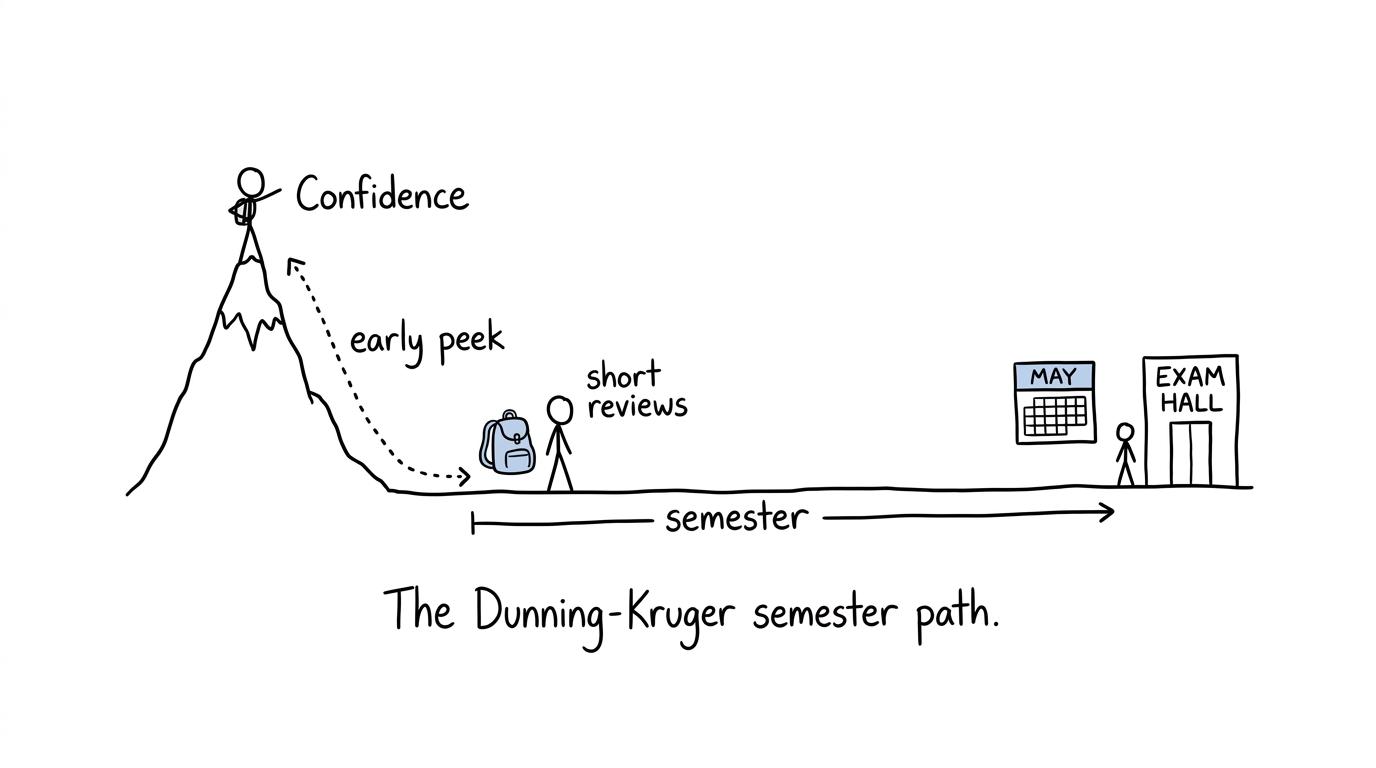 A student reaches the confidence summit before noticing the long road to May
A quick checklist for keeping knowledge fresh
Use this simple loop from now until the exam:
- Check the exact specification and assessment format for your qualification.
- Recall topics without notes before rereading anything.
- Revisit secure material occasionally rather than abandoning it.
- Return to weaker topics more frequently.
- Complete exam-style questions and mark them carefully.
- Record why marks were lost, not merely the final score.
- Include maths practice in the same weekly plan.
- Increase timed-paper practice gradually as the exam approaches.
- Protect sleep, breaks and ordinary schoolwork.
The principle is simple: learn, leave a gap, retrieve, check and revisit.
Why students feel most confident months before the exam
Confidence often arrives just after a concentrated block of revision. Perhaps your class has completed networks, cybersecurity, databases or data representation. The vocabulary is familiar, your notes are organised and recent questions feel manageable.
That feeling is real, but it does not necessarily measure long-term retention.
Immediately after revising, information is easier to recognise. A heading in your notes, the wording of a familiar question or even the layout of a page can prompt the answer. In the exam, those prompts may disappear. You must identify the topic from an unfamiliar context, recall the relevant knowledge and communicate it in the form the question requires.
This creates a gap between familiarity and retrieval. Familiarity says, “I understand that when I see it.” Retrieval says, “I can produce and apply it without help.” The second is the more useful measure of exam readiness.
Early confidence can also fall because revision naturally becomes more mixed. A short test on one recently taught unit is easier to navigate than a full paper containing material from across the course. A lower score on mixed questions does not automatically mean you are getting worse. It may mean that the practice has become more realistic.
First, confirm what qualification you are taking
“GCSE ICT” is still used informally in some schools, but your actual course may be GCSE Computer Science or a vocational digital or information technology qualification. Assessment structures and content vary.
Do not build a revision plan from the subject name on your timetable alone. Check:
- the qualification title;
- the exam board, such as AQA, Edexcel, OCR or Eduqas;
- the specification code;
- the units or papers you will sit;
- whether any controlled or non-examined assessment applies;
- the command words used in the mark schemes.
Specifications can change between cohorts. Use the version given by your teacher and match past-paper practice to your own course. A beautifully organised revision plan for the wrong specification is still the wrong plan.
The same rule applies to GCSE maths. Choose resources for your board and tier from the GCSE maths revision hub, rather than practising whatever paper happens to appear first in a search.
Replace the idea of a peak with a maintenance cycle
Revision is not a single climb followed by a permanent view from the summit. It is closer to maintaining a path. If you walk it occasionally, it stays clear. If you ignore it for months, returning becomes harder.
Research on learning supports spacing opportunities across different days and lessons. Retrieval practice, attempting to recall knowledge before looking at the answer, can also make information easier to access later. Feedback matters because repeatedly retrieving an incorrect answer can reinforce a misconception.
A practical maintenance cycle might look like this:
Soon after learning
Close your notes and list the main ideas you can remember. Answer a few short questions, then check for omissions. The purpose is to discover what is retrievable, not to produce perfect notes.
Several days later
Return without rereading first. Use flashcards, a blank-page recall task or short exam questions. Correct incomplete definitions and inaccurate technical language immediately.
One or two weeks later
Mix the topic with older content. Explain a process, compare two technologies or respond to an unfamiliar scenario. This tests whether you can recognise when the knowledge is relevant.
Later in the term
Use sections of past papers under light time pressure. Review the mark scheme and add missed ideas to a short error log. Secure topics can now be visited less frequently, while uncertain topics return sooner.
There is no universal perfect interval. A topic you cannot retrieve needs a shorter gap; one you can explain accurately several times can wait longer. Your results should control the schedule.
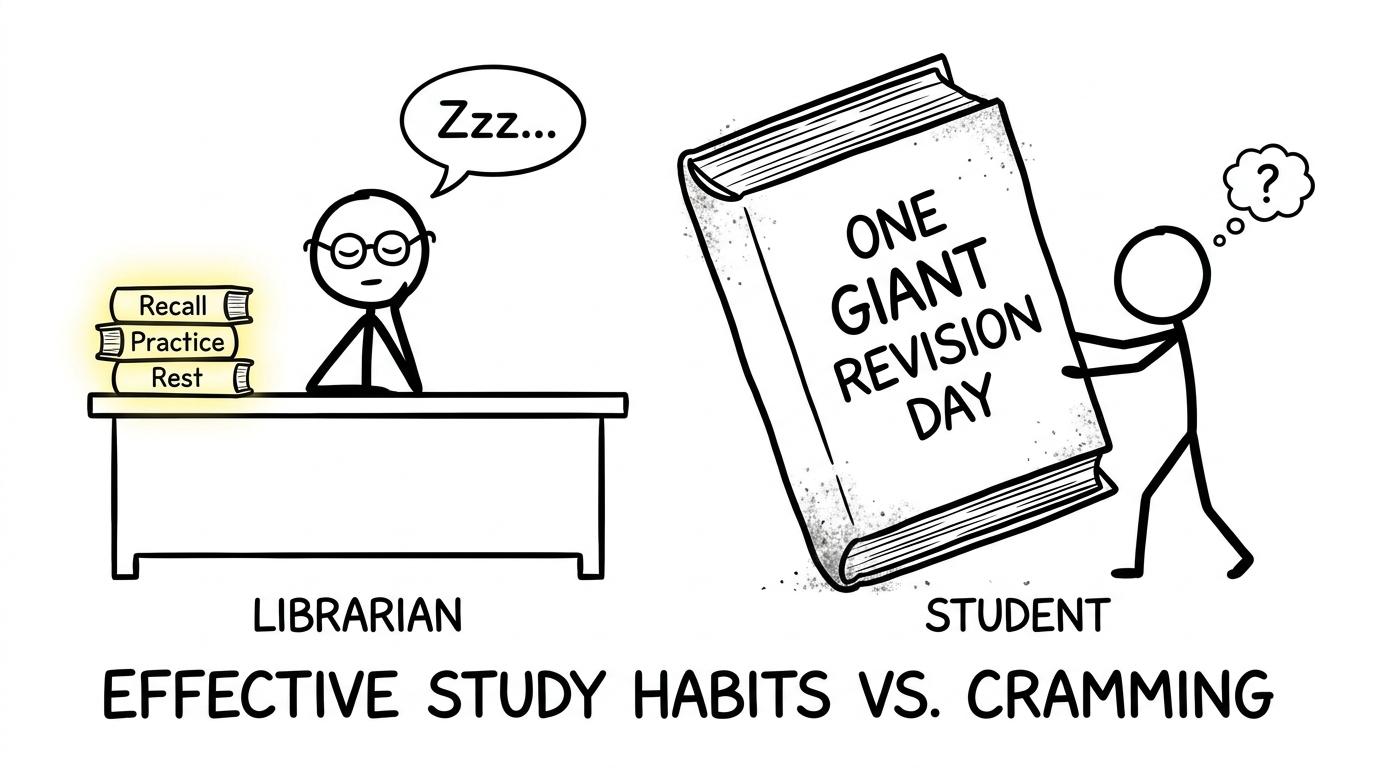 A memory librarian prefers recall, practice and rest to one enormous revision day
Build a plan that lasts until May
A sustainable plan changes as the exam approaches. Trying to work at final-week intensity throughout the year usually creates fatigue without guaranteeing better retention.
Months before the exam
Concentrate on coverage and understanding. Keep short retrieval tasks running alongside current lessons, and identify specification gaps early. Most sessions should be focused and manageable.
This is also the right stage to keep maths moving. The 20-minute GCSE maths revision routine shows how short sessions can combine recall, questions and marking without taking over an evening.
Six to eight weeks before the exam
Increase mixed and exam-style practice. Begin working with longer question sets and use mark schemes to study the required level of detail. Keep a record with three categories:
- knowledge you could not recall;
- knowledge you knew but did not apply;
- marks lost through interpretation, timing or communication.
If you are unsure where to begin in maths, use the method in GCSE revision: find your weakest topics to turn paper evidence into a focused practice list.
During the final weeks
Shift towards timed papers, targeted repairs and short recall reviews. Avoid reopening every topic simply because the exam is close. Let mistakes decide what needs attention.
For maths, Edexcel GCSE predicted papers can provide fresh practice modelled on the current exam format. Predicted papers should complement specification coverage and genuine past papers, not replace them.
The one-week GCSE maths revision plan is useful when you reach the final stretch and need a calm structure rather than a last-minute pile of tasks.
Make ICT revision active rather than decorative
Neat notes have value when they organise ideas, but producing them is not proof that you can retrieve the content. Each session should contain a moment when the support disappears.
Useful active tasks include:
- defining technical terms from memory;
- comparing two systems without looking at a model answer;
- explaining advantages and disadvantages in a stated context;
- completing exam questions before checking notes;
- correcting an answer using the mark scheme;
- teaching a process aloud, then checking what was omitted;
- sorting errors by topic and command word.
Longer responses need more than remembered facts. If a question asks you to discuss, evaluate or justify, connect the knowledge to the situation in the question. Avoid memorising a generic list of advantages and assuming it will fit every context.
The same distinction appears in maths: watching a solution can create recognition, while completing a fresh question tests application. MathsGenie combines revision lessons with practice questions and video solutions so that explanation can be followed by independent work.
Balance ICT with GCSE maths revision
Feeling ahead in one subject can tempt you to keep polishing it because success feels good. Meanwhile, a less comfortable subject receives too little attention. Revision should respond to evidence rather than mood.
Give each subject a regular place in your week, but do not assume the time must be divided equally. Use recent questions, teacher feedback and mock results to decide where the next session is most valuable.
For maths, the guide to revising without wasting time uses a reliable loop: choose a topic, learn the method, answer questions, mark them and retest. The habit transfers well to Computer Science and digital qualifications, even though the subject content is different.
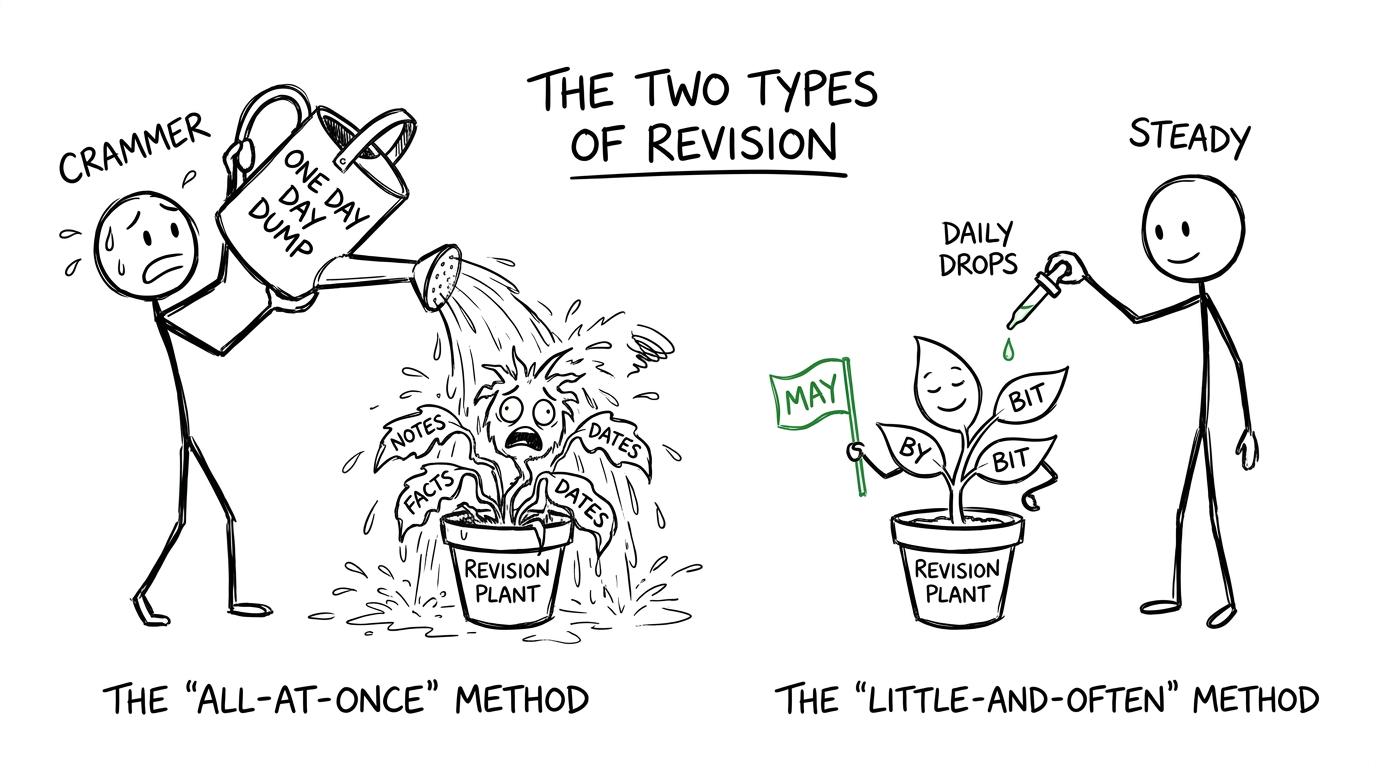 One student floods a revision plant while another keeps it alive with regular care
Common mistakes when trying not to peak early
Revising secure topics every day
This feels productive because the answers come quickly. It can crowd out weaker material. Keep secure topics in rotation, but lengthen the gap between successful reviews.
Rereading before every self-test
Rereading supplies prompts and makes recall appear stronger. Test first, check second, then repair the gaps.
Treating one high mark as permanent mastery
A strong result is encouraging, but it reflects one paper on one day. Test the same knowledge later and in a different context before calling it secure.
Completing papers without analysing errors
The paper reveals the problem; the review produces the improvement. Use the mark scheme, identify the reason for each lost mark and practise the missing skill. The same principle underpins MathsGenie's advice on redoing past papers.
Using the wrong qualification resources
GCSE Computer Science and vocational digital qualifications are not interchangeable. Confirm your board, specification and assessment structure before downloading materials.
Increasing revision intensity too soon
A plan that leaves no room for sleep, schoolwork or recovery is unlikely to survive until May. Consistency is more useful than an impressive timetable followed for four days.
Confidence should become evidence
You do not need to feel equally confident every week. In fact, a difficult mixed test can be more useful than an easy session that confirms what you already know. The important question is not, “Do I still feel at my peak?” It is, “What can I retrieve, apply and explain today?”
Keep GCSE ICT or Computer Science knowledge alive through short spaced reviews, specification-matched questions and careful feedback. Then use the same rhythm for maths: revision lesson, independent practice, marking, repair and retest.
Start at the MathsGenie GCSE maths hub. Choose your board and tier, work through free revision lessons and practice questions, then build towards mini tests, past papers, predicted papers, mark schemes and video solutions. Early confidence is not something to fear. Maintained properly, it becomes the foundation you carry into May.










