Peaking Too Early GCSE Business Revision
Peaking too early GCSE Business revision worries are normal. Learn how to retain knowledge, practise application and stay confident until the May exams.

A strange thing can happen halfway through Year 11. You finish a Business mock, remember the key terms and feel unusually confident. Then a worrying thought appears: what if this is as good as it gets?
Concern about peaking too early GCSE Business revision is normal, but confidence months before the exam is not evidence that your performance must decline. It usually means your early work has succeeded. The task now is different: preserve the knowledge, strengthen its application and arrive in May able to use it under pressure.
You do not need to maintain maximum revision intensity for months. You need a sustainable system that revisits material before it becomes inaccessible.
The short answer: have you really peaked too early?
Probably not. A peak is only visible after performance has fallen. Feeling confident early may instead mean that:
- recent lessons and mock revision have made the content easy to retrieve;
- you have finished a familiar block of the specification;
- repeated classroom questions have created fluency;
- your mock covered topics you knew particularly well;
- you have not yet tested that knowledge with unfamiliar business contexts.
Treat early confidence as a useful asset, not a deadline. Your aim is to convert temporary fluency into durable knowledge and flexible exam technique.
A simple maintenance checklist is:
- retrieve old content without notes each week;
- answer questions using unfamiliar case-study contexts;
- keep an error log organised by knowledge, application, analysis and judgement;
- revisit weaker topics more often than secure ones;
- practise quantitative business skills regularly;
- increase timed practice gradually near the exams;
- protect sleep, breaks and revision time for your other GCSEs.
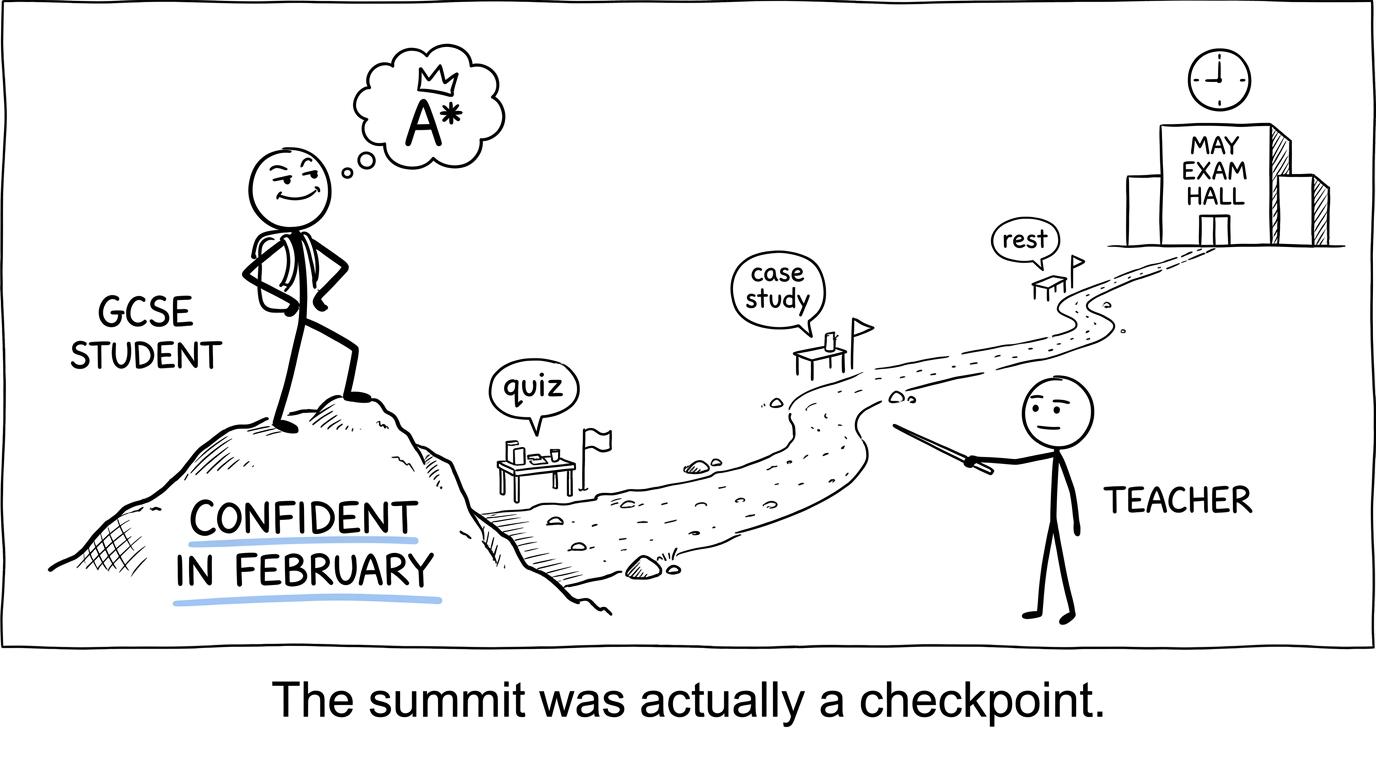 A student discovers that an early revision summit is really a checkpoint
Why GCSE Business can feel strongest months before the exam
The content is still familiar
Immediately after revising marketing, finance or operations, the definitions and chains of reasoning can feel obvious. Recognition is reassuring: you see “market segmentation” and know that you have met it before.
An exam demands more. You may need to recall the idea without a prompt, apply it to a specific organisation, analyse consequences and reach a supported judgement. Familiarity with a page is not the same as independent retrieval.
This is why rereading notes can produce confidence without revealing what will remain available in May. Research on learning consistently supports spacing practice across different sessions and retrieving information from memory rather than relying only on restudy. The practical lesson is modest: close the book sometimes.
Mock preparation creates a temporary sprint
Mocks often produce a concentrated period of revision. For a few weeks, Business receives frequent attention, so recall becomes fast. Once the mock ends, other subjects reclaim that time.
A later dip does not mean the original learning was wasted. Forgetting is feedback that the interval between reviews was too long, or that knowledge was never retrieved independently. A short review can restore it more efficiently than learning the topic from the beginning.
Confidence may be tied to one question style
Perhaps you can define terms accurately but find contextual analysis difficult. Or perhaps longer answers feel comfortable while calculations expose gaps. GCSE Business is not solely a memory examination.
Across GCSE Business specifications, the shared assessment objectives require knowledge and understanding, application to contexts, and analysis and evaluation. Exam-board structures differ, so check whether you study AQA, Edexcel, OCR or Eduqas and use the specification and assessment materials for that board. Some specifications also require quantitative skills to account for at least 10%10\%10% of the overall marks.
Early confidence should therefore be tested across the whole performance: recall, application, reasoning, evaluation, calculations and timing.
How to keep GCSE Business knowledge fresh until May
Move from learning mode to maintenance mode
When a topic is secure, it does not need another hour of highlighting every week. Give it a short retrieval check instead. Write down what you remember, complete a small quiz or plan an exam response without opening your notes.
If recall is accurate, extend the interval before the next check. If it is hesitant, schedule the topic sooner. This creates a revision timetable based on evidence rather than anxiety.
MathsGenie’s free revision planner can help you see how Business maintenance fits beside maths and your other subjects. The purpose of a timetable is not to fill every evening. It is to make sure important material returns before exam week.
For more guidance on balancing subjects, adapt the principles in the GCSE maths revision timetable guide: prioritise genuine weaknesses, revisit material little and often, and leave room for rest and catch-up.
Use retrieval that matches the Business exam
Retrieval can be brief, but it should not remain limited to flashcard definitions. Rotate several forms:
- recall key terms from a blank sheet;
- explain a benefit and drawback without notes;
- connect two parts of the specification, such as finance and marketing;
- select evidence from a case-study extract;
- outline a justified recommendation;
- complete a quantitative question and interpret the result;
- improve an old response using the mark scheme.
This progression matters. Knowing what cash flow means is useful; recognising how a cash-flow problem affects a particular expansion decision is closer to exam performance.
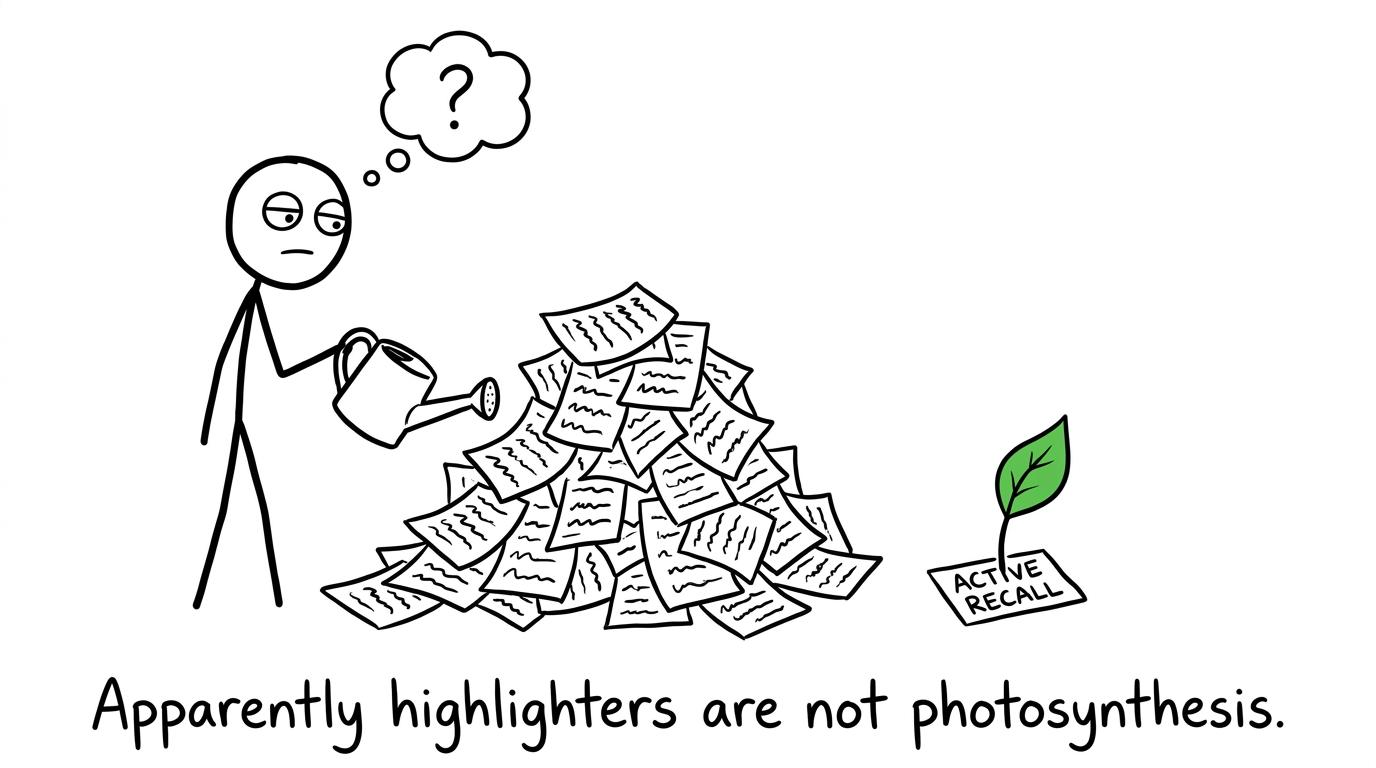 A pile of notes fails to grow while active recall flourishes
Space your reviews instead of restarting
There is no universal perfect spacing schedule. A practical approach is to revisit new or fragile material after a few days, then after roughly a week, and later after a longer interval. Adjust this according to what you can actually recall.
Your weekly Business maintenance might contain:
- one short closed-book knowledge check;
- one contextual question or response plan;
- one review of earlier errors;
- occasional timed sections as May approaches.
The same principle supports maths revision. MathsGenie’s GCSE mini tests provide short checks for foundation and higher tier maths, while Business revision can use teacher-provided quizzes and official materials from your own exam board. Keeping both subjects in short, repeatable cycles is more sustainable than alternating between panic and avoidance.
Track marks lost, not hours completed
Hours are easy to count but difficult to interpret. An error log gives you better information. After each Business task, classify the problem:
- Knowledge: the term or concept was missing.
- Application: the response was generic rather than connected to the case.
- Analysis: the chain of consequences was incomplete.
- Evaluation: the judgement lacked balance, evidence or a clear reason.
- Quantitative skill: the calculation or interpretation was inaccurate.
- Exam technique: timing or question reading caused the loss.
Then choose the next revision activity from the error. A missing definition calls for retrieval. Weak application calls for more case-based questions. Poor timing calls for a timed section, not another set of colourful notes.
This is also how MathsGenie recommends turning paper practice into improvement. The guide to using Edexcel GCSE Maths past papers properly explains the paper, mark, diagnose, repair and retest cycle. Although the subject is different, the feedback habit transfers directly.
Build towards exam readiness without burning out
Early phase: preserve and connect
Months before May, keep secure Business topics alive with short retrieval while repairing major gaps. Mix topics occasionally so that you must decide which concept is relevant rather than being told by the page heading.
At this stage, complete questions or sections rather than repeatedly sitting entire papers. Save enough unseen material for later diagnosis.
Middle phase: apply and refine
As the exam approaches, increase case-study work and timed responses. Use mark schemes and teacher feedback to understand what your exam board rewards. Do not memorise one essay and hope that the context fits; practise adapting knowledge to different organisations and decisions.
For planning your wider GCSE workload, the one-month GCSE revision plan offers a useful rhythm of retrieval, focused practice and review. Apply that rhythm to Business using resources matched to your school’s specification.
Final phase: rehearse, do not relearn everything
Near the exam, complete appropriate papers or substantial sections under realistic conditions. Review them carefully and return to the few weaknesses that repeatedly cost marks.
Maths students can follow the staged advice in when to start GCSE past papers, then use Edexcel GCSE Maths predicted papers as fresh exam-style practice. Predicted papers should supplement, not replace, real past papers. For Business, use your board’s official papers and your teacher’s recommended material rather than assuming a predicted question will appear.
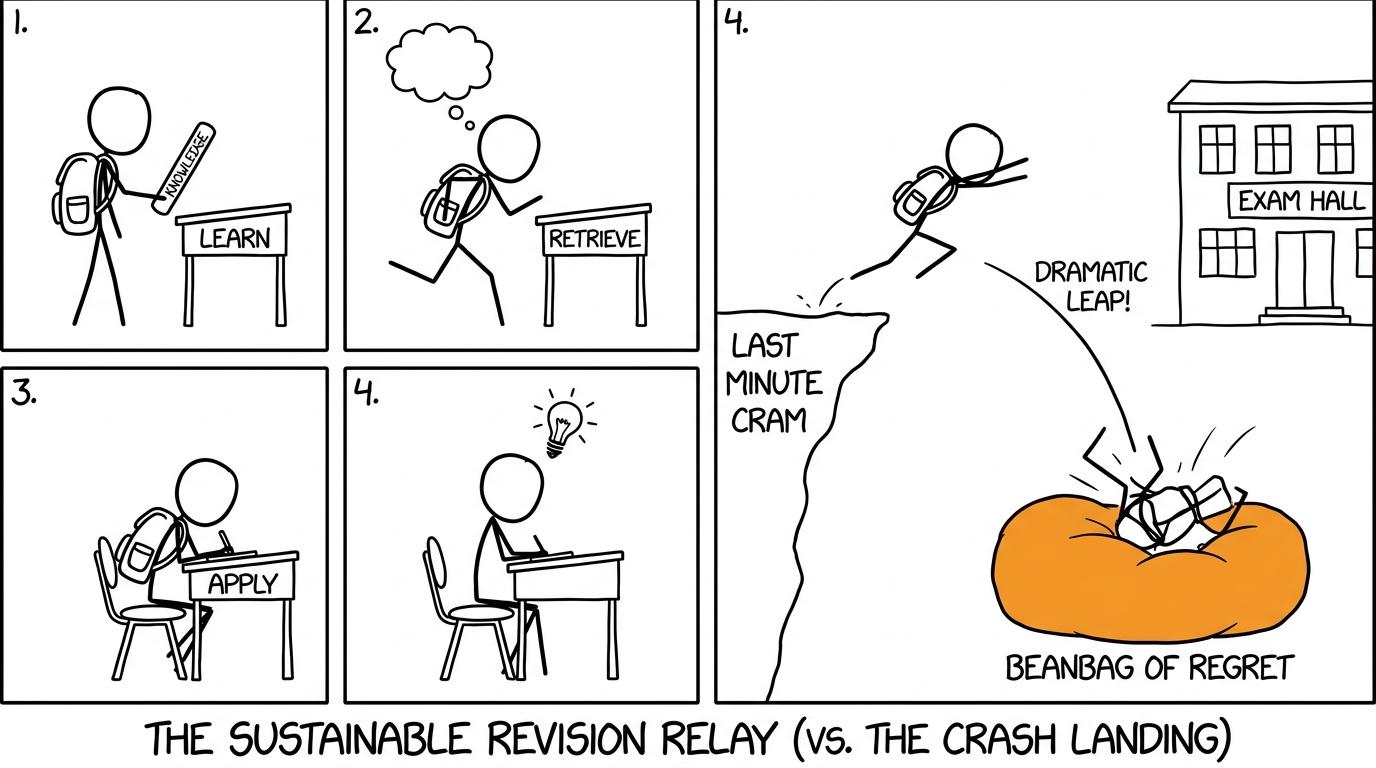 Revision knowledge moves through a relay of learning, retrieval and application
Common mistakes when trying not to peak early
Revising harder whenever confidence falls
A difficult retrieval session can feel like decline, but difficulty may simply reveal what needs strengthening. Diagnose the gap before adding more hours.
Repeating favourite topics
Secure topics feel productive because answers arrive quickly. Give more time to recurring weaknesses, while maintaining strong areas with shorter checks.
Treating notes as proof of memory
Well-organised notes are a reference, not a performance measure. Test yourself before looking at them, then correct inaccuracies immediately.
Ignoring application until the final weeks
Business marks depend on using knowledge in context, not merely reproducing definitions. Include unfamiliar businesses and decisions throughout revision.
Using full papers too often, too soon
A paper can identify weaknesses, but it does not automatically repair them. Alternate assessment with targeted revision and preserve some unseen papers for later.
Forgetting the rest of the GCSE timetable
Business is one subject within a crowded exam season. An intense plan that damages maths practice, sleep or attendance is unlikely to be sustainable. MathsGenie’s GCSE predicted topics guide reinforces an important principle: cover the specification and use predictions to focus practice, not to justify risky omissions.
Your early confidence is something to protect
Feeling strong in GCSE Business months before May is not a warning that you have peaked. It is evidence that the first stage has worked. Now lower the intensity, keep retrieval regular and make your practice increasingly contextual and timed.
Think of revision less like holding your breath and more like keeping a small flame alive. Brief, well-timed attention is enough until the moment calls for more.
Use your school and exam board materials for GCSE Business. For the maths side of your timetable, make MathsGenie your free revision base: start with the MathsGenie GCSE and A Level revision hub, then combine revision lessons, practice questions, mini tests and video solutions with past papers, predicted papers and mark schemes. Build a routine you can still trust in May, not one that exhausts you before you arrive.